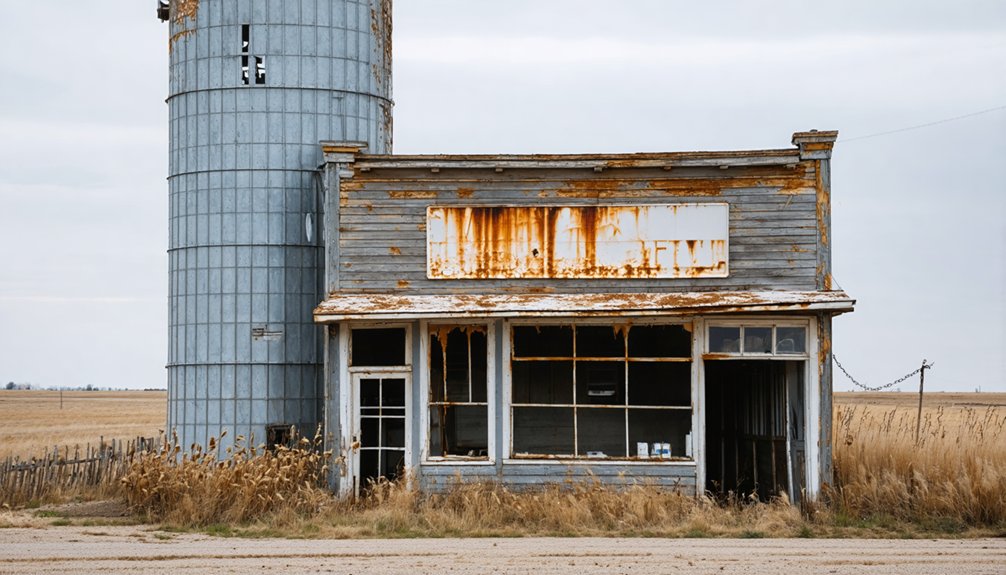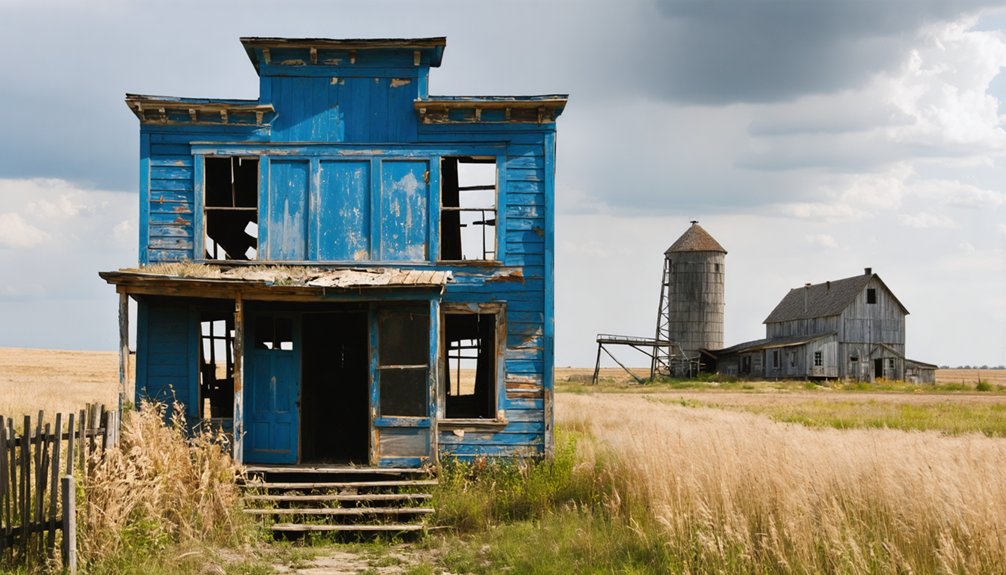
Ghost towns of the Great Plains emerged from three major boom-bust cycles, beginning with the 1862 Homestead Act. You’ll find these abandoned settlements resulted from economic collapse, environmental mismanagement, and demographic shifts as younger generations migrated to urban areas. Poor farming techniques and the 1930s drought devastated vulnerable ecosystems, forcing mass abandonment. Today, preservation efforts transform these historical remnants into heritage tourism assets, where each weathered building tells a story of frontier dreams and harsh realities.
Key Takeaways
- Ghost towns in the Great Plains emerged from three major economic boom-bust cycles, beginning with the 1862 Homestead Act.
- Environmental mismanagement and severe drought in the 1930s caused agricultural failure, forcing settlement abandonment.
- Population decline occurred as younger generations migrated to urban areas, leaving aging residents in declining communities.
- Transportation route changes significantly impacted local economies, contributing to town abandonment throughout the region.
- Preservation efforts transform deteriorating ghost towns into heritage tourism destinations, generating revenue and celebrating local history.
The Rise and Fall of Frontier Dreams
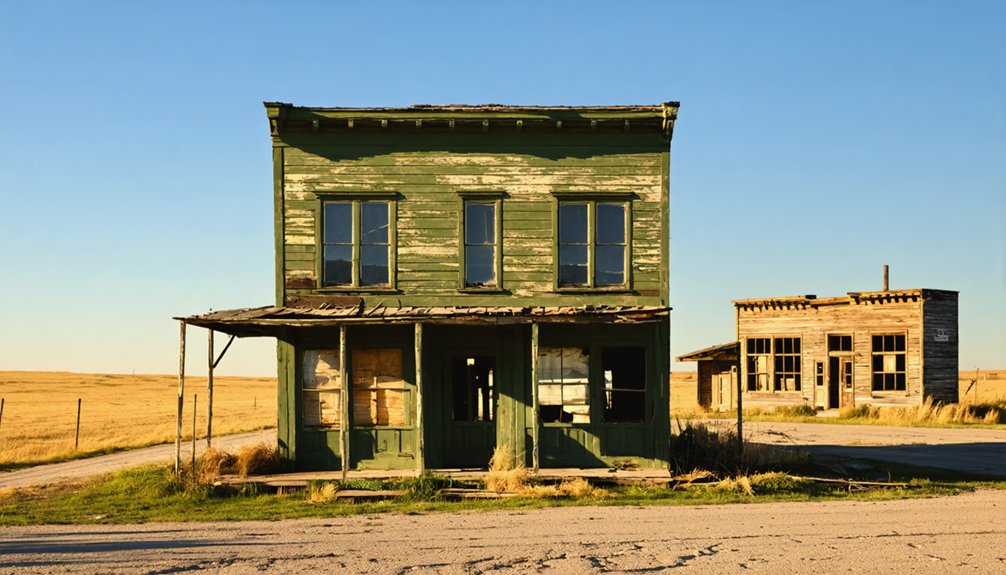
As the American frontier pushed westward in the early 19th century, a complex interplay of governmental policy, economic opportunity, and technological innovation fueled an unprecedented migration across the Great Plains.
You’d have witnessed pioneer aspirations transform into tangible settlements as the Homestead Act of 1862 offered 160 free acres to anyone willing to stake their claim on the harsh prairie landscape.
The completion of transcontinental railroads accelerated this expansion, creating boomtowns almost overnight at strategic junctions and railheads.
Yet settlement challenges were formidable—unpredictable weather, isolation, and shifting economic fortunes meant many towns flourished briefly, then faded.
Railroad companies established communities that thrived momentarily before new routes rendered them obsolete, leaving behind the skeletal remains of frontier dreams. Many of these settlements began as promising outposts along key routes such as the path from Independence, Missouri which served as a crucial departure point for westward pioneers heading to these frontier towns.
The ideology of manifest destiny played a significant role in encouraging Americans to venture into these frontier territories, despite the inherent risks and hardships of prairie life.
Dust, Drought, and Departure: Environmental Factors
The environmental factors that obliterated countless Great Plains settlements reveal how nature ultimately dictated the fate of frontier ambitions.
You’ll find the roots of this collapse in environmental mismanagement—settlers applying humid-region farming techniques to arid plains, destroying protective prairie grasses, and overgrazing vulnerable lands.
When extreme drought struck in the 1930s, these weakened ecosystems had no drought resilience.
Strong winds swept up exposed topsoil, creating devastating dust clouds while seasonal water sources dried completely. Without water rights for irrigation, communities like Dearfield were entirely dependent on rainfall that never came.
The resulting economic devastation forced thousands of farmers to abandon their homes. Many of these areas became classic examples of what T. Lindsey Baker described as places where the reason for being no longer exists.
Bank foreclosures emptied once-thriving homesteads as desperate families fled with only what they could carry.
Even after conditions improved, the damage persisted. The legacy of poor farming practices led to the rise of corporate agriculture, as small family farms could no longer sustain themselves on compromised lands.
Today’s ghost towns stand as stark warnings about the consequences of misunderstanding and misusing the Great Plains ecosystem.
Hidden Histories of the African-American Experience

Hidden beneath the forgotten landscapes of Great Plains ghost towns lies a remarkable chapter of American history—the story of Black homesteaders who carved out communities of freedom and self-determination against tremendous odds.
As adventurers seek to uncover the remnants of the past, ghost town explorations in the west reveal not only the hardships faced by settlers but also the resilience and spirit of those who once thrived in these isolated regions. Each weathered building and desolate street whispers tales of prosperity and despair, inviting curious souls to delve deeper into the rich history that shaped the American frontier. Through these explorations, we gain insight into the lives of those who shaped their destinies amidst the vast and unforgiving landscapes.
Dearfield, Colorado stands as evidence to these hidden narratives. Founded by Oliver Toussaint Jackson in 1910, this settlement grew to 300 residents with 44 cabins and thriving businesses.
Despite limited farming experience, these pioneers mastered dry techniques to grow crops in arid conditions, earning $50,000 in 1918 alone. Early settlers demonstrated incredible resilience, with many families living in tents or dugouts while working toward their agricultural dreams.
You’ll find similar patterns of community resilience in settlements like DeWitty, Nebraska and Nicodemus, Kansas. Nicodemus represents the oldest black town west of the Mississippi River established after Reconstruction, achieving National Historic Site status in 1996.
These African American homesteaders established self-sufficient economies, schools, and churches—creating cultural hubs that fostered strong collective identities despite discrimination and resource limitations.
Their achievements reveal an overlooked legacy of Black entrepreneurship and determination on the Plains.
Preserving the Past: Tourism and Heritage Protection
While many ghost towns across the Great Plains face relentless deterioration from weather and neglect, innovative preservation efforts have transformed these abandoned settlements into valuable heritage tourism assets.
You’ll find successful models in places like Kennecott, Alaska and St. Elmo, Colorado, where historical authenticity attracts visitors while generating sustainable revenue for nearby communities.
Heritage preservation creates multiplier effects as tourists spend on accommodations, dining, and retail. The Sand Creek Massacre National Historic Site’s 5,860 visitors generated $392,000 in local spending in 2023 alone.
These sites often showcase structures that date from the 1880-1940 period, representing significant eras of American westward expansion and industrialization.
States like Oklahoma with 236 ghost towns provide an untapped resource for cultural tourism development across the region.
However, challenges persist in balancing tourism development with community identity. Some locals resist changes to their towns, while infrastructure limitations can strain small communities during visitor influxes.
The delicate balance between preserving authenticity and providing modern amenities remains tourism impact’s central challenge.
Economic Boom and Bust Cycles in Great Plains Settlements
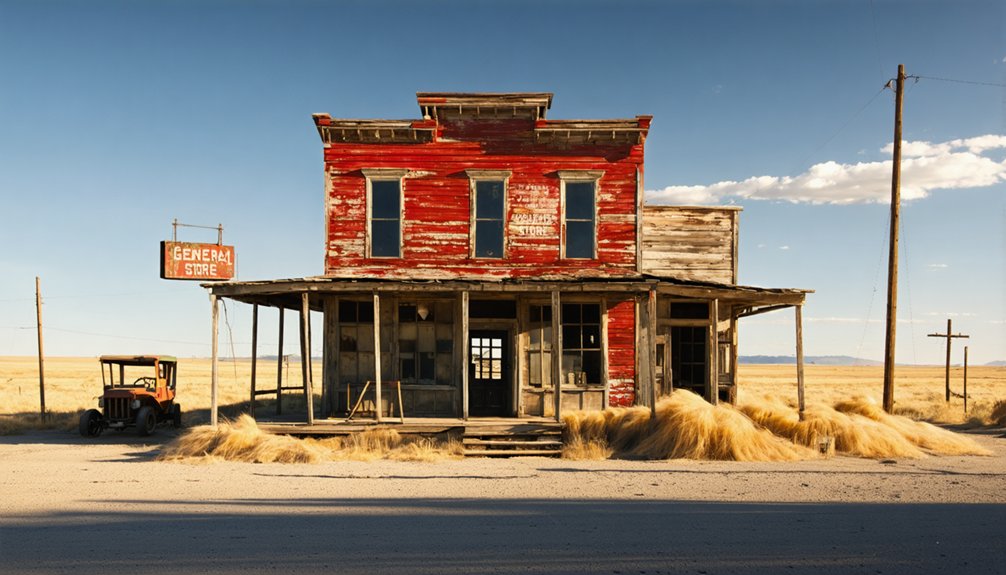
From its initial promise of free land to persistent cycles of prosperity and devastation, the Great Plains has witnessed three major economic boom and bust cycles that shaped its settlement patterns and left behind countless ghost towns.
You can trace these waves beginning with the 1862 Homestead Act, which triggered the first massive influx of settlers seeking their 160-acre claim.
The second cycle emerged in the early 1900s as expanded homesteading laws allowed claims up to 640 acres, while World War II finally lifted the region from Depression-era struggles.
The third boom during the 1970s saw agricultural policies encouraging “fencepost-to-fencepost” cultivation before collapsing in the 1980s. This pattern follows the historical 29-year cycle of agricultural economic booms and busts observed in commodity markets.
Each cycle’s aftermath left communities struggling as populations fled, infrastructure collapsed, and young people sought opportunities elsewhere.
Montana’s county expansion followed by regional depopulation illustrates this pattern perfectly. In Montana, this resource-dependent economy created a stark divide between affluent western counties and declining eastern plains communities.
Frequently Asked Questions
Are There Ghost Towns That Have Been Successfully Repopulated?
Yes, you’ll find successful repopulation efforts in places like Walhalla, Australia and Riace, Italy, where community initiatives transformed abandoned areas through heritage tourism and government-funded programs.
What Supernatural Legends Exist in Great Plains Ghost Towns?
You’ll find haunted histories across the Plains, from Kansas’s Latin-chanting Stole Cemetery to Colorado’s restless miners. Spectral sightings include North Dakota’s phantom horses and New Mexico’s whispering buildings that “have seen things.”
How Do You Legally Explore Abandoned Buildings in Ghost Towns?
You’ll need written permission from property owners, join guided tours, or visit publicly designated sites. Always prioritize safety during urban exploration and research a building’s status before entering abandoned structures.
What Artifacts Are Commonly Found in Great Plains Ghost Towns?
You’ll commonly discover mining equipment, domestic items like ceramics and barrels, military artifacts, and stone tools. Their historical preservation reveals significant insights into the everyday lives of Great Plains settlers.
How Have Indigenous Communities Been Affected by Ghost Town Phenomena?
You’ll find indigenous communities experienced double cultural displacement—first from their lands, then as nearby towns failed. They’ve often led historical preservation efforts to protect ancestral connections within ghost town landscapes.
References
- https://www.kbia.org/agriculture/2017-03-22/great-plains-ghost-town-sheds-light-on-forgotten-piece-of-african-american-history
- https://plainshumanities.unl.edu/encyclopedia/doc/egp.ct.024.html?stream=top
- https://www.geotab.com/ghost-towns/
- https://www.legendsofamerica.com/gt-emergingghosttowns/
- https://en.wikipedia.org/wiki/Ghost_town
- https://www.ndstudies.gov/sites/default/files/LessonPlans/LessonPlan-HighSchool-GhostTownsOfNorthDakota.pdf
- https://jrap.scholasticahq.com/api/v1/articles/9543-the-economics-of-ghost-towns.pdf
- https://www.richmondfed.org/-/media/richmondfedorg/publications/research/econ_focus/2011/q3/pdf/feature2.pdf
- https://en.wikipedia.org/wiki/Timeline_of_the_American_Old_West
- https://en.wikipedia.org/wiki/American_frontier