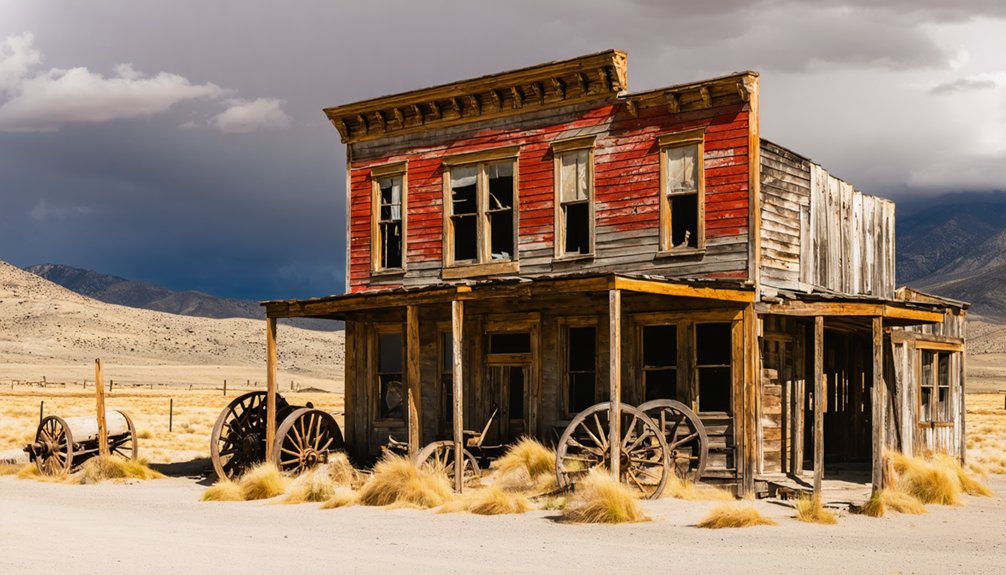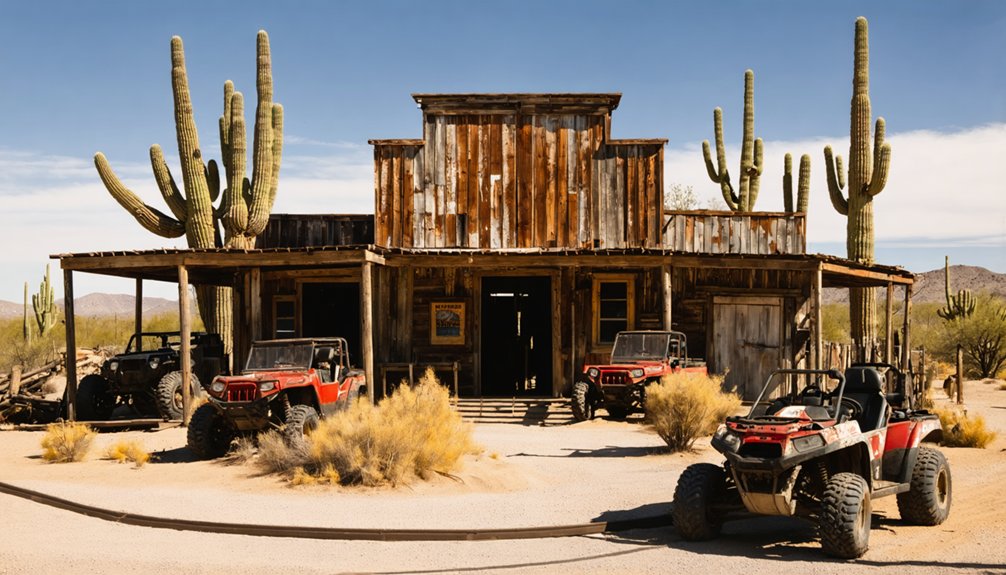
You’ll find incredible ATV-accessible ghost towns scattered throughout the Southwest’s rugged desert terrain, where authentic mining relics await exploration. Arizona’s Swansea Ghost Town features preserved 1917 adobe structures and a massive brick smelter, while Nevada’s Nelson offers the famous Techatticup Mine with illuminated underground tunnels. These remote destinations require high-clearance vehicles and proper desert safety equipment, but reward adventurous riders with uncrowded access to genuine Wild West history and spectacular photography opportunities in dramatic canyon settings.
Key Takeaways
- Swansea Ghost Town in Arizona requires high-clearance vehicles or ATVs due to rough desert terrain and features preserved adobe structures from 1909.
- Nelson Ghost Town in Nevada offers accessible ATV exploration with historic Techatticup Mine tours and authentic gold mining buildings from the 1860s.
- Eldorado Canyon provides guided ATV adventures through Wild West history with $10 million worth of gold mining heritage and restored structures.
- Arizona Peace Trail connects 750 miles of desert routes through three counties with 32 main segments suitable for ATV exploration.
- Spring and fall offer ideal temperatures (60-90°F) for safe ATV ghost town exploration, while summer heat above 105°F causes dangerous overheating.
Swansea Ghost Town: Arizona’s Remote Mining Relic
While most Arizona ghost towns have succumbed to development or vandalism, Swansea stands as a remarkable exception—a copper mining settlement frozen in time since the Great Depression ended operations in 1937.
Unlike countless Arizona ghost towns lost to progress and decay, Swansea remains untouched—a copper mining relic preserved since 1937.
You’ll discover dozens of adobe structures, worker’s cottages from 1917, and a massive brick smelter that once processed copper for World War I.
Swansea history reveals a boom-bust cycle typical of mining towns—established in 1909, reaching 500 residents by 1910, then closing permanently in 1937. The town featured modern amenities including an electric light company, saloon, theater, restaurant, and barber shop during its peak years.
Today, Swansea preservation efforts by the Bureau of Land Management have restored buildings and installed interpretive plaques. Visitors can explore the protected mine shafts that plunge depths of 1,000 feet into the desert floor.
The remote location, accessible only by high-clearance vehicles or ATVs via rough desert terrain, protects this authentic piece of mining heritage from modern intrusion.
Nelson Ghost Town: Nevada’s Historic Gold Mining Heritage
You’ll ride through Nevada’s most successful gold region where the historic Techatticup Mine produced millions in precious metals from 1861 to the 1940s.
Your ATV will navigate rugged terrain leading to spectacular Colorado River views and preserved mining structures that tell stories of lawless frontier life. The area’s mining history extends back hundreds of years, beginning when Native Americans first extracted turquoise from these canyon walls.
The combination of accessible mine tours, authentic ghost town buildings, and dramatic desert landscapes creates unmatched photography opportunities around every bend. Visitors can explore old tunnels that wind deep into the mountainside, providing a glimpse into the dangerous working conditions miners faced daily.
Historic Techatticup Mine Access
Deep in Nevada’s Eldorado Canyon, the historic Techatticup Mine stands as one of the state’s most notorious and productive gold mining sites, where Spanish explorers once searched for minerals before the 1859 discovery that sparked decades of boom and bloodshed.
You’ll find yourself exploring a location that produced $10 million in ore between 1864-1900, where Techatticup history reveals tales of murder, claim-jumping, and lawlessness that surpassed even Tombstone. The mine’s name itself derives from Paiute words meaning hunger and bread, reflecting the Indigenous heritage of this land before settler arrival.
The Werly family’s restoration allows you to venture 500 feet into illuminated tunnels, discovering original mining equipment and unmined gold-silver veins. The area once served as a refuge for Civil War deserters who fled to this remote location during the 1860s.
- Experience guided tours through authentic drift mining tunnels
- View original mining equipment from the 1800s boom era
- Explore deep mining pits with visible gold and silver veins
- Access remote desert terrain perfect for ATV adventures
- Discover Nevada’s most notorious Wild West mining camp
Colorado River Scenic Views
Towering canyon walls frame your approach to Nelson Ghost Town, where the Colorado River‘s azure waters create a striking contrast against the rusted mining relics and weathered buildings scattered throughout this historic settlement.
You’ll discover breathtaking scenic overlooks along the canyon rim, offering panoramic views of Lake Mojave’s expansive waters formed after Davis Dam’s completion. The elevated vantage points reveal how steamboats once navigated these waters during the 1860s mining boom, transporting essential supplies to fortune-seekers.
Keep your camera ready for Colorado River wildlife sightings—bighorn sheep navigate the rocky terrain while various bird species soar above the water. The area’s Wild West past comes alive as you explore remnants of the lawless frontier days when Civil War deserters and moonshine operations made Eldorado Canyon their refuge. Legend claims the canyon still echoes with voices of deceased miners who met violent ends during the area’s most chaotic period.
The dramatic landscape combines desert wilderness with riparian ecosystems, creating unforgettable photo opportunities. Each overlook tells the story of Nevada’s greatest gold rush against nature’s stunning backdrop.
Photography and Exploration Opportunities
As you navigate the rugged terrain leading into Nelson Ghost Town, your camera will capture some of Nevada’s most compelling historical remnants scattered across this 51-acre preserved mining site.
You’ll discover weathered buildings, rusting relics, and graffiti-ridden tunnels that tell stories of the Wild West’s bloodiest mining boom. The Techatticup Mine’s cleared tunnels let you explore safely while photographing authentic mining equipment and abandoned structures from the 1860s gold rush era. The town’s violent history and numerous murders during mining disputes have left an eerie atmosphere that adds depth to every photograph.
- Hundreds of vintage vehicles including abandoned cars, buses, and planes for unique automotive photography
- Preserved ghost town buildings showcasing authentic Wild West mining architecture
- Accessible mine tunnels like the historic Jubilee Mine with atmospheric lighting opportunities
- Hauntingly beautiful mining relics scattered across desert landscape
- Self-guided exploration routes perfect for discovering hidden photographic gems
Eldorado Canyon ATV Tours: Guided Adventures to 1861 Ghost Town
When you fire up your ATV and head 39 miles southeast of Las Vegas into Eldorado Canyon, you’re not just taking another desert ride—you’re rolling into one of Nevada’s most notorious Wild West chapters.
The Techatticup Mine, Nevada’s richest southern operation from 1861 to 1942, extracted $10 million in gold when the nearest sheriff sat 200 miles away in Pioche. Miners used drift mining techniques, following earthquake fault lines deep into the mountain to extract precious metals from white quartz veins.
Ten million dollars in gold flowed from this remote mine while the nearest lawman sat 200 miles away in Pioche.
Today’s guided history tours let you explore where Civil War deserters created a lawless haven with daily gunfights over mining claims.
Your ATV exploration reveals authentic mining structures restored by the Werly family since 1994. You’ll traverse the same rugged terrain where renegade outlaws like Queho terrorized miners, and steamboats once delivered supplies via the Colorado River to this remote frontier outpost.
Mojave Desert Hidden Gems: Deep Desert Ghost Town Exploration

Beyond the neon lights of Las Vegas, the Mojave Desert conceals a treasure trove of abandoned settlements where your ATV becomes your passport to authentic Western history.
These hidden ruins scattered across rugged desert trails offer unparalleled exploration opportunities for riders seeking genuine adventure beyond tourist crowds.
Nelson Ghost Town sits just one hour from Vegas, where you’ll navigate challenging terrain to reach preserved gold-mining structures and the explorable Techatticup Mine.
Meanwhile, Rhyolite’s striking ruins on Death Valley’s edge showcase dramatic bank buildings, railroad depots, and the famous bottle house.
- Deep desert locations require off-road vehicles for access
- Preserved mining structures and abandoned buildings await exploration
- Challenging terrain tests your ATV skills
- Photography opportunities at every turn
- Guided tours provide historical context and safety
Southwest Arizona OHV Trails: Sonoran Desert Ghost Town Access
Arizona’s Sonoran Desert delivers some of the Southwest’s most rewarding ghost town adventures, where your ATV opens doors to abandoned settlements that standard vehicles can’t reach.
As you explore these hidden gems, don’t forget to seek out dogfriendly attractions in Kansas, where your furry companion can join in on the adventure. From scenic parks to welcoming eateries, Kansas offers numerous spots that celebrate the bond between humans and their pets. These experiences enhance your journey, allowing for unforgettable memories with your loyal friend by your side.
You’ll discover Agua Caliente’s unique hot spring heritage 120 miles southwest of Phoenix, breaking the mold of typical mining-based ghost town history.
Kentucky Camp, nestled 40 miles south of Tucson, offers camping opportunities among 1874 gold rush ruins where 500 miners once worked.
Harshaw’s impressive legacy includes remnants from its 2,000-resident peak and nearby Mowry’s $1.5 million silver operation.
Dos Cabezas showcases preserved adobe structures east of Willcox.
Desert trail navigation through these OHV networks rewards you with authentic exploration experiences unavailable to conventional tourists.
Arizona Peace Trail: 750-Mile Desert Adventure Route
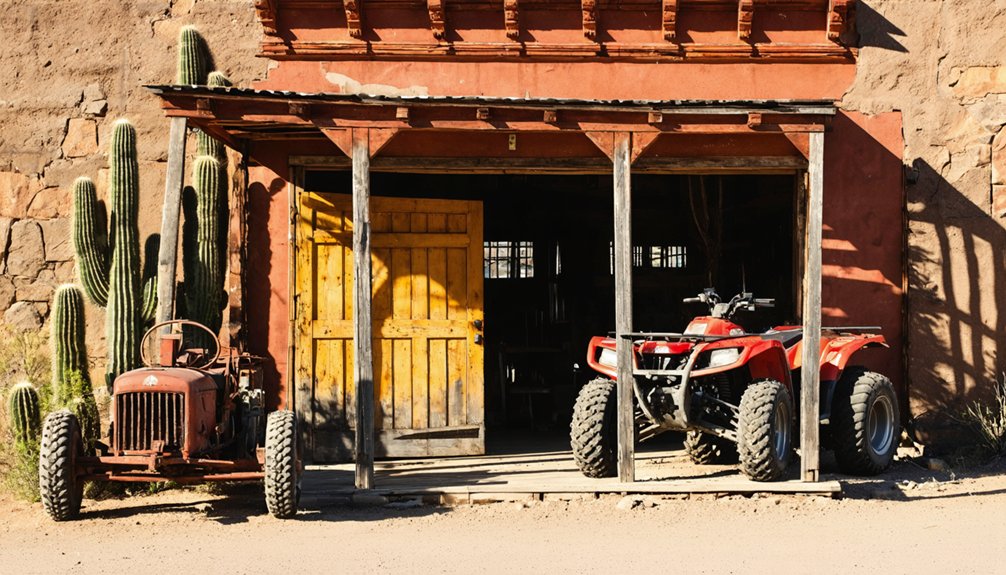
You’ll discover one of the Southwest’s most ambitious ATV adventures on the Arizona Peace Trail, where 750 miles of interconnected desert routes guide you through historic mining country and abandoned settlements.
This massive loop system emerged from partnerships between dedicated OHV clubs and government agencies, creating legal access to remote ghost towns across three Arizona counties.
The trail challenges you with everything from smooth desert washes to technical rock crawling, ensuring your ATV skills get tested while exploring forgotten pieces of the Old West.
Trail Route and Access
Stretching across 675 miles of rugged western Arizona terrain, the Arizona Peace Trail creates an epic loop connecting three counties through some of the Southwest’s most remote and historically rich landscapes.
You’ll navigate through Mojave, La Paz, and Yuma Counties, spanning elevations from 170 feet along the Colorado River to 7,070 feet in the Hualapai Mountains.
The trail’s extensive access points link major towns including Lake Havasu City, Kingman, Quartzsite, and Yuma, while connector trails provide seamless entry from multiple staging areas.
Essential Trail Features:
- 32 main segments plus alternatives totaling nearly 1,000 miles
- Complete trail mapping with GPS chips and GPX files available
- Multiple access points from cities and federal lands
- Elevation changes spanning 6,900 feet
- Desert landscapes featuring saguaro cacti and red rock formations
ATV Club Partnerships
When you’re tackling the Arizona Peace Trail‘s demanding 750-mile route, you’re riding alongside a powerful coalition of ATV clubs whose collaborative vision transformed scattered desert paths into the Southwest’s most ambitious off-highway vehicle network.
Club contributions from founding organizations like Arizona Sun Riders and Bouse Ghost Riders established the foundation, while fourteen original OHV groups recruited by 2014 expanded the mission.
You’ll benefit from partnership advantages including maintained trails, strategic staging areas, and local expertise from Yuma 4-Wheelers, Bullhead 4 Wheelers, and Havasu 4 Wheelers.
These partnerships deliver real value through equipment support from Liberty Motorsports, 928 Motorsports, and local businesses providing rider services.
Nearly 100 individuals from participating clubs guarantee you’ll experience well-maintained trails and responsible land stewardship throughout your desert adventure.
Technical Terrain Challenges
Beyond the organized support these ATV clubs provide, the Arizona Peace Trail presents technical challenges that’ll test your riding skills across 750 miles of unforgiving desert terrain.
You’ll encounter technical ratings averaging 2-3, spiking to 5 on the most demanding sections. Rocky terrain dominates this route, from crawly mountain ridges requiring precise line selection to loose rocks on steep volcanic hillsides that’ll slow your progress considerably.
The trail’s diverse challenges demand adaptability and skill:
- Off-camber sections through skinny desert trails that test balance
- Large wash crossings requiring skillful maneuvering during elevation climbs
- Narrow, twisty paths through rockier hillsides in Little Horn Mountains
- Slick, muddy hills after rain demanding full-time 4WD capability
- Snow-blocked segments in Hualapai Mountains during winter months
Essential ATV Equipment for Desert Ghost Town Expeditions
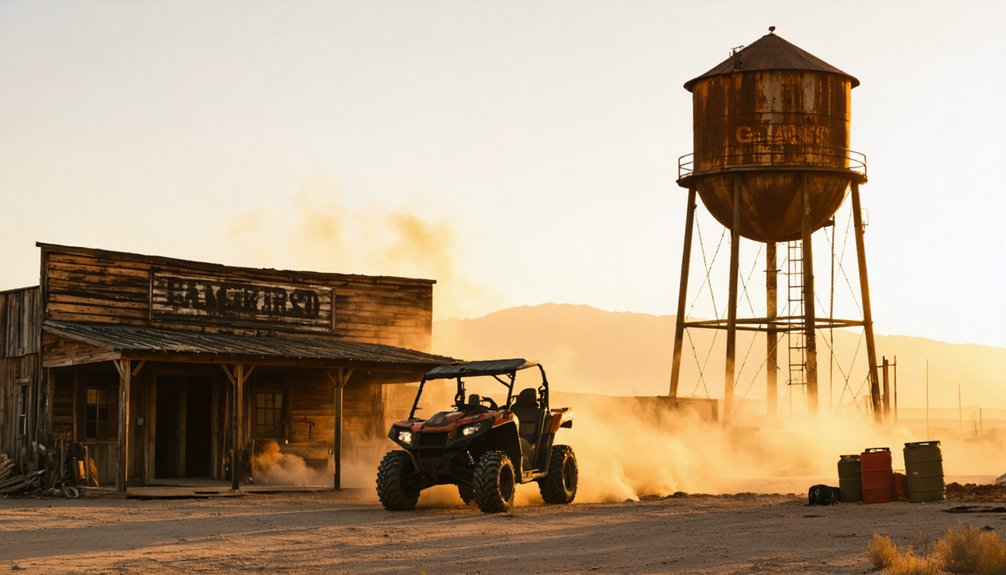
Five critical equipment categories separate successful desert ghost town expeditions from dangerous misadventures that leave riders stranded in remote terrain.
Your ATV gear arsenal starts with DOT-approved helmets, mandatory for all off-highway desert adventures, plus goggles and gloves for dust protection.
Vehicle requirements demand high-clearance 4x4s with green or red stickers, full-size spare tires, traction boards, and winches for self-recovery on rugged trails.
Navigation tools like onX Offroad satellite maps and GPS units become lifelines when plotting 95-mile routes through remote backroads.
Pack survival essentials including plenty of water, food, fuel, and first aid kits for self-reliance.
Finally, wear protective clothing—long pants, boots, and armored jackets—that shields you from desert terrain’s unforgiving rock obstacles and temperature extremes.
Best Seasons for Desert Ghost Town ATV Adventures
You’ll face serious heat dangers when exploring desert ghost towns during summer months, as temperatures soar above 100°F and ground heat can reach 140°F in sandy areas.
Plan your ATV adventures for spring through winter when daytime highs stay between 60-85°F, giving you comfortable conditions for extended rides to remote sites like Tip Top and Courtland.
Time your trips during these cooler seasons and you’ll enjoy clear visibility, fewer crowds, and safer riding conditions across Arizona’s vast ghost town network.
Avoiding Summer Heat Dangers
While Southwest Arizona’s ghost towns beckon year-round, summer’s brutal heat transforms what should be thrilling ATV adventures into potentially deadly ordeals.
Desert temperatures routinely exceed 110°F in areas like Yuma and Quartzsite, creating conditions where heat safety becomes your top priority. Your body can’t handle prolonged exposure to triple-digit heat while traversing rocky trails to remote locations like Swansea.
Essential summer heat dangers to avoid:
- Hyperthermia and heatstroke – Primary killers in desert conditions
- Rapid dehydration – Low humidity accelerates fluid loss
- ATV engine overheating – Mechanical failures above 105°F
- Limited escape routes – Ghost towns offer no shade or amenities
- Poor cell coverage – Delays emergency rescues
Smart hydration strategies demand one gallon per person hourly, but even that won’t overcome summer’s merciless assault.
Spring Through Winter Timing
Fortunately, Southwest Arizona’s desert ghost towns offer spectacular ATV adventures during three magnificent seasons that showcase why timing matters more than gear.
Spring delivers perfect 60-85°F temperatures for exploring Swansea’s remote ruins, while reduced crowds enhance your freedom to discover hidden canyon sites.
Fall ranks supreme with comfortable 70-90°F days and crisp mornings ideal for long rides along the Arizona Peace Trail’s rocky stretches.
Winter provides nearly flawless conditions with cool 50-70°F temperatures and crystal-clear visibility for traversing dirt roads to Eldorado Canyon.
Smart trail timing and seasonal planning reveal year-round adventures except summer’s dangerous triple-digit heat.
You’ll find Low Desert OHV areas near Parker accessible during all three prime seasons, with elevation variations at places like 5,200-foot Gooseberry Mesa offering consistently mild conditions.
Photography Tips for Capturing Desert Ghost Town Ruins
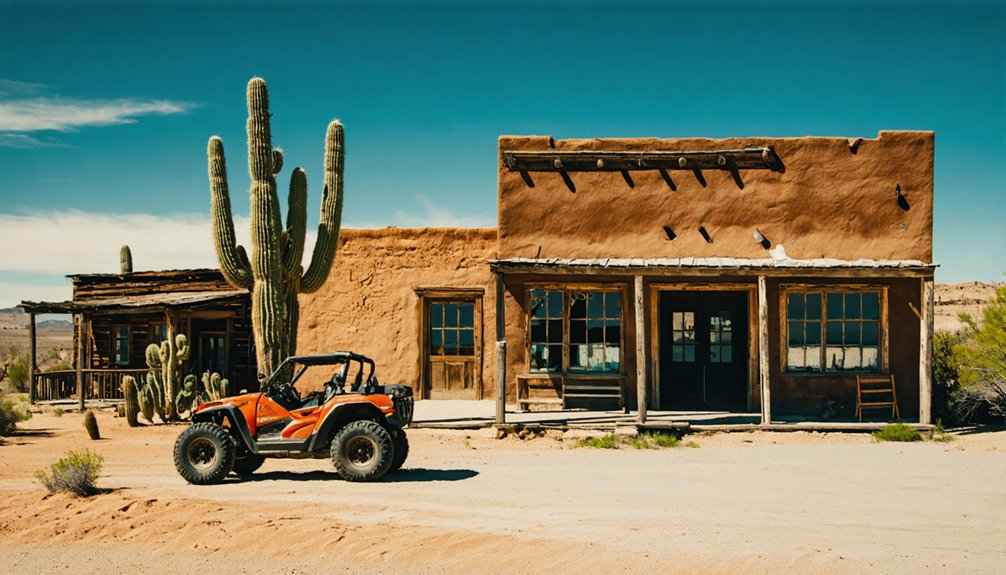
When your ATV kicks up dust as you approach weathered ruins rising from the desert floor, you’re witnessing scenes that demand careful photographic consideration. These abandoned settlements offer extraordinary opportunities for capturing the Southwest’s haunting beauty through strategic photography techniques and proper lighting gear.
Your DSLR or mirrorless camera excels at capturing subtle shadows dancing across crumbling adobe walls. Wide-angle lenses frame vast scenes of abandonment, while prime lenses reveal intimate details like rusted door hinges and weathered wooden beams. Golden hour transforms ordinary ruins into cinematic masterpieces.
- Pack tripods for stable long exposures capturing star trails over ghost towns
- Use flashlights for light painting dark interiors through broken windows
- Shoot during dawn/dusk for soft, eerie lighting on desert structures
- Focus on main street buildings like saloons, jails, and general stores
- Level horizons to prevent distortion in wide-angle shots
Safety Considerations for Remote Desert ATV Exploration
Although desert ghost towns offer incredible ATV adventures, remote exploration demands serious safety preparation that can mean the difference between an epic ride and a dangerous situation.
Desert ghost town ATV adventures require serious safety preparation to avoid turning an epic ride into a dangerous situation.
You’ll need proper safety gear including DOT-compliant helmet, eye protection, long sleeves, pants, gloves, and over-the-ankle boots to shield against desert hazards.
Before hitting those isolated trails, inspect your ATV‘s oil, brakes, throttle, tires, and suspension – mechanical failure in remote areas can strand you.
Emergency preparedness is essential. Pack extra water, food, spare parts, tools, and communication devices. Inform someone of your route and return time.
Ride with others when possible, stay on marked trails, and never operate under the influence. The desert’s unforgiving terrain won’t give you second chances.
Frequently Asked Questions
Can I Camp Overnight at Ghost Town Locations During ATV Trips?
You can camp overnight at many ghost town locations, but camping regulations vary by land management agency. Most ghost towns lack amenities, so you’ll need self-sufficient gear and must follow designated camping rules.
Are There Restroom Facilities Available at Remote Desert Ghost Towns?
Restroom accessibility varies dramatically at ghost town amenities. You’ll find vault toilets at managed sites like Swansea, flush facilities at Bodie’s parking area, but many remote locations offer absolutely nothing—pack accordingly.
What Permits or Licenses Are Required for ATV Ghost Town Exploration?
You’ll need Arizona’s OHV decal for ATVs under 2,500 pounds, plus specific ghost town permits depending on location. ATV regulations require forest permits for Tonto zones and state land permits for exploration freedom.
Can Children Safely Participate in Desert Ghost Town ATV Adventures?
Yes, they can thrive on these adventures! You’ll need proper safety gear and constant child supervision, but guided tours with age-appropriate vehicles let kids experience desert freedom safely alongside adults.
Are There Fuel Stations Along Desert ATV Routes to Ghost Towns?
You’ll find limited fuel availability at most desert ghost town routes, so thorough route planning becomes essential. Pack extra fuel, map highway stations like those in Arizona, and always carry backup supplies for freedom.
References
- https://www.youtube.com/watch?v=Xv9v-xRS_3I
- https://offroad.vegas/mojave-ghost-town-tour/
- https://awesomeadventures.com/Best_Ghost_Town_Gold_Mine_ATV_Tours.html
- https://www.tripadvisor.com/Attraction_Review-g31301-d7645184-Reviews-Swansea_Ghost_Town-Parker_Arizona.html
- https://azstateparks.com/southwest-az-ohv-trailheads
- https://www.onxmaps.com/offroad/blog/ghost-towns-off-roading
- https://www.frommers.com/slideshows/848476-9-ghost-towns-to-explore-during-road-trips-through-the-american-west/
- https://www.colorado.com/articles/colorado-ghost-towns
- https://www.mywestshore.com/best-places-in-the-southwest-usa-to-ride-a-mini-atv/
- https://www.atlasobscura.com/places/swansea-ghost-town