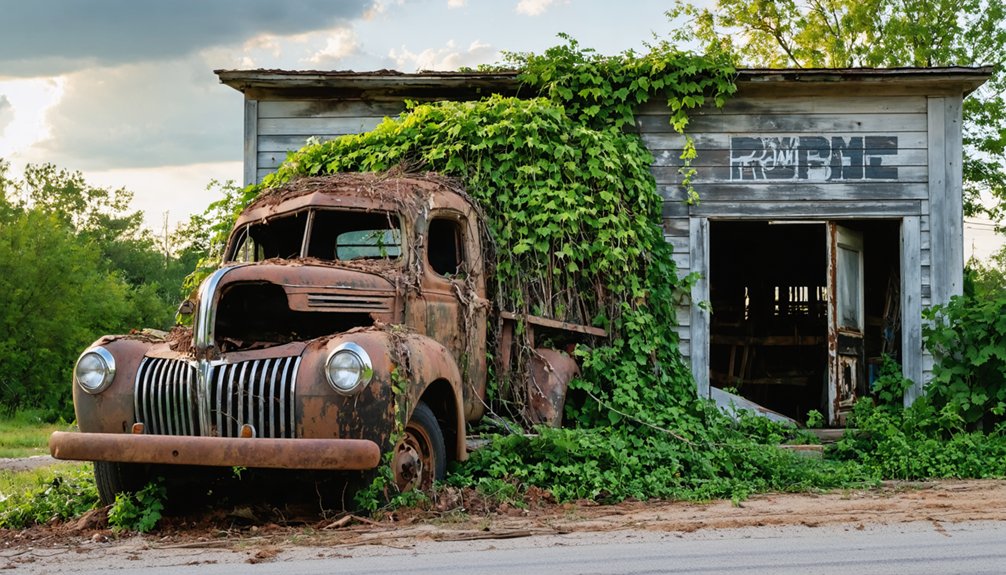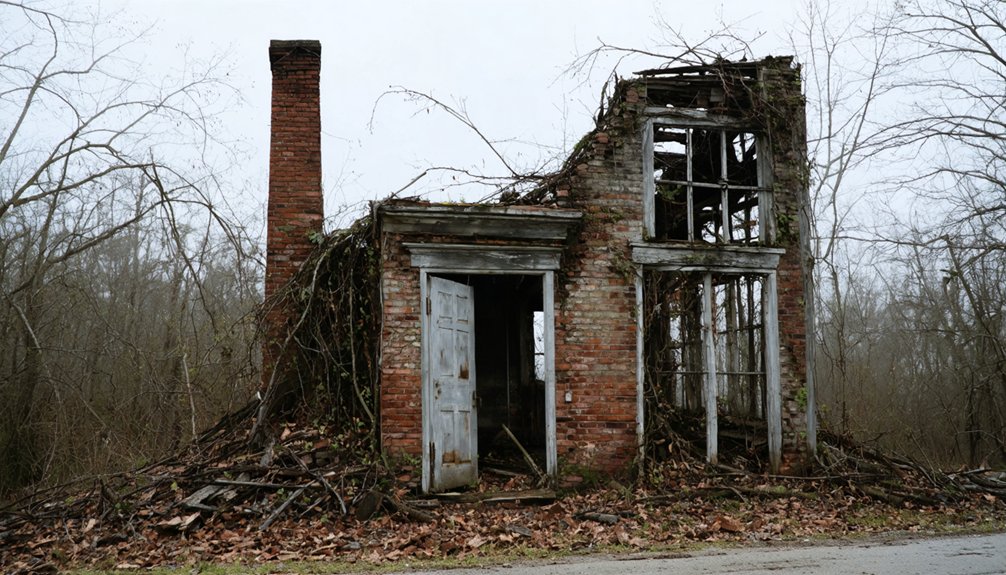
You’ll find Alabama’s most fascinating ghost towns along ATV trails through Bankhead National Forest, where Flint Creek’s 16-mile multi-use trail leads to abandoned settlements hidden among rolling hills. Ride to Fort Blakeley’s Civil War earthworks, explore Houston’s 1830s log cabin remnants via Forest Service trails from Double Springs, or navigate to St. Stephens’ historic trading post overlooking the Tombigbee River. These adventures reveal crumbling foundations, weathered tombstones, and stories of Alabama’s forgotten past that await your discovery.
Key Takeaways
- Flint Creek Multi-Use Trail offers 16 miles of ATV paths through Bankhead National Forest with ghost town remnants.
- Fort Blakeley features Civil War earthworks and ruins accessible by ATV trails with historical significance from 1865.
- Houston ghost town contains 1830s-1850s log cabin remnants reachable via 5-7 mile Forest Service ATV trails.
- St. Stephens Historic Park provides 600 acres of wilderness trails leading to Alabama’s former territorial capital ruins.
- Spring and fall seasons offer optimal conditions for ATV ghost town exploration with mild temperatures and firm trails.
Flint Creek Multi-Use Trail: Your Gateway to Alabama’s Hidden Past
Why settle for ordinary trails when you can ride through Alabama’s most accessible gateway to forgotten history? Flint Creek Multi-Use Trail delivers 16 miles of wide dirt paths through Bankhead National Forest, where ghost town remnants hide among rolling hills and hardwood forests. You’ll navigate two distinct loops using white diamond markers for seamless trail navigation, while your ATV cuts through terrain where settlements once thrived.
The hard-packed surfaces accommodate any skill level, making this perfect for family expeditions to discover Alabama’s past. Wildlife encounters add excitement as you cruise past poison ivy thickets and hearts-a-bustin shrubs. Cross the single bridge carefully—it’s your gateway deeper into forgotten territories. With camping permitted nearby, you can extend your ghost town hunting adventures under Alabama’s starlit skies.
This family-friendly atmosphere makes the trail welcoming for riders of all ages exploring Alabama’s historical landscapes together. Along the way, you’ll witness nature’s continuous forest dynamics as fallen trees create openings that reveal hidden historical artifacts beneath the canopy.
Essential ATV Gear for Ghost Town Exploration
Before you venture into Alabama’s forgotten settlements, your survival depends on the gear strapped to your back and mounted on your ATV.
Ghost town exploration demands more than casual trail riding—you’re heading into territories where help isn’t coming.
You’re venturing beyond civilization’s reach where self-reliance isn’t just recommended—it’s your only lifeline to getting home safely.
Your gear checklist starts with protection. Helmets aren’t optional when dodging low branches near crumbling structures. Helmets are mandatory for safe exploration, just as they are required on designated off-road trails. Goggles shield your eyes from debris kicked up by decades of decay.
Pack essential supplies including doubled water rations, tire repair kits, and recovery gear. Desert terrain requires offline maps and GPS apps since cell service disappears in remote ghost town locations.
- Tire Service Kit: Plug kit, compressor, and full-size spare for sharp metal debris around abandoned sites
- Recovery Essentials: Winch capability and tow rope for traversing unstable terrain near ghost structures
- Emergency Supplies: First aid kit, LED headlamp, and fire starters for unexpected overnight situations
Blakeley: Fort Ruins Reclaimed by Nature
With your gear secured and safety protocols in place, you’re ready to tackle one of Alabama’s most haunting destinations. Blakeley’s ghost town emerges through towering oaks and Spanish moss, where nature’s reclaimed what civilization abandoned.
You’ll navigate trails through Fort Blakeley’s earthen fortifications, following the same paths where 20,000 Union and Confederate soldiers clashed in April 1865.
The Blakeley history unfolds as you explore crumbling jailhouse ruins and scattered brick foundations marking vanished homes.
Your ATV handles the overgrown terrain perfectly, letting you access remote cemetery corners where weathered tombstones tell stories of yellow fever victims. The historic Blakeley Town Cemetery holds graves dating back to 1818, with two distinct sections marking different eras of this forgotten settlement.
Fort Blakeley’s preserved earthworks stretch through dense forest, offering glimpses into Alabama’s final Civil War battleground while delivering the freedom to explore forgotten chapters of American history. This once-thriving settlement reached its peak population of 4,000 in the early 1820s, even surpassing Mobile at that time.
Houston: Log Cabin Remnants in the Wilderness
Adventure awaits deep in Winston County’s Bankhead National Forest, where Houston’s ghost town hides among towering hardwoods and forgotten creek beds.
You’ll discover authentic log cabin architecture from the 1830s-1850s scattered throughout this remote wilderness, accessible via a 5-7 mile ATV ride on Forest Service trails from Double Springs.
These hand-hewn structures tell stories of pioneer life when Houston thrived as a logging outpost. Stone chimneys and foundations mark where families carved out their existence before economic decline forced abandonment in the 1920s.
- Navigate moderate terrain on beginner-intermediate trails through designated OHV routes
- Explore multiple cabin remnants forming the original homestead cluster
- Camp primitively within 200 feet of trails for extended wilderness exploration
Fall through spring offers the clearest views through reduced undergrowth, revealing Houston’s forgotten legacy. The site features historical interpretive markers that provide educational context about the settlement’s rise and eventual abandonment. First-time ATV riders should exercise extra caution when navigating the challenging terrain around the cabin ruins to avoid potential safety risks.
St. Stephens: Historic Trading Post Accessible by Trail
You’ll discover one of Alabama’s most significant historical sites at St. Stephens, where hiking trails lead you through 600 acres of preserved wilderness to explore the remnants of what was once the Alabama Territory’s bustling capital.
The trail system winds past archaeological dig sites and foundation ruins, offering glimpses into a trading post that served as the political and economic heart of early Alabama from 1817 to 1819. The settlement’s strategic position on a limestone bluff overlooking the Tombigbee River made it an ideal location for both Spanish fortification and American territorial governance.
Your journey through the mixed pine and hardwood forests reveals scattered artifacts and structural remains that tell the story of a once-thriving riverfront community that housed over 2,000 residents before yellow fever and political changes turned it into a ghost town. Due to the multiple meanings associated with St. Stephens throughout Alabama and other regions, this particular historic site represents one of several locations sharing similar names across the southeastern United States.
Trading Post History
The limestone bluffs overlooking Alabama’s Tombigbee River hold secrets of a once-thriving settlement that shaped the territory’s early history.
You’ll discover St. Stephens evolved from Spanish fort to America’s bustling Choctaw Trading House, where frontier commerce flourished from 1803 to 1822. The trading post architecture showcased American ingenuity—George Strother Gaines repurposed the old Spanish blockhouse and constructed Alabama’s first brick building in 1811.
This strategic location’s economic significance can’t be overstated, as manufactured goods flowed to Choctaw Indians in exchange for valuable deerskins.
- Spanish foundations: Fort established 1789 with nearly 300 residents by 1796
- American transformation: Trading house opened 1803, becoming territorial capital 1817-1819
- Peak prosperity: 2,000-3,000 residents and 450 buildings by 1820
Trail Access Routes
Multiple routes lead adventurers to St. Stephens, each offering unique access to this historic ghost town’s fifteen-mile trail network.
You’ll find the primary route from Highway 43 at Leroy most reliable, following County Road 34 west for 6.2 miles before maneuvering the final connections to the gatehouse. Trail maintenance here stays consistent, keeping paths clear for both hiking and horseback riding through the 200-acre park.
Guidance tips prove essential when exploring the Yellow Trail winding through original town streets. The walking trail outlines Old Capital Town’s layout, while rugged paths extend toward the 70-acre quarry lake.
From St. Stephens town, you can access Jim Long Road for alternate entry, providing flexibility when weather conditions affect your preferred route choice.
Remnants and Ruins
Although St. Stephens doesn’t offer towering ruins like movie sets, you’ll discover something more authentic—genuine remnants of Alabama’s territorial capital scattered across the landscape.
Walking these grounds, you’re exploring a site with incredible archaeological significance where regular digs uncover historical artifacts spanning centuries.
What you’ll find tells the story of America’s westward expansion:
- Foundation stones and cellar depressions marking where territorial officials once conducted business
- Cisterns and building remnants from the town’s 1817-1819 capital years
- Natural “Indian Bathtubs”—rock basins formed by ancient springs
The Alabama Historical Commission actively preserves this undisturbed site, making it a living laboratory.
You’ll experience history through tangible remains rather than reconstructions, connecting directly with the past through every artifact beneath your feet.
Safety Considerations for Off-Road Ghost Town Adventures
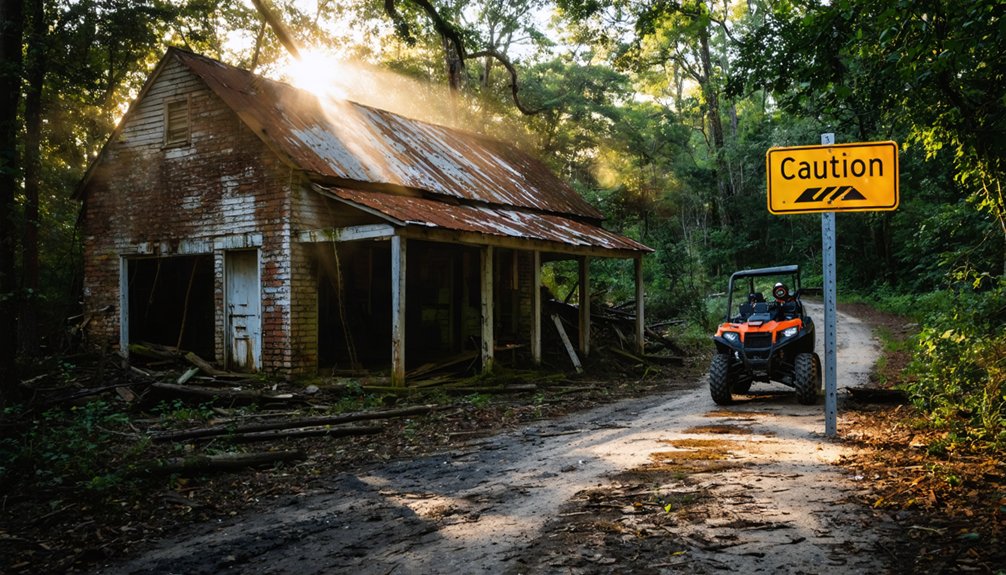
Venturing into Alabama’s forgotten settlements on your ATV transforms an ordinary ride into an expedition through history, but these crumbling structures and overgrown paths demand respect for both the terrain and your own safety.
Before exploring these ghostly destinations, equip yourself with proper safety equipment—helmet, goggles, gloves, and sturdy boots protect against unseen hazards lurking in deteriorated buildings and unstable ground. Hidden debris, rotting floorboards, and overgrown vegetation can catch you off-guard.
Emergency planning becomes essential when you’re miles from civilization. Pack your survival kit with first-aid supplies, extra water, flashlight, and emergency flares. Tell someone your route and expected return time—cell service often disappears in these remote locations.
Check your ATV thoroughly before departure, inspecting tires, brakes, and fluids. These abandoned places reward careful riders with unforgettable glimpses into Alabama’s past.
Best Seasons for ATV Ghost Town Expeditions
The rhythms of Alabama’s seasons dramatically shape your ghost town adventures, turning each expedition into a unique encounter with both weather and history.
Spring exploration offers you perfect conditions with mild 60-75°F temperatures and reduced rainfall, making ATV trails safer while blooming flora reveals hidden ruins like Cahaba.
Fall visits deliver comfortable temperatures and stunning colors that illuminate overgrown paths to forgotten places like the Spectre film set.
- Spring (March-May): Longer daylight hours let you tackle extended 6-8 hour loops with minimal mosquito interference
- Fall (September-November): Decreased rainfall firms up trails while fewer crowds mean you’ll have neglected sites like Old Cahawba to yourself
- Winter advantage: Minimal vegetation exposes hidden structures at abandoned settlements you’d miss during leafy seasons
Camping and Lodging Options Near Trail Access Points
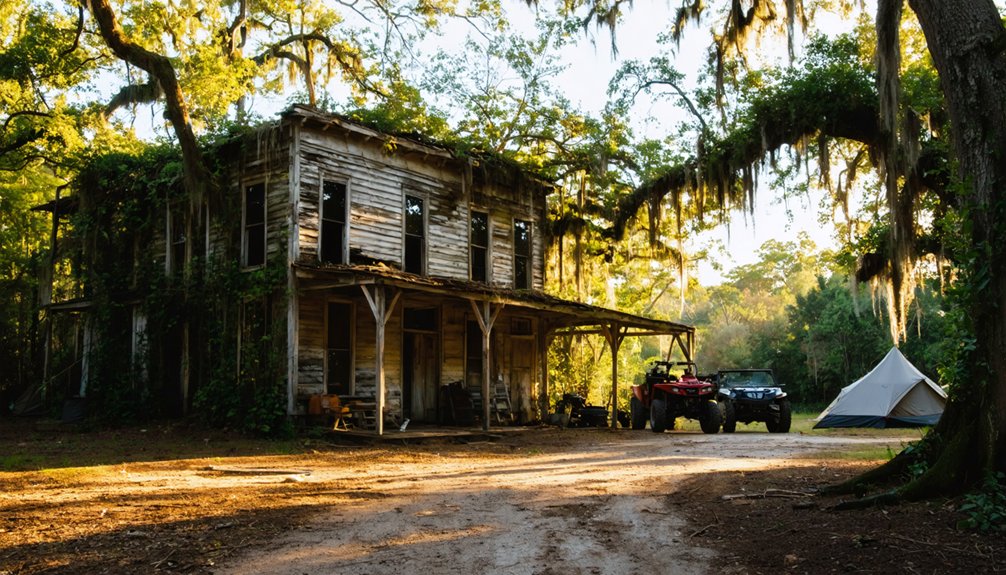
When your ATV adventure winds down after hours of exploring forgotten settlements, you’ll find Alabama’s ghost town regions offer compelling overnight options that keep you close to the trails.
Top Trails OHV Park in Talladega provides developed campsites with restrooms and showers, plus cabins for those seeking comfort after dusty rides.
Clean up in comfort at Top Trails OHV Park’s developed campsites with full facilities and cozy cabin options.
Hollytree Off-Road Park’s 800 wooded acres accommodate your lodging preferences with primitive spots or cozy cabin rentals near Paint Rock Valley’s abandoned sites.
Southern Ridge ATV Park delivers family-friendly camping amenities including RV hookups and creek-side tent areas.
For ultimate freedom, Talladega National Forest permits dispersed camping along 24-mile Road 500, where lakeside sites put you within striking distance of Bibb County’s ghostly remains.
Trail Etiquette and Preservation of Historic Sites
As you throttle through Alabama’s backcountry searching for remnants of bygone eras, responsible riding becomes your gateway to preserving these fragile historical treasures for future explorers.
Trail etiquette isn’t just about following rules—it’s about respecting the stories these ghost towns tell. You’ll want to stick to designated trails and avoid damaging property or historic sites through reckless operation.
Historic preservation depends on riders like you who understand that these abandoned settlements are irreplaceable windows into Alabama’s past.
- Stay on marked trails to prevent erosion around delicate foundations and artifacts
- Operate at reasonable speeds when approaching historic structures to avoid disturbing wildlife and maintaining reverence
- Follow all signage controlling traffic flow around sensitive archaeological sites
Frequently Asked Questions
Are ATVS Allowed on All Sections of the Flint Creek Multi-Use Trail?
Yes, you’ll find ATVs allowed on designated multi-use trail sections. Trail accessibility spans both red and white loops, but ATV regulations restrict width to fifty inches while you explore this freedom-filled adventure.
Do I Need Special Permits to Visit Ghost Town Sites With My ATV?
You’ll need permits if ghost towns sit on Forest Service land following ATV regulations. Private ghost town sites don’t require special permits beyond basic registration. Check ghost town guidelines and land ownership before riding there.
Which Ghost Towns Have the Most Intact Structures Still Standing Today?
Coincidentally, Old Cahawba offers you the most intact structures, including St. Luke’s Church ruins. New St. Stephens preserves complete town layouts through active preservation efforts, maintaining its historical significance for adventurous explorers.
Can I Bring Metal Detectors to Search for Artifacts at These Sites?
You can’t legally metal detect at Alabama’s ghost town sites due to strict artifact preservation laws. These historic locations fall under state protection with hefty fines enforcing metal detecting regulations that prioritize archaeological integrity.
Are There Guided ATV Tours Available for Alabama’s Ghost Town Locations?
You won’t find specific guided tours to Alabama’s ghost towns, but several outfitters offer general ATV experiences. You’ll need your own safety gear and navigation skills to explore these abandoned settlements independently.
References
- https://www.youtube.com/watch?v=Pfs_D-MuJlw
- https://www.drrusa.com/post/places-to-ride-in-alabama
- https://deepsouthurbex.com/2020/01/02/6-south-alabama-ghost-towns/
- https://app.advcollective.com/journal/mud-moss-and-momentum-riding-southern-ridge-atv-park-in-south-alabama
- https://www.tripadvisor.com/Attractions-g28922-Activities-c61-t90-Alabama.html
- https://www.alapark.com/parks/bucks-pocket-state-park/ohv-trail
- https://www.onlyinyourstate.com/trip-ideas/alabama/ghost-towns-road-trip-al
- https://en.wikipedia.org/wiki/List_of_ghost_towns_in_Alabama
- https://www.atvtrails.org/AL/flintcreek.html
- https://stevejonesgbh.com/2022/11/30/flint-creek-trail-at-wheeler-national-wildlife-refuge/