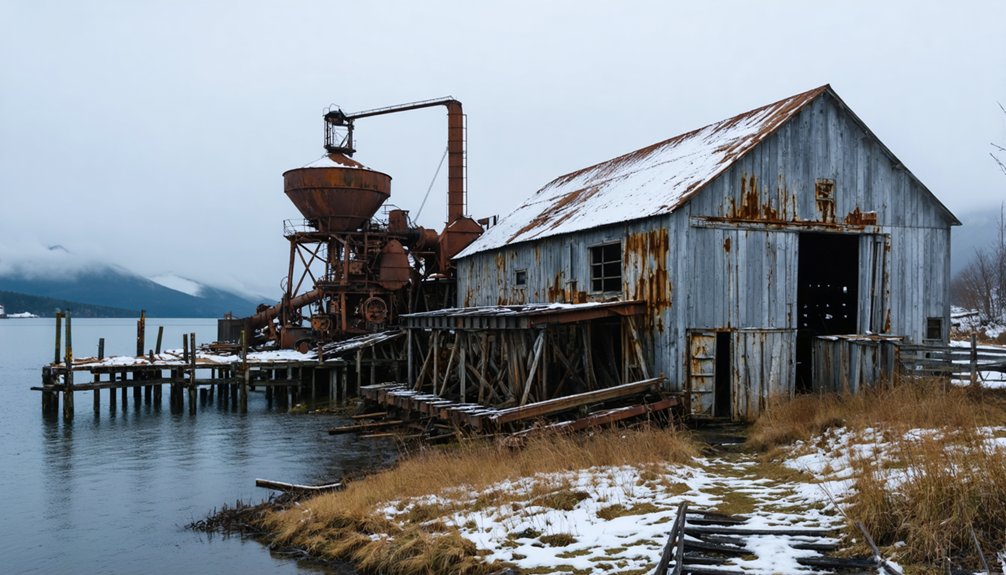
You’ll discover some of Alaska’s most fascinating abandoned mining settlements by following rugged ATV trails that wind through remote wilderness to places like the Kennecott Mines, where 1.183 billion pounds of copper were extracted before the operation shut down in 1938, leaving behind a perfectly preserved ghost town complete with mills, hospitals, and recreation halls. The 60-mile McCarthy Road follows the original railway roadbed, while Crown Point Mine Road offers challenging terrain through the Chugach Mountains to abandoned claims. These adventures reveal Alaska’s rich mining heritage hidden in spectacular backcountry locations.
Key Takeaways
- Kennecott Mines offers Alaska’s richest copper discovery site with abandoned mills, hospitals, and recreation halls accessible via McCarthy Road.
- McCarthy Road provides 60-mile gravel access to ghost towns, following original railway roadbed with wildlife viewing opportunities.
- Petersville Mining District features abandoned 1930s mining camps with steam-powered equipment remnants accessible along historic Petersville Road.
- White Mountains National Recreation Area contains million-acre wilderness with abandoned logging settlements from the late 1800s boom period.
- Knik Glacier Region preserves gold rush ghost settlements and mining claims from early 1900s, accessible through remote valleys.
McCarthy Road: Gateway to Alaska’s Mining Past
Adventure beckons along the McCarthy Road, a 60-mile gravel route that transforms Alaska’s abandoned railway into your gateway to copper mining history.
You’ll navigate the original Copper River and Northwestern Railway roadbed, built between 1908-1911 to haul precious ore from Kennicott mines to coastal shipping ports. The McCarthy history unfolds as you traverse engineering marvels like the Kuskulana Bridge, suspended 238 feet above rushing waters.
Your ATV handles what passenger cars can’t—sharp turns, potholes, and rugged terrain that defined this wilderness corridor. The two-hour journey through pristine wilderness offers opportunities to spot swans, moose, grizzly bears, and eagles along the route.
The road ends half-mile before McCarthy, where you’ll cross a footbridge into Alaska’s most authentic ghost town. Beyond lies Kennecott Mines National Historic Landmark, where copper kings once ruled America’s largest national park. The railway’s final journey concluded on November 11, 1938, when the last train reached Cordova, marking the end of an era that shaped Alaska’s industrial heritage.
Kennecott Mines: Copper Mining Legacy in the Wilderness
Four massive mines carved into Alaska’s wilderness tell the story of America’s richest copper discovery, where you’ll explore the remains of a $200 million empire that transformed raw mountain ore into industrial fortune.
The Kennecott legacy spans from 1900’s initial discovery to 1938’s final shutdown, when prospectors found malachite deposits containing 70% pure chalcocite on Bonanza Peak.
You’ll witness engineering marvels including the 196-mile Copper River Railway and massive trams that hauled ore from mountainside claims.
This copper heritage produced 1.183 billion pounds of copper over 28 years, ranking among America’s top producers. The mine’s ore averaged over 25% copper, making it one of the richest deposits ever discovered in North America.
The abandoned infrastructure—mills, hospitals, recreation halls—creates an authentic ghost town experience where freedom seekers can explore America’s industrial wilderness legacy firsthand. At its peak, this remote wilderness community housed around 300 residents who lived and worked in one of Alaska’s most isolated mining operations.
Chitina: From Boom Town to Historic Remnant
You’ll find Chitina’s dramatic transformation from a bustling railroad hub of thousands to fewer than 100 residents makes it one of Alaska’s most accessible ghost town experiences.
The town’s population peaked during the copper boom era but plummeted after the railroad ceased operations in 1938, leaving behind weathered buildings and rustic streets that tell the story of boom-and-bust frontier life. Originally inhabited by the Ahtna Athabascan people, Chitina served as a vital hunting and fishing ground long before its mining heyday. The town developed when the railroad reached it in 1910, becoming an important junction point connecting to the Richardson Road.
Your ATV can easily navigate the well-maintained Edgerton Highway to reach this historic remnant, where you’ll discover the last supply stop before entering America’s largest national park.
Historic Population Decline
Long before copper sparked Alaska’s most dramatic boom-and-bust cycles, the Ahtna Athabascan people had established a thriving village at what would become Chitina, using this strategic location as essential hunting and fishing grounds for thousands of years.
This rich Indigenous history crumbled when European settlers arrived, bringing devastating diseases and conflicts that decimated the native population.
You’ll witness the stark remnants of this transformation when exploring Chitina’s weathered structures.
Population impacts tell the story through numbers: from thousands of Indigenous inhabitants to a copper boom peak, then crashing to 176 residents by 1939 after the mines closed.
The final blow came when the last train departed November 11, 1938, leaving behind a haunting reminder of Alaska’s volatile frontier economics.
ATV Access Route
Despite the railroad’s departure in 1938, Chitina’s ghost town remnants beckon modern adventurers through the paved Edgerton Highway, where your ATV can trace the same strategic corridor that once bustled with copper-laden trains and fortune seekers.
You’ll navigate fifty-three miles southeast from Copper Center along well-maintained pavement that transforms into prime ATV trails extending beyond the town’s borders.
The Edgerton Highway’s 1980s paving project eliminated rough terrain, giving you smooth access to explore historic landmarks like the National Register-listed Tin Shop and Ed S. Orr Cabin.
Your machine can handle the route’s gentle grades while you follow the same path that connected railroad terminals to Interior Alaska, where mail carriers and miners once traveled toward Richardson Road and distant Fairbanks. The townsite’s grid plan still guides navigation through remnants of false-fronted buildings that housed five hotels during the early 20th-century boom.
Today’s Chitina attracts summer dip netting enthusiasts who combine ATV exploration with Alaska’s premier salmon fishing opportunities along the Copper River.
Crown Point Mine Road: Homer and Seward Area Exploration
You’ll find Crown Point Mine Road nestled in the Chugach Mountains between Homer and Seward, where remnants of Alaska’s gold rush era await your discovery.
This 5.6-mile trail challenges you with hard-packed surfaces and muddy stretches as it winds through backcountry forests toward the abandoned Crown Point Mine. The trail gains approximately 3,500 feet of elevation through a series of switchbacks that provide a gradual ascent through the wilderness.
The trail system spans 12,800 acres of diverse terrain across the mountain wilderness. Your ATV adventure connects you to mining history while offering multiple route options from both the Homer and Seward areas.
Crown Point Mining History
When you follow the Crown Point Mine Road through Alaska’s Kenai Peninsula backcountry, you’re tracing a path carved during the region’s gold rush era that connected multiple mining operations across Solars Mountain.
Crown Point’s second operation launched in 1924, joining four other mines that shipped gold ore from the Nuka Bay area until 1941.
You’ll discover mining relics scattered throughout the canyon, including remnants of a 630-foot aerial tramway and mill buildings at 997 feet elevation.
The underground extraction operation processed ore using stamp mills and tramway systems before wartime conditions forced closure.
These silent artifacts, now claimed by encroaching brush, mark Alaska’s ambitious mining legacy.
Trail Access and Conditions
Crown Point Mine Road demands serious ATV skills and preparation before you tackle its challenging 10.7-mile out-and-back route to 3,900 feet elevation.
You’ll need advanced trail navigation techniques to handle narrow switchbacks, steep inclines, and technical rock sections that’ll test your riding abilities.
Plan your adventure between Sunday and Wednesday from April through November, though seasonal weather considerations make June the sweet spot for reliable access.
Snow lingers at higher elevations well into spring, blocking your path to freedom.
Essential gear for conquering this trail:
- Safety glasses for dusty conditions
- Rubber boots for creek crossings and mud holes
- Rain gear and layers for unpredictable mountain weather
You’ll share this narrow path with hikers and other riders, so use pullouts strategically when passing becomes necessary.
Homer Seward Route Options
After conquering Crown Point Mine Road‘s technical challenges, you’ll discover this remarkable trail offers two distinct exploration opportunities spanning the Homer-Seward corridor.
The north side beckons you up mountainous terrain for three miles along Falls Creek, delivering unmatched panoramic views of Kenai Lake and hanging glaciers. You’ll climb from 785 to 4,500 feet elevation over five miles of the peninsula’s highest mining trail.
The south side provides separate access to Fall Creek Mine, offering different perspectives of this historic area.
Both routes demand attention to Trail Safety given the narrow, difficult terrain and mixed traffic including hikers and other ATVs. Plan frequent Scenic Stops to appreciate the turquoise lakes and extensive mountain vistas across 12,800 acres of wilderness freedom.
Petersville Mining District: ATV Adventures Through History
Since gold fever first struck the Yentna Cache-Creek Mining District in 1898, the Petersville area has beckoned adventurous souls with promises of fortune hidden beneath Alaska’s rugged terrain.
Your ATV exploration through this historic mining district will take you along the legendary Petersville Road, originally carved by determined miners in the 1920s.
Mile 26 reveals the abandoned Petersville mining camp, where you’ll discover remnants of a post office that operated through the 1930s.
The Petersville history unfolds dramatically here, including the unsolved 1939 murders that shocked the nation.
Key discoveries await your journey:
- Steam-powered dragline tailings scattered along Peters Creek
- Old hydraulic mining ditches carved into Dutch Hills
- Red-brown stream stains from 65-million-year-old Tertiary conglomerate deposits
Cache Creek’s 115,000 ounces of extracted gold tell stories of fortunes won and lost.
White Mountains National Recreation Area: Remote Ghost Site Access
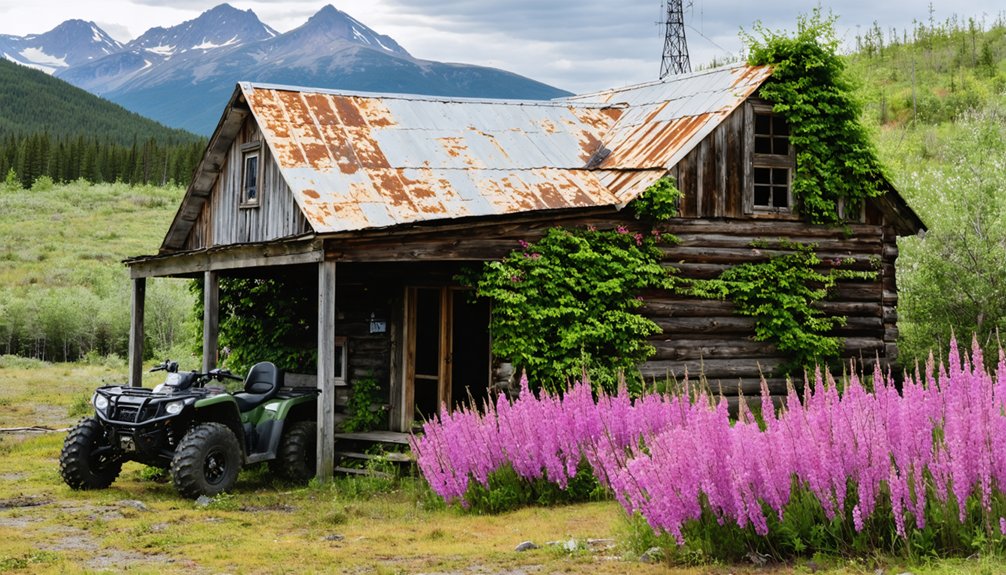
When you venture into Alaska’s White Mountains National Recreation Area, you’ll discover a million-acre wilderness where abandoned logging settlements hide among dense forests and rugged peaks.
Your ATV becomes the key to revealing these forgotten places, carrying you along designated trails to sites where entire communities once thrived during the late 1800s logging boom.
These ghost towns tell stories of sawmills, schools, and homesteads that supported bustling populations before economic shifts left them empty.
Forgotten communities where families once gathered now stand silent, their abandoned structures bearing witness to dreams that faded with changing times.
You’ll find cellar holes, crumbling foundations, and overgrown cemeteries scattered throughout the backcountry.
The BLM-managed ATV trails provide unguided access to places like former mill sites and vanished villages, where nature slowly reclaims what industry once built, offering you complete solitude in Alaska’s remote wilderness.
Knik Glacier Region: Mining Claims and Abandoned Settlements
Beyond the towering peaks of the Talkeetna Mountains, your ATV will carry you into the Knik Glacier region, where Alaska’s gold rush history lies scattered across rugged terrain in the form of abandoned mining claims and ghost settlements.
The historical Knik settlement once thrived as a supply hub for miners, handling massive gold shipments and supporting nearly 500 residents during peak years.
Mining history reveals fascinating remnants throughout this wilderness:
- Abandoned quartz veins in iron-stained metasedimentary rocks mark former extraction sites
- Nine active placer Knik claims were established in 1965, continuing the region’s mining legacy
- Ghost buildings and equipment from the early 1900s dot remote valleys
Your off-road adventure here connects you with Alaska’s untamed past, where fortunes were won and lost beneath glacier-fed waters.
Essential ATV Gear and Safety for Ghost Town Expeditions
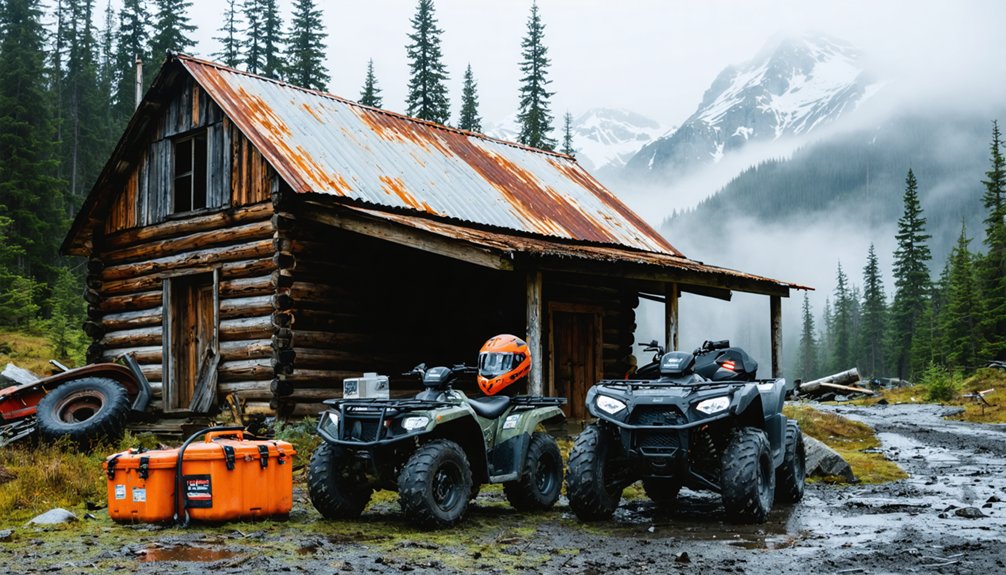
While Alaska’s ghost towns promise incredible adventures, proper gear and safety preparation can mean the difference between an unforgettable expedition and a dangerous situation in the wilderness. Your ATV needs working brakes, headlights, and rear red lights before hitting remote trails.
Proper gear and safety preparation can mean the difference between an unforgettable expedition and a dangerous wilderness situation.
Don’t forget your DOT-approved helmet, shatterproof goggles, leather gloves, and sturdy over-ankle boots – these aren’t suggestions when exploring abandoned settlements miles from civilization.
Follow essential safety guidelines by carrying a minimal tool kit for basic repairs and wearing long sleeves plus pants for protection. Regular ATV maintenance becomes critical when you’re far from help.
Pack emergency supplies, verify your registration’s current, and check local community laws. These ghost town expeditions offer ultimate freedom, but smart preparation keeps your adventure from becoming a survival story.
Frequently Asked Questions
What Permits or Fees Are Required for ATV Access to Ghost Towns?
You’ll need different permits depending on location – state land requires DMLW General Permits, national parks need NPS ORV permits, and trust lands cost $300 annually. Check ATV regulations before your permit application.
Are Camping Facilities Available Near Ghost Town ATV Trail Access Points?
You’ll find limited camping amenities near ghost town access points. McCarthy Road offers primitive camping near Chitina, while Hatcher Pass provides wooded campsites with vault toilets, ensuring trail accessibility for your freedom-seeking adventures.
What Is the Best Time of Year to Visit Ghost Towns?
Summer’s your prime window for ghost town adventures. Weather conditions stay favorable, daylight extends your exploration time, and seasonal attractions like wildflowers enhance the experience. You’ll navigate rough terrain safely while discovering Alaska’s abandoned treasures.
Can ATVS Be Rented Locally for Ghost Town Exploration Trips?
Don’t worry about complicated logistics—you’ll find excellent ATV rental options throughout Alaska. Local rental shops in Girdwood, Seward, and Hatcher Pass offer single and double-rider machines perfect for your ghost town adventures.
Are Guided ATV Tours Available for Alaska’s Historic Ghost Town Sites?
You’ll find guided tours that pass historical sites like abandoned mining cabins, but dedicated ghost town tours aren’t widely available. Most operators focus on scenic trails, though you’ll discover historical significance along mining routes.
References
- https://www.drrusa.com/post/places-to-ride-atvs-in-alaska
- https://hatcherpasstour.com/blog/top-5-places-to-explore-in-alaska-atv-tours/
- https://motorcyclemojo.com/2015/09/alaska-ghost-towns/
- https://www.youtube.com/watch?v=P1ZqxD5x478
- https://49smt.com/alaska-off-roading/
- https://www.akhaul.com/exploring-alaska-our-favorite-local-atv-adventures/
- https://www.tripadvisor.com/Attractions-g28923-Activities-c61-t90-Alaska.html
- https://www.alaska.org/detail/hatcher-pass
- https://alaskabackcountryaccess.com/atv-experiences/
- https://www.alaskagold.com/copper/mcarthy/mcarthy.html