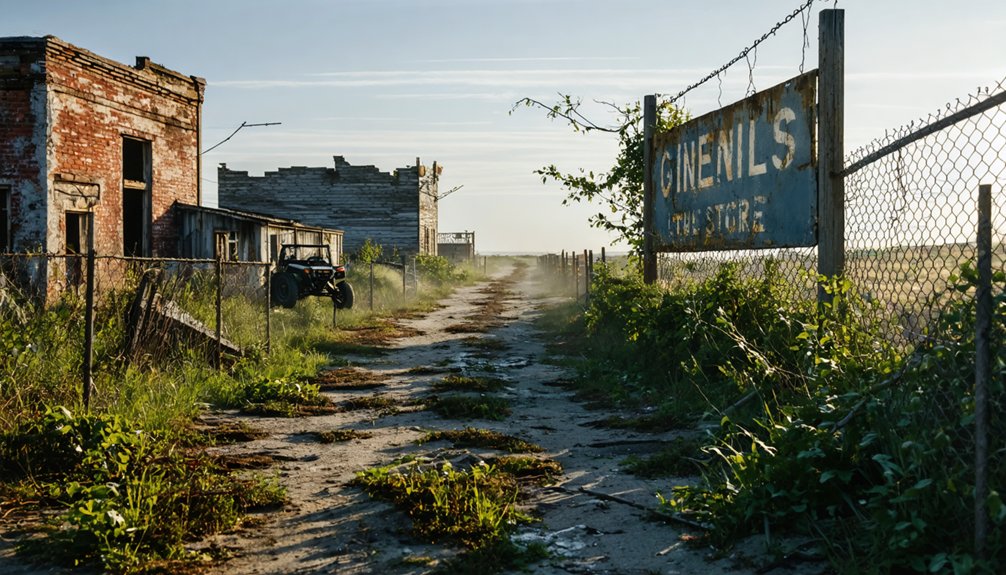
You’ll find five intriguing ghost towns across Delaware’s wilderness perfect for ATV exploration, including Friendship Ruins with its cranberry farm remnants in the Pine Barrens, flood-devastated Glenville near Stanton, and the mysterious railroad settlement of Woodland west of Seaford. New Market’s 18th-century remains and remote Owens Station in Sussex County offer additional adventures. While Delaware’s official ATV trails don’t directly access these sites, you can stage from nearby areas and explore on foot to discover the complete story behind each abandoned community.
Key Takeaways
- Delaware’s official ATV trail system does not extend to ghost town locations like New Market.
- ATV access is limited to designated state forest routes with strict regulations and seasonal restrictions.
- Foot exploration is necessary after initial ATV staging from nearby parking areas like Cool Spring Road.
- OHVs are banned on public property where ghost town sites exist, requiring landowner permission for private routes.
- Seasonal ATV access runs Memorial Day through September, then after deer season through April 1st.
Friendship Ruins: A Cranberry Farm Turned Ghost Town
Deep in New Jersey’s Pine Barrens, the concrete foundations of Friendship tell the story of a once-thriving cranberry operation that housed workers and their families for over a century.
You’ll discover scattered ruins across meadows and pine forests, where families lived until the 1970s before abandonment claimed this industrial settlement.
Your Ghost Town Exploration begins east of Carranza Road, where old dirt paths lead to crumbling foundations now reclaimed by wilderness.
You can navigate these forgotten roads by ATV, though guard rails restrict access to some areas.
The site offers authentic Cranberry Heritage experiences as you explore packing house remains and worker housing foundations. Like Delaware’s mining boom history, Friendship once supported over a thousand residents during its operational peak.
Similar to other abandoned sites, horticulturalists have begun studying how nature reclaims these industrial locations, documenting the return of native vegetation to former work areas.
Contact Wharton State Forest for detailed maps before venturing into this haunting reminder of Pine Barrens history.
Glenville: Tropical Storm Destruction and Abandonment
When Tropical Storm Henri released its fury in 2003, it transformed the quiet subdivision of Glenville near Stanton into Delaware’s most devastating flood zone, where you’ll now find the haunting remnants of a community that couldn’t survive nature’s wrath.
This 1-in-500-year flood devastated 270 homes when White Clay Creek became a raging torrent, submerging entire neighborhoods under 12 feet of water.
Today’s Glenville recovery remains incomplete, with demolished foundations marking where families once lived.
Your ATV exploration reveals:
- Concrete slabs and twisted infrastructure scattered across overgrown lots
- Remnants of the destroyed covered bridge at Rolling Mill Road
- Altered creek channels carved by Henri’s destructive force
Despite heroic rescue efforts that saved every resident, flood resilience proved impossible. The storm’s total damage across Delaware reached $16.1 million, making it one of the most costly natural disasters in the state’s history. Similar devastating flooding occurred in 1999 when Hurricane Floyd brought record rainfall of 10.58 inches to Greenwood, setting a new state record.
You’re witnessing nature’s ultimate victory over human settlement.
Woodland: Railroad Heritage and Rural Exploration
While Henri’s floodwaters carved destruction through northern Delaware, Sussex County’s Woodland tells a different tale of abandonment rooted in tragic folklore and faded transportation networks.
You’ll find this eerie settlement west of Seaford, where Maggie’s Bridge spans a Nanticoke River branch at 4673 Woodland Church Road. The area once thrived around Woodland Ferry operations and steamboat connections to Philadelphia, but storms and tragedy transformed it into Delaware’s most haunted ghost town.
Your ATV can navigate rural roads connecting the historic ferry landing to mysterious crop circles visible on satellite imagery. The dense woods harbor “Ghost Pits” where locals report strange flashes during blue moon nights.
Unlike the better-known Woodland Beach that suffered devastating storms in 1878 and 1914, this inland Woodland maintains its ghostly reputation through supernatural encounters rather than natural disasters. Ghostly Encounters intensify around midnight when Maggie Bloxom’s headless spirit allegedly emerges, creating an unforgettable backdrop for your off-road exploration through Sussex County’s most supernatural abandoned community. Brave visitors attempt the witching hour ritual of chanting “Maggie, Maggie, Maggie” three times to summon her presence at the bridge.
New Market: Southern Delaware’s Forgotten Settlement
You’ll find New Market’s haunting remains tucked away in the rural crossroads of Holly Tree Road and Reynolds Pond Road, just one mile east of Ellendale.
This 18th-century settlement once thrived with its own church, blacksmith shop, and general store before mysteriously fading into Delaware’s forgotten past. The New Market Church served the community from 1810 until services ceased around 1931, when only a few congregation members remained.
Your ATV can easily navigate the quiet country roads leading to this vanished community, where only a small cemetery and a mobile-home park bearing its name hint at the bustling village that once stood here. Like many Delaware settlements, New Market represents the broader pattern of economic change that transformed rural communities throughout the state’s history.
Historical Background Overview
Hidden among southern Delaware’s rolling countryside, New Market stands as one of the state’s most elusive ghost towns, positioned just one mile east of Ellendale at the intersection of Holly Tree Road and Reynolds Pond Road.
This 18th-century settlement’s Historical Significance lies in its complete transformation from thriving village to vanished community, offering you a haunting glimpse into Delaware’s forgotten past.
When you explore New Market’s remnants, you’ll discover:
- A weathered graveyard that survived three different church buildings (1800s, 1850, 1881)
- Traces of economic life including a vanished blacksmith shop and general store
- Modern mobile-home community marking where the original village once flourished
The site reflects Delaware’s broader pattern of colonial architecture preservation, similar to other historical locations throughout the state that maintain their 18th-century character.
You can access this atmospheric location via Reynolds Pond Road to Route 16, making it perfect for ATV exploration through Delaware’s rural backcountry. The settlement shares its name with numerous other geographical locations across the United States, highlighting the common practice of reusing place names in American colonial history.
ATV Access Routes
Reaching New Market’s ghostly remnants requires careful planning since Delaware’s official ATV trail system doesn’t extend into this forgotten corner of southern Delaware.
You’ll need to navigate around strict ATV trail regulations that limit motorized access to designated state forest routes like Dixon Miller’s 13-mile stretch and Burnt Mills’ seven-mile circuit. Your best approach involves staging from nearby parking areas, such as the new lot on Cool Spring Road near Lewis, then shifting to foot exploration.
Understanding seasonal riding guidelines becomes essential for your ghost town quest.
Summer seasons run from Memorial Day weekend through September’s final weekend, while winter access opens after deer season through April 1st.
You’ll cross unpaved surfaces featuring hard-pack, gravel, and mud puddles, requiring caution when traversing public roads like Route 9.
Owens Station: Remote ATV Adventures in Sussex County

You’ll find Owens Station’s remnants scattered across Sussex County’s remote wilderness, where former railroad corridors now offer challenging terrain for ATV exploration.
The area’s transformation from transportation hub to wildlife refuge creates unique opportunities to navigate through forested wetlands and abandoned rail beds on your four-wheeler.
Before you venture into this backcountry ghost town territory, you’ll need proper registration, insurance, and navigation tools to safely explore the overgrown trails that once connected Delaware’s forgotten settlements.
Ghost Town History
- Railroad failure triggered the community’s complete disappearance
- Trade shifted to nearby Greenwood, strangling economic growth
- Unlike western ghost towns, no buildings survived—only memories and postcards remain
- Communication devices – Carry a fully charged cell phone, GPS unit, and whistle for signaling help
- First aid supplies – Pack bandages, antiseptic, pain relievers, and emergency contact information
- Survival essentials – Bring extra water, energy bars, flashlight, and basic tools for minor repairs
- onX Maps – Provides detailed Ocean View area coverage including Quaker Bridge routes and Eagle Road Bypass connections to Friendship Ruins
- TrailLink – Offers extensive ATV trail maps with real rider reviews, amenities listings, and precise directions across Delaware’s ghost town territories
- Stay The Trail interactive maps – Delivers adaptable off-highway vehicle system coverage perfect for Delaware expedition planning
- Full-face helmet with DOT certification – Your brain’s your most valuable navigation tool
- Shatterproof goggles – Delaware requires eye protection for all operators to shield against flying debris
- Long pants, boots, and gloves – Protect your skin from thorny underbrush and sharp metal remnants
- Engine off completely when crossing public roads leading to historical areas
- Stick to private property with explicit landowner permission for access routes
- Maintain noise levels below 88 dB(A) with proper muffler systems near sensitive sites
- https://www.pa.gov/agencies/dcnr/recreation/where-to-go/state-forests/find-a-forest/delaware/atv-riding
- https://www.traillink.com/stateactivity/de-atv-trails/
- https://www.onxmaps.com/offroad/beginner-offroad-trails-near-me/harrington-de
- https://en.wikipedia.org/wiki/List_of_ghost_towns_in_Delaware
- https://www.tripadvisor.com/Attractions-g34006-Activities-c42-Delaware_City_Delaware.html
- https://www.visitkeweenaw.com/listing/delaware-the-ghost-town/515/
- https://99wfmk.com/delaware-ghost-town-and-abandoned-mine/
- https://www.smithsonianmag.com/travel/abandoned-industrial-ruin-garden-wilmington-dupont-crowninshield-180981544/
- https://pinelandsalliance.org/learn-about-the-pinelands/pinelands-history-and-culture/ghost-towns-of-the-pine-barrens/
- https://www.narratively.com/p/the-park-built-on-forgotten-ghost-towns
When the Queen Anne Railroad collapsed, Owens Station couldn’t survive the economic shift.
Today, you’ll find the state-owned Owens Station Shooting Sports facility where this lost community once welcomed travelers and conducted daily business along the rails.
ATV Trail Access
While most Delaware ghost towns have vanished without a trace, Owens Station offers adventurous ATV riders a unique opportunity to explore where this forgotten railroad community once thrived.
You’ll find the Liberty Loop Trail providing a 2.5-mile adventure through varied terrain of gravel, grass, dirt, and crushed stone surfaces. Though primarily designated for hiking, this trail connects to broader networks including Timberdoodle Trail at Bassett’s Bridge Road.
For serious ATV action, you’ll need to venture into nearby Pennsylvania’s Delaware State Forest, where 28 miles of Class 1 and Class 2 ATV trails await.
ATV regulations require registration and liability insurance. Trail maintenance keeps these routes accessible during summer seasons and winter riding periods, ensuring year-round exploration opportunities near Sussex County’s historic borders.
Exploration Safety Tips
Since Owens Station’s remote location places you miles from immediate help, proper safety preparation becomes your lifeline during ATV exploration of this forgotten railroad community.
Following essential safety guidelines protects your freedom to explore while minimizing risks in this isolated terrain.
Your emergency preparedness checklist should include:
Before venturing into Owens Station’s overgrown paths, inform someone of your planned route and expected return time.
The crumbling foundations and hidden debris demand slow, deliberate navigation.
Your preparedness determines whether this ghost town adventure remains memorable for the right reasons.
Saint Johnstown: Hidden Trails and Historical Mysteries

Between the modern towns of Ellendale and Greenwood lies Saint Johnstown, a forgotten railroad stop that’s become one of Delaware’s most intriguing ghost town destinations.
You’ll discover hidden trails that once bustled with Queen Anne’s Railroad activity, now reclaimed by nature and perfect for ATV exploration.
Saint Johnstown history reveals a community that thrived until the railroad’s closure sealed its fate. The centerpiece remains Saint Johnstown Church, built in 1872, standing as a haunting reminder of better times.
The 1872 church stands alone amid overgrown ruins, a silent monument to Saint Johnstown’s lost railroad era.
You can explore the area’s mysterious connections to figures like Patty Cannon while traversing overgrown paths.
Ghost town exploration here offers authentic solitude – no crowds, just you and Delaware’s forgotten past. The unmarked trails provide the freedom to discover remnants at your own pace, making each visit uniquely yours.
Planning Your Delaware Ghost Town ATV Route
You’ll need detailed route maps before heading out to Delaware’s ghost towns, especially when maneuvering the two-mile Eagle Road Bypass that leads directly to Friendship Ruins.
Your ATV adventure requires proper safety gear including helmets, protective clothing, and emergency supplies since these remote historical sites often lack cell coverage.
Start by plotting your course through designated trails like those at Redden State Forest near Georgetown, then identify connection points to ghost town access roads for a seamless exploration experience.
Route Mapping Essentials
Five essential trails form the backbone of Delaware’s ghost town ATV network, each offering distinct advantages for reaching abandoned settlements scattered across the state’s pine barrens and forested regions.
Your trail navigation success depends on leveraging multiple map resources before hitting the backcountry.
Essential mapping tools include:
You’ll encounter signage challenges between Lewes and Georgetown, making pre-ride digital mapping essential for accessing remote settlements safely.
Safety Equipment Requirements
Three categories of safety equipment will determine whether your Delaware ghost town expedition becomes an unforgettable adventure or a dangerous mishap.
First, helmet laws mandate DOT-standard helmets for riders under 18, with properly fastened chin straps. You’ll need eye protection and should carry helmets regardless of age.
Second, your ATV requires functional brakes, headlights, and taillights for sunset-to-sunrise operation. Mufflers can’t exceed 88 dB(A), and spark arresters are mandatory.
Third, protective safety gear includes goggles with anti-fog coating, sturdy boots, gloves, and ATV-specific clothing. Skip loose clothing, jewelry, and sandals—they’ll turn your freedom ride into a medical emergency.
This equipment isn’t just legal compliance; it’s your ticket to exploring Delaware’s forgotten places safely.
Essential Gear and Safety Tips for Off-Road Exploration
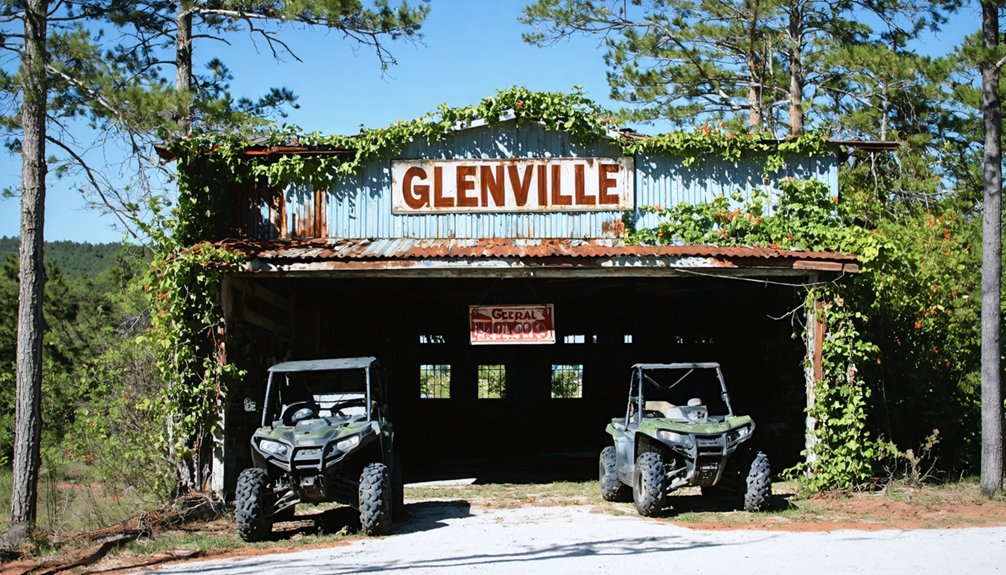
Before you fire up your ATV and head toward Delaware’s forgotten settlements, proper safety gear transforms a risky adventure into an exhilarating exploration.
Delaware’s safety regulations mandate specific equipment that’ll keep you protected while maneuvering crumbling foundations and overgrown trails.
Essential gear includes:
Master off road techniques like reading terrain changes and maintaining proper speed through loose gravel.
Never ride alone when exploring remote ghost town sites. Your protective clothing and neck brace aren’t just accessories—they’re your ticket to discovering Delaware’s hidden history safely.
Trail Conditions and Seasonal Access Considerations
While Delaware’s ghost town trails beckon year-round, timing your expedition can mean the difference between traversing smooth sandy paths and wrestling through muddy quagmires.
You’ll find Eagle Road Bypass and other tech rating 1 routes accessible across all seasons, offering consistent 2.2-mile stretches of manageable sand and light obstacles.
However, seasonal challenges emerge with conservation closures in Pine Barrens areas and habitat preservation restrictions that’ll block your favorite routes unexpectedly.
Summer seasons typically run from Memorial Day’s Friday through September’s final weekend, while winter access opens post-deer season until April 1st.
Trail maintenance schedules at Tidbury Creek Park and state forest management practices directly impact your ride quality, so you’ll want to check current conditions before heading out to those Friendship Ruins.
Respecting Historical Sites During ATV Adventures
Though Delaware’s ghost towns hold centuries of enchanting history, you’ll need to navigate strict legal boundaries that protect these fragile remnants from ATV damage.
Historical preservation takes precedence, with OHVs banned on all public property where most ghost town sites exist.
Your approach requires strategic planning to minimize environmental impact:
Dawn-to-dusk restrictions apply in public-adjacent areas, while spark arresters prevent fire risks around weathered structures.
You’re free to explore, but compliance with zoning codes and local ordinances protects these irreplaceable historical treasures for future adventurers.
Frequently Asked Questions
Do I Need Special Permits to Ride ATVS on Delaware Ghost Town Trails?
Picture dusty trails leading to forgotten ruins—you’ll need ATV registration with Delaware’s Department of Conservation plus mandatory liability insurance. Check specific permit requirements and trail regulations with local park authorities before exploring.
Are There Guided ATV Tours Available for Delaware’s Abandoned Settlements?
No guided tours exist for Delaware’s abandoned settlements by ATV. You’ll need to arrange private local guides or explore independently, as current guided tours focus on walking ghost tours rather than off-road adventures.
What Are the Penalties for Damaging Historical Artifacts at Ghost Town Sites?
You’ll face state-managed fines and access restrictions for damaging artifacts at ghost towns. Artifact preservation laws protect these sites’ historical significance, so respect boundaries and stick to designated trails when exploring Delaware’s abandoned settlements.
Moreover, you might stumble upon intriguing remnants of history as you traverse abandoned places in Delaware. Each site tells a unique story of the past, offering a glimpse into the lives that once thrived there. Remember to take only photographs and leave only footprints to ensure these locations remain preserved for future exploration.
Can I Camp Overnight Near These Ghost Towns During Multi-Day ATV Trips?
Picture starlit nights beside forgotten ruins—you’ll find primitive camping at Lower Forge near Friendship Ruins, but camping regulations require checking with authorities first for proper overnight accommodations during your multi-day ghost town adventures.
Are There Age Restrictions for ATV Riders Exploring Delaware’s Historical Sites?
Yes, Delaware’s ATV safety laws enforce strict age requirements for historical exploration. You must be 12+ for unsupervised riding, wear helmets if under 18, and follow manufacturer guidelines for engine size restrictions.