You’ll find Kansas’s most accessible ghost towns by exploring the northeast lakes region on ATV trails. Perry Lake‘s 140-acre system reveals stone foundations and submerged church steps from lost settlements, while Tuttle Creek’s 310 acres crosses terrain where Irving once thrived. Council Grove Lake’s wooded trails connect directly to Santa Fe Trail historic sites, and the Big Blue River system links multiple abandoned towns like Barrett and Bigelow through 250 miles of scenic routes that unveil countless hidden stories.
Key Takeaways
- Perry Lake ATV Trails offer 15 miles through historic ghost town remnants with stone foundations and fence posts.
- Tuttle Creek ORV Area provides 310 acres of terrain that once bordered the lost town of Irving.
- Council Grove Lake ORV Area features five miles of trails connecting directly to Santa Fe National Historic Trail sites.
- Big Blue River Trail System links multiple ghost towns including Irving, Bigelow, and Barrett along 250 miles.
- Prairie Spirit Trail provides gateway access to nearby ghost towns like Barryton and Swiss Veil for ATV exploration.
Perry Lake ATV Trails and Historic Ghost Town Remnants
When you fire up your ATV at Perry Lake‘s sprawling 140-acre trail system, you’re not just starting on 15 miles of challenging terrain—you’re riding through layers of Kansas history where abandoned settlements once thrived along these now-quiet ridgelines.
Ride through Kansas history where ATV trails cross forgotten settlements and abandoned homesteads beneath Perry Lake’s sprawling terrain.
The Corps of Engineers land beneath your wheels holds secrets of forgotten communities that vanished when the 12,500-acre reservoir flooded their valleys in the 1960s.
Your machine tackles moderate-to-difficult sections while you navigate past stone foundations and weathered fence posts—ghostly remnants of homesteads and farming communities.
The single-tier stacked loop design lets you explore ATV History through four distinct sections, each revealing different chapters of Perry Lake’s submerged past. Local riders have documented their experiences through ridelog scans, creating a valuable database of trail conditions and historical discoveries over recent seasons.
Beyond the main trails, experienced riders can venture onto gravel roads like those found throughout Kansas that connect to nearby conservation areas and offer additional exploration opportunities.
You’ll discover freedom riding where families once built dreams before progress claimed their land.
Tuttle Creek ORV Area and the Lost Town of Irving
As you navigate the 310 acres of Tuttle Creek ORV Area southeast of Randolph, your ATV carries you across terrain that once bordered the bustling farm community of Irving—a town that disappeared beneath the reservoir’s waters when Tuttle Creek Lake rose in the 1950s.
Today’s trails offer you unrestricted access to explore this haunting piece of Irving history. You’ll find steep climbs and rugged terrain maintained by the Flint Hills Jeep Club, with connections stretching throughout the region. The varied terrains provide suitable challenges for different skill levels, from muddy water crossings to rocky obstacles.
Essential features for your ghost town expedition:
- All motorized vehicles welcome year-round from 9 a.m. to sunset
- Free access with loading ramps and facilities at entrance parking
- Trail connections linking Irving Marsh to surrounding Tuttle Creek wildlife areas
Your exploration requires DoT-approved helmets for safety while riding through this primitive area with minimal maintenance. Your wheels trace paths where families once walked, carrying you through Kansas’s submerged past.
Council Grove Lake ORV Area Gateway to Historic Sites
Below Council Grove Dam, the 30-acre ORV area managed by the US Army Corps of Engineers offers your ATV a unique launching point into Kansas’s rich frontier heritage.
You’ll navigate five miles of wooded trails across old riverbed terrain, where hardpack surfaces and loose dirt create perfect conditions for beginners and intermediates seeking adventure.
The flat routes weave through trees toward marked obstacles including mud bogs and water crossings.
What sets Council Grove apart is its historic significance – you’re riding gateway trails that connect directly to the Santa Fe National Historic Trail sites and Council Grove’s historic district.
These fee-free paths let you explore both natural terrain and cultural landmarks, making each ride a journey through time where frontier history meets modern off-road freedom. The area receives minimal maintenance from the Corps of Engineers, preserving its natural character while ensuring basic trail accessibility.
A staging area provides riders with a designated preparation zone before heading out on the trails.
Santa Fe Trail Cycle Park Near Carbondale Ghost Town
You’ll find rugged trails winding through prairie grasslands and limestone outcroppings that mirror the challenging terrain early Santa Fe Trail travelers once navigated on foot and wagon.
The cycle park’s elevated ridges offer commanding views of the surrounding Osage County landscape, where Carbondale’s coal mining operations once dominated the horizon with towering headframes and bustling activity.
As you navigate the park’s interconnected trail system, you’re riding through the same geographic corridor that witnessed both westward expansion and the industrial boom that built Carbondale into a thriving mining community. The rolling prairie terrain connects to other historic settlements like Diamond Springs, which served as a Santa Fe Trail stop before Confederate attacks forced its abandonment in 1863. The Atchison, Topeka & Santa Fe Railroad reached this area in 1869, fundamentally transforming the transportation landscape that had relied on wagon trails for decades.
Trail Features and Terrain
When you roll into Santa Fe Trail Cycle Park‘s 100 acres near the Carbondale ghost town, you’ll discover a rider’s playground that seamlessly blends natural Kansas terrain with purpose-built challenges.
The park’s trail accessibility accommodates both ATVs and dirt bikes across diverse landscapes that’ll test your skills without overwhelming beginners.
You’ll navigate narrow wooded paths that demand precision, then power through steep hill climbs that challenge even experienced riders. The terrain challenges shift from dense forest sections to open areas where you can open up the throttle.
Key trail highlights include:
- Motocross track: One mile of purpose-built jumps and technical features
- Natural terrain loop: 0.75-mile course following Kansas’s rolling topography
- Practice areas: Dedicated spaces for honing skills before tackling advanced sections
From dawn to dusk, you’ll find terrain suited for every skill level. The park operates with no maximum engine size restrictions, allowing riders to bring their most powerful machines to tackle the challenging terrain.
Historic Carbondale Connection
While modern riders tear through Santa Fe Trail Cycle Park‘s purpose-built tracks, they’re exploring terrain steeped in Kansas’s frontier history, just miles from where Carbondale emerged as a bustling coal mining hub in 1869.
You’ll discover Carbondale Heritage markers dotting the landscape, remnants of when fifty coal operations surrounded this railroad town. The Atchison, Topeka & Santa Fe Railroad’s arrival sparked rapid growth, transforming wilderness into a thriving community of miners and merchants. The town officially incorporated as a third-class city on October 15, 1872, with CC Moore serving as its first mayor.
Today’s ATV adventures connect you to this Mining Legacy through preserved trails and historical markers.
You can explore where the original Santa Fe Trail crossed Osage County, linking past and present through shared paths of adventure and discovery across Kansas’s rugged terrain.
Cooper Creek ATV Area Access to Regional Historic Areas
Nestled just across the Missouri border from Kansas, Cooper Creek ATV Area serves as your gateway to exploring the ghost towns and abandoned settlements that dot the landscape around Harry S. Truman Reservoir.
This 400-acre riding paradise puts you within striking distance of forgotten communities scattered throughout the region’s rolling hills.
Your Cooper Creek adventure begins one mile east of Deepwater, where you’ll find:
Adventure awaits just one mile east of Deepwater, where trails beckon explorers toward Missouri’s forgotten historical treasures.
- Free access to trails leading toward historic exploration sites
- Rolling terrain perfect for discovering remote settlement remnants
- Strategic location overlooking western shores of Truman Reservoir
The Corps-managed area’s extensive trail network connects you to backcountry routes where old homesteads and abandoned structures await discovery.
You’ll navigate through scattered mud pits and wooded paths that once served as lifelines for vanished communities throughout this historically rich corner of Missouri.
Sumner County Forgotten Towns: Riverdale and Belle Plaine
You’ll find Riverdale’s scattered remnants eight miles north of Wellington, where overgrown structures mark what was once a thriving railroad junction town that peaked at 240 residents in 1910.
The old railroad traces still cut through the landscape, guiding you toward Belle Plaine’s ghost town remains that were devastated by catastrophic flooding in 1923.
Both forgotten Sumner County settlements offer ATV riders a chance to explore Kansas history, though Belle Plaine’s mineral springs legacy contrasts sharply with Riverdale’s railroad-dependent past.
Riverdale’s Historic Remnants
As you navigate the overgrown terrain where Riverdale once thrived in Sumner County, you’ll discover a landscape that tells the story of Kansas’s forgotten railroad communities through scattered remnants and natural landmarks.
Your ghost town exploration reveals fascinating Riverdale remnants that paint a picture of this lost settlement’s past:
- Natural springs that once powered a bottled water business shipping to Kansas and Oklahoma
- Visible railroad bed traces marking the northwest junction from the 1902 town layout
- Abandoned brick structures standing precariously among fire-hazardous vegetation
You’ll find these crumbling foundations and overgrown ruins tell the tale of a community that operated from 1887 until its post office closed in 1973.
The springs that attracted original settlers from South Haven, Michigan, still mark where commerce once flourished before railroad abandonment sealed Riverdale’s fate.
Belle Plaine Access
Just thirteen miles northeast of Riverdale’s abandoned springs, Belle Plaine stands as Sumner County’s oldest surviving city, offering a stark contrast to the ghost town you’ve just explored. Founded in 1871 by the Hamilton brothers and fellow pioneers, this valley settlement between the Arkansas and Ninnescah Rivers represents what permanence looks like in Kansas frontier country.
Belle Plaine history reveals settlers from across America and Europe who built something lasting.
Belle Plaine infrastructure began with David Richards’ ferry operation, the county’s first river crossing. Your ATV can navigate the rural roads leading to this historic community, where you’ll discover how geography and determination created survival while neighboring settlements faded into prairie grass.
The valley location that attracted those original settlers still defines this enduring Kansas town.
Big Blue River Trail System Connecting Historic Settlements
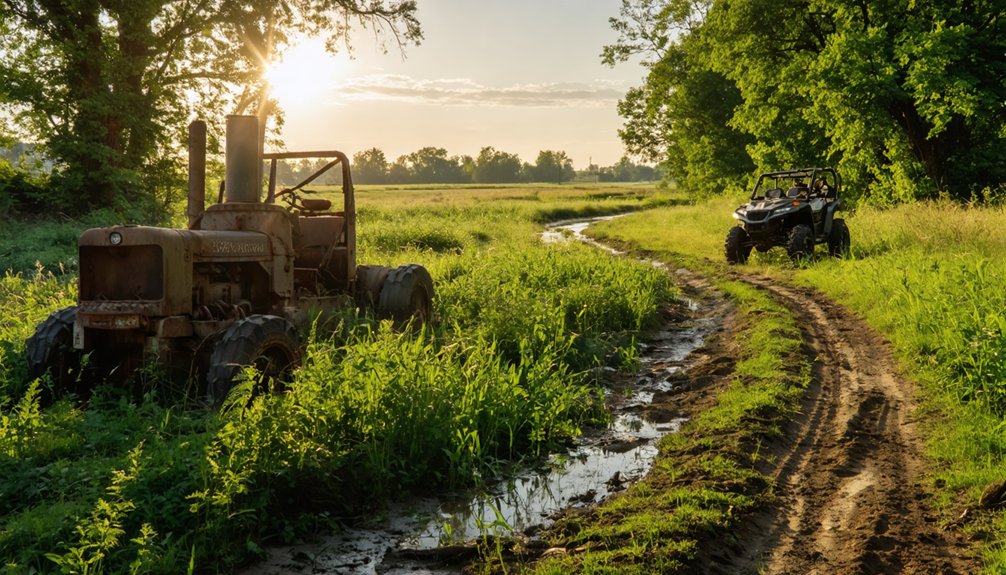
The Big Blue River‘s 250-mile journey from Nebraska through northeastern Kansas creates a natural corridor that links some of the region’s most fascinating ghost towns, making it an ideal route for ATV exploration.
You’ll discover remnants of Historic Settlements that once thrived along this principal waterway, where the Kanza tribe camped and Oregon Trail pioneers crossed.
The Blue River Rail Trail offers exceptional Trail Accessibility for off-road vehicles, connecting multiple Ghost Towns while preserving Cultural Heritage.
Your adventure includes:
- Irving – Submerged town with population over 400, now beneath Tuttle Creek Lake
- Bigelow – Stone markers mark this vanished Marshall County settlement
- Barrett – Cemetery remnants tell stories of early settlers
Eight historic River Crossings near Marysville carried 75,000 Oregon Trail travelers, creating the foundation for today’s ghost town discoveries.
Northeast Kansas Lakes Region Ghost Town Network
You’ll find Northeast Kansas’s lakes region offers a unique network of ghost town sites where water access meets forgotten history.
Among these intriguing locations are the underwater ghost towns in Kansas, remnants of communities that once thrived before being submerged. As the waters ebb and flow, glimpses of the past can be seen, enticing those with a sense of adventure and curiosity. Exploring these submerged histories offers a haunting yet captivating experience for both locals and visitors alike.
Perry Lake’s shoreline holds remnants of Franklin and other Douglas County settlements, while Tuttle Creek’s waters have claimed much of Irving’s original footprint, leaving only stone markers accessible via Marshall County’s gravel roads.
These interconnected waterways create natural corridors between abandoned sites, though you’ll need landowner permission since dedicated ATV trails don’t officially connect these historic locations.
Perry Lake Historic Remnants
When Perry Dam’s floodgates closed in 1966, they didn’t just create Kansas’s third-largest lake—they submerged an entire community beneath 11,000 acres of water.
The original town of Ozawkie vanished forever, leaving only ghostly remnants for determined explorers.
Your ATV can access these haunting traces along Perry Lake’s 160 miles of shoreline.
Lake exploration reveals fragments of a lost world, where historic preservation meets underwater archaeology:
- Old stone church steps emerge near the shoreline during low water periods
- Submerged townsite foundations become visible through clear lake water
- Upland forest trails in Slough Creek Public Use Area preserve pre-reservoir landscape features
You’ll find multiple entry points from Jefferson County’s trail network, connecting you to this drowned community’s story while experiencing true off-road freedom.
Tuttle Creek Irving Access
Hidden beneath towering cottonwoods along the Big Blue River, Irving’s ghost town streets still echo with memories of the 1879 tornado that claimed nineteen lives and inspired Dorothy’s journey to Oz.
You’ll find this Marshall County settlement six miles southeast of Blue Rapids, where Irving history began in 1859 before Tuttle Creek Dam construction doomed it in 1960.
The Big Blue River Route delivers 35.2 miles of adventure through gravel roads and water crossings, perfect for your ATV or high-clearance 4×4.
Ghost town accessibility remains excellent—you can walk the original street grid, explore building foundations, and sign the visitor notebook at the stone marker.
The makeshift park at Zenith and 12th Roads offers picnic spots where former residents still gather annually.
Trail Network Connections
While modern trail networks weave through northeast Kansas’s ghost town territory, the Prairie Spirit Trail serves as your primary gateway to exploring abandoned settlements across three counties.
You’ll discover that trail history intersects perfectly with ghost town exploration along this 53-mile corridor spanning Allen, Anderson, and Franklin counties.
The network opens up incredible opportunities for your adventures:
- Prairie Spirit Trail connects Ottawa to Iola, providing direct access to nearby ghost towns like Barryton and Swiss Veil
- Flint Hills Trail stretches 118 miles from Osawatomie to Herington, intersecting with Prairie Spirit near Ottawa
- Nature trails follow abandoned railroad lines through actual ghost town sites
You can combine rail-trail cycling with ATV exploration, using established paths as staging areas for deeper backcountry ghost town hunting throughout the northeast lakes region.
Quindaro and Lecompton Historic Sites via ATV Routes
Although Quindaro’s dramatic bluffs overlooking the Missouri River hold stories of Underground Railroad courage and Civil War-era abandonment, you can’t ride your ATV directly to these haunting ruins.
The National Historic Landmark restricts access to guided walking tours only, protecting the deteriorating foundations where 1,000+ residents once defied slavery’s reach.
Lecompton politics from the territorial era created another historically significant site, but it lacks accessible ghost town features via ATV routes.
You’ll find the nearest ATV action at Riverside ATV Park in Topeka—150 acres of open fields and wooded trails with no fees.
While these sites preserve vital freedom-fighting history, their archaeological importance means your machine stays parked.
The stories live on through guided exploration instead.
Shoal Creek Living History Museum and Surrounding Trails
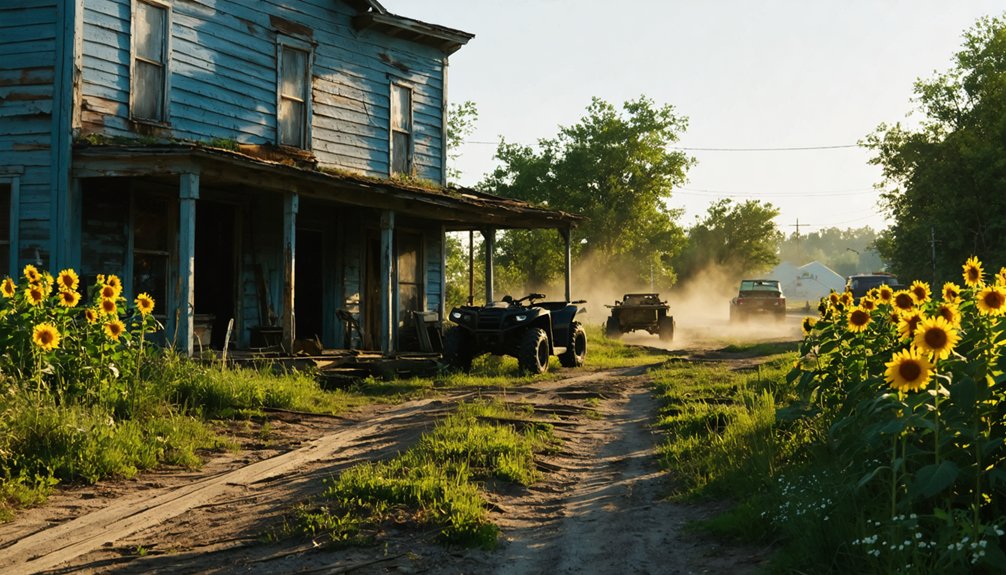
Moving beyond Kansas’s restricted historic sites, you’ll discover that Missouri’s Shoal Creek Living History Museum offers a different approach to exploring the past—though your ATV will face similar limitations here.
Located in Hodge Park near Kansas City, this 80-acre museum houses twenty-one historical structures dating from 1807-1885.
While you can’t ride ATVs through the museum itself, the surrounding 1,000-acre Hodge Park provides wooded trails for exploration.
The museum’s authentic buildings create an immersive experience:
- Relocated log cabins and homes from surrounding counties
- Original grist mill, schoolhouse, and church structures
- Mercantile building showcasing 19th-century commerce
You’ll find free self-guided tours available daily from dawn to sunset, with detailed maps at multiple locations throughout the grounds.
Frequently Asked Questions
What Safety Gear Is Required When Riding ATVS to Ghost Town Sites?
You’ll need quality helmet regulations compliance, protective clothing covering arms and legs, sturdy gloves and boots, plus goggles shielding your eyes from debris while exploring those forgotten places where freedom calls.
Are Guided Tours Available for Ghost Town Exploration via ATV?
You won’t find guided exploration operators combining ATVs with ghost town tours in Kansas. Instead, you’ll create your own adventure using self-guided routes like Big Blue River’s 35-mile trail through Irving and Cleburne.
What Is the Best Time of Year to Visit Ghost Towns?
Spring and fall offer the best seasons for your ghost town adventures. You’ll enjoy mild weather considerations like comfortable 50-70°F temperatures, fewer crowds, and ideal trail conditions without summer’s heat or winter’s dangers.
Can I Metal Detect or Collect Artifacts at Ghost Town Sites?
You can’t metal detect or collect artifacts at ghost town sites without proper permits. Metal detecting regulations protect these historical locations, and artifact preservation ethics demand we leave discoveries untouched for future generations to appreciate.
Are There Age Restrictions for ATV Riders Accessing These Areas?
Yes, youth regulations apply when you’re accessing ghost towns on public land. Riders under 16 need adult supervision, while those 8-15 must have safety certificates. Rider licenses aren’t required on private property though.
References
- https://www.nwk.usace.army.mil/Locations/District-Lakes/Harry-S-Truman-Lake/ATV-Dirt-Bike-Area/
- https://www.travelks.com/blog/stories/post/kansas-off-roading-jeep-and-orv-trails/
- https://www.drrusa.com/post/places-to-ride-atvs-in-kansas
- https://www.kcur.org/arts-life/2022-04-09/ghost-towns-are-all-around-kansas-city-if-you-know-where-to-look
- https://www.youtube.com/watch?v=OyBXD18P_j4
- https://www.onxmaps.com/offroad/dirt-bike-trails-near-me/carbondale-ks
- https://www.tripadvisor.com/Attractions-g28937-Activities-c47-t14-Kansas.html
- https://www.trailforks.com/region/perry-lake-state-park/map/
- https://www.onxmaps.com/offroad/beginner-offroad-trails-near-me/perry-ks
- https://www.nwk.usace.army.mil/Locations/District-Lakes/Perry-Lake/Trails/ATV-Trail/