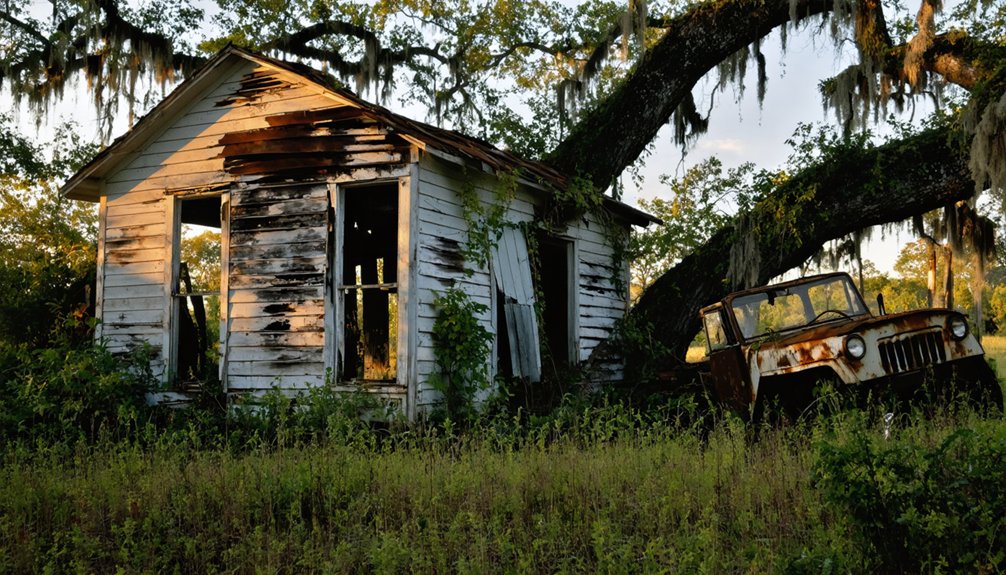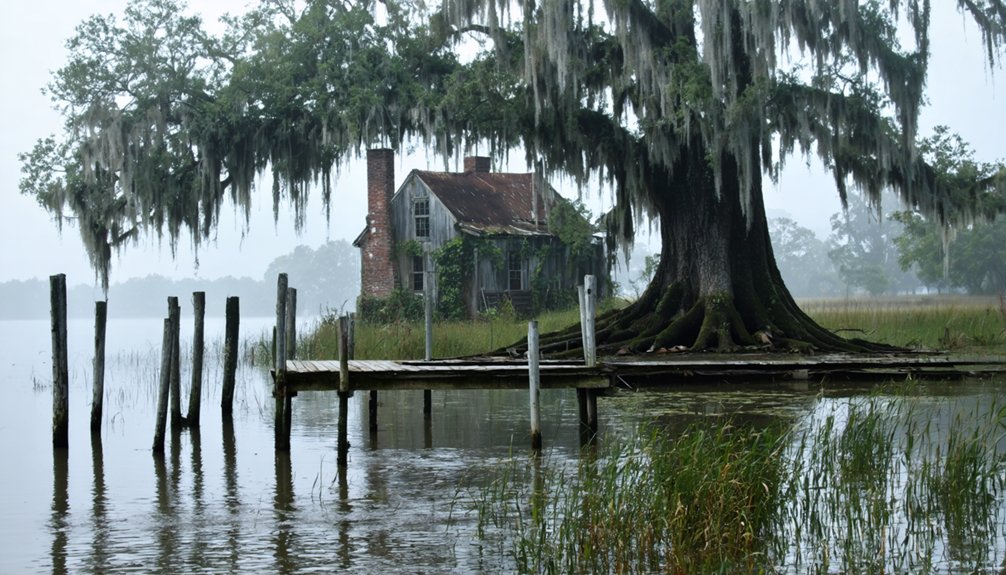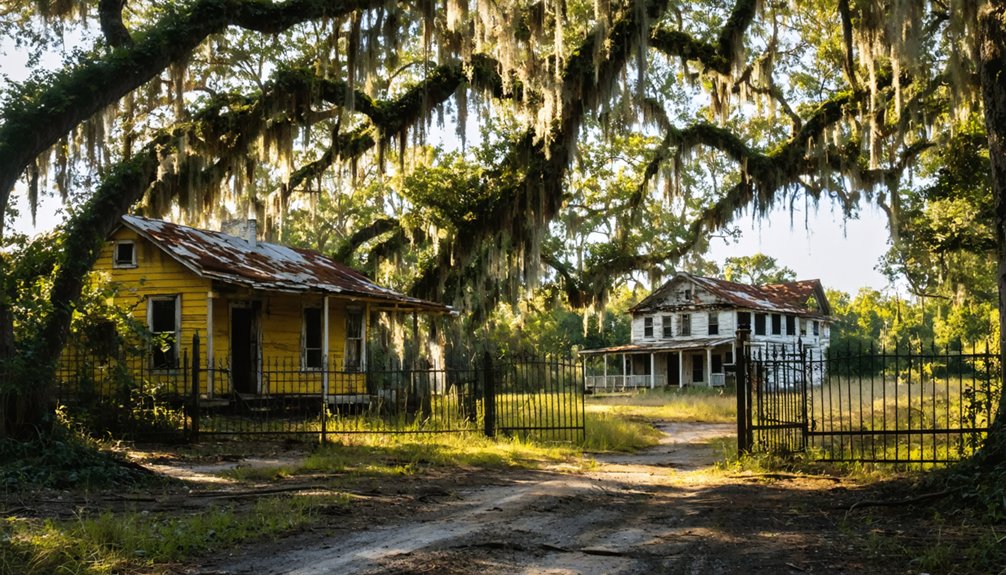
You’ll discover Louisiana’s most haunting ghost towns scattered across 600,000 acres of accessible swampland, where your ATV can navigate muddy trails through Frenier’s voodoo-cursed ruins near Lake Pontchartrain, explore Ruddock’s hurricane-devastated remains visible above dark waters, and ride forgotten paths to Laurel Valley’s crumbling sugar plantation with 76 surviving structures. From Kisatchie National Forest’s 70-mile trail system to High Lifter’s challenging terrain, these forgotten settlements tell stories of tragedy and abandonment that await your exploration.
Key Takeaways
- Frenier Ghost Town offers ATV trails through Manchac Swamp with access to Julia Brown’s grave and hurricane remnants.
- Kisatchie National Forest provides 600,000 acres with multiple trail loops connecting various ghost town sites throughout Louisiana.
- High Lifter Proving Grounds features 600 acres of challenging muddy trails located 14 miles southwest of Shreveport.
- Claiborne Multiple-Use Trails offer over 70 miles of exploration through historic sites within Kisatchie National Forest.
- Creek Side Trail connects routes to Northshore ruins, providing access to additional ghost town locations.
Ruddock Ghost Town: Swamp Access Adventures
Deep in the Louisiana swamplands where cypress trees stretch toward gray skies, Ruddock Ghost Town lies submerged beneath dark waters that claimed an entire community over a century ago.
While you can’t directly ATV to this haunting site, you’ll stage your adventure from Exit 7 on I-55, then switch to airboat or shallow-draft vessel to reach the remains.
Ruddock history tells of German settlers who built a thriving cypress lumber town that housed 700 residents by 1910.
The 1915 Category 4 hurricane obliterated everything, killing nearly everyone.
Today, concrete blocks and rotting pilings emerge from tea-colored water like skeletal fingers.
The site remains overgrown with vegetation, where remnants of rotted wood from buildings still mark the boundaries of what once was a thriving community.
Local swamp folklore whispers of the Rougarou stalking these waters, while divers still unearth artifacts from the tragedy that transformed a bustling community into Louisiana’s most haunting aquatic ghost town. These forgotten places connect travelers to stories of resilience and ruin that reveal Louisiana’s true essence.
Frenier Ghost Town: Voodoo Legends and Lake Pontchartrain Trails
Where else can you chase legends of voodoo curses while traversing ATV trails along Lake Pontchartrain’s haunted shores?
Frenier legends draw riders to this vanished town where Julia Brown once sang her prophetic warnings. Your machine cuts through Manchac Swamp terrain where a Category 4 hurricane obliterated everything in 1915, just as the voodoo priestess predicted.
Navigate these four haunting remnants:
- Julia’s isolated grave – 100 yards from the mass burial site
- Cabin foundations – Hidden beneath cypress roots and Spanish moss
- Railroad remnants – Twisted steel from the town’s lifeline
- Hurricane scars – Cypress stumps marking the storm surge line
You’ll ride where 300 souls perished, following muddy paths through America’s most mystical swampland. The 22.80-mile bridge spanning Manchac Swamp provides easy access to this legendary ghost town destination.
Local guides whisper you can still hear Julia’s guitar echoing across these dark waters. The cemetery exists as a mass grave with no burial records, accessible only through specialized swamp tours that reveal the town’s tragic secrets.
Taft Ghost Town: Industrial Ruins and River Road Routes
Industrial giants tower over Louisiana’s most unusual ghost town, where Taft’s vanished community lies buried beneath America’s heaviest concentration of chemical facilities.
You’ll navigate your ATV through Dow’s sprawling complex, where pipelines snake around the lone survivor—Our Lady of the Most Holy Rosary Cemetery. This active burial ground stands defiant amid towering reactors, preserving memories of sugar plantations and dairy farms that flourished here until the 1960s.
Your industrial exploration reveals stark contrasts between corporate power and cemetery preservation. Founded in 1866, the original church relocated to Hahnville, but parishioners refused to abandon their ancestors. Taft reflects the broader pattern of Louisiana’s seventeen ghost towns, each marking where thriving communities once stood before economic decline. The 2000 Census recorded Taft’s population as zero, officially confirming what industrial development had already accomplished.
You’ll access this surreal landscape via River Road routes, where levees and overgrown agricultural plots create challenging trails through Louisiana’s most industrialized ghost town.
Laurel Valley Sugar Plantation: Movie Set Ruins Along Forgotten River Road
Although Hollywood cameras haven’t rolled here in decades, Laurel Valley’s crumbling sugar mill and weathered worker cabins still evoke the cinematic decay that once drew filmmakers to this forgotten stretch of Highway 308.
You’ll discover remnants of Louisiana’s largest surviving sugar plantation village, where 76 structures tell stories of boom and decline.
Your ATV can navigate the rural roads leading to this atmospheric movie set, where guided tours reveal:
- Original 1906 village store displaying antique cane harvesting tools
- Massive sugar mill ruins that processed crops from 5,000 acres
- 60 surviving worker houses creating an authentic ghost town atmosphere
- Fifteen miles of abandoned railroad tracks once linking fields to mill
The mosaic disease that devastated crops in the 1920s transformed prosperity into haunting preservation. Local residents and visitors report strange noises throughout the abandoned structures, adding to the plantation’s eerie reputation. The site preserves evidence of Acadian heritage dating back to 1785 when French Cajun settlers first recognized this land’s agricultural potential.
Burrwood Ghost Town: Delta Exploration Challenges
Beyond the reach of your ATV’s treads lies Burrwood, a ghost town that surrenders its secrets only to the relentless Gulf waters that claimed it.
Once home to 1,000 souls and a World War II naval base defending against German U-boats, this Mississippi River Delta settlement met its match against nature’s unstoppable advance. Coastal erosion devoured heavy-duty docks that once harbored destroyers and patrol craft, while subsidence pulled the last house beneath the waves in 2010.
You can’t ride trails to Burrwood remnants—they’re submerged in open marsh waters accessible only by boat.
Sun-bleached pilings emerge like tombstones from the wetlands, marking where a thriving community once defied the delta’s shifting moods until Hurricane Betsy and rising seas claimed their final victory. The town also endured Hurricane Katrina in 2005, which surpassed Betsy as the region’s most devastating storm. Today, only a ship pilots station remains operational in the area where Burrwood once stood.
Bogue Chitto ATV Park: Gateway to Northshore Ghost Sites
Where Silver Creek carves through Louisiana’s Northshore pine forests, Bogue Chitto ATV Park opens your gateway to forgotten settlements that timber barons and river traders left behind.
You’ll find trails winding beyond the park’s mud holes into Washington Parish’s forested uplands, where ghost communities hide among towering pines.
Your adventure starts at the Mount Hermon facility, where ATV safety requirements guarantee you’re prepared for backcountry exploration.
The park’s position near Franklinton creates access to:
- Abandoned logging camps from early 1900s timber booms
- Remnants of river settlements along forgotten waterways
- Ghost hamlets depopulated after industry decline
- Historic rural sites scattered throughout rolling terrain
Creek Side trail offers natural beauty while connecting you to routes leading toward these faded Northshore ruins, where freedom-seekers discover Louisiana’s hidden history.
High Lifter and Cooterville: Mud Riding Near Historic Locations
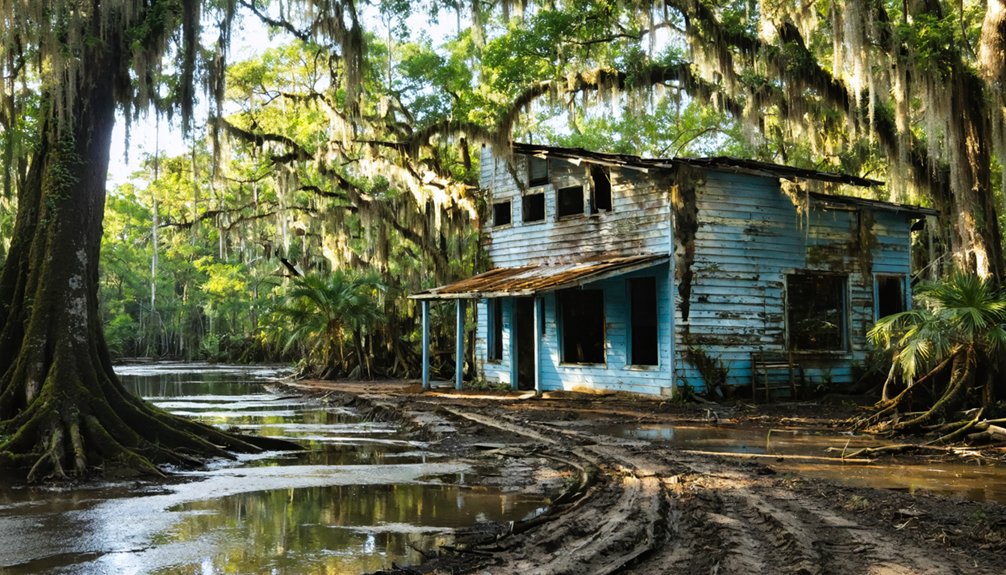
Fourteen miles southwest of Shreveport, High Lifter Proving Grounds transforms 600 acres of northwest Louisiana wilderness into mud-slinging paradise, where your ATV adventures intersect with Caddo Parish’s forgotten history.
Where northwest Louisiana wilderness meets forgotten history, 600 acres of muddy trails await your ATV adventure in Caddo Parish.
You’ll navigate dozens of trails threading through deep mudholes and water crossings, while Albany’s ghost town remnants whisper stories from nearby shadows. The man-made lake “Booty Beach” anchors this proving ground where cleared wet and dry trails test your machine’s limits.
Though Cooterville’s historic connections remain elusive in these backwoods, you’re riding through landscapes where sawmill communities once thrived and vanished.
Annual membership ($250 individual, $400 family) grants year-round access to this muddy playground, where primitive camping lets you chase both adrenaline and history under Louisiana stars.
Kisatchie National Forest: Enduro Trails to Sawmill Ghost Towns
Deep within Kisatchie National Forest‘s 600,000 acres, the Claiborne Multiple-Use Trails carve through Louisiana’s largest timber wilderness, where sawmill ghost towns lie scattered among towering longleaf pines like forgotten secrets.
You’ll discover over 70 miles of Kisatchie Trails threading through historic Camp Claiborne, where 500,000 WWII troops once trained. The terrain shifts from upland forests to hardwood bottoms, revealing remnants of Louisiana’s logging era.
Your ghost town hunting strategy:
- North Loop (31 miles) – Penetrates deepest into abandoned sawmill territory
- Boy Scout Loop (30 miles) – Single-track access to remote settlement ruins
- Woodworth Loop (20 miles) – Connects multiple ghost site clusters
- Enduro Racing closures – Check hotline (318)473-7069 before departing
You’ll pay $5 daily for unlimited exploration of these phantom communities.
Planning Your Louisiana Ghost Town ATV Adventure
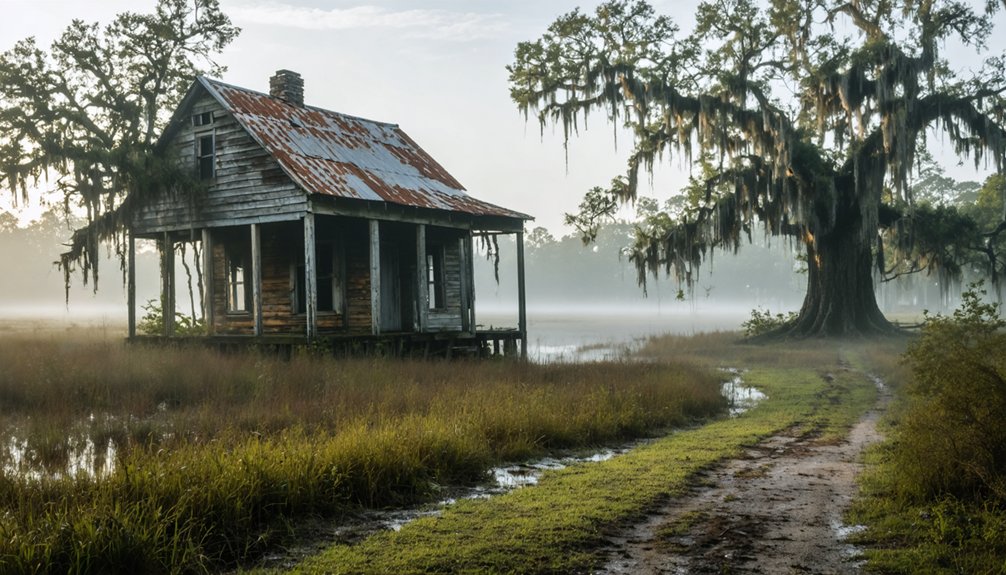
You’ll need to chart your course through Louisiana’s backwoods carefully, marking GPS coordinates for ghost towns like Frenier near Lake Pontchartrain and the abandoned settlement of Bayou Chene in St. Martin Parish.
Your route map should include fuel stops every 20-30 miles, especially when tackling longer trail systems like Claiborne’s 70-mile loops that wind through old WWII sites.
Pack your safety arsenal with water, first aid supplies, and GPS devices since cell towers don’t reach into those pine forests where forgotten sawmill towns wait among the cypress shadows.
Route Mapping Essentials
Several digital mapping resources transform your Louisiana ghost town expedition from wishful wandering into a precisely planned adventure through the state’s forgotten corners.
You’ll navigate abandoned settlements with confidence when proper route mapping guides your wheels through history’s remnants.
Essential tools for trail accessibility and ghost town exploration:
- onX Offroad delivers GPS coordinates for difficulty ratings on routes leading to Frenier’s skeletal trees and broken docks near Lake Pontchartrain.
- Stay The Trail’s interactive maps pinpoint designated OHV sections while avoiding restricted areas around historical sites.
- TrailLink provides real-time conditions for accessing Circle Through the Past’s 1800s cemeteries in Kisatchie.
- RiderPlanet-USA connects 850 acres of motorized trails linking forgotten settlements along Mississippi River routes.
These digital guides guarantee you’ll reach Louisiana’s ghostly destinations safely.
Safety Gear Requirements
While precise steering gets you to Louisiana’s abandoned settlements, protective gear keeps you safe during encounters with the unexpected hazards that haunt these forgotten places. Your Department of Transportation-compliant helmet becomes your first line of defense against low-hanging branches and debris lurking in overgrown pathways.
Eye protection shields you from dust storms kicked up by ancient foundations and flying fragments from crumbling structures.
Don long sleeves, pants, and over-the-ankle boots—these ghost towns don’t forgive exposed skin when you’re traversing through rusty remnants and thorny undergrowth. Padded gloves give you confident grip control when maneuvering around collapsed buildings.
This essential safety gear transforms potential disaster into adventure, ensuring injury prevention while you explore Louisiana’s most remote and mysterious destinations. Freedom requires preparation.
Frequently Asked Questions
What ATV Safety Gear Is Required for Louisiana Ghost Town Exploration?
You’ll need DOT-compliant helmets, eye protection, long sleeves, pants, over-ankle boots, and gloves. Follow ATV maintenance schedules and safety tips before exploring Louisiana’s abandoned settlements where freedom meets adventure.
Are There Camping Facilities Near These Ghost Town ATV Trails?
You’ll discover camping options coincidentally clustered near trailheads—Goldonna’s pavilion camping offers $10 hookups, while Sibley’s official trailhead provides basecamp access. These nearby attractions blend ghost town exploration with convenient overnight stays for freedom-seeking adventurers.
Do I Need Special Permits to Ride ATVS in Louisiana Swamp Areas?
You’ll need ATV permits for Louisiana’s wild swamp territories – a $20 ORV decal plus WMA Access Permit. These Louisiana regulations reveal endless muddy trails through moss-draped cypress cathedrals where adventure awaits.
What’s the Best Time of Year to Visit Louisiana Ghost Towns by ATV?
Like autumn leaves revealing hidden secrets, you’ll find fall and spring are the best seasons for Louisiana ghost town exploration. Weather considerations include cooler temperatures, clearer trails, and ideal visibility through overgrown ruins.
Can I Bring My Dog on ATV Ghost Town Adventures in Louisiana?
You can bring your dog on most Louisiana ATV ghost town adventures. Kisatchie’s dog friendly trails welcome leashed pets, though ATV pet guidelines require six-foot leashes and waste cleanup in these mosquito-laden backwoods.
References
- https://thebayouinsider.substack.com/p/ghost-towns-and-forgotten-roads-louisianas
- https://thumperfab.com/blogs/the-atv-utv-blog-with-thumper-fab/exploring-louisiana-s-best-atv-trails-a-rider-s-guide
- https://etsn.fm/ixp/33/p/7-louisiana-ghost-towns/
- https://www.onxmaps.com/offroad/trails/us/louisiana
- https://en.wikipedia.org/wiki/List_of_ghost_towns_in_Louisiana
- https://byways.explorelouisiana.com/sites/default/files/2021-01/11-Myths_Legends_Tearsheet.pdf
- https://www.tripadvisor.com/Attraction_Review-g40424-d5191178-Reviews-Shreve_Town_Ghost_Walk-Shreveport_Louisiana.html
- https://hnoc.org/publishing/first-draft/julia-brown-curse-hoodoo-hurricanes-and-storm-swamped-ruddock
- https://lobservateur.com/2015/09/30/ruddock-washed-away-100-years-ago/
- https://manchacgreenway.org/ruddock/