You’ll find Maryland’s most accessible ghost town is Daniels in Patapsco Valley State Park, where ATV trails lead directly to mill ruins destroyed by Hurricane Agnes in 1972. Savage River and Potomac-Garrett State Forests offer additional routes to abandoned mining settlements scattered throughout Garrett County’s wilderness. You’ll need a $10 DNR permit and liability insurance for March-December access. These forgotten communities feature crumbling churches, old dams, and textile mill remains that tell compelling stories of Maryland’s industrial past.
Key Takeaways
- Daniels Ghost Town in Patapsco Valley State Park features mill town remnants from 1810, accessible via old Alberton Road trail.
- Maryland offers 40+ miles of designated ATV trails across five major systems, operating March through December annually.
- ATV riders need $10 Maryland DNR Off-Road Permit, liability insurance, registration, and proper documentation for ghost town access.
- Additional abandoned sites include Calverton in Calvert County, Port Tobacco Village, and Harmony Grove mill town ruins.
- Safety requirements include DOT helmets for minors, staying on designated trails, and carrying first aid supplies for emergencies.
Maryland’s ATV Trail Networks and Regulations
When you’re ready to explore Maryland’s rugged backcountry aboard your ATV, you’ll discover an extensive network of state-managed trails that span from the mountainous terrain of Garrett County to the coastal forests of the Eastern Shore.
You’ll find over 40 miles of designated trails across five major systems, including Wolf Den Run’s sprawling 2,039 acres and Savage River’s challenging 54,000-acre wilderness.
Before hitting the trails, you’ll need proper documentation. ATV regulations require annual DNR registration and sticker display on all off-road vehicles.
Annual DNR registration and proper sticker display are mandatory requirements for all ATV riders before accessing Maryland’s trail systems.
You’ll obtain permits online or at DNR offices, with some locations requiring advance reservations.
Trail maintenance schedules affect access—most trails operate March through December, though weather and upkeep can trigger temporary closures that’ll impact your adventure plans. Maryland’s diverse terrain offers scenic views and challenging routes that cater to riders of varying experience levels.
All riders must carry liability insurance along with their registration and lease or rental agreement while exploring Maryland’s designated trail systems.
Daniels Ghost Town: The Crown Jewel of Abandoned Places
Your ATV adventure through Maryland’s trail networks leads to one of the state’s most enchanting destinations: the haunting remains of Daniels, a once-thriving mill town that earned its ghost town status after Tropical Storm Agnes devastated the community in 1972.
Daniels history spans back to 1810 when the Ely family established their textile mill, creating a bustling company town complete with churches, stores, and employee housing. The B&O Railroad arrived in 1831, significantly boosting the town’s economic growth and connectivity.
You’ll discover crumbling stone gothic church remnants, the skeletal Pentecostal Holiness Church, and an old dam that once powered the mill’s operations.
Ghost town exploration here reveals graffiti-covered building fragments and flood-damaged cars scattered throughout the ruins. The town shares its name with numerous other places and references throughout the region, making it part of a broader collection of locations bearing the Daniels designation.
Access this atmospheric destination via old Alberton Road trail in Patapsco Valley State Park, where freedom meets history.
Savage River State Forest Off-Road Vehicle Access
Beyond the haunting remnants of Daniels lies Maryland’s premier off-road destination: Savage River State Forest, where 54,000+ acres of rugged Appalachian terrain await your ATV exploration.
The crown jewel here is Meadow Mountain Trail, a 14-mile route following the Eastern Continental Divide with breathtaking east-west views.
You’ll need to navigate ORV regulations carefully. The 4-mile northern section near I-68 welcomes both licensed vehicles and ATVs year-round, while the remaining 8-10 miles stay closed to motorized traffic.
A $10 Maryland DNR Off-Road Permit gets you access from March 15 to December 15. Don’t forget your spark arrestor—it’s required.
Access this freedom via New Germany Road off I-68, where adventure begins at one of Maryland’s most spectacular riding destinations. The trail originally served for fire control before opening to recreational riders. Winter months transform the trail into a snowmobiling corridor when weather conditions permit.
Potomac-Garrett State Forest Trail System
You’ll find Potomac-Garrett State Forest‘s extensive trail network offers over 80 miles of designated routes, including green-blazed ORV trails like the 8.5-mile Snaggy Mountain Road and the challenging 2.7-mile Backbone Mountain complex.
Before you hit these remote paths searching for Maryland’s forgotten settlements, you’ll need to secure your annual DNR vehicle registration and permit from their headquarters at 1431 Potomac Camp Road in Oakland.
The forest operates under seasonal restrictions that allow snowmobiles from December 15 through March 15, while your ATV or UTV can access these backcountry routes during the remaining months of the year. Special permits also allow travel up to 2 miles on county roads for snowmobiles or ATVs when connecting between trail systems.
The trail system spans various areas including Backbone Mountain, Lostland Run, Wallman Complex, Snaggy Mountain, and Piney Mountain, providing diverse terrain for exploring remote historical sites.
Trail Network Overview
When you’re exploring Maryland’s western frontier, the Potomac-Garrett State Forest Trail System serves as your gateway to abandoned settlements scattered throughout Garrett County’s rugged terrain.
You’ll navigate approximately 10 miles of designated ORV-accessible paths through hard-packed gravel surfaces with gentle elevation changes. The network connects three major systems: Snaggy Mountain’s 8.5-mile easy-to-moderate trails, Backbone Mountain’s 6.7-mile routes, and Laurel Run Road’s 2.4-mile corridor.
Trail maintenance guarantees reliable access to scenic routes year-round, though you’ll encounter stream crossings and standing water depending on conditions. These green-blazed paths wind through areas where forgotten communities once thrived, offering you unrestricted exploration from your ATV seat while sharing trails with hikers and horseback riders seeking the same wilderness freedom.
Similar to Pennsylvania’s trail networks, you’ll find routes with tech ratings ranging from easy to moderate difficulty levels that accommodate various skill levels and ATV capabilities.
Permit Requirements Process
Before you fire up your ATV and head into Maryland’s backcountry ghost towns, you’ll need proper documentation from the Maryland Department of Natural Resources. The permit application requires your personal details, including residence information and ATV specifications like make, model, horsepower, and serial number.
You can complete the registration process through multiple channels: online via DNR’s website, in-person at regional service centers, or by mail to their Annapolis office. For those seeking instant access to their permits, the online Citizen Connect platform provides immediate permit availability upon completion of the application process.
For Potomac-Garrett State Forest access, visit 1431 Potomac Camp Road in Oakland or call 301-334-2038. Your ATV must display the registration sticker and meet noise limits of 84 dB maximum.
Always carry your certificate or rental agreement while exploring. Licensed vehicles registered with MVA are exempt from ORV permits on DNR public lands, giving you immediate trail access.
Seasonal Access Restrictions
Maryland’s Potomac-Garrett State Forest operates on a seasonal rotation that alternates between snowmobile and ATV access throughout the year.
You’ll find trail accessibility shifts dramatically based on these seasonal restrictions. From March 16 through December 14, you’re free to explore designated trails with your two-wheel or four-wheel ATV.
However, December 15 to March 15 transforms the forest into snowmobile territory, blocking your wheeled adventures.
Deer firearms season adds another layer of complexity, temporarily banning snowmobiles while keeping ATV access open.
Some trail segments like Potomac River Trail’s western portions and Garrett Trail’s southern sections maintain year-round wheeled vehicle bans.
You’ll need to plan carefully around these rotating access windows to maximize your ghost town exploration opportunities.
Accessibility Challenges for Ghost Town Exploration
Five major barrier types can transform your ghost town ATV adventure from thrilling exploration into frustrating disappointment across Maryland’s diverse terrain.
Trail navigation becomes critical when tackling Savage River State Forest’s rocky sections or maneuvering through Red Oak Loop’s challenging 2-mile circuit.
Terrain challenges intensify at Rockey Gap State Park, where technical rocky obstacles demand experienced riders only.
Legal restrictions complicate access through permit requirements at Chandler ATV Trail System and seasonal closures affecting Potomac Garrett State Forest from December through March.
Surface conditions create additional hurdles—expect deep puddles without bypass options on Cumberland routes and loose sand mixed with stones on Henson Creek Trail.
Environmental factors like wildlife protection at Indigo Tunnel and ocean risks at Assateague Island further limit your exploration opportunities.
Additional Abandoned Sites Across Maryland Counties
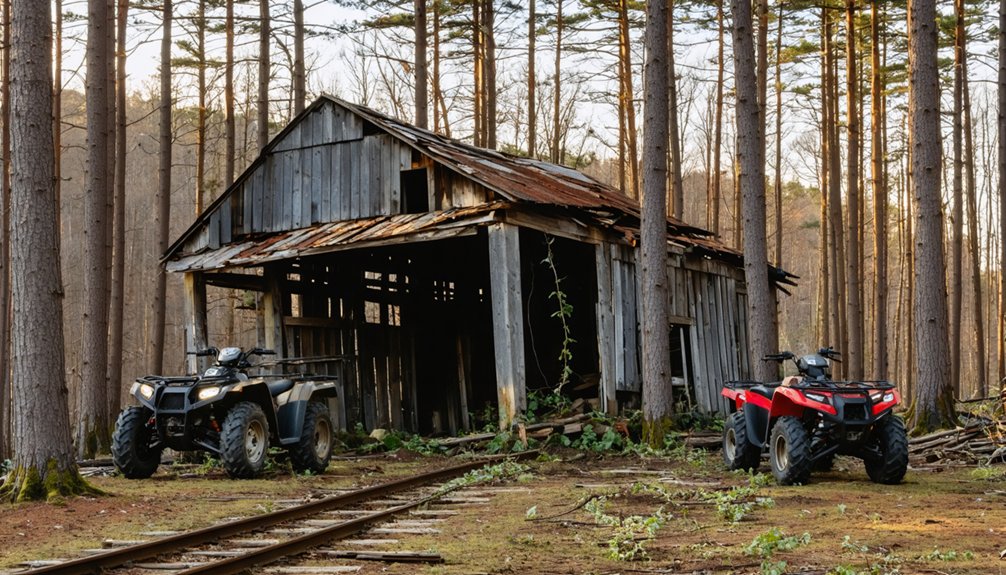
While exploring Maryland’s ghost towns by ATV presents its challenges, discovering the state’s forgotten communities scattered across diverse counties reveals fascinating chapters of American history waiting beneath overgrown trails and crumbling foundations.
Beneath Maryland’s overgrown trails lie forgotten settlements where fascinating chapters of American history await discovery by intrepid explorers.
You’ll find Calvert County‘s completely vanished settlements like Calverton, while Charles County’s Port Tobacco Village showcases dramatic decline from Maryland’s second-largest town to its smallest.
Frederick County offers Harmony Grove‘s demolished mill town ruins and the mysterious, never-rediscovered Monocacy settlement.
Garrett County’s mining communities dot the landscape, and Howard County’s Daniels provides haunting remnants of Hurricane Agnes’s destruction.
Exploration Opportunities:
- Abandoned structures in Howard County’s Daniels reveal 1950s cars and partial church walls
- Historical significance emerges through colonial-era Port Tobacco’s preserved provincial life insights
- Mining heritage connects you to Garrett County’s coal community legacy
Seasonal Restrictions and Permit Requirements
Before you fire up your ATV and head toward Maryland’s abandoned settlements, you’ll need to navigate the state’s complex web of regulations that govern off-road vehicle operation throughout the year.
Your ORV requires annual registration with Maryland DNR, complete with that essential sticker proving you’ve completed the permit application process.
Seasonal usage dictates when and where you can explore – snowmobiles dominate December 15 through March 15, while two-wheel and four-wheel vehicles claim the remaining months.
Department lands demand state registration and inspection before you can chase ghost town legends.
Street-legal ATVs need DMV plates, while unregistered vehicles face hefty $290 fines.
Alternative Routes to Reach Historical Ruins
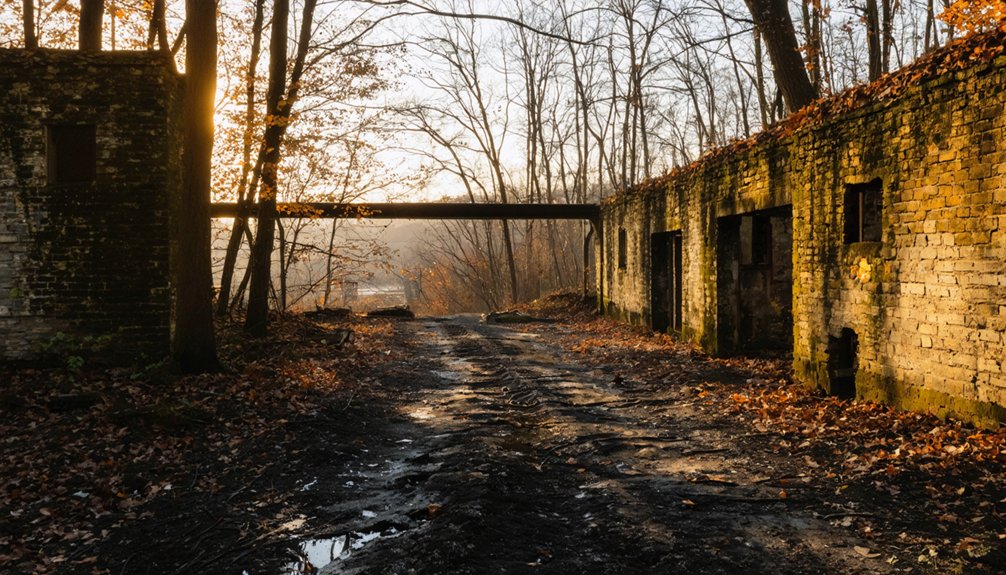
Maryland’s ghost towns aren’t always reachable by standard ATV routes, but resourceful explorers can discover multiple pathways that lead to these haunting historical sites.
Resourceful adventurers can uncover hidden routes to Maryland’s eerie abandoned settlements beyond conventional ATV trails.
You’ll find ghost town accessibility through creative route planning and connecting trail networks across state forests.
Alternative trails for reaching historical ruins:
- River trail connections – Follow Patapsco River trail systems that wind through Daniels Ghost Town, where you’ll spot foundations, rusting vehicles, and cemetery remnants along sandy paths branching into hillside ravines.
- State forest networks – Utilize Savage River and Potomac-Garrett trail systems as staging areas, then branch onto connecting paths that lead toward abandoned settlements and historical markers.
- Multi-use access points – Combine hiking segments with ATV routes through Wolf Den Run’s 2000-acre network, accessing river corridors where old communities once thrived.
Safety Considerations for Off-Road Ghost Town Adventures
Three critical safety zones demand your attention when exploring Maryland’s abandoned settlements by ATV: personal protection, vehicle operation, and emergency preparedness.
Essential safety gear includes DOT-compliant helmets for riders under 18, goggles, long sleeves, sturdy boots, and gloves to shield against debris and falls common in ghost town ruins.
Stick to designated trails only—never venture cross-country or onto paved roads where ATV tires lose grip.
Practice proper trail etiquette by yielding to hikers and controlling speed on turns around crumbling structures.
Travel in groups and inform others of your route, since remote locations delay emergency help.
Pack first aid supplies and communication devices.
Match ATV size to your experience level, and complete required safety training before venturing into these historically rich but potentially hazardous environments.
Frequently Asked Questions
Can I Camp Overnight Near Ghost Towns While ATV Riding in Maryland?
You’ll need overnight permits for state forest camping, but campsite regulations don’t allow camping directly on ORV trails. Maryland’s ghost towns lack nearby ATV-accessible campsites, requiring separate accommodations.
Are Metal Detectors Allowed When Exploring Abandoned Sites via ATV Trails?
Like treasure hunters of old, you can’t use metal detectors on DNR lands due to strict metal detecting regulations. Practice proper abandoned site etiquette by respecting “Leave No Trace” principles and exploring responsibly without disturbing historic remnants.
What Ghost Town Artifacts Are Legal to Collect During ATV Explorations?
You can’t legally collect any ghost town artifacts during ATV explorations due to strict legal restrictions protecting historical resources. Artifact preservation laws prohibit removing anything, but you’re free to photograph and document discoveries.
Do Any Maryland Ghost Towns Have Public Restroom Facilities for ATV Riders?
Don’t expect modern conveniences—Maryland’s ghost towns lack public restroom facilities. You’ll need planning ahead for restroom locations and rider amenities, especially during extended explorations through remote wilderness areas where nature calls.
Are Guided ATV Tours Available for Exploring Maryland’s Abandoned Historical Sites?
No dedicated guided ATV tours explore Maryland’s abandoned historical sites currently exist. You’ll find separate ghost tours and ATV adventures, but no combined experiences highlighting these locations’ historical significance through off-road exploration.
References
- https://www.youtube.com/watch?v=nJzauuAFgr0
- https://www.tripadvisor.com/Attraction_Review-g41131-d10035193-Reviews-Daniels_Ghost_Town-Ellicott_City_Maryland.html
- https://thumperfab.com/blogs/the-atv-utv-blog-with-thumper-fab/exploring-maryland-unforgettable-atv-trails
- https://en.wikipedia.org/wiki/List_of_ghost_towns_in_Maryland
- https://dnr.maryland.gov/forests/pages/orv/trails.aspx
- https://www.onxmaps.com/offroad/blog/ghost-towns-off-roading
- https://visitmontgomery.com/blog/see-do/montgomery-county-mysterious-and-haunted-places-road-trip/
- https://www.prestonpowersports.com/Exploring-Marylands-Best-ATV-Trails
- https://www.drrusa.com/post/places-to-trail-ride-in-maryland
- https://dnr.maryland.gov/publiclands/pages/western/wolf-den-run.aspx