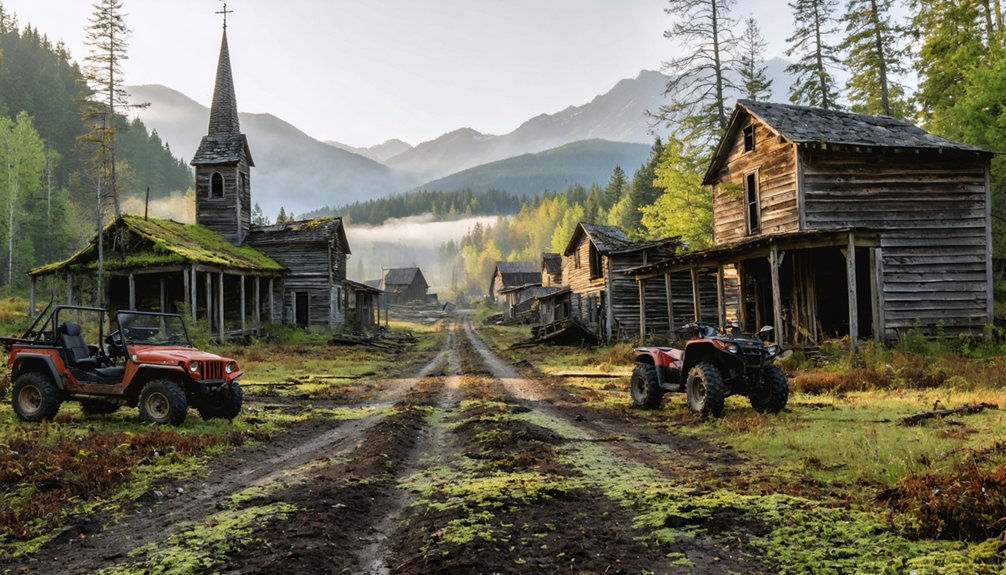
You can reach several authentic ghost towns across New England by ATV, from Massachusetts’ witch-haunted Dogtown with its eerie cellar holes and boulder inscriptions to New Hampshire’s perfectly preserved Monson ruins connected by marked trails. Connecticut’s Gay City offers dark religious history among woolen mill remnants, while Maine’s Swan Island provides shipbuilding ruins accessible via mainland Richmond trails. Each destination requires proper safety gear and terrain awareness for exploring these atmospheric settlements that reveal fascinating stories of community collapse and abandonment.
Key Takeaways
- Dogtown, Massachusetts offers scattered cellar holes from 100 families with eerie remnants and Roger Babson’s 36 inspirational boulder inscriptions.
- Monson, New Hampshire features 200 acres of preserved ruins with marked trails connecting labeled foundations and a museum.
- Gay City, Connecticut provides ten miles of trails exploring mill ruins and stone foundations from a failed religious settlement.
- Swan Island, Maine requires boat access only, with no direct ATV routes available to the ghost town remnants.
- ATV access varies by location with strict regulations; some sites emphasize hiking over motorized vehicle access.
Dogtown Massachusetts: Witch Legends and Haunted Ruins
When you navigate your ATV through the dense woods of Cape Ann, you’ll discover the eerie remnants of Dogtown, Massachusetts—a settlement that thrived from 1693 until its complete abandonment by 1830.
Deep in Cape Ann’s shadowy wilderness lie the haunting ruins of Dogtown—a forgotten settlement abandoned over two centuries ago.
You’ll find scattered cellar holes marking where 100 families once sought inland protection from pirates and Native attacks. The settlement’s witchcraft history centers on Thomazine Younger, the infamous “Queen of the Witches,” who demanded offerings from travelers seeking safe passage.
As you explore the disorienting trails, you’ll encounter Roger Babson’s 36 inspirational boulder inscriptions and the unsettling “toy cemetery.” The terrain presents hazards from old foundations and treacherous cellar holes that may collapse beneath unwary visitors. The remaining cellar holes are now marked by boulders displaying the former house numbers of the original dwellings.
The haunted legends include werewolf sightings and reports of supernatural cackles echoing through these ruins where outcasts once lived among roaming protective dogs.
Monson New Hampshire: Best-Preserved Ghost Town Experience
Unlike most abandoned settlements that leave only mysterious foundations, Monson offers you New Hampshire’s most thoroughly documented ghost town experience, where every cellar hole tells a researched story of the families who called this remote wilderness home from 1730 to 1770.
You’ll explore 200 acres of preserved ruins where families like the Baileys with eleven children and Dr. John Brown once struggled against harsh conditions.
The Monson history reveals how political discord and poor planning forced residents to abandon their dreams, requesting charter revocation before the Revolution.
Thanks to preservation efforts by the Society for Protection of New Hampshire Forests, you can follow marked trails connecting labeled ruins. The restored Gould House now serves as a museum displaying artifacts and genealogical information about the original settlers.
The Bailey house sign details their westward journey with Mormon pioneers, while stone walls and original roads guide your adventure through authentic New England wilderness. The site features a network of trails that leads visitors to at least 6 cellar holes and the historic town pound.
Gay City Connecticut: Religious Zealot Community Gone Wrong
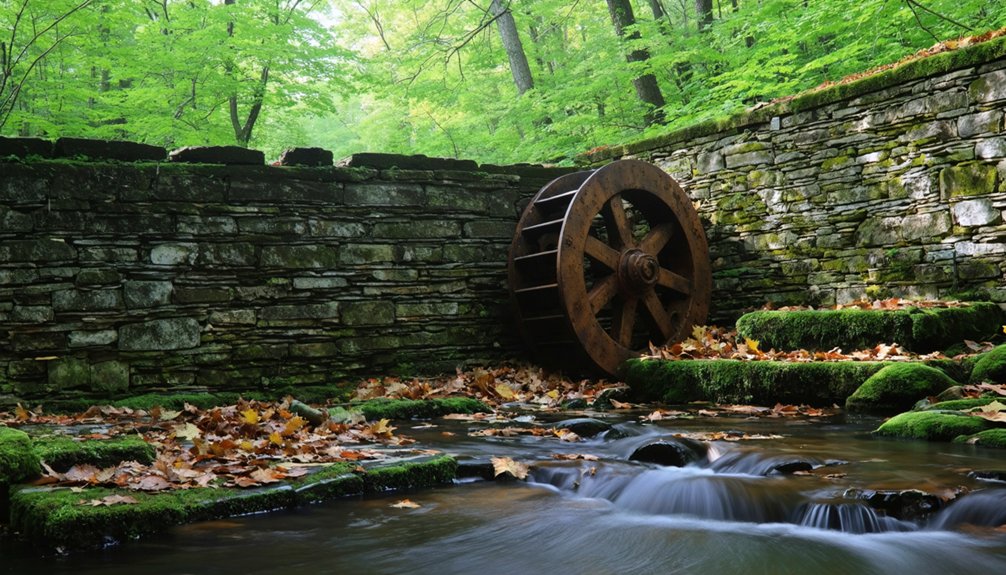
You’ll discover Connecticut’s most notorious failed religious settlement deep in Gay City State Park, where Elijah Andrus’s Methodist community spiraled into chaos through a toxic mix of zealotry and alcohol-fueled worship.
This bizarre 1796 experiment in frontier faith collapsed within decades, leaving behind stone foundations, mill ruins, and chilling murder legends that still haunt the hollow today. The community was originally named after founder John Gay, who established this 18th-century riverside settlement that would eventually become known as Factory Hollow. The woolen mill burned down in 1830, accelerating the community’s final economic collapse.
Navigate the park’s ten miles of trails to explore crumbling cellar holes, canal systems, and cemetery remnants that tell the dark story of how religious extremism destroyed an entire community.
Elijah Andrus Religious Foundation
Deep in Connecticut’s Meshomasic State Forest, the ruins of Gay City mark one of New England’s most notorious religious experiments gone wrong.
You’ll discover the legacy of Elijah Andrus, who led 25 families from Hartford in 1796 seeking religious freedom along the Blackledge River. This persecuted Methodist group, dominated by families bearing the Gay surname, chose this isolated hollow to escape Congregationalist persecution and worship without interference.
Andrus established unique religious practices that included twice-weekly services featuring generous alcohol consumption for “spiritual elevation.”
These controversial rituals served only male members but quickly sparked community tensions among the zealots.
When Andrus mysteriously departed around 1800, his abandonment left behind feuding followers and a fractured community that would struggle with internal conflicts for decades. The settlement’s economy thrived on its Wool Mill operations until the devastating War of 1812 disrupted production. The community faced economic decline when the main mill burned down twice, with the final devastating fire occurring in 1885.
Community Decline and Downfall
After Andrus vanished around 1800, Gay City’s religious experiment began its slow spiral toward destruction.
You’ll discover how Rev. Henry Sumner’s mandatory twice-weekly services sparked fierce resistance among settlers craving independence. The community’s decision to build a distillery in 1811 backfired spectacularly—rum-fueled worship meetings descended into violent brawls and chaos.
Economic collapse struck repeatedly. The War of 1812 shuttered their woolen mill, and devastating fires in 1830 and 1879 destroyed any hope of recovery.
Young men died in Civil War battles while survivors fled to Hartford’s factories. By the 1880s, community nostalgia couldn’t mask reality—Gay City was finished. The textile mill finally burned down in 1885, marking the definitive end of the settlement.
A series of strange murders further haunted the declining community, including a peddler discovered dead in a charcoal pit and a blacksmith’s apprentice killed for being late to work. Founding families abandoned their deteriorating homes, leaving behind a cautionary tale about religious extremism’s ultimate price.
Exploring Village Ruins Today
When you park at Gay City State Park‘s main entrance in Hebron, Connecticut, you’re stepping into one of New England’s most haunting ghost town experiences.
The blue trail cuts through western woodlands, leading you to scattered ruins of this failed religious community. Your village exploration reveals massive stone canals, a towering chimney stack, and crumbling cellars hidden among overgrown vines and bushes.
Ten miles of hiking trails connect foundation remnants, stone walls, and basement holes where 25 families once lived.
Near the entrance, you’ll discover a small cemetery with weathered tombstones adorned by hiker offerings.
Many visitors report ghostly encounters here—disembodied voices, spirit mists, and mysterious footsteps echoing through the hollow woods surrounding the Blackledge River.
Perkins Maine: Swan Island’s Forgotten River Settlement

You’ll find Perkins, Maine’s ghost town remnants scattered across Swan Island in the Kennebec River, where wealthy Boston merchant Thomas Handasyd Perkins funded the town’s incorporation in 1847.
This forgotten settlement once thrived on shipbuilding and river commerce, with seven ocean-going vessels launched from its shores before economic decline forced disincorporation in 1918.
You can access the island’s historic cellars and Federal-era manor house via boat, then explore the wildlife management area’s trails that wind past abandoned foundations and the old cemetery.
Thomas Handasyd Perkins Legacy
Fortune and determination transformed a remote Maine river island into one of New England’s most unusual incorporated towns when wealthy Boston china merchant Thomas Handasyd Perkins discovered Swan Island in the 1820s.
You’ll find Perkins’ legacy written across this abandoned settlement where he personally funded the entire town incorporation process on June 24, 1847. His historical significance extends beyond mere financial backing—he created Maine’s smallest municipality covering just 1,500 acres including Swan Island and Little Swan Island.
When you explore the remaining structures, you’re witnessing how one man’s vision overcame bureaucratic opposition to establish the Town of Perkins.
His wife Jane Frances Gardiner introduced him to this Kennebec River sanctuary, sparking a transformation that lasted seventy-one years until disincorporation in 1918.
River Commerce History
Perkins’ ambitious town-building efforts capitalized on Swan Island’s position as a natural commercial hub where the Kennebec River had supported thriving economies for millennia.
You’ll discover how this strategic location built upon an indigenous legacy spanning 9,000 years, where the Kennebec tribe established essential transportation networks through Merrymeeting Bay’s six-river confluence.
When you explore the island’s commercial history, you’ll find evidence of diverse river trade operations that made Perkins prosperous.
Seven ocean-going vessels launched from these shores, while three massive ice houses—Deering’s, Consumer’s, and Underwood’s—harvested winter ice for distant markets.
The community’s nearly 100 residents mastered shipbuilding, farming, and shad fishing, transforming this ancient Native American stronghold into Maine’s most ambitious island settlement until pollution and technological changes ended their river-dependent prosperity.
ATV Access Routes
While Swan Island’s remote location once relied on ferry crossings that ceased in the mid-1940s, reaching this abandoned settlement now requires careful planning since traditional ATV access doesn’t exist to the island itself.
You’ll need to approach Perkins from mainland Richmond, where ATV trail regulations become essential for your ghost town navigation strategy. The state-managed Wildlife Management Area emphasizes hiking over motorized access, so you can’t ride directly onto Swan Island’s forested terrain where five period houses still stand among the evergreens.
Your best bet involves parking your ATV at designated mainland areas, then crossing by foot or small watercraft. The Maine Department of Inland Fisheries and Wildlife maintains strict guidelines, but self-guiding exploration of this forgotten river settlement rewards those who respect the boundaries while seeking adventure through Maine’s haunting historical landscape.
Whitewash Village Massachusetts: Hurricane-Destroyed Coastal Town

Off the coast of Chatham, Massachusetts, you’ll discover the haunting remains of Whitewash Village on Monomoy Island, where Atlantic storms claimed an entire community that thrived for over 150 years.
Established in 1710 as a fishing settlement, this barrier island village housed 200 residents who caught cod, mackerel, and lobster in the deep natural harbor. You can explore the windswept terrain where schoolchildren once waded to classes during high tides and fishermen dried their catch for Boston markets.
A devastating hurricane around 1860 filled the harbor with sand, sealing the village’s fate.
Today’s ATV trails lead through landscapes rich with maritime myths and ghostly sightings, where only Monomoy Lighthouse stands sentinel over this storm-swept ghost town.
North Country New Hampshire: Ride the Wilds Trail System
Moving inland from Massachusetts’s storm-battered coast, New Hampshire’s North Country opens up the Northeast’s most expansive ATV playground through the legendary Ride the Wilds trail system.
You’ll discover over 1,000 miles of interconnected trails cutting through rugged Great North Woods terrain, offering unmatched freedom to explore. This massive network accommodates your ATV, UTV, or trail bike from Memorial Day through September’s end.
Your ATV adventures here lead through challenging mud sections, baby head rocks, and dense forested paths that’ll test your skills.
What makes this system exceptional for historical exploration is its backcountry access to abandoned settlements scattered throughout remote Coos County. These forgotten ghost towns, reachable only by the trail network’s most isolated routes, reward riders seeking authentic wilderness discoveries beyond conventional boundaries.
Essential ATV Equipment for Ghost Town Exploration
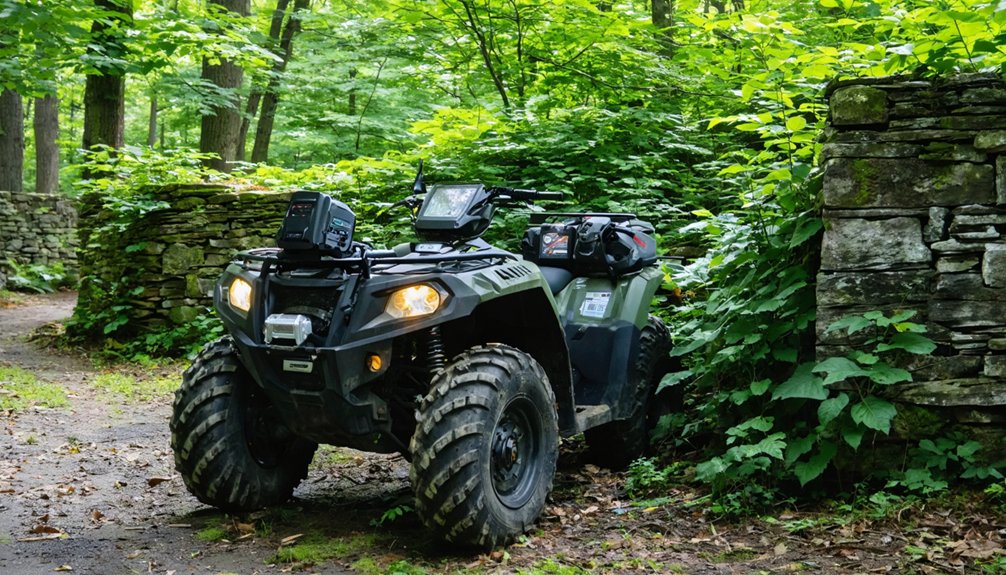
Before you venture into New England’s forgotten settlements, proper equipment preparation determines whether you’ll successfully navigate treacherous terrain or find yourself stranded miles from civilization.
Your essential gear starts with DOT-approved helmets and reinforced gloves for protection against rocky New England trails. Pack quality tires with full-size spares, plug kits, and 12-volt compressors—punctures happen when you’re exploring remote ghost towns.
Your tool kit needs wrenches, LED flashlights, and tow ropes for unexpected breakdowns. ATV maintenance tips include carrying jumper cables and tire service kits for those moments when isolation becomes dangerous.
Don’t forget GPS apps with downloaded waypoints, first aid supplies, and emergency fire-starting tools. These abandoned settlements won’t offer rescue services when your adventure takes an unexpected turn.
Safety Considerations When Exploring Abandoned Settlements
When you’re threading your ATV through crumbling foundations and overgrown pathways of New England’s ghost towns, danger lurks in every collapsed beam and hidden sinkhole.
Your safety gear becomes your lifeline—Connecticut law mandates helmets, and protective clothing shields you from debris when structures suddenly give way.
Terrain awareness proves critical as you navigate unstable ground where buildings once stood.
Stay sober and alert; impaired judgment can’t assess the shifting risks of deteriorated foundations and concealed obstacles.
Maintain controlled speeds and avoid blind approaches around ruins where hidden hazards wait.
Your ATV’s single-rider design helps you maneuver through tight spaces between abandoned structures.
Check your machine weekly—mechanical failures in remote ghost towns can strand you far from help in these forgotten landscapes.
Photography Tips for Documenting Historic Ruins
Your camera captures more than crumbling walls and broken windows—it preserves the haunting stories these forgotten settlements whisper through shadows and decay.
Every photograph becomes a time capsule, freezing moments where memory and abandonment converge in perfect, melancholic silence.
Urban exploration photography demands specific gear: pack a sturdy tripod for 30-second exposures at f/8, wide-angle lenses to emphasize vast emptiness, and graduated neutral density filters balancing bright windows against dark interiors.
Your flashlight becomes a precision tool—illuminate subjects like abandoned chairs while ambient light exposes surrounding walls. Bracket your shots to capture every detail from deep shadows to blown highlights.
Focus on decay photography elements: peeling wallpaper, rust patterns, nature reclaiming forgotten spaces. Shoot low angles upward to amplify disorientation and scale.
Early morning provides natural softbox lighting through broken windows, creating dramatic contrasts that tell each ruin’s unique story.
Frequently Asked Questions
What Are the Best Months to Visit New England Ghost Towns by ATV?
June through October offers the best weather for your ghost town adventures. You’ll dodge mud season’s grip while enjoying seasonal events like harvest festivals, plus ideal trail conditions for exploring New England’s forgotten settlements.
Do I Need Special Permits to Ride ATVS in These Historical Areas?
You’ll need standard ATV registration through state environmental agencies, but no special historical preservation permits exist for ghost towns. Follow standard ATV regulations while respecting these fragile sites during your adventures.
Are There Guided ATV Tours Available for These Ghost Town Locations?
You won’t find dedicated guided tours specifically targeting ghost town locations, but you can book guided ATV rentals and request routes to historically significant areas like Pisgah State Park’s abandoned homesteads.
What Should I Do if I Encounter Wildlife While Exploring Abandoned Settlements?
During wildlife encounters, maintain 25-yard distance and speak firmly while backing away slowly. Don’t run—it triggers chase instincts. Carry bear spray, make noise, and take essential safety precautions when exploring remote areas.
Can I Camp Overnight Near These Ghost Towns During Multi-Day ATV Trips?
You’ll find excellent overnight accommodations at ATV-friendly campgrounds like Big Rock and Bear Rock Adventures. Check local camping regulations first, then enjoy ride-in/ride-out access to remote ghost towns during your multi-day expeditions.
References
- https://northernontario.travel/atving/ghost-towns-old-nipissing-road-atv-mission-part-1-first-attempt
- https://www.youtube.com/watch?v=jPneYGJR4-o
- https://newenglandhistoricalsociety.com/six-new-england-ghost-towns/
- https://www.alcomusa.com/blog/five-of-alcoms-favorite-atv-destinations-in-new-england
- https://explorenewengland.tv/atv/thrill-ride-new-hampshires-north-country-atv-trail-system/
- https://www.youtube.com/watch?v=xlJYGWUN0s0
- https://www.youtube.com/watch?v=xICXTlwh5Oo
- https://www.onlyinyourstate.com/experiences/massachusetts/ghost-town-dogtown-ma
- https://historyofmassachusetts.org/the-witches-of-dogtown/
- https://travelnoire.com/abandoned-town-in-northern-massachusetts