You’ll discover some of New Mexico’s most enchanting ghost towns by firing up your ATV and heading into rugged terrain where crumbling Victorian mansions, abandoned silver mines, and Wild West saloons wait among the desert mountains. White Oaks offers straightforward gravel roads through Malpais landscape to Billy the Kid’s old stomping grounds, while Chloride’s silver camp remnants challenge riders with authentic mining equipment displays. Six Mile Canyon provides narrow sandstone passages and fast, flowy sections through the Magdalenas, and Pinos Altos showcases restored 1800s buildings where Apache warriors once battled fortune-seekers during the $8 million gold rush that brought 700 miners within a month.
Key Takeaways
- White Oaks offers straightforward gravel road access with maintained dirt roads and numerous off-road trails for ATV exploration.
- Six Mile Canyon features challenging ATV terrain with narrow passages, fast flowy sections, and volunteer-maintained trails.
- Chloride provides ATV access via Highway 52’s Geronimo Trail to explore restored mining structures and authentic equipment displays.
- Winston and Hillsboro offer quieter ATV alternatives with accessible routes to explore former mining camps and historical remnants.
- Pinos Altos allows ATV riders to explore restored 1800s buildings while experiencing gold rush history in mountain terrain.
Six Mile Canyon: Narrow Slot Adventure in the Magdalena Mountains
When you’re craving a slot canyon adventure that’ll test your ATV’s agility, Six Mile Canyon delivers an unforgettable ride through narrow sandstone passages and vibrant bentonite hills in the Magdalena Mountains.
You’ll access this gem via Forest Road 38 off US 60, starting from Water Canyon Campground’s dirt surface approximately six miles southwest of Socorro.
Canyon exploration here means maneuvering through challenging terrain where tree blazes mark the path through hard-to-follow sections. The middle stretch offers fast, flowy riding that’ll get your adrenaline pumping.
Trail navigation becomes easier with NMVFO and Socorro Trails volunteers maintaining the cleared segments. Volunteers regularly tackle significant deadfall in the upper sections using specialized crosscut saws to keep the trail accessible. As you venture deeper into the canyon, you’ll reach The Box Spring where the passage transforms into a narrow box canyon that creates an incredible natural endpoint to your ride.
You can tackle this as an out-and-back adventure or integrate it into larger loops connecting Dead Horse Trail and South Canyon. The multi-use designation welcomes your ATV for legitimate backcountry freedom.
White Oaks: Gold Rush Ghost Town Near Carrizozo
You’ll discover White Oaks’ remarkable transformation from a 1879 gold strike into New Mexico Territory’s second-largest city, where eastern-influenced Victorian mansions and pitched-roof homes replaced typical frontier shanties.
The town’s unique architectural blend creates a haunting backdrop as you explore everything from the infamous “No Scum Allowed Saloon” to the unfinished Hoyle House mansion that locals dubbed “Hoyle’s Folly.” White Oaks served as a popular retreat for the notorious outlaw Billy the Kid, who frequented the town’s brothels and gambling establishments during its heyday. The town’s decline began in the 1890s when the railroad bypassed White Oaks, leaving it isolated despite its rich mining history.
Your ATV adventure begins just three miles north of Carrizozo off US Highway 54, where vehicle-friendly dirt roads lead you through this accessible ghost town on the edge of Lincoln National Forest.
Gold Discovery History
Beneath the shadow of Baxter Mountain in 1879, three determined prospectors—John Wilson, Jack Winters, and Harry Baxter—struck pay dirt that would transform the quiet Jicarilla Mountains into New Mexico’s second-largest city within a decade.
You’ll find their discovery site near white oak springs, where placer gold mining revealed rich chloride deposits and wire gold threading through a 3.5-foot crevice stretching 750 feet.
Wilson, rumored to be a Texas prison escapee, abandoned his claim when word spread to Las Vegas, bringing hundreds of fortune-seekers.
Winters and Baxter persevered, eventually selling their stakes for $300,000 each—equivalent to $10 million today. The town became a favorite spot of Billy the Kid, who frequented the bustling settlement with its taverns, gambling halls, and brothels.
Their mines produced ore assaying 52 ounces of gold and 42 ounces of silver per ten feet, sustaining the boom until inevitable town decline followed resource depletion. The mining operations ultimately yielded approximately $20 million in gold and minerals before the town’s eventual abandonment.
Frontier Architecture Features
The wealth from White Oaks’ extraordinary gold strikes didn’t just fill miners’ pockets—it transformed the entire architectural landscape of this remote mountain settlement.
You’ll discover frontier architecture that broke Southwest traditions, where Anglo miners introduced Victorian-style homes with pitched roofs instead of flat adobe structures. Mining influences shaped everything from the elaborate Exchange Bank Building‘s stone façade to Watt Hoyle’s stunning $40,000-70,000 mansion featuring stained glass windows and hand-carved pine details.
As you explore, you’ll find the impressive 1895 brick schoolhouse that cost $10,000—now a museum—alongside surviving structures like the Gumm family’s Victorian home and the notorious “No Scum Allowed” Saloon. The community’s white oak trees that surrounded the settlement inspired the town’s distinctive name and provided a natural backdrop for its unique architectural development.
This boomtown’s permanent buildings replaced frontier tents, creating New Mexico’s second-largest settlement with distinctly Eastern architectural flair. The Golden Era newspaper, established in 1881, documented the rapid transformation of temporary wood shacks into elaborate Victorian residences.
ATV Access Route
While most ghost towns require lengthy hikes through rough terrain, White Oaks sits just three miles north of Carrizozo off US Highway 54, making it one of New Mexico’s most ATV-accessible abandoned settlements.
You’ll navigate straightforward gravel roads that wind through arid Malpais landscape dotted with volcanic rock formations.
Your ATV navigation begins on County Road 349, leading eight miles through desert terrain before connecting to Pine Street.
These maintained dirt roads provide direct access to the town’s remnants without challenging technical riding.
The surrounding Lincoln County wilderness opens countless off-road trails for ghost town exploration, where abandoned gold mines hide among desert foliage. White Oaks once ranked as the second largest city in New Mexico after Santa Fe, before the railroad’s decline led to its abandonment.
You’ll discover the crumbling No Scum Allowed Saloon, historic schoolhouse, and weathered cemetery markers—all reachable via your machine’s capabilities through this perfectly preserved frontier landscape.
Chloride: Silver Strike Survivor With Pioneer Museum
You’ll discover Chloride’s rich silver mining legacy when you explore this well-preserved ghost town where Harry Pye’s 1879 ore discovery sparked a boom that drew thousands to the rugged canyon.
The town’s fascinating rise from a single prospector’s claim to a bustling community of 3,000 residents comes alive as you walk past 27 original buildings that survived the 1893 silver crash. During its heyday, the community supported nine saloons alongside a general store and various other businesses that served the thriving mining population.
Your adventure centers on the remarkable Pioneer Store Museum, frozen in time since 1923 with original merchandise still lining the shelves, offering an authentic glimpse into New Mexico’s wild mining era.
Silver Discovery and Boom
Hidden deep in a Black Range Mountains canyon in 1879, Harry Pye stumbled upon silver chloride samples while seeking refuge from Apache warriors during an Army supply haul—a discovery that would transform this remote gulch into one of New Mexico’s most significant silver camps.
You’ll find Chloride’s Pioneer Heritage rooted in deadly risk and extraordinary reward. When Pye returned in 1881 with partners Forbes and Elliot, they staked claims despite Apache threats.
Though Pye died months later, his discovery sparked a massive rush. By 1880, 3,000 miners had descended on the tent city, filing 480 claims that became 42 working mines.
Advanced Mining Techniques produced $500,000 in silver, with the Silver Monument mine alone yielding over $100,000 before the 1893 crash ended the boom.
Pioneer Store Museum Today
Today, you can walk Highway 52’s Geronimo Trail to experience this time capsule firsthand.
The museum operates daily, letting you touch authentic mining equipment and explore sixteen restored structures.
It’s like stepping through a portal into 1920s frontier life, where freedom meant carving existence from unforgiving desert.
Winston: The Quieter Mining Alternative to Rowdy Chloride
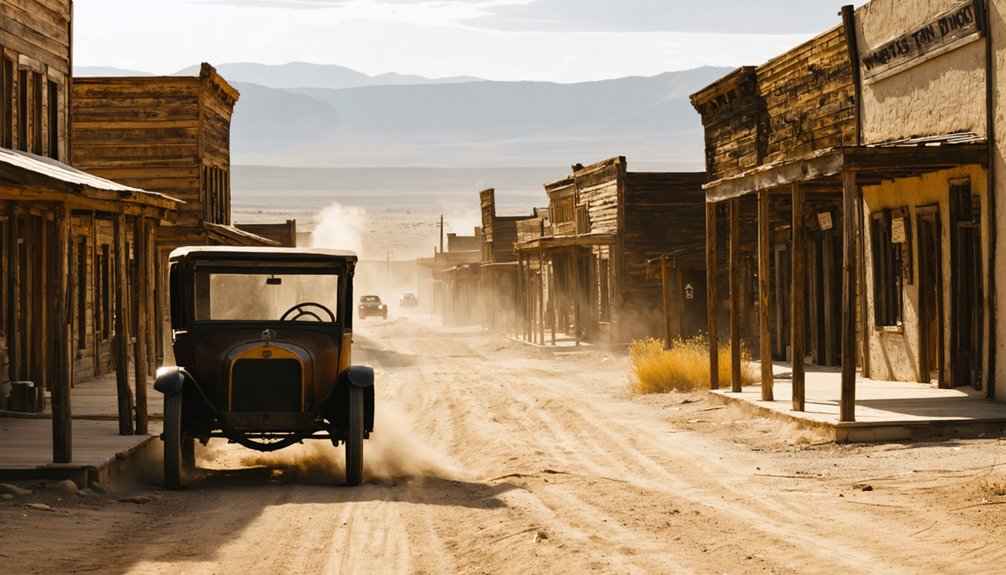
While Chloride’s saloons rang with gunfights and drunken brawls, determined miners carved out Winston five miles down the canyon in 1881, seeking profitable silver veins without the constant threat of violence.
Originally called Fairview, this settlement honored Frank H. Winston’s contributions to the community’s Winston history and enduring mining legacy.
You’ll discover a boom town that swelled to 3,100 residents within three years, featuring:
- Nine saloons, three general stores, and Cloudman Hall hosting theatrical performances
- Essential services including doctor, lawyer, Chinese laundry, and red-light district
- Mining operations extracting silver, copper, lead, and zinc until the early 1930s
Today’s ATV riders can explore this semi-ghost town via State Road 52, accessing preserved remnants of a quieter mining alternative.
Hillsboro: Black Range Mountains Gold Discovery Hub
Joe Yankie’s Winchester rifle shot echoed through these canyons when he struck ore worth $160 per ton, alerting his partners to fortune beneath their boots.
Today, you can explore the skeletal remains of the 1892 Sierra County Courthouse and the restored Black Range Museum, once Sadie Orchard’s Ocean Grove Hotel.
Hillsboro history lives on through 200 resilient residents who’ve transformed this former boomtown from mining powerhouse to ranching community, preserving its rebellious spirit against time’s relentless march.
Pinos Altos: Where Three 49ers Sparked a 700-Man Rush
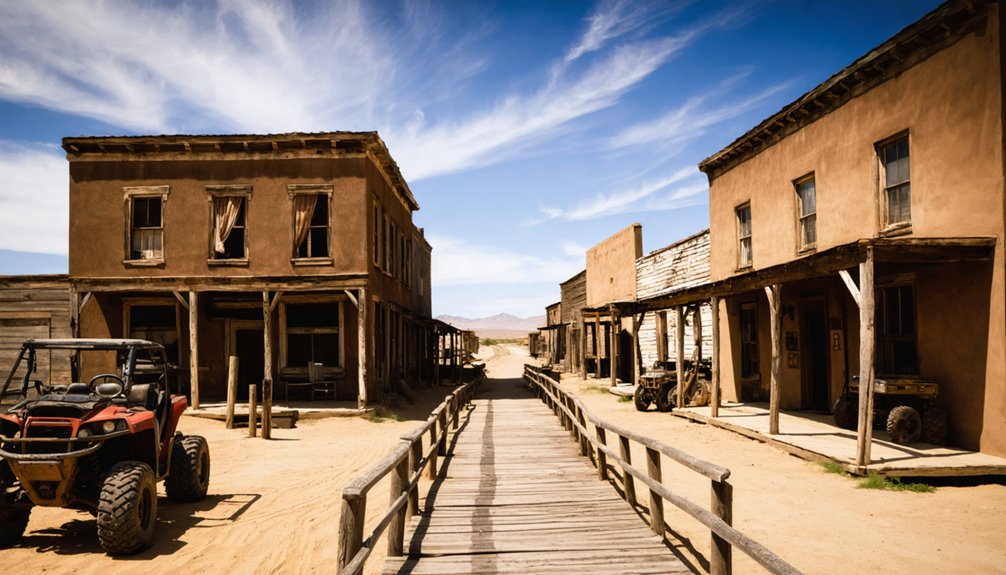
When three weary 49ers dismounted at Bear Creek in 1860 for what they thought would be a simple water stop, their pans revealed glittering flakes that would release chaos across the Southwest.
This discovery among towering pines north of Silver City would transform into Pinos Altos, honoring the 49ers legacy with an $8 million gold rush.
Within a month, over 700 fortune-seekers descended on the hastily established mining camp.
You’ll discover a town where legends collided:
- Roy Bean ran his mercantile before becoming the notorious “Law West of the Pecos”
- Billy the Kid launched his criminal career in these lawless streets
- Apache warriors Cochise and Mangas Coloradas led 400 fighters against the miners
Today’s 300 residents maintain restored 1800s buildings offering you authentic Wild West atmosphere.
Planning Your ATV Ghost Town Exploration Route
Before you fire up your ATV and head into New Mexico’s backcountry, you’ll need to map out strategic routes that balance accessibility with adventure.
Smart route planning starts with obtaining OHV trail maps from the Questa Ranger District for Carson National Forest areas. You’ll find Elizabethtown’s gold rush remnants 4.8 miles north of Eagle Nest, accessible via B-20 dirt road.
Southern routes like Riley’s FSR 354 offer obstacle-free rides to authentic ghost towns, while Quebradas Backcountry Byway near Socorro provides 6000 acres of diverse terrain.
Essential exploration tips include sticking to designated trails, respecting private land boundaries, and checking seasonal restrictions.
Consider guided experiences through outfitters like Angels Outback Adventures to maximize your ghost town discoveries while maneuvering safely through New Mexico’s rugged wilderness.
Frequently Asked Questions
What ATV Permits or Licenses Are Required for Riding in New Mexico?
You’ll need registration with validation decals dancing on your machine. ATV regulations demand permit fees: residents pay at Motor Vehicle Division, non-residents shell out $18-48 online, plus safety courses for under-18 riders seeking adventure.
Are There Camping Facilities Available Near These Ghost Town Locations?
You’ll find limited camping facilities near these ghost towns. Shakespeare offers RV parking, while Hachita provides community center stays. Check camping regulations for dispersed options and explore nearby attractions on surrounding public lands.
What Safety Equipment Should I Bring for ATV Ghost Town Exploration?
You’ll need essential safety gear: DOT helmet, protective goggles, sturdy boots, gloves, and long sleeves. Pack an emergency kit with first aid supplies, tools, and communication devices for your wild ghost-chasing adventure.
Which Ghost Towns Have the Best Cell Phone Coverage for Emergencies?
Madrid offers your best cell service with its Turquoise Trail proximity to Albuquerque and Santa Fe. You’ll reach emergency contacts easily from this artsy ghost town, while Shakespeare and Chloride provide decent backup coverage options.
Are There Guided ATV Tours Available for New Mexico Ghost Towns?
Like treasure hunters following ancient maps, you’ll find guided tours through Red River Offroad and local operators who’ll lead you to ghost towns, gold mines, and historic sites across Carson National Forest’s rugged terrain.
References
- https://www.youtube.com/watch?v=AdPphS7fDnI
- https://www.tripadvisor.com/Attractions-g28952-Activities-c47-t14-New_Mexico.html
- https://www.newmexico.org/places-to-visit/ghost-towns/
- https://visitquesta.com/atv-orv/
- https://www.visitlascruces.com/blog/post/5-local-ghost-towns-you-dont-want-to-miss/
- https://www.onxmaps.com/offroad/trails/us/new-mexico/riley-s-fsr-354
- https://redriver.org/things-to-do/off-road-ohv/
- https://www.blm.gov/visit/hackberry-lake-ohv-area
- https://www.onxmaps.com/hiking/9e7qelny061y/6-mile-canyon-to-south-canyon-loop
- https://nmvfo.org/projects/six-mile-canyon-trail-magdalena-rd/