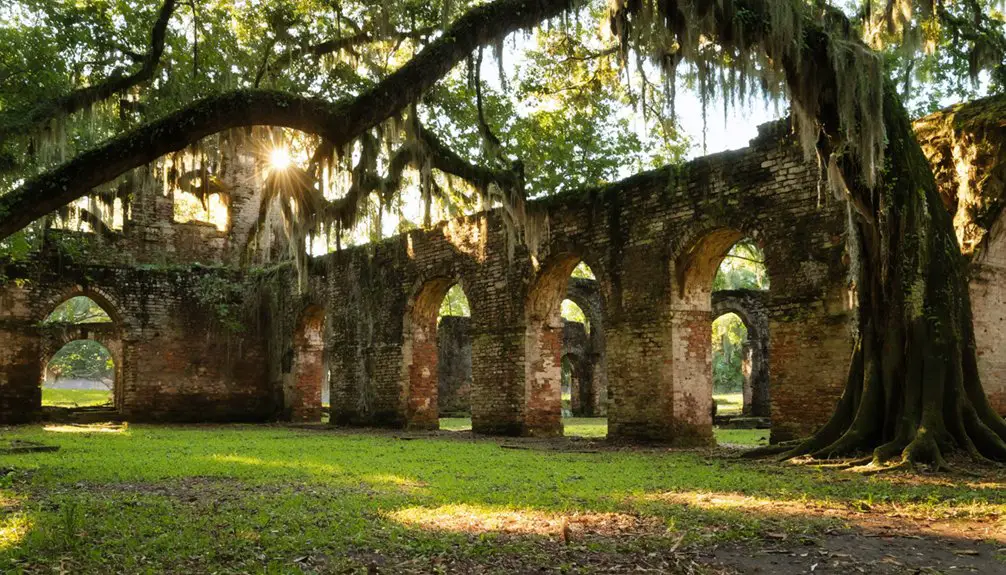
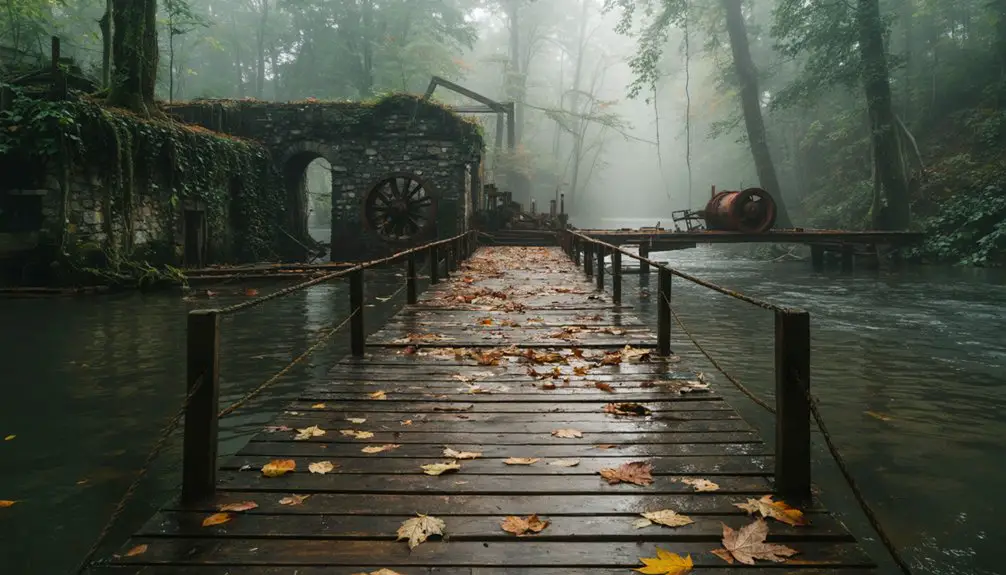
You’ll find exceptional ATV ghost town adventures at North Carolina’s Henry River Mill Village, accessible via I-40 with over 20 preserved buildings from the early 1900s. Lost Cove in Pisgah National Forest offers challenging trails to Civil War-era remnants, while Mortimer’s flood-damaged ruins hide along Wilson Creek’s remote forest roads. Proctor’s submerged lumber town requires backcountry navigation near Fontana Lake. Always wear protective gear and bring recovery equipment for these rugged mountain terrains. Discover essential preparation tips and detailed trail guidance ahead.
Key Takeaways
- Henry River Mill Village offers easy ATV access from I-40 with over 20 original buildings from the early 1900s textile community.
- Lost Cove features challenging ATV trails through Pisgah National Forest to reach authentic Civil War-era Appalachian settlement remnants.
- Mortimer requires careful forest road navigation but rewards riders with eerie mill town ruins reclaimed by nature since 1940.
- Proctor’s remote location demands backcountry ATV trails through Great Smoky Mountains National Park to reach submerged lumber community remains.
- Spring through summer provides ideal ATV conditions for ghost town exploration, with March-May offering safer trails and fewer crowds.
Why ATVs Are Perfect for North Carolina Ghost Town Adventures
When you’re traversing the rugged terrain that leads to North Carolina’s forgotten settlements, ATVs become your most reliable companions for reaching places where ordinary vehicles simply can’t venture.
The ATV advantages shine through when you’re maneuvering overgrown trails to ghost towns like Proctor and Mortimer, where dense forests and steep inclines demand superior traction and maneuverability.
You’ll encounter terrain challenges that include elevation changes up to 4,600 feet, rocky Wilson Creek paths, and unpaved roads throughout the Brushy Mountains.
Your ATV’s high ground clearance handles these obstacles while its specialized suspension absorbs the punishment of mountain trails.
From ferry-accessible Portsmouth Island to the depths of Pisgah National Forest, ATVs provide the freedom and capability you need to explore North Carolina’s most remote abandoned settlements safely. Some of these towns like Proctor were submerged beneath lakes after the creation of Fontana Lake during World War II, making ATV access to their visible ruins even more crucial for exploration. However, some preserved towns like Love Valley maintain horse-only access on their main streets, requiring you to park and explore on foot to respect these unique community regulations.
Henry River Mill Village: Well-Preserved Ruins Within Easy Reach
You’ll find Henry River Mill Village just one mile south of Hildebran, easily accessible off I-40 exit 119 for a safe day trip exploration.
The preserved ruins include over 20 original buildings from this early 1900s textile community, offering you clear trails through worker houses, the company store, and mill remnants. This National Register site was officially recognized for its historic significance in 2019.
Your adventure here combines manageable terrain with well-maintained structures that let you safely explore authentic industrial history without venturing into remote wilderness. The village gained Hollywood fame when it served as District 12 in The Hunger Games film.
Accessible Ghost Town Exploration
Where can you find a perfectly preserved mill village that Hollywood chose to represent dystopian America? Henry River Mill Village, just off I-40 near Hildebran, offers you accessible exploration of authentic Carolina textile history.
You’ll discover 35 worker houses, the original dam, and bridge structures that survived since 1905. The site’s transformation from operational mill to Hunger Games filming location makes it perfect for ghost town photography, showcasing both industrial heritage and cinematic fame.
Standard vehicles can reach this Burke County foothills location easily. You’ll navigate maintained roads without needing specialized equipment.
The village demonstrates exceptional historical preservation – brick buildings constructed from river mud survived lightning strikes, hurricanes, and decades of abandonment. Workers once received payment in “doogaloo” coins that were only accepted at the company store, creating a self-contained economic system within the village. The mill operated successfully for decades, producing 15,000 pounds of yarn weekly during its peak years in the 1930s.
Recent flood debris around the dam adds authentic decay atmosphere while remaining safely accessible for freedom-seeking explorers.
Preserved Mill Village Structures
Standing among Henry River Mill Village’s ruins, you’ll witness remarkable structural preservation that spans over a century of Carolina weather. These sun-baked mud bricks, crafted from riverbank clay and set on rock foundations, demonstrate exceptional preservation techniques that withstood lightning strikes, hurricanes, and tornadoes since 1905.
You’ll explore 35 worker houses scattered across the terrain, each originally providing families with about one acre of freedom from urban crowding.
The two-story company store remains intact, where workers once received “doogaloo” tokens. Navigate carefully around the debris-strewn dam foundations—recent floods created hazardous conditions.
The village’s historical significance earned National Register recognition in 2019, representing typical Carolina textile communities. The mill’s establishment followed the Cotton Mill Campaign of the 1880s, which promoted local textile production as a symbol of regional regeneration after the Civil War. Most homes originally functioned without modern plumbing until major infrastructure updates were completed decades after the mill’s closure.
Hollywood recognized its authenticity, filming District 12 scenes here for “The Hunger Games.”
Lost Cove: Historic Settlement in the Nolichucky Gorge
Deep within the rugged Nolichucky Gorge, where the boundaries of Yancey and Mitchell Counties blur along the rushing river, Lost Cove stands as one of the most legendary ghost towns in the eastern United States.
This historic settlement thrived from Civil War era until 1958, when the last Bailey family departed.
You’ll find concrete church steps, a vegetation-buried house, and cemetery remnants scattered across this 95-acre preserve.
Access requires serious commitment—either a grueling trail from Flat Top Mountain switchbacks or a risky 3-mile hike along active railroad tracks from River Road.
The terrain’s unforgiving, but you’ll experience authentic Appalachian wilderness where moonshine once flowed and timber barons made fortunes before nature reclaimed everything. The Carolina, Clinchfield, and Ohio Railroad arrival in the 1890s brought unprecedented prosperity to this remote settlement before its eventual decline. The area now sits within Pisgah National Forest, where four streams originating on the property contribute to the Nolichucky River’s flow through this Significant National Heritage Area.
Mortimer: Hidden Remnants Along Wilson Creek
You’ll find Mortimer’s eerie remnants scattered throughout dense forest along Wilson Creek, where nature has steadily reclaimed collapsed buildings and rusted mill machinery since the town’s 1940 abandonment.
The remote location requires careful navigation via Forest Service roads and demands constant awareness of sudden flood risks in this wilderness area populated by bears and venomous snakes.
Your trek into these overgrown ruins rewards you with haunting glimpses of a once-thriving mill community that disasters ultimately surrendered back to the mountains.
Forest-Reclaimed Decay Structures
While decades of forest growth have swallowed most evidence of Mortimer’s bustling past, you’ll still discover haunting remnants of the mill town that once housed 800 residents before the catastrophic 1940 flood swept it away.
Nature’s reclamation has created an eerie landscape where ghostly encounters with history emerge through tangled vegetation.
You’ll find cotton mill ruins fighting against encroaching vines and the skeletal remains of a railroad bridge surrendering to forest dominance.
One resilient white building stands defiantly isolated, having survived the destructive floodwaters that claimed everything else.
Hidden structural fragments blend seamlessly into the surrounding wilderness, their flood-damaged surfaces telling silent stories of that devastating night when Wilson Creek claimed an entire community forever.
Deep Mountain Access
Reaching Mortimer’s hidden remnants requires traversing narrow forest roads that wind deep into Caldwell County’s mountainous terrain, where your vehicle’s clearance and your route-finding skills become essential.
ATVs excel in this remote terrain, maneuvering rutted paths that standard vehicles can’t handle. You’ll encounter steep grades and rocky sections demanding careful throttle control and proper tire placement.
The rugged access route follows old logging roads through Pisgah National Forest, where GPS signals weaken and trail markers become your lifeline.
Wilson Creek’s gorge creates additional maneuvering challenges as paths split without warning. Plan for self-recovery situations—bring recovery gear and inform others of your route.
Once you’ve conquered these demanding approaches, you’ll discover foundation ruins and mill remnants that reward your determination to explore where few dare venture.
Proctor: Submerged Lumber Town Near Fontana Lake
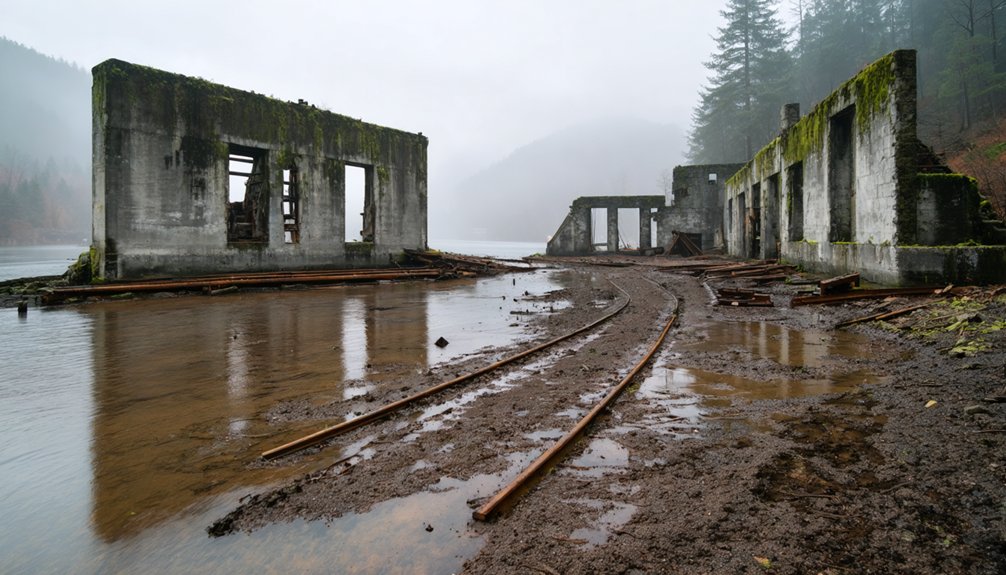
Though accessible only by boat or challenging backcountry trails, Proctor offers one of North Carolina’s most haunting ghost town experiences beneath the waters of Fontana Lake.
You’ll discover remnants of a once-thriving lumber community founded in 1886, where the Ritter Lumber Company created a bustling town along Hazel Creek. Proctor history changed dramatically in 1943 when the Tennessee Valley Authority‘s dam flooded most structures, displacing over 1,200 families.
Today, you can explore stone foundations scattered across hillsides and locate 26 cemeteries above the waterline containing over 1,000 graves. The surviving Calhoun House stands as your primary landmark.
Plan carefully—Fontana Lake access requires proper watercraft or demanding backcountry navigation through Great Smoky Mountains National Park terrain.
Essential ATV Gear for Ghost Town Exploration
Since North Carolina’s ghost towns often lie at the end of rugged backcountry trails, proper ATV preparation becomes your lifeline between adventure and emergency.
Your ATV gear for ghost town exploration must handle Carolina’s unforgiving terrain while keeping you safe during remote discoveries.
Essential equipment includes:
- Protective gear – Helmet, goggles, gloves, and long sleeves shield you from branches and debris
- Tire maintenance – Repair kit, spare tire, and air pump handle punctures from sharp rocks
- Recovery tools – Tow rope, basic toolkit, and winch extract you from challenging situations
- Emergency supplies – First aid kit, extra water, GPS device, and headlamp guarantee survival
Don’t venture into abandoned settlements unprepared.
Carolina’s backcountry demands respect, and proper gear transforms potentially dangerous ghost town exploration into unforgettable freedom-filled adventures.
Safety Considerations When Riding to Remote Locations

When you’re heading deep into Carolina’s backcountry to explore forgotten settlements, understanding the sobering reality of ATV accidents becomes critical to your survival. Over 100,000 emergency room visits annually stem from ATV incidents, with 65% of overturns causing fatal accidents in remote terrain.
Your safety gear isn’t optional—it’s your lifeline. Helmets reduce fatality risks considerably, yet 85% of victims ride unprotected. Essential protective equipment includes helmets, goggles, boots, and protective clothing.
Terrain awareness separates experienced riders from casualties. Carolina’s backcountry presents hidden hazards: stumps, holes, ruts, and unstable ground that’ll flip your machine instantly.
Rural settings report higher accident rates due to challenging conditions. Speed must match visibility and terrain difficulty. Stay alert, ride defensively, and respect the wilderness that beckons your adventurous spirit.
Best Times of Year for ATV Ghost Town Visits
Once you’ve mastered the safety fundamentals, timing your ghost town expeditions can make the difference between an epic adventure and a miserable slog through mud or dangerous ice.
When comparing spring vs summer, you’ll find ideal conditions from March through August, with spring’s 50-70°F temperatures and reduced rainfall offering safer trail access than summer’s afternoon thunderstorms.
Fall vs winter presents a stark contrast—September through November delivers crisp 40-65°F weather and stunning foliage, while winter’s icy trails become downright treacherous.
- Spring (March-May): Wildflower blooms, fewer crowds, safer high-elevation access
- Summer (June-August): Extended daylight, warmest temperatures, peak thunderstorm season
- Fall (September-November): Spectacular foliage, dried trails, comfortable riding temps
- Winter (December-February): Icy conditions, limited daylight, blocked mountain access
Frequently Asked Questions
Do I Need Permits or Special Permissions to Ride ATVS to These Ghost Towns?
You’ll need special permissions for organized ATV tours to Portsmouth Island. Love Valley and Gold Hill restrict ATVs entirely. Always check local ATV regulations and prioritize riding safety before exploring these historic destinations.
Are There Guided ATV Tours Available for North Carolina Ghost Town Exploration?
Ironically, you’ll find more living adventure than dead history! Yes, guided tours like Portsmouth Island ATV Tours offer ghost town exploration with boat shuttles, exclusive beach access, and historical storytelling for ultimate trail freedom.
For those looking to enjoy the outdoors with their pets, there are plenty of dogfriendly spots in New Jersey that cater to furry companions. Many parks feature dedicated areas for dogs to run freely, while several beaches even allow leashed pets to enjoy the sun and surf. Exploring these options not only enhances your adventure but also creates unforgettable experiences with your four-legged friends.
What ATV Engine Size Is Recommended for Reaching These Remote Ghost Town Locations?
You’ll need 700-900cc engine power for North Carolina’s challenging terrain types. Steep mountain climbs and rocky paths demand serious torque, while remote ghost town adventures require reliable four-stroke engines with low-range gearing for ultimate trail freedom.
Can I Camp Overnight at These Ghost Town Sites With My ATV?
You can’t camp directly at ghost town ruins, but nearby designated sites work perfectly. Follow camping regulations for overnight safety, secure your ATV, and respect historical sites while enjoying backcountry freedom responsibly.
Are There ATV Rental Companies Near These North Carolina Ghost Town Areas?
You’ll find excellent ATV rental options throughout North Carolina’s mountain regions. Uwharrie ATV Rentals and Appalachians Outdoor Adventures offer quality machines near several ghost town locations, ensuring safe trail access for your exploration adventures.
References
- https://www.youtube.com/watch?v=O9X8AoLffOs
- https://www.youtube.com/watch?v=iWhjTfCyUpY
- https://www.tripadvisor.com/Attraction_Review-g49313-d3583670-Reviews-Ghost_Town_in_the_Sky-Maggie_Valley_North_Carolina.html
- https://www.romanticasheville.com/ghost_town.htm
- https://appalachian.org/lost-cove-ghost-town-in-the-national-forest/
- https://www.visitnc.com/list/ncs-mysterious-disappearances-and-abandoned-places
- https://www.accuweather.com/en/travel/inside-portsmouth-island-abandoned-ghost-village/931491
- https://www.tripadvisor.com/ShowUserReviews-g49407-d256159-r566536627-Portsmouth_Village-Ocracoke_Outer_Banks_North_Carolina.html
- https://www.outerbanks.com/portsmouth-island.html
- https://www.visitnc.com/henry-river-mill-village