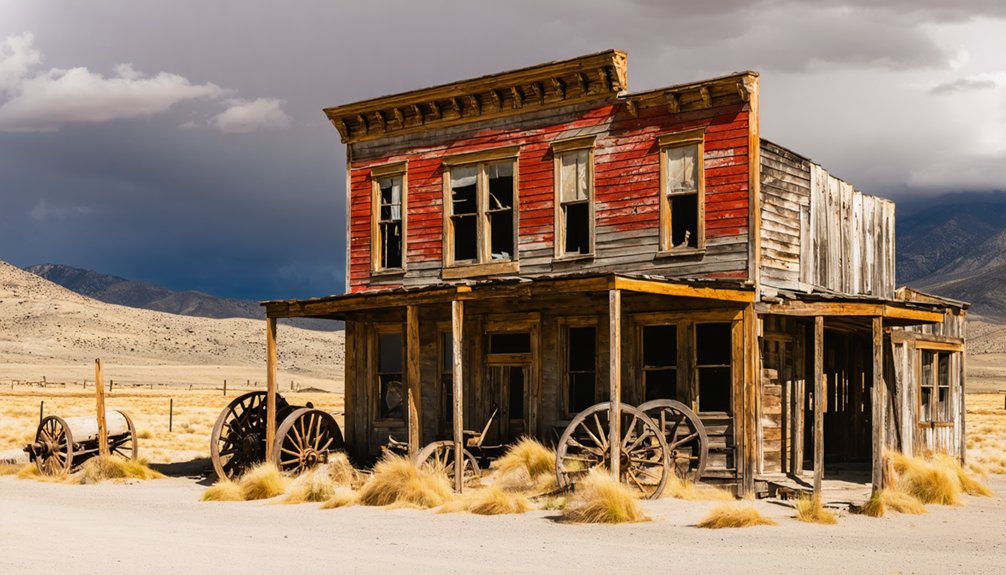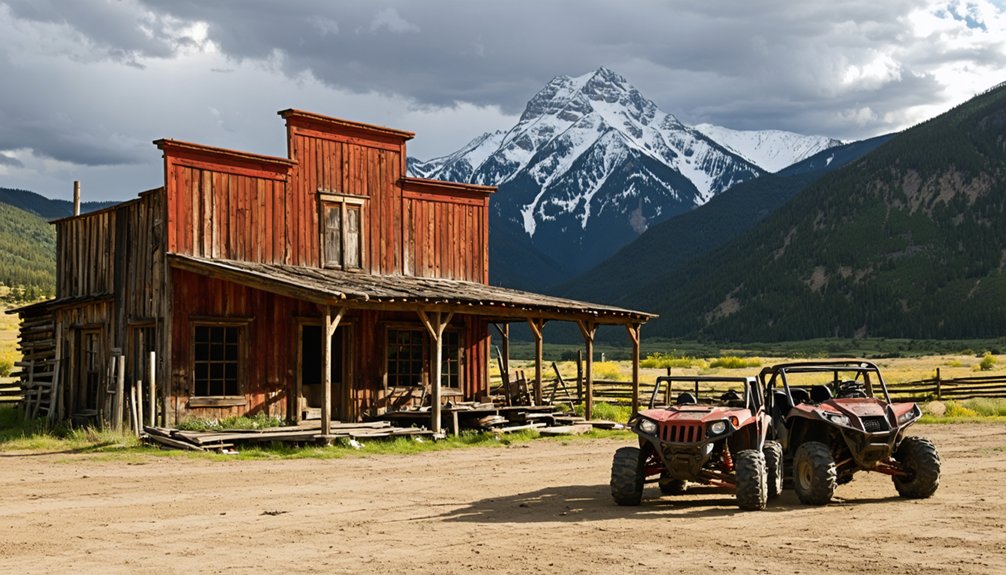
You’ll discover some of Colorado’s most enchanting ghost towns by firing up your ATV and heading into the high country, where abandoned mining camps like Animas Forks at 11,200 feet and Tomboy near Imogene Pass await exploration along rugged backcountry trails. These preserved settlements feature everything from the Duncan House’s weathered walls to Alta’s remarkable two-story boardinghouse, accessible via challenging 4WD routes that wind through dramatic mountain terrain. Each destination offers unique glimpses into Colorado’s mining heritage and adventure opportunities.
Key Takeaways
- Animas Forks sits at 11,200 feet with preserved structures accessible via Alpine Loop requiring high-clearance 4WD vehicles.
- Tomboy ghost town reaches 11,509 feet via an 18-mile ATV route with dramatic switchbacks near Imogene Pass.
- Carson is located at 12,000 feet on the Continental Divide, accessible through rough 4WD routes from Lake City.
- Alta features remarkably preserved structures at nearly 12,000 feet with three distinct access routes requiring high-clearance vehicles.
- Vicksburg and Winfield in Clear Creek Canyon offer ATV adventures with preserved cabins and historic log buildings.
Animas Forks: High-Altitude Mining Camp With Preserved Buildings
Perched at a breathtaking 11,200 feet in Colorado’s San Juan Mountains, Animas Forks stands as one of the most spectacular ghost towns you can reach by ATV.
You’ll navigate the challenging Alpine Loop from Silverton, where high-clearance 4WD becomes essential for conquering this rugged terrain.
The Animas history dates back to 1873 when prospectors built the first cabin at Three Forks.
By 1883, this remote settlement housed 450 residents chasing gold and silver dreams. The town even published its own local newspaper called the Animas Forks Pioneer during its boom years.
By 1883, this windswept mountain outpost had transformed into a thriving community of 450 fortune-seekers pursuing precious metal riches.
The town’s mining legacy includes surviving the legendary 1884 blizzard that dumped 25 feet of snow, forcing residents to tunnel between buildings.
Today, you’ll discover a dozen preserved structures, including the impressive two-story Duncan House and Frisco Mill, offering authentic glimpses into Colorado’s high-altitude mining past. This well-preserved ghost town has been abandoned for over 100 years yet remains one of the most intact mining settlements in the Western United States.
Tomboy: Remote Ghost Town Near Colorado’s Second Highest Pass
You’ll find Tomboy ghost town perched at 11,509 feet, just two miles west of Colorado’s second highest pass, Imogene Pass, making it accessible via an challenging 18-mile ATV route.
Your high-clearance 4×4 or ATV can navigate the unpaved Tomboy Road through dramatic switchbacks and cliff-edge terrain to reach this former mining camp that once housed up to 2,000 residents.
The ruins you’ll discover include mining relics, building foundations, and remnants from one of Telluride’s most productive gold operations that generated millions in value between 1894 and 1926. During its peak years, the settlement featured essential amenities including a store and school that served the bustling mining community. Remarkably, this remote mountain town also boasted recreational facilities including tennis courts that provided entertainment for miners and their families at this extreme elevation.
Imogene Pass ATV Access
Few ATV adventures in Colorado match the thrill of conquering Imogene Pass to reach the remote ghost town of Tomboy, perched high in Savage Basin at over 11,000 feet.
However, ATV regulations restrict where you can legally ride. Unlicensed OHVs can’t access the first 2.5 miles from Telluride, forcing riders to start from Camp Bird Road on the Ouray side.
Key considerations for your Imogene Pass ATV expedition:
- High-clearance 4×4 with low range and lockers recommended
- Navigate 30% grades, rock crawling, and severe erosion
- Pass opens early July through November, weather permitting
- Recent washouts create dangerous cliff drop-offs
- San Miguel County enforces turn-around points at Marshall Creek
You’ll conquer Colorado’s second-highest drivable pass while experiencing authentic backcountry freedom. The challenging 11.9-mile trail typically requires approximately 4 hours of driving time for the complete journey. This same route hosts the famous Imogene Pass Run, an annual race spanning 17 miles from Ouray to Telluride that has attracted mountain runners since 1974.
Historic Mining Camp Ruins
At 11,500 feet above sea level, Tomboy’s weathered ruins sprawl across Savage Basin’s dramatic glacial cirque, offering ATV adventurers a haunting glimpse into Colorado’s mining boom era.
You’ll discover crumbling miner cabins, rusted equipment, and massive tailings piles that showcase the mining techniques once used to extract millions in gold, silver, and zinc between 1880 and 1927.
The skeletal remains tell stories of a bustling community that housed nearly 1,000 residents. This remote settlement featured remarkable amenities including a YMCA, bowling alley, tennis courts, and dance club that brought entertainment to miners living thousands of feet above civilization.
Whispering Jim’s green shack stands as a symbol to ghost town preservation efforts, while the yellow compressor shed marks where the Smuggler-Union Mine Complex operated 20 miles of tunnels. The Tomboy Road that leads to these ruins also serves as a historic route connecting Telluride to Ouray.
These authentic ruins provide an unfiltered connection to Colorado’s untamed past, accessible only to those willing to tackle the challenging Tomboy Road.
Carson: Continental Divide Mining Settlement at 12,000 Feet
Perched dramatically on Colorado’s Continental Divide at 12,000 feet, Carson stands as one of the state’s most extreme mining settlements, where melting snow literally flows toward both the Pacific and Atlantic oceans.
You’ll discover Carson history dating back to 1882 when John Christopher Carson staked claims across this brutal alpine terrain. The mining operations here once employed 500 miners working multiple shifts, extracting over $1 million in silver and gold. The Economic Panic of 1893 temporarily halted operations before rich gold discoveries brought renewed activity just three years later.
Your high-clearance ATV adventure from Lake City follows rough 4WD routes up Wager Gulch to reach this remarkably preserved ghost town:
- Explore remnants of St. Jacob Mine and Bachelor Mine structures
- Navigate between upper and lower camp ruins
- Witness panoramic views into Weminuche Wilderness
- Photograph well-preserved cabins and mining equipment
- Experience authentic Continental Divide wilderness isolation
Winter mining operations required ingenious transportation methods, with ore transported down the mountain using wooden toboggans across the snow-covered terrain.
Ironton and Red Mountain Town: San Juan Mountains Historic Sites
Two spectacular ghost towns crown Colorado’s Red Mountain Mining District, where your ATV can explore the dramatic ruins of Ironton and Red Mountain Town along the legendary San Juan Skyway.
Ironton history traces back to 1883’s silver boom, when hundreds of structures housed miners working the high-altitude claims. You’ll discover stabilized historic houses, foundations, and interpretive signs marking this once-thriving community that died after 1893’s silver crash.
Red Mountain ruins showcase the Yankee Girl and Guston mining operations through collapsed cabins, visible portals, and massive tailings piles.
Your machine handles the backcountry roads easily during summer months, accessing the Joker Tunnel boarding house and surrounding mine adits. The oxidized scarlet mountainsides create stunning backdrops for your high-country ghost town adventure at nearly 10,000 feet.
Alta: Million-Dollar Mining Camp Above Telluride
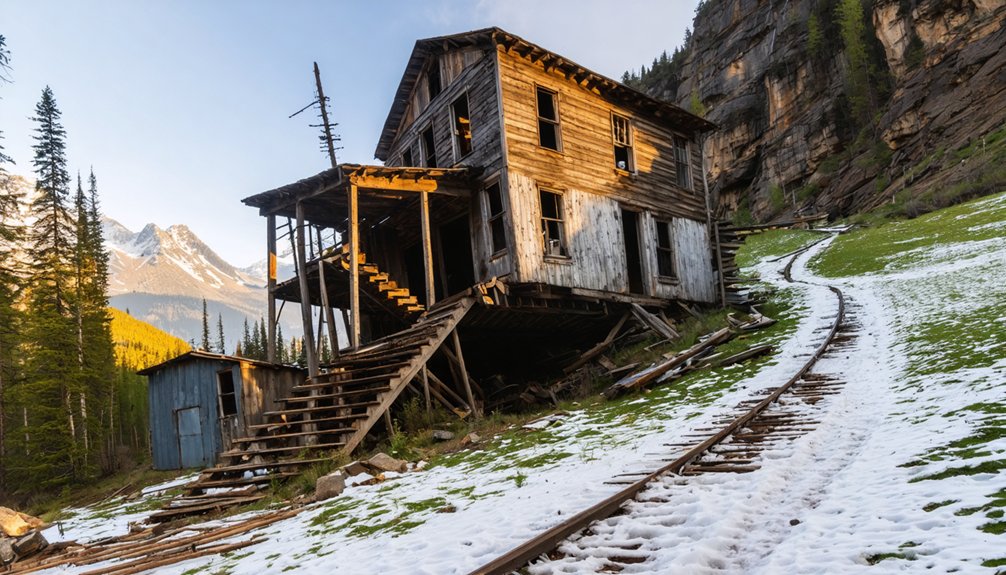
You’ll find Alta perched dramatically at nearly 12,000 feet elevation in Gold King Basin, where millions of dollars in ore were extracted from one of Colorado’s highest mining camps.
The treacherous ATV routes that wind up from Telluride’s box canyon reward you with remarkably preserved structures including a two-story boardinghouse, mill foundations, and tunnel portals scattered across the alpine landscape.
This remote ghost town earned its place in history as one of the world’s first commercial users of AC electrical power, enabling operations to continue at this extreme elevation well into the 20th century.
High-Altitude Mining History
While most Colorado mining camps struggled to survive above treeline, Alta thrived at nearly 12,000 feet elevation, becoming one of the state’s most profitable high-altitude operations.
You’ll discover how innovative mining technology transformed this remote camp into a million-dollar enterprise between 1877 and 1948.
Alta’s success stemmed from groundbreaking adaptations to extreme conditions:
- Tesla’s AC power system – Among first commercial uses, eliminating coal transport via mule trains
- 9,000-foot Black Hawk tunnel – Direct vein access that tripled production after 1898
- Aerial tramways – Moved ore downslope efficiently from the high camp
- Year-round operations – Electrification conquered seasonal isolation
- Stratified community dynamics – “Snob Hill” housed owners above miners’ quarters
The camp’s innovative approach to high-altitude challenges created a template for extreme-elevation mining that you can still explore today.
Surviving Camp Structures
Alta’s remarkable engineering legacy lives on through scattered ruins that tell the story of Colorado’s most successful high-altitude mining operation.
You’ll discover boarding house foundations where 300 residents once lived, including remnants on “Snob Hill” where wealthy owners built their homes. The Gold King Mine‘s stone platforms and collapsed mill timbers showcase early AC electrical innovation that revolutionized mountain mining.
Near Alta Lakes, you can explore schoolhouse foundations, mill basements, and ore-processing terraces that carved the mountainside.
Steam boiler pads and electrical equipment footprints reveal the camp’s technological sophistication.
Though weathered and unstable after decades of exposure, these mining heritage sites offer tangible connections to Colorado’s pioneering spirit, where determined miners conquered extreme altitude through ingenuity and persistence.
Access Routes Available
Three distinct routes lead adventurous ATV riders to Alta’s windswept ruins at 11,800 feet above sea level.
You’ll need high-clearance vehicles to conquer these challenging access routes, as standard cars won’t survive the rocky terrain and extreme elevation gains.
Vehicle requirements and route options:
- Highway 62 approach – Primary access point with dirt roads branching toward Alta Lakes
- Telluride backcountry trails – Connect directly through forest roads to the ghost town site
- Snob Hill connector – Links adjacent mining areas via rugged mountain passages
- 4×4 capability essential – High ground clearance mandatory for boulder fields and washouts
- Winter access impossible – Snow blocks routes from October through June
Each path delivers breathtaking San Juan Mountain vistas while testing your machine’s limits.
Plan fuel stops carefully—you’re entering genuine wilderness territory.
Vicksburg and Winfield: Secluded Clear Creek Canyon Ghost Towns

Deep in Clear Creek Canyon‘s rugged terrain, two of Colorado’s most secluded ghost towns await your ATV adventure.
Vicksburg history comes alive as you ride past century-old poplars lining the main street, where 700 residents once called home during the 1880s silver boom. You’ll discover preserved cabins, an outdoor mining equipment museum, and hear authentic stories through audio guides.
Continue four challenging miles to Winfield exploration, where open meadows reveal dramatic mountain views.
This former boomtown of 1,500 people offers four historic log buildings, including a false-front schoolhouse and the Ball Cabin museum filled with mining artifacts.
Both towns provide cabin rentals, letting you experience frontier life firsthand while surrounded by towering 14ers and Clear Creek’s rushing waters.
Frequently Asked Questions
What ATV Rental Companies Operate Near These Ghost Town Locations?
You’ll find ATV rental operators scattered throughout Colorado’s mining regions. Companies like Leadville ATV Tours, San Juan Backcountry, and Adventure Times Rentals offer the keys to access ghost town adventures across the Rockies.
Are There Camping Facilities Available Near These High-Altitude Ghost Towns?
You’ll find dispersed camping opportunities around these ghost towns, but no formal facilities exist. These high-altitude locations offer primitive camping experiences near historic attractions, perfect for adventurers seeking remote mountain freedom.
Exploring the haunting history of midwest ghost towns can lead to intriguing discoveries of bygone eras. Each site holds stories of resilience and the spirit of those who once thrived in these now-abandoned communities. As the sun sets, the remnants of these towns cast long shadows, inviting visitors to reflect on the past.
What Safety Equipment Is Recommended for ATV Ghost Town Exploration?
You’ll need essential safety gear: DOT-certified helmet, impact-resistant goggles, abrasion-resistant clothing, sturdy boots, and reinforced gloves. Don’t forget thorough ATV maintenance checks, emergency supplies, GPS navigation, and first-aid kits for remote exploration adventures.
Do Any Ghost Towns Require Special Permits for ATV Access?
You’ll need permits for ghost town access on most public lands. Colorado requires OHV registration, while Forest Service areas demand MVUM compliance. Check permit regulations beforehand—wilderness zones completely prohibit motorized access.
What Are the Best Months for ATV Ghost Town Visits?
Like telegraph operators timing messages perfectly, you’ll find July and August deliver the best weather for ATV adventures. Clear trails, minimal snow, and active seasonal wildlife create ideal conditions for exploring remote ghost towns.
References
- https://ouraymountainadventures.com/blog/four-wheeling-routes-in-ouray/
- https://www.visitouray.com/ghost-towns
- https://www.onxmaps.com/offroad/blog/ghost-towns-off-roading
- https://axlengear.com/1150-2/
- https://www.uncovercolorado.com/ghost-towns/
- https://www.colorado.com/articles/colorado-ghost-towns
- https://thefaiolas.com/cinnamon-pass-in-colorado-adventure-to-remember/
- https://www.youtube.com/watch?v=99MEDdHbn7c
- https://www.durango.com/animas-forks/
- https://www.uncovercolorado.com/ghost-towns/animas-forks/