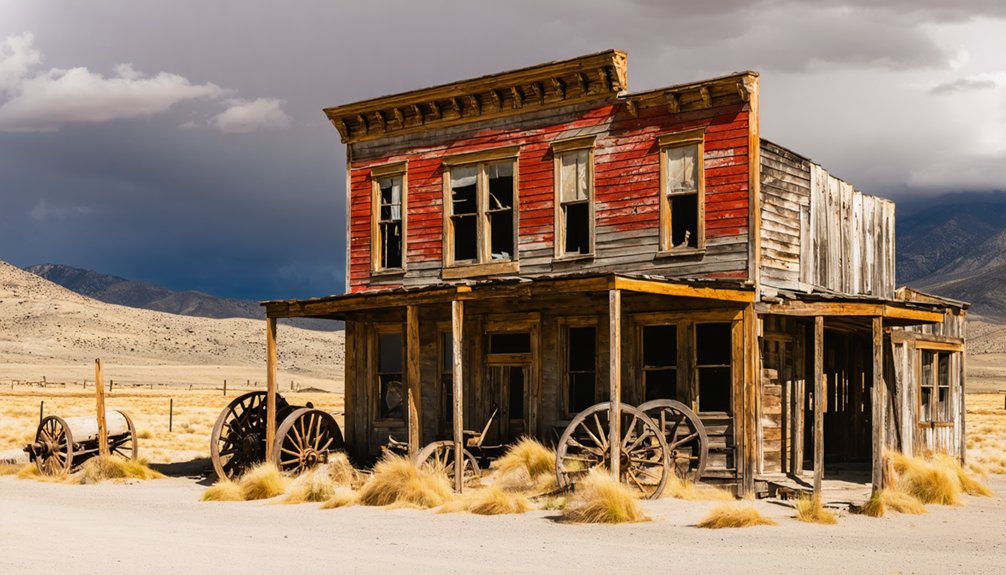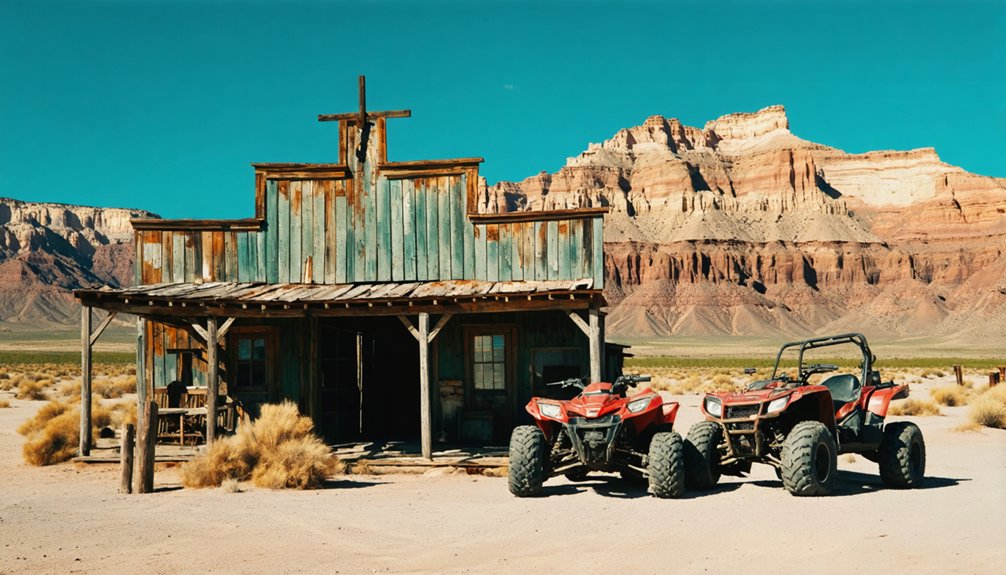
You’ll find exceptional ATV-accessible ghost towns throughout the Southwest, from Swansea’s adobe ruins in Arizona’s Sonoran Desert to Animas Forks’ 11,200-foot elevation mining camp in Colorado’s San Juans. Navigate challenging 4WD routes to Kirwin’s preserved structures in Wyoming’s Shoshone National Forest, or explore Rhyolite’s gold rush remnants via Nevada’s technical backcountry trails. Grafton offers scenic BLM access near Zion, while Silver City provides rugged Forest Service routes through Idaho’s mining heritage. These remote destinations reveal authentic Western history beyond standard tourist access.
Key Takeaways
- Swansea Ghost Town, Arizona offers ATV access through Sonoran Desert terrain with adobe ruins, mine shafts, and primitive camping sites.
- Rhyolite, Nevada features ATV trails up to 50 inches wide accessing Cook Bank building ruins and challenging Secret Pass routes.
- Grafton, Utah provides a 2.5-mile BLM trail accommodating ATVs with restored homesteads and views of Zion’s formations.
- Animas Forks, Colorado requires high-clearance 4WD for the challenging 12-mile route to nine preserved 1880s mining structures.
- Kirwin, Wyoming demands high-clearance 4WD, permits, and Wyoming ORV decal to access 38 buildings and Amelia Earhart’s cabin site.
Swansea Ghost Town Arizona – Desert Mining Adventure on the Peace Trail
Deep in Arizona’s Sonoran Desert, Swansea Ghost Town delivers one of the Southwest’s most authentic off-road mining experiences along the challenging Peace Trail network.
You’ll navigate unpaved desert routes requiring high-clearance vehicles to reach this copper-mining community founded circa 1908-1909. Swansea history reveals rapid development following the Arizona & California Railroad’s arrival, complete with smelters, electric lighting, and thriving businesses that attracted investors seeking fortune.
The mining significance becomes clear as you explore substantial adobe ruins, mine shafts, and industrial remnants scattered across BLM-managed terrain. The town’s infrastructure was supported by a massive 350-ton furnace that processed the extracted copper ore during its operational years. Engineers constructed a 22-mile-long aqueduct to transport water from the Bill Williams River to support the growing mining operations.
Peak production occurred during the 1910s-1920s before economic collapse triggered abandonment around 1943. Stay alert for open mine hazards while respecting the fragile historic fabric.
Five primitive camping sites let you extend your desert exploration beyond daylight hours.
Animas Forks Colorado – High Alpine Exploration via Backcountry Byway
Perched at a breathtaking 11,200 feet in Colorado’s San Juan Mountains, Animas Forks Ghost Town challenges ATV enthusiasts with one of America’s highest alpine mining camp experiences along the legendary Alpine Loop Backcountry Byway.
You’ll navigate twelve rugged miles northeast from Silverton through unimproved mountain roads that demand high-clearance 4WD capability. This National Register site preserves nine stabilized structures from its 1880s boom years when 450 residents endured legendary 23-day blizzards and 25-foot snowdrifts. The town has been abandoned for over 100 years, making it one of the most well-preserved ghost towns in the Western United States. The settlement was originally established by prospectors in 1873 who built the first cabins in this remote alpine location.
High Altitude Exploration Highlights:
- Conquer two 12,000-foot passes on the 65-mile backcountry loop
- Explore preserved Duncan House and Columbus Mill ruins
- Experience America’s most extreme mining camp elevation
- Navigate challenging alpine terrain requiring technical driving skills
- Witness where pioneers tunneled between buildings during epic snowstorms
Kirwin Wyoming – Remote Shoshone National Forest Discovery
You’ll need high-clearance 4WD for the final eight miles to reach Kirwin’s remote location in Wyoming’s Shoshone National Forest, where multiple Wood River crossings and rocky terrain test your vehicle’s capabilities.
The preserved mining ruins offer excellent exploration opportunities on foot, with intact structures from the 1880s gold rush era scattered across the mountainous townsite below Francs Peak. The town once housed over 200 residents by 1906 before being abandoned following a devastating avalanche. The 1907 avalanche that led to the town’s abandonment claimed three lives and marked the end of Kirwin’s mining era.
Your adventure includes a unique connection to aviation history, as you can hike to the cabin site where Amelia Earhart once stayed during the 1930s Dunrud family dude ranch operations.
Remote Forest Access Requirements
Although Kirwin’s weathered buildings lie deep within Wyoming’s Shoshone National Forest, reaching this abandoned mining town requires traversing a complex web of federal regulations and primitive mountain terrain.
You’ll need proper permits and equipment before attempting remote access to this historic site. Your adventure demands a Wyoming ORV decal ($15 annually) even with street-licensed vehicles.
Forest conditions require high-clearance ATVs with spark arrestors and approved mufflers. ATVs typically do not come with safety features upon purchase, so modifications may be necessary for both legal compliance and remote terrain navigation. Check Motor Vehicle Use Maps before departure—designated wilderness areas remain permanently closed to motorized travel. Trail operators must carry current travel maps from the Forest Service to ensure compliance with updated restrictions.
- Washouts and seasonal snow block primitive roads without warning
- Cell coverage vanishes miles before reaching Kirwin’s ghost buildings
- Narrow single-track trails demand precise navigation through dense timber
- Emergency rescue becomes your responsibility in this isolated wilderness
- Freedom comes with self-reliance when civilization disappears behind you
Historic Building Exploration Opportunities
Beyond the regulatory maze and treacherous mountain access, Kirwin’s remarkably preserved structures offer an unparalleled glimpse into high-altitude mining life from the early 1900s.
You’ll discover 38 buildings scattered across this 9,200-foot elevation ghost town, including the two-story hotel with original furnishings and the fully-equipped assay office where miners tested ore samples.
The architectural significance becomes apparent as you explore structures featuring electricity systems and telephone connections—remarkable innovations for remote mountain settlements.
Historic preservation efforts by Wyoming maintain these buildings’ integrity, allowing you to examine sawmill equipment, mining tools, and personal belongings abandoned during the 1907 evacuation.
Each cabin and storehouse tells stories of frontier resilience against harsh mountain conditions. The town was managed by Charles Tewksbury and his wife Sarah, who operated both the general store and the hotel, creating a model mining camp that provided essential goods and lodging for the thriving community. The mining operations flourished between 1902 and 1907 when most tunnels and shafts were driven into the mineral-rich volcanic terrain.
Amelia Earhart Connection Hike
Deep within Shoshone National Forest’s backcountry, a 27.1-mile technical trail leads to one of aviation history’s most intriguing mysteries—Amelia Earhart’s unfinished cabin at Kirwin ghost town.
You’ll navigate multiple Wood River crossings and demanding terrain requiring high-clearance 4×4 capabilities. Once you reach Kirwin’s preserved buildings, hike upstream one mile to discover the Earhart Legacy cabin remnants.
Cabin Exploration highlights:
- Stand where aviation’s most legendary pioneer planned her wilderness retreat in 1934
- Walk among half-finished walls that echo with dreams cut short by her 1937 disappearance
- Experience the profound solitude that drew Earhart to this remote valley sanctuary
- Touch weathered timber beams that witnessed history’s greatest aviation mystery unfold
- Feel the mountain silence that promised peace to a restless explorer’s spirit
Grafton Utah – Scenic BLM Trail With Zion National Park Views
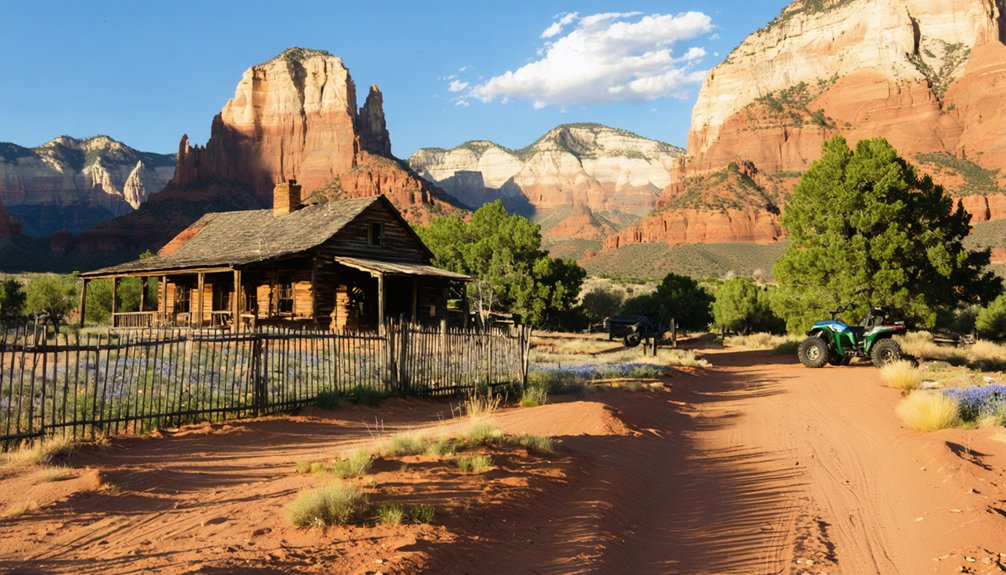
Where else can you cruise a technical rating 1 trail that delivers Zion National Park views while accessing a genuine ghost town?
Grafton’s 2.5-mile out-and-back road starts paved before shifting to dirt, welcoming your ATV, SxS, or high-clearance 4×4. You’ll reach elevation 4,920 feet while absorbing scenic views of Zion’s iconic formations stretching north.
Easy technical rating meets spectacular Zion views on this 2.5-mile dirt road adventure to 4,920 feet elevation.
The trail connects to Smithsonian Butte National Back Country Byway via West Grafton Road in Rockville. BLM manages this network, ensuring your off-road freedom remains protected.
Once you’ve parked, a short 0.4-mile walk reveals Grafton’s restored homesteads and cemetery—authentic Grafton history preserved in Utah’s backcountry.
Pack water during summer’s triple-digit heat, respect surrounding private land, and explore spring through winter for ideal conditions.
Rhyolite Nevada – Historic Gold Rush Ruins Near California Border
You’ll navigate desert trails through southern Nevada’s rugged terrain to reach Rhyolite, where gold discovery in 1904 triggered one of the West’s most dramatic boom-and-bust cycles.
Your ATV can handle the maintained BLM roads leading to this remarkably preserved ghost town, which peaked at 5,000 residents before collapsing to fewer than 25 by 1920.
The surviving ruins include the iconic three-story Cook Bank building and restored Bottle House, offering prime exploration opportunities just outside Death Valley National Park‘s boundaries.
Gold Discovery Mining Boom
When Frank “Shorty” Harris and Ernest L. Cross struck gold on Bullfrog Mountain‘s south side that August morning in 1904, they’d triggered one of Nevada’s most explosive gold rush booms. Their ore samples assayed at $665 per ton in Goldfield, with some reaching $3,000 per ton—equivalent to $105,000 today.
Word spread from Tonopah like wildfire across the desert, drawing thousands of fortune-seekers to this remote terrain. The Montgomery Shoshone Mine became the district’s crown jewel, producing over $1 million in its first three years.
This mining history transformed barren desert into Nevada’s newest boomtown, with over 2,000 claims staked across the rugged 30-mile area.
- Assays reached astronomical $16,000 per ton at peak production
- 1,200 prospectors arrived within two weeks of discovery
- Remote desert location tested every adventurer’s survival skills
- Fortunes made and lost on single ore samples
- Raw frontier justice ruled this lawless territory
Peak Population Ghost Ruins
Towering concrete ruins and crumbling foundations mark where Rhyolite once housed between 3,500 and 5,000 residents during its 1907-08 peak, transforming from desert wasteland to Nevada’s most sophisticated boomtown in just three years.
You’ll navigate past the skeletal remains of what scholars’ population estimates reveal was an electric-powered metropolis complete with opera house, stock exchange, and school serving 74 children while 200 more waited for admission.
The ghost town history unfolds through concrete shells where 50 saloons and gambling halls once thrived.
Alongside the remnants of those vibrant establishments, abandoned mines in California reveal the struggles and aspirations of the prospectors who sought fortune in the harsh landscape. As you wander through these eerie sites, the echoes of ambition and despair resonate with each step, telling tales of a bygone era. These sites not only serve as a reminder of the past but also invite exploration into the rich history of California’s mining boom.
Your ATV will traverse the same desert terrain where four daily stagecoaches carried fortune-seekers before financial panic and ore depletion triggered complete abandonment.
ATV Access Desert Trails
Since the 50-mile Rhyolite Ghost Town Loop cuts through Nevada’s Bullfrog Hills mining district, you’ll tackle fairly easy terrain that accommodates ATVs up to 50 inches wide alongside high-clearance 4x4s and side-by-sides.
These ATV trails connect hundreds of miles of backcountry routes through Sarcobatus Flat’s public lands, offering unrestricted desert exploration beyond park boundaries.
Your machine will handle water crossings up to one foot during wet months, though you’ll face pinstripes and potential sidewall damage on rockier sections.
Secret Pass presents the only technical challenge with steep grades and tight passages, but a bypass keeps you moving.
- Ancient petroglyphs etched into canyon walls by native peoples
- Abandoned mine shafts echoing with century-old prospector dreams
- Rattlesnakes coiled beneath desert sage awaiting unwary riders
- Ghost town ruins standing defiant against relentless desert winds
- Endless horizon promising undiscovered trails beyond mapped territory
Silver City Idaho – Owyhee Mountains Mining Heritage Experience
Sixty million dollars in gold and silver once flowed from Silver City’s mountainous terrain, and today your ATV can navigate the same rugged Forest Service roads that miners carved through Idaho’s Owyhee Mountains at 6,200 feet elevation.
This ghost town preserves extraordinary mining history through 70-plus structures spanning the 1860s boom era when 4,000 residents worked twelve ore-processing mills extracting high-grade silver from War Eagle and Poorman lodes.
You’ll need high-clearance vehicles for steep mountain trails leading from Murphy staging areas.
Navigate carefully around 132,000 feet of documented underground workings and numerous mine portals scattered across Florida Mountain’s granite ridges.
Remember that 99% of property remains privately owned—respect boundaries while exploring this preserved piece of frontier freedom where epithermal veins once yielded thousands per ton.
Frequently Asked Questions
What Safety Equipment Should I Bring When Exploring Abandoned Mine Shafts?
You’ll need essential safety gear for mine exploration: MSHA-approved hard hat, cap lamp, respirator, gas detector, harness with fall protection, first aid kit, and communication device. Don’t venture into vertical shafts without proper climbing equipment.
Are There Camping Facilities or Overnight Accommodations Near These Ghost Towns?
Like scattered oases across desert terrain, you’ll find campground options ranging from primitive BLM dispersed sites to nearby lodgings in towns like Parker, Beatty, and Silverton—each offering freedom to explore remote backcountry.
What Are the Best Months to Visit These Locations for Optimal Weather?
You’ll find ideal temperatures during spring and fall months when seasonal attractions like wildflower blooms enhance ghost town exploration. These periods offer perfect ATV conditions before summer’s brutal heat locks down desert terrain.
Do I Need Special Permits for ATV Riding in These Areas?
Maneuvering bureaucratic red tape isn’t rocket science—you’ll need state-specific permit requirements and must follow local riding regulations. Colorado demands registration fees, Arizona requires range permits, while Nevada’s ghost towns offer freer access.
What Should I Do if My ATV Breaks Down in These Remote Locations?
You’ll want emergency repair kits with essential tools, spare belts, and fluids for quick fixes. Follow basic ATV maintenance tips: check fuel lines, clean air filters, and signal for help while staying with your machine.
References
- https://www.youtube.com/watch?v=Xv9v-xRS_3I
- https://www.outsideonline.com/adventure-travel/destinations/north-america/most-adventurous-ghost-towns-u-s/
- https://dixie4wheeldrive.com/gooseberry_mesa_ghost_town_grafton/
- https://www.tripadvisor.com/Attraction_Review-g31301-d7645184-Reviews-Swansea_Ghost_Town-Parker_Arizona.html
- https://www.frommers.com/slideshows/848476-9-ghost-towns-to-explore-during-road-trips-through-the-american-west/
- https://www.onxmaps.com/offroad/blog/ghost-towns-off-roading
- https://axlengear.com/1150-2/
- https://www.utah.com/listing/rector-dragon-trail/17345/
- https://visithopecounty.com/atvs-in-hope-county-montana/
- https://www.atlasobscura.com/places/swansea-ghost-town