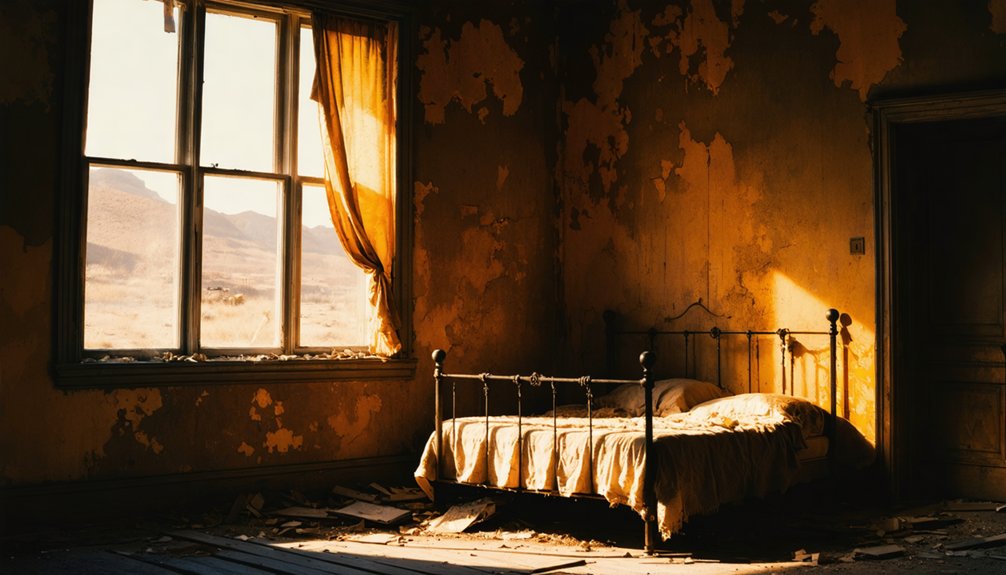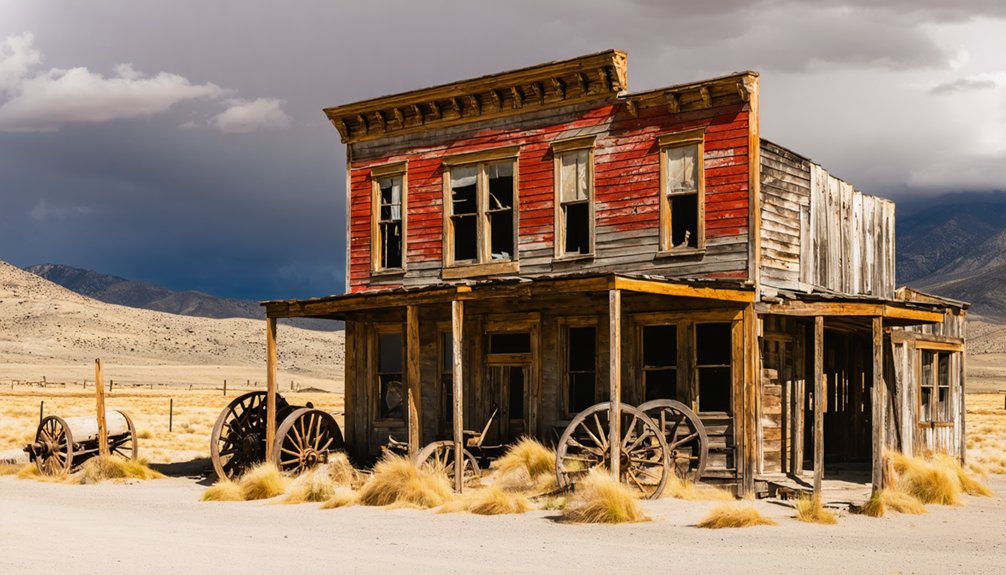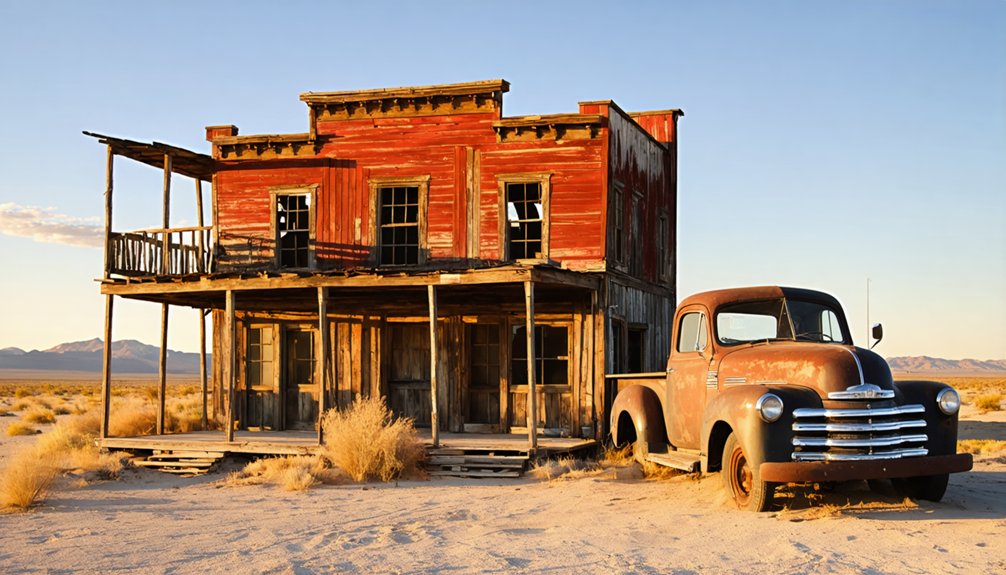
You’ll find over 3,800 documented ghost towns scattered across America, with Texas leading at 511 abandoned settlements, followed by California’s 346 gold rush remnants and Kansas’s 308 failed agricultural communities. These empty places resulted from mining booms gone bust, environmental disasters, economic collapses, and transportation route changes that left entire communities behind. From Bodie’s preserved structures to Centralia’s underground fires, each tells a story of American ambition and the forces that shape our landscape today.
Key Takeaways
- Texas leads with 511 ghost towns, followed by California (346) and Kansas (308), reflecting frontier history and boom-bust cycles.
- Modern ghost towns result from environmental contamination, real estate speculation, infrastructure collapse, and natural disasters like floods and wildfires.
- Historic ghost towns like Bodie, California and Bannack, Montana preserve over 100 weathered structures for public exploration.
- Rust Belt cities experience massive population declines, with Youngstown losing 65% of residents since 1930 due to industrial collapse.
- Mining rushes, single-industry company towns, and transportation hubs created predictable settlement and abandonment patterns across American regions.
The States Leading America’s Ghost Town Count
When you examine the distribution of abandoned settlements across America, Texas dominates the landscape with 511 documented ghost towns, reflecting the state’s vast size and turbulent frontier history.
California follows with 346 abandoned places, largely stemming from gold rush boom-and-bust cycles that left countless mining camps empty.
California’s 346 ghost towns stand as monuments to gold rush dreams that turned to dust when the mines ran dry.
Kansas ranks third with 308 ghost towns, evidence of failed agricultural ventures and railroad route changes that bypassed once-thriving communities.
Florida’s 257 ghost towns reveal how land speculation and environmental challenges created temporary settlements.
South Dakota rounds out the top five with 238 abandoned places, primarily mining towns that couldn’t survive resource depletion. Oklahoma contributes over 200 ghost towns to America’s abandoned landscape, with many emerging from the dramatic land runs that characterized the state’s settlement history. At the county level, Kern County, California leads the nation with 113 ghost towns concentrated in a single area.
This ghost town history demonstrates how economic shifts, natural disasters, and transportation changes shaped America’s settlement patterns, leaving behind tangible reminders of entrepreneurial dreams and pioneering spirit.
What Makes a Modern City a Potential Ghost Town
While historical ghost towns emerged from frontier hardships and 19th-century boom-bust cycles, today’s abandoned settlements stem from distinctly modern forces that can transform thriving communities into empty shells within decades.
You’ll find these contemporary factors drive urban planning failures and population trends toward abandonment:
- Environmental contamination – Dioxin poisoning evacuated Times Beach, Missouri, while coal fires emptied Centralia, Pennsylvania, forcing government buyouts.
- Real estate speculation bubbles – Overbuilding creates empty developments like Spain’s Ciudad Jardín Soto Real and Turkey’s unfinished Burj Al Babas luxury villas.
- Infrastructure dependency collapse – Highway bypasses devastated Route 66 towns like Glenrio, while mine closures abandoned Eagle Mountain, California. Mining communities like Picher, Oklahoma faced complete dissolution when lead and zinc extraction left behind toxic chat piles and contaminated soil. Armed conflicts have also created abandoned settlements, as seen when population exchanges forced the desertion of entire communities.
Modern ghost towns emerge when environmental disasters, speculative overbuilding, or infrastructure shifts make communities economically or physically uninhabitable.
These remnants of human activity can be found in various locations, particularly in remote areas like ghost towns in California’s wilderness. Exploring these forgotten places reveals the stories of those who once called them home and the circumstances that led to their abandonment. As nature reclaims these spaces, they serve as haunting reminders of the fragility of human existence in the face of change.
Historic Ghost Towns You Can Still Visit Today
You can explore dozens of America’s best-preserved ghost towns that offer authentic glimpses into 19th-century frontier life.
These walkable historic mining sites range from California’s Bodie, where over 100 weathered structures stand frozen in time since the 1940s, to Montana’s Bannack, which preserves more than 60 explorable buildings from its 1862 gold rush origins. Some locations like Saint Elmo, Colorado feature ghost sightings with reports of spirits like Annabelle Stark still wandering the historic streets.
State and national park services now maintain these abandoned settlements, allowing you to peer through windows of frontier homes and walk the same streets where thousands of miners once sought their fortunes. Some towns like Terlingua, Texas have been revived as tourist destinations, hosting attractions such as annual chili cook-offs alongside their historic mining ruins.
Best Preserved Western Towns
Among America’s most remarkable ghost towns, several Western settlements have survived decades of abandonment with their historic structures largely intact, offering visitors authentic glimpses into 19th-century frontier life.
You’ll find exceptional preservation at these destinations:
- Bodie, California – Features 100+ original structures maintained through “arrested decay” Bodie preservation policies, though seasonal access limits winter visits.
- Tombstone, Arizona – Offers living Tombstone interpretation with staged re-enactments and museums documenting the famous 1881 O.K. Corral gunfight era.
- Rhyolite, Nevada – Provides outstanding Rhyolite photography opportunities among stone ruins from its 1905-1911 boom period, enhanced by dramatic desert lighting.
Garnet, Montana rounds out top choices with superior Garnet accessibility to dozens of intact log cabins nestled within recovering forest landscapes, managed through low-impact public land policies. Animas Forks stands as Colorado’s highest ghost town at 3,413 meters elevation, where extreme weather conditions once forced residents to construct underground tunnel systems for winter survival. The town’s authentic experience comes without commercial development, preserving its original character for visitors seeking genuine historical encounters.
Walkable Historic Mining Sites
Beyond admiring preserved structures from a distance, several historic mining towns invite you to walk through their streets and explore the very sites where miners once extracted precious metals from the earth.
Park City, Utah offers self guided tours covering 4.2 miles of mining sites, starting at McPolin Barn and ending at the Park City Museum. The tour showcases the largest collection of preserved residential buildings from a metal mining town in Utah.
Lake Valley, New Mexico provides interpretive walking tours year-round through its silver mining remnants, where the Bridal Chamber mine once yielded $7,000 ore pieces.
Gold Hill, North Carolina features restored boomtown streets with wood sidewalks and the Gold Hill Rail Trail. Many of these historic sites offer hands-on experiences where visitors can try gold panning or gemstone sifting using traditional mining techniques.
Historic preservation efforts by organizations like the Bureau of Land Management guarantee these walkable sites remain accessible for exploration.
Cities Experiencing the Steepest Population Declines
Where are America’s once-thriving cities losing residents at the most alarming rates?
You’ll find the steepest declines aren’t just in familiar Rust Belt locations. St. Louis leads major cities with 21,700 residents lost between 2020-2024, while traditional manufacturing centers continue their multi-decade slide.
Population trends reveal three distinct patterns of urban decay:
- Rust Belt collapse: Youngstown’s population plummeted 65% since 1930, with Detroit and Cleveland following similar trajectories due to deindustrialization.
- Coastal exodus: San Francisco, New York City, and Los Angeles shed thousands annually as residents flee high costs and quality-of-life concerns.
- Sunbelt surprises: Even growing states see pockets of decline, with specific suburbs experiencing double-digit drops from economic shocks.
These cities face shrinking tax bases, reduced services, and accelerating outmigration—creating modern ghost towns.
The Most Common Names Found in Abandoned Towns

You’ll find that Center Point dominates America’s ghost town nomenclature, appearing in seven abandoned settlements across Texas counties—the highest frequency among 4,531 documented ghost towns nationwide.
Names reflecting hope and prosperity created distinct patterns in these failed communities, with optimistic choices like Hopewell appearing five times across Florida, Mississippi, Tennessee, and Missouri.
The prevalence of aspirational names such as Aurora, Providence, and Silver City—each appearing four times in the dataset—reveals settlers’ universal desire to establish thriving communities that ultimately couldn’t sustain themselves.
Center Point Dominance
Although ghost towns scatter across America with diverse histories, certain place names appear repeatedly among abandoned settlements, with “Center Point” ranking among the most common designations for these forsaken communities.
You’ll discover that Center Point history reveals a pattern of optimistic beginnings followed by inevitable decline across multiple states.
Texas alone hosts two distinct Center Point communities that exemplify this phenomenon:
- Camp County’s Center Point – Established around 1865-70 by the Willie Johnson family as a Freedmen’s community, attracting additional families seeking post-Civil War independence.
- Panola County’s Center Point – Founded after the American Civil War, thrived until World War II population relocations began.
- Complete abandonment – Panola County’s Center Point community became fully deserted by 2000.
These Center Point community examples demonstrate how geographic centrality promised prosperity but couldn’t guarantee permanence.
Hope and Prosperity Names
Beyond geographic positioning, settlers frequently chose town names that reflected their dreams and aspirations for the future.
“Hopewell” stands as the most prevalent hope-themed name among America’s ghost towns, appearing five times across Florida, Mississippi, Tennessee, and twice in Missouri (including Hopewell Furnace).
This optimistic naming pattern extends throughout abandoned settlements, with “Wilson” matching Hopewell’s frequency at five instances across Florida, Illinois, Maryland, and Michigan.
“Providence” follows closely with four ghost towns sharing this faith-based name.
You’ll find prosperity themes woven throughout America’s lost settlements—”Victoria,” “Silver City,” “Carpenter,” and “Corwin” each appear four times.
These aspirational names reveal settlers’ unwavering belief that their communities would flourish, even as economic realities eventually forced abandonment of their once-promising towns.
Economic Booms That Created Ghost Town Clusters
When massive gold and silver discoveries swept across the American West in the mid-19th century, they triggered unprecedented population explosions that transformed empty landscapes into bustling towns within months.
You’ll find these boom-bust cycles created America’s largest ghost town clusters through predictable patterns of economic fluctuations and eventual resource depletion.
Three major boom types generated ghost town clusters:
Mining rushes, company towns, and transportation hubs each followed distinct economic patterns that created America’s concentrated ghost town corridors.
- Mining rushes – Gold, silver, and copper discoveries created thousands-strong populations overnight, followed by rapid abandonment when ore ran out.
- Single-industry company towns – Coal and oil operations built entire communities that collapsed when corporations departed or restructured.
- Transportation hubs – Railroad junctions and freight stops thrived until route changes redirected commerce elsewhere.
These economic patterns repeated across regions, leaving behind concentrated ghost town corridors that still dot the American landscape today.
Natural Disasters and Environmental Factors Behind Abandonment
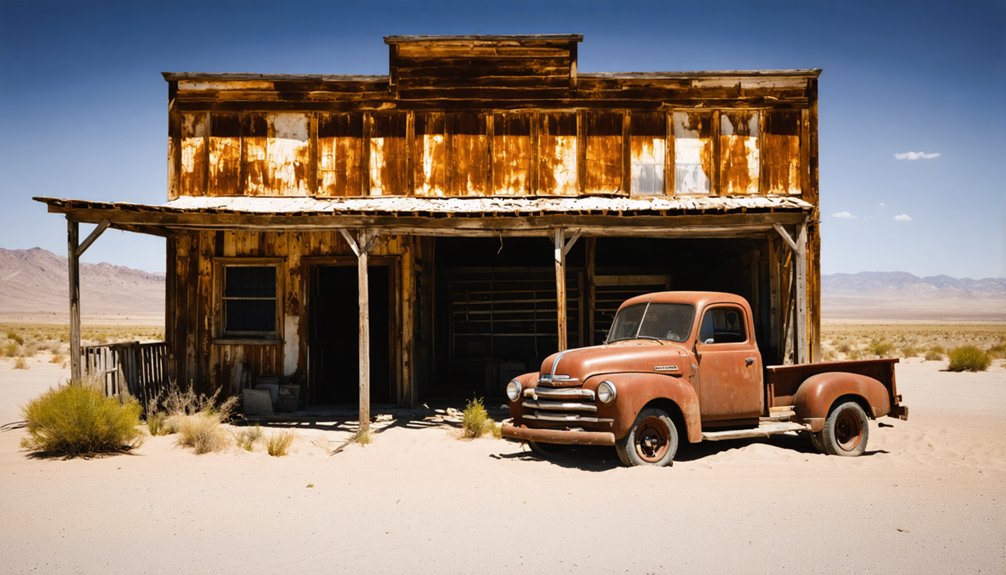
While economic forces created most of America’s ghost towns, natural disasters and environmental changes have claimed hundreds of communities through sudden catastrophes and gradual habitat degradation.
You’ll find abandoned settlements along coastlines where rising seas swallowed Holland Island, Maryland, and Burrwood, Louisiana, forcing permanent evacuations as infrastructure collapsed beneath advancing waters.
Climate impact extends beyond coastlines—extended droughts emptied agricultural towns across western plains when groundwater wells failed and crops withered.
Catastrophic floods prompted complete relocations, like Valmeyer, Illinois, after 1993’s devastating deluge made rebuilding impossible.
Wildfires have erased entire neighborhoods in western states, while hurricanes routinely overwhelm disaster recovery efforts in vulnerable communities, leaving residents no choice but permanent abandonment when reconstruction costs exceed local resources.
From Mining Camps to Oil Boomtowns: Regional Patterns of Rise and Fall
America’s extractive industries created distinct regional patterns of settlement and abandonment that stretched from California’s gold rush camps to Texas oil boomtowns, each following predictable cycles tied to resource discovery, extraction economics, and market forces.
You’ll find mining legacies concentrated in western mountain regions, where gold and silver discoveries sparked rapid population spikes followed by inevitable decline as deposits exhausted. Oil discoveries created different patterns, producing more sustained communities in Texas, Oklahoma, and California due to longer-term extraction potential.
Three key factors determined survival rates across regions:
- Transportation infrastructure – proximity to railroads and shipping routes
- Resource longevity – depth and quality of deposits determined extraction timeframes
- Corporate investment – company-backed operations outlasted individual prospector camps
Regional boom-bust cycles reflected broader economic forces beyond local resource depletion.
Frequently Asked Questions
Are There Any Ghost Towns That Became Populated Again After Being Abandoned?
Yes, you’ll find several ghost towns experienced community resurgence through revitalization efforts. Jerome, Arizona transformed from abandoned copper town into thriving arts community. Aspen, Colorado evolved from silver crash ghost town into major ski destination.
What Happens to the Property Rights When a Town Becomes Abandoned?
You’ll face massive ownership disputes when towns die—property titles don’t vanish with residents! Private ownership persists until formal property transfer through foreclosure, tax sales, or escheat proceedings legally clear fragmented titles.
Can You Legally Live in or Buy Property in Ghost Towns?
You can legally buy ghost town property if clear title exists, but legal restrictions often prevent immediate habitation. You’ll face zoning laws, building codes, environmental hazards, and utility requirements that typically require extensive permits and investments.
How Long Does It Typically Take for a Town to Become Abandoned?
Like leaves falling from a dying tree, towns typically face abandonment within 30-40 years. You’ll find the abandonment timeline depends on historical factors: resource depletion, economic shifts, infrastructure changes, and population decline accelerating the process.
Do Ghost Towns Pose Any Safety or Health Risks to Visitors?
Yes, you’ll face significant risks from unstable abandoned structures that can collapse without warning, plus serious environmental hazards including toxic gases, contaminated water, heavy metals, and asbestos exposure from deteriorating buildings.
References
- https://themortgagepoint.com/2024/10/25/americas-new-ghost-towns/
- https://www.loveexploring.com/gallerylist/188219/the-us-state-with-the-most-ghost-towns-revealed
- https://devblog.batchgeo.com/ghost-towns/
- https://www.geotab.com/ghost-towns/
- https://www.mentalfloss.com/geography/american-ghost-towns-can-still-walk-through
- https://www.youtube.com/watch?v=aTbMdOZRZO4&vl=en
- https://en.wikipedia.org/wiki/Lists_of_ghost_towns_in_the_United_States
- https://joybird.com/blog/top-ghost-towns-in-america/
- https://infrastructureusa.org/spooky-infrastructure-ghost-towns-across-the-united-states/
- https://www.islands.com/2003205/state-with-most-abandoned-ghost-towns-texas/