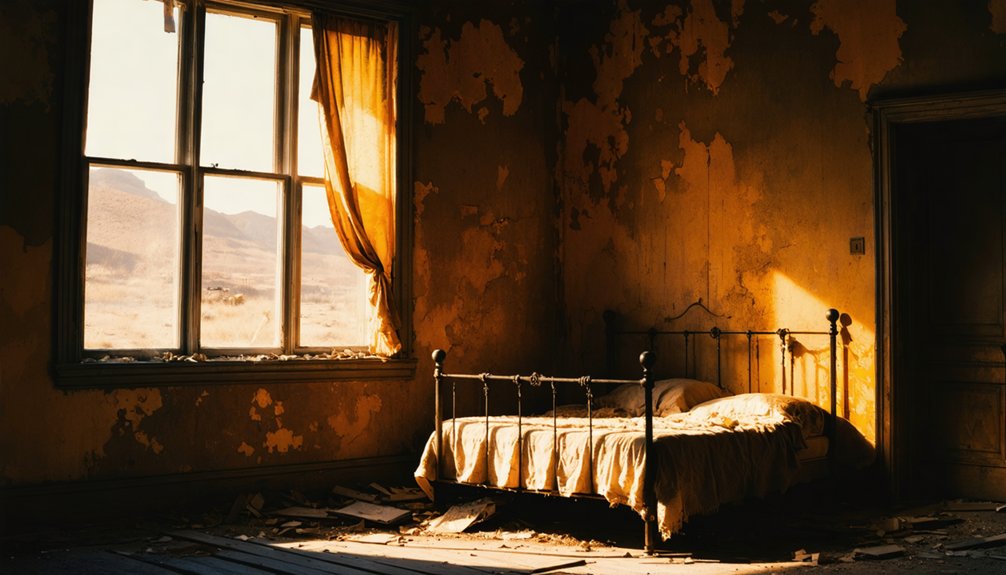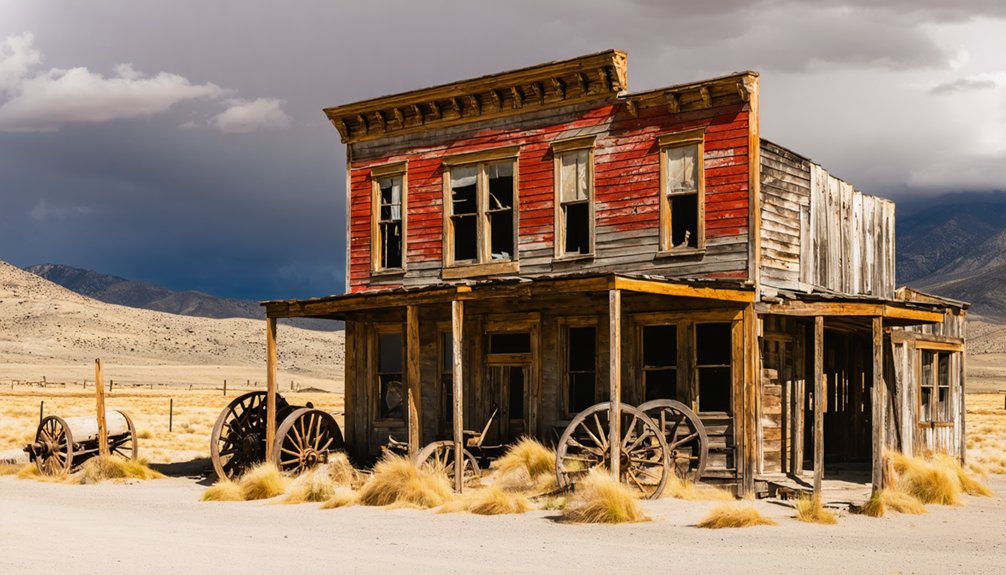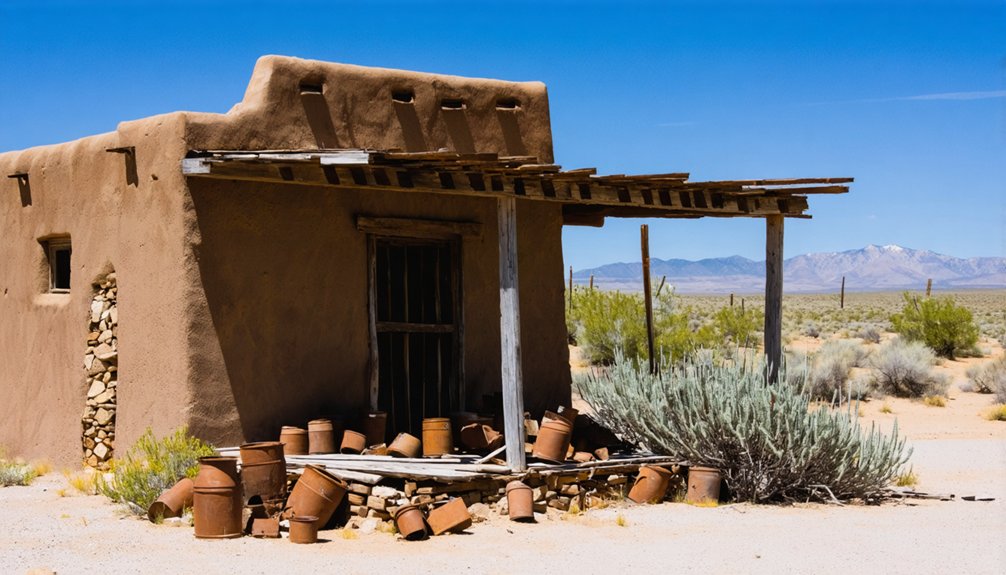
You’ll find authentic ghost towns scattered throughout New Mexico’s high desert, each telling stories of boom and devastating bust. Cerrillos preserves turquoise-mining ruins where Pueblo peoples extracted stones for centuries before 21 saloons served 1880s prospectors. Madrid’s coal-powered past transformed into an artist haven, while Dawson’s tragic mining explosions claimed 383 lives. Golden marks the first gold rush west of the Mississippi. These haunting landscapes offer deeper histories than their weathered facades suggest.
Key Takeaways
- Historic mining towns like Cerrillos and Madrid along the Turquoise Trail offer preserved structures and ghost-town aesthetics.
- Dawson became a ghost town after deadly mining explosions in 1913 and 1923 killed 383 miners total.
- Abandoned railroad communities like Duran and Magdalena declined when rail traffic patterns shifted, leaving visible remnants.
- Albuquerque’s urban sprawl has absorbed smaller settlements, with mining shafts and Route 66-era ruins still discoverable.
- Ghost town destinations within two hours of Albuquerque include Golden’s gold rush sites and Shakespeare’s 1854 buildings.
Historic Mining Towns Along the Turquoise Trail
When you drive north from Albuquerque along the Turquoise Trail (NM-14), you’ll encounter three ghost towns that tell the story of New Mexico’s mining heritage spanning over two millennia.
Cerrillos history reaches back 900–2,000 years when Pueblo peoples extracted sacred turquoise from these hills. By the 1880s boom, you’d have found 21 saloons and four hotels serving miners pulling gold, silver, and zinc from the earth. The town was once considered as a potential capitol of New Mexico during its prosperous mining days. The Cerrillos Hills were formed from volcanic up-thrust 34 million years ago, rich in turquoise, silver, and lead.
Today, you can explore the preserved mining landscape at Cerrillos Hills State Park.
Wander through ancient turquoise mining sites and discover centuries of extraction history preserved in this remarkable state park landscape.
Madrid’s coal-powered past transformed into an artist haven after mid-20th-century mine closures. The Madrid revival repurposed company town structures into galleries and shops, preserving its ghost-town aesthetic.
Golden marks 1825’s first gold rush west of the Mississippi, where San Francisco Catholic Church still stands from 1830.
Abandoned Railroad Communities and Flood-Devastated Settlements
The iron rails that once carried prosperity through central New Mexico now lie buried under decades of desert sand and urban development.
You’ll discover abandoned stations scattered throughout the region where towns like Duran and Magdalena once thrived around railroad repair shops and freight spurs. When rail traffic shifted to larger hubs, these communities withered into ghost settlements.
As you continue your journey, you’ll encounter abandoned towns along highway 395 that tell stories of a past era. The remnants of shops and homes offer a haunting glimpse into the lives once lived. Exploring these forgotten places reveals the quiet beauty that nature has reclaimed over time.
You can still trace visible grades and trestles from aerial imagery, while roadside exploration reveals rail artifacts like scattered spikes and tie fragments at former depot sites.
The historic Santa Fe yards in Albuquerque left massive derelict infrastructure after downsizing—roundhouse foundations and unused spurs creating urban ruins. The original large roundhouse with 35 bays for engine repairs was demolished in 1986, erasing one of the most significant structures from the railway era. The nearby Bridal Chamber at Lake Valley produced over 2 million ounces of silver from a pocket the size of a dining room, connecting the region’s rail network to its lucrative mining heritage.
These remnants represent your freedom to explore forgotten chapters of New Mexico’s transportation history.
Industrial Disasters That Created Ghost Towns
Although New Mexico’s mining boom promised prosperity, industrial catastrophes transformed thriving communities into memorial landscapes scattered with white crosses and silent foundations.
You’ll find Dawson’s story epitomizes how mining tragedies can erase entire towns from existence. Two devastating explosions—October 1913 claiming 236 lives, February 1923 killing 123—claimed 383 miners total when coal dust ignited underground. The 1913 explosion was the second-worst mining disaster in U.S. history. The 1923 blast was so powerful it shattered half-ton concrete boulders like paper. Many victims in the second disaster were sons of 1913 casualties.
Two explosions a decade apart claimed 383 miners in Dawson, with sons dying in the same tunnels that killed their fathers.
After Phelps Dodge shuttered operations around 1950, residents received thirty days’ notice to evacuate. The company-owned city had previously avoided the labor disputes that plagued other mining regions.
Today, you’ll discover only ghostly remnants: 383 white iron crosses marking immigrant miners’ graves, scattered foundations, and the haunting silence beneath craggy mesas where 9,000 people once lived.
Hidden Remnants Within Albuquerque Metro Area
While Dawson’s industrial catastrophes created instant ghost towns, Albuquerque’s metropolitan sprawl has quietly swallowed dozens of smaller settlements, leaving hidden remnants scattered across the high desert like archaeological breadcrumbs.
You’ll discover these hidden histories along the Turquoise Trail, where collapsed mining shafts and tailings piles mark centuries-old extraction sites in the Ortiz Mountains.
Route 66-era settlements survive as stone foundations visible on satellite imagery, while abandoned railroad spurs reveal freight platforms and scattered ballast from forgotten branch lines.
The Rio Puerco Valley holds homestead ruins and dried acequia traces—remnants of agricultural communities abandoned during the Dust Bowl. Some locations have served as filming locations for movies and television productions, emphasizing their cultural significance beyond their historical value.
This urban archaeology tells stories of economic shifts and cultural adaptation. Many sites sit on private land, requiring landowner permission, but public areas offer interpretive markers connecting you to Albuquerque’s layered past. These forgotten settlements often carry spiritual echoes, with visitors reporting ghostly apparitions similar to those documented at Old Town’s historic buildings.
Day Trip Destinations and Visitor Safety Guidelines
When planning ghost town explorations from Albuquerque, you’ll find exceptional destinations within a two-hour radius that showcase New Mexico’s mining heritage and Route 66 history.
Madrid offers well-preserved coal-mining structures with galleries and authentic Route 66 atmosphere. Cerrillos displays turquoise-mining ruins just 45 minutes away, while the Cuervo corridor reveals abandoned gas stations along historic I-40.
Your day trip planning must account for vehicle clearance on dirt roads and seasonal weather impacts. Visitor preparedness requires checking land ownership—many sites mix private and public access.
Pack extra water, maps, and emergency supplies since cell coverage disappears in remote canyons.
Never enter unstable structures or approach mine shafts. These hazards killed miners decades ago and remain deadly today.
Respect artifact protection laws and leave sites undisturbed for future explorers seeking authentic encounters with New Mexico’s vanished communities. Golden represents the site of the first gold rush west of the Mississippi River and provides additional historical context for understanding the region’s mining legacy. Shakespeare Ghost Town features the oldest building dating to 1854 and offers guided tours that detail the area’s extensive historical significance through displayed artifacts.
Frequently Asked Questions
What Legal Permissions Are Needed to Explore Ghost Towns on Private Property?
You’ll need written landowner permission protecting your property rights—signed letters or emails work best. For repeated visits, owners often require exploration permits, liability waivers, or insurance documentation before granting access.
How Do I Identify Authentic Ghost Town Artifacts Versus Modern Debris?
You’ll distinguish authentic pieces through careful artifact evaluation—examining patina depth, manufacturing marks, and soil encrustation patterns. Historical significance emerges when you document provenance, compare typologies, and assess wear consistent with prolonged burial versus recent placement.
Which Ghost Towns Offer Overnight Camping or Accommodation Options Nearby?
You’ll find camping options near Chloride via Winston’s motels, while Pinos Altos offers Gila Forest campgrounds nearby. Mogollon provides primitive forest camping, and Cerrillos has nearby accommodations in Madrid’s charming artist community.
Are There Guided Ghost Town Tours Available From Albuquerque Year-Round?
Like whispers calling from forgotten streets, you’ll find guided tours operating year-round from Albuquerque’s Old Town. These lantern-lit adventures run nightly since 2001, offering you freedom to explore centuries of haunted history whenever wanderlust strikes.
What Photography Restrictions Exist at Historical Ghost Town Cemetery Sites?
You’ll need written permission for commercial shoots and must respect photography ethics by avoiding recent graves, staying on paths, and practicing cemetery respect—especially at private sites like White Oaks where owner consent’s mandatory.
References
- https://newmexicotravelguy.com/new-mexico-ghost-towns/
- https://www.atlasobscura.com/things-to-do/new-mexico/ghost-towns
- https://www.newmexicoghosttowns.net/counties
- https://santafe.com/new-mexico-road-trip-ghost-towns/
- https://www.newmexico.org/places-to-visit/ghost-towns/
- https://en.wikipedia.org/wiki/List_of_ghost_towns_in_New_Mexico
- https://www.newmexico.org/places-to-visit/ghost-towns/map/
- https://www.turquoisetrail.org/stops/category/cerrillos/
- https://santafe.com/cerrillos-and-madrid-new-mexico-magic-on-the-turquoise-trail/
- https://www.newmexicomagazine.org/blog/post/on-the-turquoise-trail/