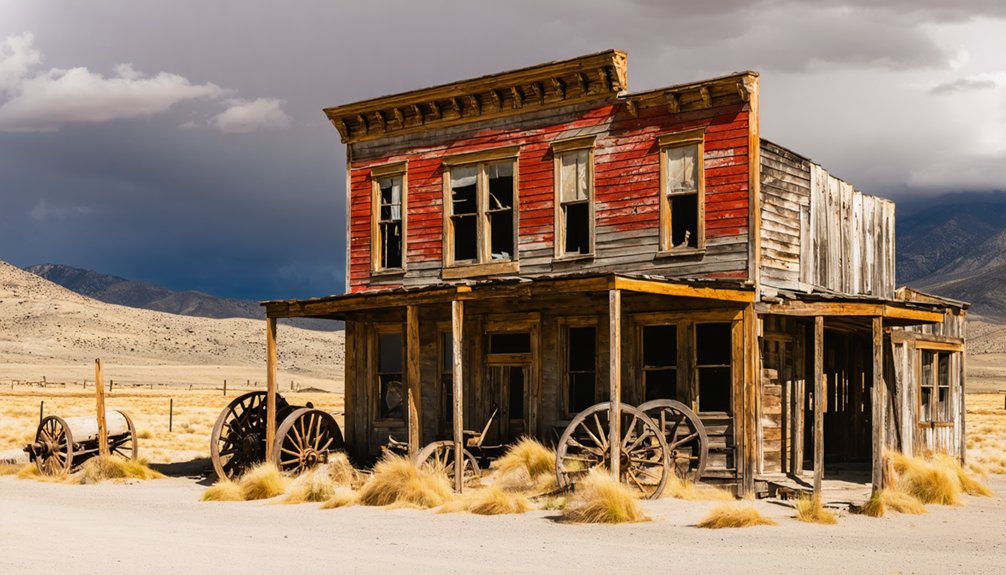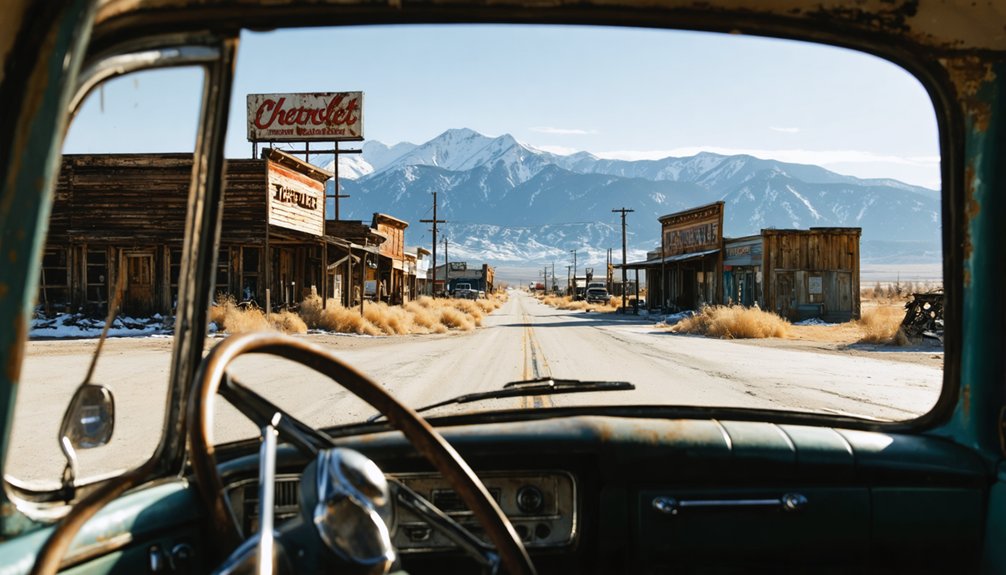
You’ll discover dozens of abandoned settlements along Interstate 70‘s 451-mile stretch through Colorado, where crumbling Victorian storefronts and rusted mining equipment mark the dramatic rise and fall of America’s last great mineral boom. These ghost towns emerged from railroad expansion in the 1870s, flourished during gold and silver rushes, then withered after the 1893 silver crash and technological changes that eliminated mining jobs. Understanding their stories reveals the powerful forces that shaped the American West.
Key Takeaways
- I-70 follows historic railroad routes that connected Denver to Colorado’s mining regions, creating numerous boom-and-bust communities.
- Georgetown and Silver Plume serve as preserved Victorian railroad centers offering mine tours and heritage tourism attractions.
- Leadville peaked at 25,000 residents during the 1879-1880 silver boom before declining after the 1893 silver crash.
- Visitors face safety hazards including deteriorating mine buildings, contaminated soil, and trespassing restrictions on private property.
- Many ghost towns offer seasonal access with restrictions, particularly along Independence Pass during winter months.
Railroad Watering Stops and Transportation Hubs
As you drive along I-70 through Colorado’s mountain corridors, you’re following paths that railroads carved more than a century ago to connect Denver with the state’s mineral wealth.
The Colorado Central Railroad reached Georgetown in 1877, establishing essential railroad hubs that served mining operations throughout the Rockies. These transportation stops became lifelines for boomtowns like Silver Plume, connected by the engineering marvel of Georgetown Loop‘s 300-foot trestle spanning Devil’s Gate canyon. The narrow gauge railroad was completed in 1884 and originally transported ore to Denver.
The Denver & Rio Grande aggressively expanded westward from 1870-1876, creating competing networks with the Denver, South Park & Pacific. Their race to reach Leadville and Aspen transformed remote mountain settlements into bustling railroad hubs. The Glenwood Canyon corridor became crucial for American land transportation when the railroad was built in 1887.
When silver crashed in 1893, these once-vital transportation stops gradually emptied, leaving behind the ghost towns you’ll encounter today along your I-70 journey.
Mining Boom Communities in the Colorado Rockies
The railroad networks that connected Colorado’s mountain settlements enabled the explosive growth of mining boom communities that would define the state’s character for generations.
You’ll discover remarkable mining heritage as you explore these legendary districts that once housed tens of thousands of fortune-seekers.
Three major boom communities showcase Colorado’s mining evolution:
- Leadville – Silver capital peaking at 25,000 residents during 1879-1880, featuring extensive smelting operations and labor unrest requiring militia intervention.
- Cripple Creek & Victor – Last great gold camp exceeding 50,000 people, built within a volcanic caldera with hundreds of independent mines.
- Georgetown & Silver Plume – Victorian railroad centers processing regional ores, connected by narrow-gauge railways across steep terrain.
These mining communities were shaped by territorial designation following the gold discoveries that led to Colorado’s territorial status in 1861. The first working gold arrastra was installed at Gregory Diggings near Black Hawk in 1860, establishing early ore processing technology in the territory.
Today’s ghost town exploration reveals preserved Victorian architecture, mine tours, and heritage tourism attractions where underground workings and stamp mills tell stories of Colorado’s mineral wealth.
Carbon County’s Short-Lived Boomtowns
You’ll find Carbon County’s boomtowns epitomized the volatile cycle of rapid expansion and swift abandonment that characterized western mining settlements.
When the Denver and Rio Grande Western Railroad discovered vast coal fields in the early 1880s, entire communities sprang up almost overnight to house miners and railroad workers in company-built towns.
These settlements experienced dramatic population surges during construction booms, only to face inevitable decline as resources depleted or economic conditions shifted toward oil and gas in the mid-20th century. The dangerous working conditions led to high tuberculosis rates among miners in these underground operations. Many of these abandoned mining camps eventually became ghost towns, mirroring the fate of Colorado’s silver mining communities after the economic collapse of 1893.
Rapid Rise and Fall
When Denver and Rio Grande Western Railroad discovered vast coal fields in Carbon County during the early 1880s, it triggered one of Utah’s most dramatic mining booms that would reshape the entire region within decades.
You’ll find ghost town narratives throughout Carbon County that reveal how quickly fortunes changed. Coal companies imported laborers from southern and eastern Europe plus Japan, creating transient populations that swelled mining camps almost overnight.
The boom’s intensity becomes clear through these peak population figures:
- Price – 8,712 residents as county seat and principal city
- Helper – 2,148 inhabitants earning the nickname “town of 57 Varieties”
- Wellington – 1,632 people amid coal-driven growth
However, economic shifts eventually reduced coal reliance, leaving many short-lived boomtowns as abandoned relics scattered across the landscape. The dangerous nature of mining became tragically apparent through devastating mine explosions that claimed hundreds of lives and sparked major labor strikes throughout the region. These boom-and-bust cycles would later echo throughout western energy regions, with communities experiencing similar patterns of rapid growth followed by economic decline.
Railroad Construction Boom
Railroad companies didn’t just extract coal from Carbon County—they built entire towns around their operations.
You’ll find remnants of settlements that sprang up wherever spur lines reached profitable coal seams. Railroad expansion drove immediate town platting near new sidings, creating company-controlled communities with boarding houses, stores, and mine offices.
The Carbon County Railway’s 4.72-mile line from Columbia Junction to Columbia exemplifies how short feeder lines created logistical nodes supporting service communities. This Utah corporation operated through an operating agreement with The Denver and Rio Grande Railroad Company, which provided locomotives and crews for the actual transportation.
Labor migration brought diverse immigrant workers—including substantial Greek populations—who settled in these rail-mining towns. Construction gangs boosted populations during tracklaying, then vanished when projects finished.
By 1915, coal mining became a major contributor to Utah’s economic growth, supported by the Rio Grande line through Carbon County and various coal transport railroads.
These towns depended entirely on continued rail operations. When companies abandoned branch lines or shifted routes, thriving settlements became ghost towns almost overnight.
Mining Camp Volatility
Three factors drove rapid boom-and-bust cycles:
- Resource depletion – Seams proved marginal or exhausted faster than anticipated.
- Market volatility – Declining coal prices and competition forced closures.
- Catastrophic events – Mine explosions and fires triggered permanent abandonment.
These transient communities experienced massive population swings tied directly to mine operations, creating the ghostly remnants you’ll encounter today.
Economic Forces Behind Mass Abandonment

Although boom-and-bust cycles defined much of the American West’s settlement patterns, the ghost towns scattered along Interstate 70 reveal how economic forces systematically dismantled communities that once thrived.
You’ll find that single-resource economic dependency created fatal vulnerabilities—when gold mines closed in Bodie, California after 1913, rapid population decline followed inevitably.
Resource price collapses triggered catastrophic busts in dependent communities, while infrastructure bypassing accelerated abandonment. Interstate 70 itself bypassed places like Cisco, Utah, draining highway-dependent businesses of essential traffic.
Critical service losses compounded these problems—hospital closures in rural counties triggered population exodus, creating vicious cycles where declining populations made remaining services unviable, ultimately sealing entire communities’ fates.
Technological Changes That Sealed Their Fate
While economic dependency made these communities vulnerable, technological revolutions delivered the final blow that transformed thriving settlements into empty shells along the interstate corridor.
Technological progress carved out the heart of America’s small towns, leaving behind hollow monuments to obsolete industries.
You’ll witness how mining towns like Rhyolite, Nevada and Ashcroft, Colorado couldn’t adapt when mechanization reduced labor needs after exhausting their gold and silver veins.
Railway bypasses systematically isolated places like Glenrio when I-40 replaced Route 66, severing transportation lifelines.
Modern ghost towns emerge from three critical technological shifts:
- Resource extraction automation – eliminating thousands of mining jobs
- Transportation modernization – highways bypassing railroad-dependent communities
- Digital infrastructure gaps – rural connectivity failures preventing economic diversification
Today’s rural leaders recognize that inadequate broadband access dooms remaining communities.
Without digital infrastructure connecting them to modern commerce, you’re watching history repeat as technological progress continues abandoning those who can’t keep pace.
Current Conditions and Safety Hazards
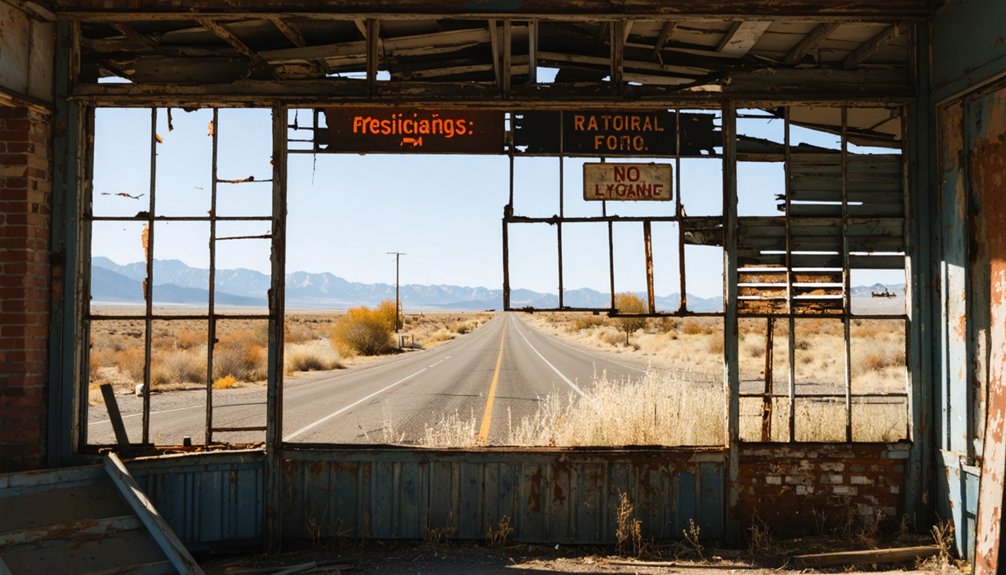
Despite their haunting allure, today’s ghost towns along I-70 present serious dangers that have intensified since abandonment decades ago.
You’ll encounter seasonal access restrictions—Independence Pass typically closes November through May, while unpaved roads become impassable when wet. These timing constraints can trap you in dangerous conditions.
Structural hazards dominate these sites. Abandoned mine buildings suffer advanced deterioration, creating collapse risks without warning.
You’ll find rotting railroad trestles, unstable masonry chimneys, and hidden mine shafts that pose entrapment dangers. Contaminated soil from heavy metals like lead and arsenic threatens your health through contact or ingestion.
Legal risks compound physical dangers. Many sites sit on private property or closed Superfund areas, resulting in trespass fines.
Vandalism has prompted managers to restrict access further, limiting your freedom to explore safely.
Film Locations and Cultural Legacy
You’ll discover that ghost towns along I-70 became essential Hollywood backdrops starting in 1928 when *In Old Arizona*, the first outdoor sound Western, filmed at Grafton near Zion National Park.
Cisco emerged as the most cinematically significant location after serving as the climactic setting for *Vanishing Point* (1971) and key scenes in *Thelma & Louise* (1991), transforming this abandoned railroad town into a pilgrimage destination for film enthusiasts.
You can still visit the remnants of the Shell gas station where these iconic scenes unfolded, while Buzzard’s Belly General Store capitalizes on this legacy by selling movie memorabilia to tourists drawn by Hollywood’s enduring connection to these authentic desert ruins.
Hollywood’s Desert Backdrops
The vast desert landscapes stretching along the I-70 corridor have served as Hollywood’s canvas for decades, transforming Utah’s red-rock canyons and salt flats into iconic backdrops that defined the American Western genre.
These Hollywood landscapes became synonymous with frontier freedom, from Monument Valley‘s towering buttes in John Wayne classics to San Rafael Swell‘s rugged canyons.
You’ll recognize these cinematic aesthetics from productions that shaped America’s visual identity:
- Monument Valley – John Wayne Westerns established the iconic sandstone formations as symbols of untamed frontier.
- Bonneville Salt Flats – High-speed chase sequences utilized the distinctive white expanses for dramatic effect.
- San Rafael Swell – Red-rock formations provided authentic homestead and canyon backdrops accessible via I-70.
Thelma & Louise immortalized I-70’s desert vistas, cementing these locations as cinematic landmarks representing American independence and boundless horizons.
Cinematic Tourism Impact
Despite vandalized structures and desert heat, movie enthusiasts travel across state lines to stand where Hollywood’s most iconic chase scenes unfolded, proving cinema’s power to transform forgotten places into cultural landmarks.
Preserving Filmed Heritage
Hollywood’s cameras didn’t just capture these ghost towns—they inadvertently rescued them from complete obscurity. Film preservation efforts have transformed decaying settlements into cultural landmarks where cinematic heritage thrives.
You’ll find three distinct approaches to maintaining these filmed locations:
- Commercial preservation – Cisco’s Buzzard’s Belly General Store capitalizes on Thelma & Louise and *Vanishing Point* nostalgia, selling memorabilia to movie pilgrims.
- Structural maintenance – Grafton’s five adobe buildings remain intact as Utah’s best-preserved ghost town, thanks to its Butch Cassidy fame.
- Natural decay documentation – Cisco’s crumbling structures continue deteriorating, creating authentic backdrops for contemporary productions.
While Cisco faces ongoing vandalism and structural collapse, its film legacy guarantees continued visitor interest.
Grafton’s movie connection secured permanent preservation status, proving cinema’s power to save abandoned places.
Preservation Efforts and Heritage Tourism
While many I-70 ghost towns face inevitable decay, preservation organizations have stepped forward to protect Colorado’s mining heritage through coordinated efforts spanning local, state, and national levels.
History Colorado stabilizes historic places statewide, while Colorado Preservation Inc. maintains an annual Endangered Places List. You’ll find Empire’s successful heritage conservation has added four buildings to state and national registers, including the historic Peck House.
These preservation efforts have created sustainable tourism strategies that benefit both conservation and local economies.
Forest City residents secured Historic Landmark designation, allowing structure ownership while maintaining public land status. You can visit Bodie’s 200,000 annual visitors or explore Forest City’s dance hall tours.
Signs at preserved sites emphasize your responsibility as a citizen protecting Colorado’s historical heritage.
Frequently Asked Questions
Can I Legally Camp Overnight in Abandoned Ghost Towns Along I-70?
You can’t legally camp in most ghost towns along I-70. With 50+ abandoned sites restricting access, ghost town regulations typically prohibit overnight stays, though legal camping exists on nearby BLM dispersed areas and designated campgrounds.
What Permits or Permissions Do I Need to Explore Private Ghost Towns?
You’ll need written permission from property owners before entering private ghost towns. Follow exploration guidelines requiring owner contact, respect posted boundaries, and conduct historical research to identify current landowners through county records.
Are There Any Ghost Towns With Remaining Residents or Businesses Still Operating?
Life still flickers in residential ghost towns like Gold Hill and St. Elmo, Colorado, where you’ll discover operating businesses including general stores, museums, and lodging that serve both residents and adventurous visitors.
In contrast, ghost towns in Arizona’s deserts often stand as silent witnesses to a different era, where remnants of mining operations and abandoned structures evoke a sense of history yet to be fully captured. Some of these sites, like Jerome and Tombstone, attract those curious about the tales of old, offering glimpses into lives once lived in harsh conditions. Visitors can explore crumbling facades and dusty streets, each corner inviting stories of resilience, adventure, and decline.
Which Ghost Towns Are Wheelchair Accessible or Suitable for Young Children?
Silver Plume offers excellent wheelchair access with flat terrain and paved highways. St. Elmo and Gold Hill provide family friendly activities on level ground, perfect for young children exploring dusty streets and historic buildings safely.
What’s the Best Time of Year to Visit High-Altitude Ghost Towns Safely?
You’ll find the best hiking months are early June through September when seasonal weather conditions offer mild temperatures and accessible roads. Start early morning to avoid afternoon thunderstorms and always check current conditions.
References
- https://www.onlyinyourstate.com/experiences/utah/cisco-ut
- https://welovetoexplore.com/ghost-town-cisco-utah/
- https://www.wyomingcarboncounty.com/blog/123-5-ghost-towns-to-explore
- https://www.colorado.com/articles/colorado-ghost-towns
- https://en.wikipedia.org/wiki/Cisco
- https://seelincolncounty.com/bovina-colorado-ghost-town/
- https://savingplaces.org/guides/ghost-towns-on-route-66
- https://texashighways.com/travel/the-quest-to-resurrect-a-ghost-town/
- https://www.deseret.com/1995/7/9/19181272/georgetown-silver-plume-colorado-historic-district-west-of-denver-along-i-70-includes-2-old-mining-t/
- https://www.simonsulyma.com/2019/01/5-must-see-stops-along-i-70-in-colorado.html