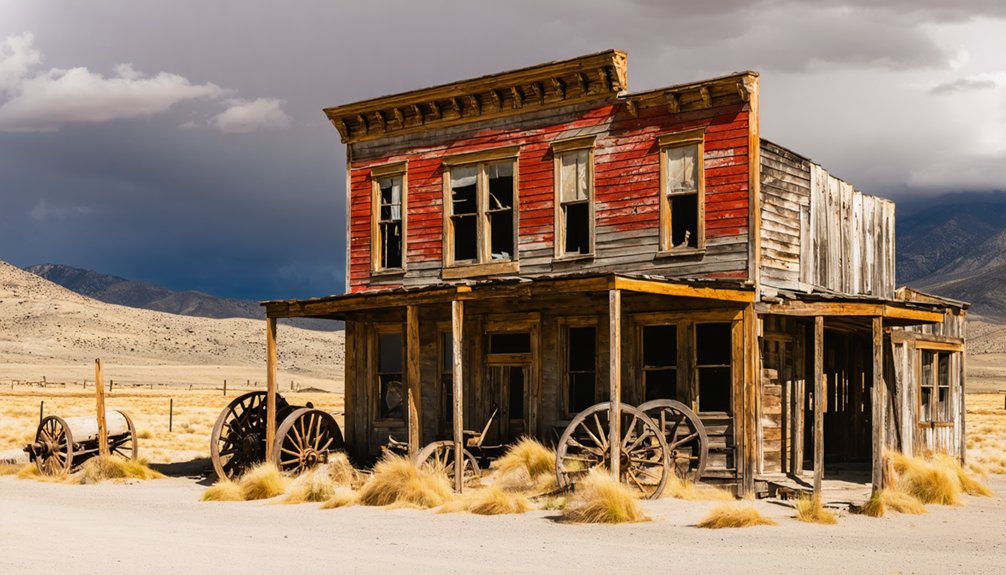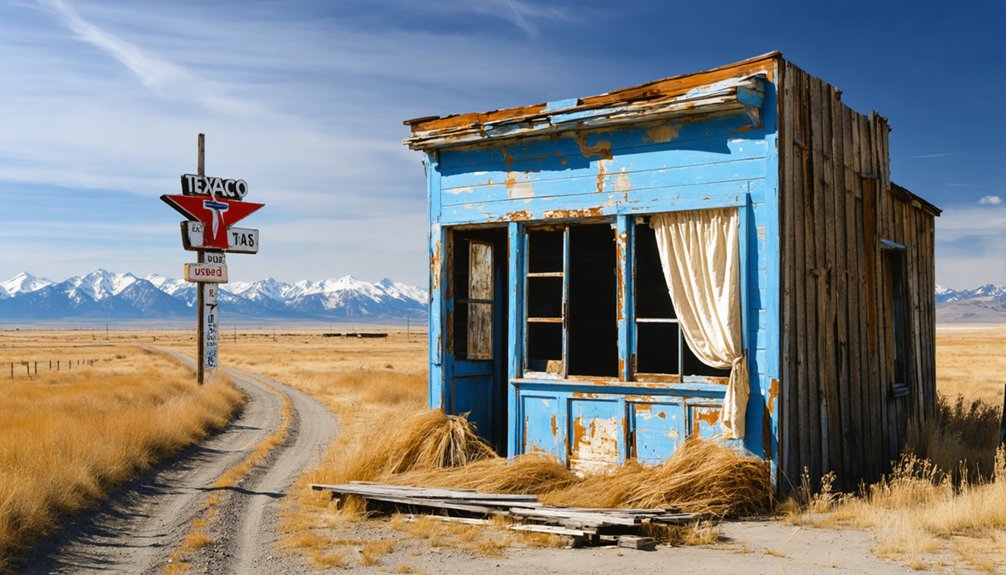
You’ll find dozens of ghost towns within 50 miles of Interstate 90, spanning from South Dakota’s abandoned railroad settlements to Montana’s collapsed mining camps. Notable stops include Okaton, which thrived until the 1980s when railroad operations ceased, and Galena in Vanocker Canyon, where a schoolhouse remains from its 1940s abandonment. Route 385 connects you to Black Hills gold rush settlements from 1876, including Mystic’s restored Victorian buildings and Rochford’s period structures that survived declining placer yields.
Key Takeaways
- The Interstate 90 corridor passes through historical communities including mining camps and abandoned railroad towns.
- Galena in Vanocker Canyon preserves heritage with a schoolhouse remaining from its 1940s abandonment.
- Okaton was founded in 1906 for railroad workers and thrived until operations ceased in the 1980s.
- Route 385 connects I-90 travelers to Black Hills settlements from the 1876 gold rush era.
- Harsh winters and job losses contributed to the abandonment of these Northern Plains communities.
Northern Plains Mining Camps and Abandoned Railroad Towns
While the Interstate 90 corridor stretches across modern South Dakota, it passes through regions where dozens of once-thriving communities have faded into history.
You’ll discover Galena heritage preserved in Vanocker Canyon, where over 300 miners built a bustling camp during the 1876 Black Hills Gold Rush. The community featured businesses, a dance hall, and post office before abandonment in the 1940s left only a schoolhouse standing.
Traveling east, you’ll encounter Okaton memories frozen in time. Founded in 1906 for railroad workers, this northern plains settlement thrived until the 1980s when railroad operations ceased.
Harsh winters and job losses drove residents away, leaving another reflection of the region’s boom-and-bust cycles that shaped the American frontier experience. These abandoned communities attract adventure seekers drawn to photography opportunities and historical exploration. Further exploration reveals Spokane, where a fragile structure from 1927 stands as testament to a community that funded its own school during boom times before complete abandonment by 1940.
Black Hills Gold Rush Settlements and Route 385 Discoveries
Beyond the scattered remnants of Galena, Route 385 connects I-90 travelers to a constellation of Black Hills settlements born from the frenzied 1876 gold rush that transformed Dakota Territory.
You’ll find Galena relics accessible via Vanocker Canyon Road—schoolhouse foundations, tailings, and collapsed mine adits marking this boom-to-bust cycle. Railroad changes accelerated abandonment by the 1940s.
Following US-385 north, you’ll encounter Mystic structures including a restored schoolhouse and Victorian-era buildings that served railroad operations.
Mystic’s restored schoolhouse and Victorian railroad buildings stand as enduring monuments to Black Hills mining era prosperity.
Rochford’s mining service village retains multiple period structures, though placer yields declined by century’s end.
Hill City, established February 1876, became the supply hub connecting peripheral camps to Deadwood’s massive discoveries. The route follows the historic trail where armored stagecoaches carried daily gold shipments worth nearly $200,000 from Black Hills camps back to Sidney, Nebraska. Prospectors searched for quartz outcroppings and traced creek gold upstream to locate the original sources of their discoveries.
These settlements created transportation corridors that evolved into today’s highway system, preserving access to Dakota’s golden heritage.
Western Montana’s Boom-and-Bust Mining Communities
As I-90 carries you westward into Montana, the highway traces routes that once connected some of the territory’s most explosive mining booms, where Alder Gulch’s 1863 gold discovery triggered the rapid emergence of Virginia City and Nevada City—camps that produced an estimated $30 million in their first three seasons alone.
These gold strikes created Montana’s first territorial capital at Bannack in 1862, establishing patterns of boom-and-bust cycles that defined the region through the 1890s. The extraction wealth extended beyond gold to include millions of dollars in silver, copper, and zinc pulled from Montana’s mountain ranges. Today these abandoned places stand as historical artifacts showcasing life during mining booms, with empty streets and remnants of past life reflecting dramatic changes over time.
- Garnet’s preserved cabins showcase BLM-managed ruins from the 1890s gold boom that housed 1,000 residents
- Bannack State Park protects over fifty buildings from Montana’s founding gold rush and vigilante era
- Granite’s silver mines demonstrate how mining infrastructure evolved from placer to hard-rock operations
- Archaeological artifacts reveal socioeconomic details through newspaper-insulated walls and foundation remains
Idaho and Eastern Washington Ghost Town Clusters
When I-90 crosses into Idaho’s panhandle, you’ll discover the Silver Valley‘s extraordinary concentration of mining ghost towns, where the Coeur d’Alene Mountains yielded some of America’s richest silver-lead-zinc deposits from the 1880s through the 1980s.
Wallace preserves its intact downtown commercial district as a living museum of mining heritage. Burke Canyon holds the dramatic ruins of hard-rock operations, though floods and fires have claimed most structures. The Gem-to-Burke mining strip contains scattered camps and mill foundations along canyon tributaries.
Wallace’s preserved downtown serves as a living testament to Silver Valley’s mining legacy, while Burke Canyon’s dramatic ruins tell stories of industrial ambition claimed by nature’s forces.
Eastern Idaho’s high-country clusters require more adventurous travel. Leesburg’s 1860s gold rush remnants sit in the remote Lemhi Mountains, while Custer County’s mining camps offer backcountry exploration. Many sites are classified as abandoned sites with buildings still standing but completely uninhabited except for occasional caretakers. The state’s arid climate helps preserve these structures, maintaining their integrity for modern visitors.
Silver City anchors the Owyhee Plateau’s well-preserved 1860s boomtown district, though accessing these Idaho ghost towns and Eastern Washington camps demands serious planning and suitable vehicles.
Preservation Efforts and Visitor Access Guidelines
While ghost towns represent irreplaceable historical resources, their remote locations and deteriorating structures create complex preservation challenges that require coordinated efforts between federal agencies, state organizations, and dedicated volunteers.
Exploring ghost towns in Colorado offers a unique glimpse into the past, revealing stories of the gold rush and the lives of those who once thrived in these now-abandoned places. Hiking through these desolate landscapes, visitors can appreciate the artistry in the decaying architecture and the natural beauty that surrounds them. Each ghost town serves as a reminder of the region’s rich history and the relentless passage of time.
You’ll find that preservation techniques focus primarily on structural stabilization—roof repairs, foundation work, and wall shoring prevent immediate collapse while maintaining historical authenticity.
Sites like Garnet demonstrate effective stewardship through Bureau of Land Management oversight combined with local nonprofit support.
Visitor safety protocols include seasonal road restrictions, posted hazard warnings, and physical barriers around dangerous features like unstable floors and open mine shafts.
Managed access balances preservation needs with public education through designated trails, interpretive signage, and controlled entry points. Winter activities such as snowmobiling and cross-country skiing provide year-round access opportunities when traditional vehicle routes become impassable.
Many ghost towns preserve authentic artifacts within their structures rather than pursuing complete restoration, allowing visitors to experience genuine historical environments that tell the stories of former residents.
- National Register listings provide tax incentives for qualifying preservation projects
- Stabilization prioritizes standing structures using historically compatible materials
- Seasonal closures protect both sites and visitors during harsh weather
- Combined funding from grants, donations, and volunteer programs sustains operations
Frequently Asked Questions
Are There Any Haunted Ghost Towns Along the I-90 Corridor?
Yes, you’ll find five documented haunted ghost towns along I-90’s corridor. Deadwood’s haunted history includes Mount Moriah Cemetery tours, while Garnet, Montana and Okaton, South Dakota feature ghostly legends from mining-era deaths and frontier tragedies.
What’s the Best Time of Year to Visit I-90 Ghost Towns?
Summer’s your best bet for exploring these abandoned settlements. You’ll find clear roads, open visitor centers, and ideal weather conditions. June through August offers maximum daylight hours and eliminates snow-related access barriers along mountain routes.
Can You Camp Overnight Near Ghost Town Sites Along I-90?
Absolutely, though steering through camping regulations feels like deciphering ancient treasure maps! You’ll find nearby campgrounds at preserved sites like Calico, while BLM dispersed camping offers free alternatives with 14-night limits.
Which I-90 Ghost Towns Have the Most Intact Original Buildings?
You’ll find Deadwood’s preserved National Historic Landmark district and Montana’s Garnet with 30 surviving structures offer the most intact abandoned architecture. These sites maintain exceptional historical significance through formal preservation efforts along I-90’s corridor.
Are Metal Detectors Allowed at Ghost Town Sites Near I-90?
You’ll face strict metal detecting regulations at most I-90 ghost towns—many sit on protected federal land where removing ghost town artifacts triggers felony charges, though some private sites allow detecting with owner permission.
References
- https://www.blackhillsbadlands.com/blog/post/old-west-legends-mines-ghost-towns-route-reimagined/
- https://idaho-forged.com/idahos-ghost-towns-eerie-yet-approachable/
- https://www.powderhouselodge.com/black-hills-attractions/fun-attractions/ghost-towns-of-western-south-dakota/
- https://glaciermt.com/ghost-towns
- https://en.wikipedia.org/wiki/List_of_ghost_towns_in_South_Dakota
- https://www.blm.gov/visit/garnet-ghost-town
- https://www.1880town.com
- https://www.theroadwanderer.net/ghosttow.htm
- https://texashighways.com/travel-news/four-texas-ghost-towns/
- https://www.legendsofamerica.com/gt-emergingghosttowns/