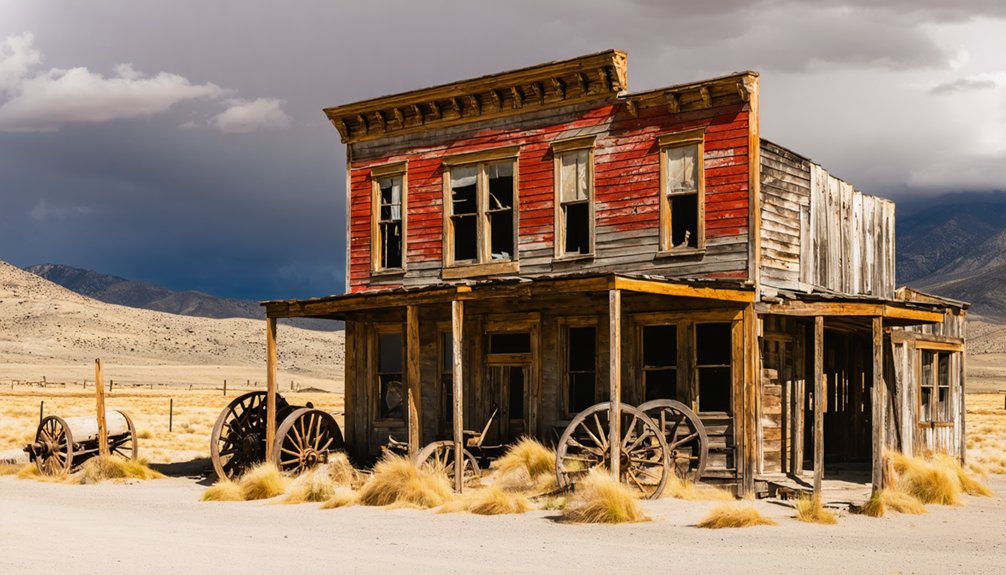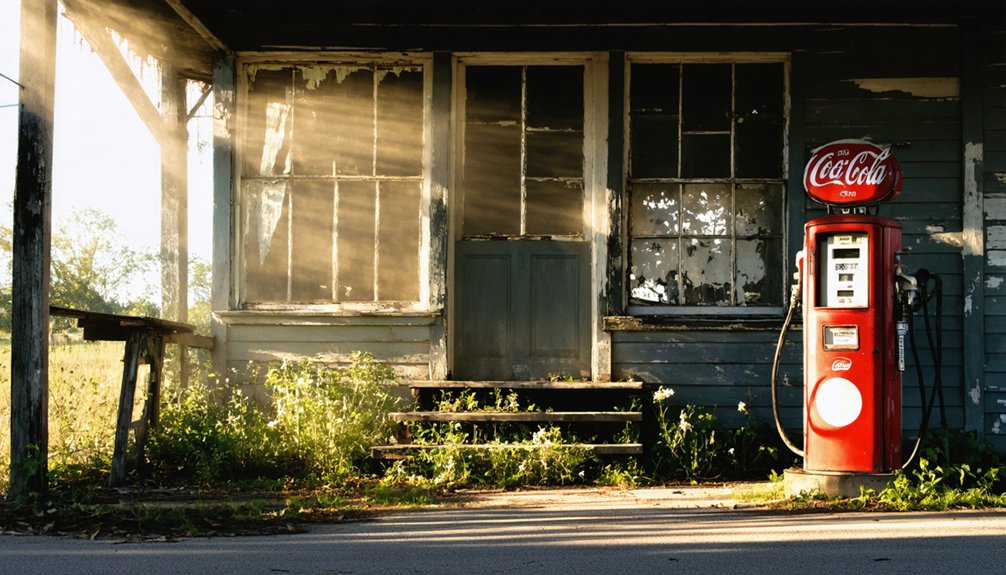
You’ll find haunting remnants of lost communities along the Deep South’s most traveled trails, from North Carolina’s Lost Cove near the Tennessee border to the submerged towns beneath Fontana Lake. The Great Smoky Mountains National Park offers backcountry access to flooded settlements like Proctor and Judson, displaced when Fontana Dam created the Tennessee River system’s largest reservoir in 1944. Alabama’s Old Cahawba ruins mark the state’s first capital at major river confluences, while abandoned railroad corridors tell stories of economic boom and bust cycles that shaped regional history.
Key Takeaways
- Lost Cove near the North Carolina-Tennessee border offers hidden settlement ruins accessible through backcountry trails along the Nolichucky River.
- Fontana Lake submerged communities like Proctor and Judson are accessible via Great Smoky Mountains National Park backcountry trails.
- Old Cahawba ruins at Alabama and Cahaba rivers confluence feature interpretive trails through Alabama’s first capital city remains.
- Abandoned railroad corridors throughout the Deep South have been converted into rail-trails connecting former mining and railroad boom towns.
- National Park Service units provide well-maintained ghost town sites with interpretive trails, while Forest Service lands offer remote experiences.
Lost Cove: Hidden Settlement Along the North Carolina-Tennessee Border
While most ghost towns fade from memory alongside their crumbling structures, Lost Cove‘s story remains embedded in the rugged landscape where North Carolina meets Tennessee along the Nolichucky River.
You’ll find this settlement’s origins trace to Civil War-era homesteaders like Morgan Bailey, who carved out self-sufficient farms in the isolated gorge. The early settlers built a thriving community of nearly 100 residents, establishing essential institutions like churches and schools while developing a mixed economy of subsistence farming and timber harvesting.
Railroad access around 1910 brought temporary prosperity, but the community’s remote location across state lines also fostered moonshining operations. When timber resources dwindled and rail service ceased, families abandoned their mountain refuge for opportunities elsewhere. The last family departed in 1957, marking the final chapter of this once-thriving mountain settlement. The complete story of this Appalachian settlement was later preserved through oral history interviews with former residents who witnessed its transformation from thriving community to ghost town.
Submerged Communities Beneath Fontana Lake and Beyond
When the Tennessee Valley Authority completed Fontana Dam in 1944, the rising waters didn’t just create the largest reservoir in the Tennessee River system—they erased entire communities that had flourished along the Little Tennessee River for generations.
You’ll find submerged history beneath Fontana Lake, where thriving towns like Proctor and Judson once stood. The lumber town of Proctor, named after Moses Proctor, displaced 1,200 families who received as little as 50 cents per acre compensation. Proctor was founded in 1886 and became a bustling community with its own post office, school, and theatre before its eventual demolition.
Among the lost communities was Bushnell, which featured a feed store, grocery store, and train station before the flooding forced residents from their ancestral lands. Today, you can access remnants through backcountry trails in Great Smoky Mountains National Park. These community memories live on through the infamous “Road to Nowhere”—an unfinished promise that was supposed to provide cemetery access to over 1,000 graves now underwater.
Railroad and Mining Boom Towns That Time Forgot
Across the Deep South’s landscape, abandoned railroad corridors and forgotten mining settlements tell stories of economic boom and inevitable bust that shaped entire regions before vanishing into obscurity.
You’ll discover railroad history written in rusted rails and crumbling foundations throughout this region. Mining heritage lives on in abandoned smelter towns like Douglas, where insufficient canyon space drove industry to remote borderlands.
McComb’s massive repair complex once employed over 1,000 workers before 1980s layoffs erased entire communities. The Golden State Limited and other passenger trains once brought life to these remote stations during the peak years of rail travel.
Key railroad boom towns you can explore:
- Weldon, North Carolina – Five railroad convergence point on Roanoke River plateau
- Meridian, Mississippi – Founded 1831, burned by Sherman, rebuilt around rail depot
- El Paso & South Western stations – Mount Riley, Potrillo, Noria vanished after 1961 abandonment
- McComb, Mississippi – 64-acre repair complex reduced to scattered remnants
These ghost towns represent freedom from corporate dependency, showing how communities adapt when economic foundations disappear. Today, communities honor their railroad heritage through monuments like the historic coal chute structures that mark where steam locomotives once fueled their journeys across the region.
River Confluence Ghost Towns and Floodplain Ruins
You’ll find Old Cahawba‘s haunting brick columns and foundation ruins scattered across Alabama’s floodplain, where the Alabama and Cahaba rivers meet in a landscape that claimed the state’s first capital through repeated flooding.
The town’s cemetery sits on higher ground above the ruins, though seasonal floods still restrict access to many graves and archaeological sites during Alabama’s wet months.
These remnants mark one of the South’s most documented examples of how river confluence settlements faced inevitable abandonment when natural flooding cycles overwhelmed 19th-century engineering and urban planning. The preserved St. Luke’s Church stands as one of the few intact structures that survived the town’s decline and has been restored for visitors to explore.
Visitors today can participate in the local tradition of throwing coins into Perine Well while making wishes among the ghostly ruins.
Old Cahawba Ruins
At the confluence of the Cahaba and Alabama Rivers in Dallas County, Alabama, the ruins of Old Cahawba stand as remnants of what was once the state’s first capital city.
You’ll discover Cahawba history spans from prehistoric Mississippian villages to Alabama’s political center from 1819-1826. The archaeological significance includes Native American earthworks incorporated into the original town grid.
When you visit Old Cahawba Archaeological Park, you can explore:
- Crocheron mansion column ruins – Civil War prisoner exchange site
- Methodist church remains – Built in 1849
- Historic cemetery – Final resting place of early settlers
- Visitor center trails – Guided tours through government building foundations
Flooding and political shifts forced the capital’s relocation in 1826. The town later became home to the Cahawba Rifles, Fifth Alabama Regiment, during the Civil War period. By 1860, the community had experienced a remarkable resurgence with a population of about 2,000 residents, making it a thriving cotton distribution center in the Black Belt region.
You’ll find this ghost town represents Alabama’s complex heritage, from indigenous trade centers to antebellum prosperity.
Submerged Cemetery Access
When hydroelectric dams transformed the Deep South’s river systems throughout the mid-20th century, thousands of family burial grounds disappeared beneath rising reservoir waters.
You’ll find over 2,300 documented graves beneath Lake Murray’s surface, while Jordan Lake conceals entire homesteads and cemeteries in North Carolina’s New Hope Valley.
Accessing this submerged history requires careful planning and legal compliance. You can’t simply dive without permits—state laws strictly protect human remains, and utility companies control reservoir access.
Remote sensing offers the safest documentation method, using sonar and magnetometry to map burial sites without disturbance.
For cemetery preservation efforts, you’ll need coordination with descendant communities and property owners.
Historic maps and county records provide vital starting points before attempting physical access to these underwater monuments.
Accessing Ghost Town Sites Through National Parks and Forests
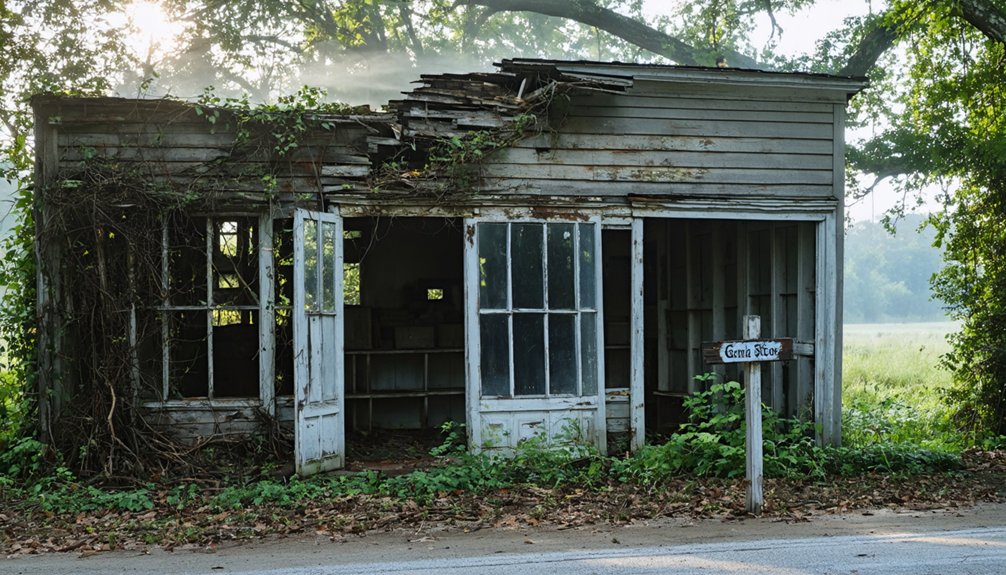
Multiple federal land management agencies oversee ghost town sites across the Deep South, each offering distinct access methods and visitor experiences.
You’ll find well-maintained sites within National Park Service units like Thurmond in New River Gorge, complete with interpretive trails and visitor centers.
Forest Service lands offer more remote experiences where you’ll navigate unpaved roads and overgrown paths to discover hidden settlements.
Essential preparation steps for your ghost town exploration:
- Check current conditions – Contact ranger offices before traveling to avoid unexpected closures
- Understand ghost town regulations – Stay on designated trails and never remove artifacts
- Prepare for varying difficulty – Some sites require 4WD vehicles or strenuous hiking
- Respect site preservation – Federal penalties apply for disturbing archaeological materials
Both agencies prioritize cultural resource protection while maintaining public access.
Heritage Tourism and Trail Networks to Abandoned Communities
Beyond individual site visits, organized trail networks now connect multiple abandoned communities across the Deep South, creating extensive heritage tourism experiences that draw visitors deeper into regional history.
You’ll find rail-trail conversions transforming former mining and logging corridors into interpretive pathways that link ghost towns through guided programming and outdoor museum installations. These networks require careful infrastructure planning—parking, stabilization, and monitoring systems protect fragile sites while ensuring your safe access to remote locations.
Community engagement proves essential as local historical societies partner with trail managers to develop authentic interpretation that includes descendant voices in storytelling.
This approach supports heritage preservation while creating economic opportunities through guided tours, adaptive reuse projects, and small-scale entrepreneurship that benefits gateway communities near these historically significant abandoned settlements.
Common Causes Behind Deep South Town Abandonment
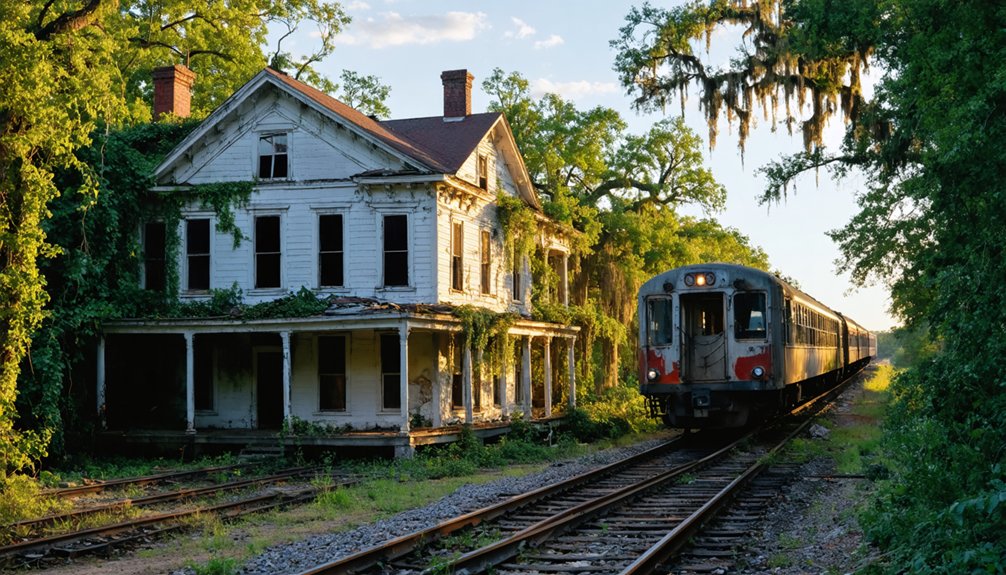
You’ll find that Deep South ghost towns share remarkably similar stories of abandonment, despite their scattered locations across the region.
As you delve deeper into these captivating narratives, you may also consider exploring dogfriendly locations in Georgia that reveal the state’s charm and hospitality. From picturesque parks to welcoming cafes, these spots not only cater to our four-legged friends but also enable unique experiences steeped in local history and culture. Embracing both adventure and companionship can truly enrich your journey through Georgia’s captivating landscapes.
Industrial boom and bust cycles created the most dramatic rise-and-fall patterns, as timber mills, mining operations, and phosphate extraction sites attracted thousands of workers before resource depletion or market crashes eliminated entire local economies overnight.
Transportation changes and dam construction projects then delivered final blows to struggling communities, forcing residents to abandon towns that railroads no longer served or that federal agencies flooded for reservoir projects.
Industrial Boom and Bust
While agricultural decline often receives attention as the primary driver of Deep South abandonment, industrial boom and bust cycles proved equally devastating to communities across the region.
You’ll discover that Southern states aggressively pursued laggard industries from the North, creating temporary prosperity that masked underlying vulnerabilities. This industrial growth strategy ultimately backfired when economic downturn struck.
The boom-bust pattern destroyed Deep South towns through:
- Coal mining collapse – Bituminous coal employment dropped over 208,000 workers from 1923-1932, devastating Black Appalachian communities.
- Factory relocations – Rising labor costs and international competition prompted manufacturers to abandon Southern locations.
- Railroad overexpansion – Reckless borrowing led to receiverships during every late-19th century financial collapse.
- Market speculation – Unregulated credit cycles created property-less workers amid devastating panics.
Dam Construction Displacement
When federal agencies launched massive dam construction projects across the Deep South, they released a displacement crisis that erased entire communities from the map.
You’ll find that TVA projects alone displaced 82,000 people between 1933 and 1945, acquiring 1.3 million acres through eminent domain. Federal cost-benefit frameworks prioritized electrification over local property rights, enabling compulsory relocations with minimal compensation.
Rural farm families, small towns, and Indigenous communities bore the heaviest burden as reservoirs submerged town centers, cemeteries, and cultural sites.
These displacement narratives reveal how economic planning dismissed local populations as “surplus.” Despite devastating losses, affected communities demonstrated remarkable cultural resilience, preserving traditions and memories even as their ancestral landscapes disappeared beneath rising waters forever.
Transportation Route Changes
As America’s transportation networks evolved from canals to railroads to highways, countless Deep South communities found themselves stranded when major routes shifted elsewhere.
You’ll discover that transportation evolution repeatedly reshaped regional economies, leaving ghost towns in its wake.
Highway impacts devastated communities when interstates bypassed established settlements:
- Railroad Expansion Era – Southern rail mileage exploded from 11,000 to 29,000 miles between 1870-1890, abandoning canal-dependent towns.
- Highway System Development – US highways like Route 61 replaced older trails, making previous commercial centers obsolete.
- Interstate Construction – I-20’s rerouting around Dallas and Fort Worth left original downtown corridors economically isolated.
- Corridor Concentration – Economic growth concentrated along I-85 and I-20, creating stark disparities for off-corridor communities.
Towns couldn’t survive when commerce moved elsewhere.
Planning Your Ghost Town Trail Adventure Safely

Before you lace up your hiking boots for Deep South ghost town exploration, thorough preparation determines whether you’ll return with memorable photographs or require emergency rescue.
Research trail conditions through official park websites and secure necessary permits before departure. Download offline maps since remote areas like Big South Fork often lack cell service.
Check park websites for trail updates and download offline maps before venturing into remote ghost towns with spotty cell coverage.
Pack essential gear including sturdy boots, layered clothing for variable temperatures, and at least two liters of water per person. Carry insect repellent and long sleeves for swampy terrain near boardwalks.
Your hiking safety depends on traveling in groups of two minimum and staying on marked paths around unstable ruins.
Navigate environmental hazards like toxic soil remnants, flash floods, and extreme heat. Memorize emergency numbers, identify access points, and consider satellite communicators for remote locations without service coverage.
Frequently Asked Questions
Are Metal Detectors Allowed at Ghost Town Sites on Public Lands?
Despite seeming abandoned, you can’t freely metal detect ghost towns on public lands. Metal detecting regulations and historical preservation laws strictly protect these sites, requiring permits and often prohibiting artifact removal entirely.
What’s the Best Season to Visit Submerged Towns When Water Levels Drop?
Late fall through early spring offers the best times for viewing submerged towns, as seasonal changes bring lower water levels from reduced rainfall and increased drawdowns for dam maintenance across southeastern reservoirs.
Can I Camp Overnight Near Ghost Town Ruins in National Forests?
Yes, you can generally camp near ghost town ruins in national forests, but you’ll need to check specific camping regulations and obtain required forest permits from the local ranger district before your trip.
Are There Guided Ghost Town Tours Available Through Professional Outfitters?
Yes, you’ll find guided tours through professional outfitters across the Deep South. Ghost City Tours operates in 50+ cities, while regional companies like Southern Ghost Girls and Southwest Expeditions offer specialized ghost town experiences.
What Should I Do if I Find Historical Artifacts at Abandoned Sites?
Like finding treasure that isn’t yours, you shouldn’t remove anything. Legal considerations require reporting discoveries to authorities immediately. Artifact preservation demands leaving items untouched while documenting their location for professional archaeologists.
References
- https://appalachian.org/lost-cove-ghost-town-in-the-national-forest/
- https://www.thewanderingappalachian.com/post/the-underwater-towns-of-appalachia
- https://quirkytravelguy.com/ghost-towns-of-the-deep-south/
- https://www.youtube.com/watch?v=4oHlJFXbrCk
- https://styleblueprint.com/everyday/ghost-towns-in-the-south/
- https://theforgottensouth.com/ghost-towns/
- https://dc.etsu.edu/etd/2147/
- https://www.atlasobscura.com/places/lost-cove-settlement
- https://thelaurelofasheville.com/lifestyle/history-feature-love-and-lawlessness/
- https://www.youtube.com/watch?v=E8F-4BTqJSs