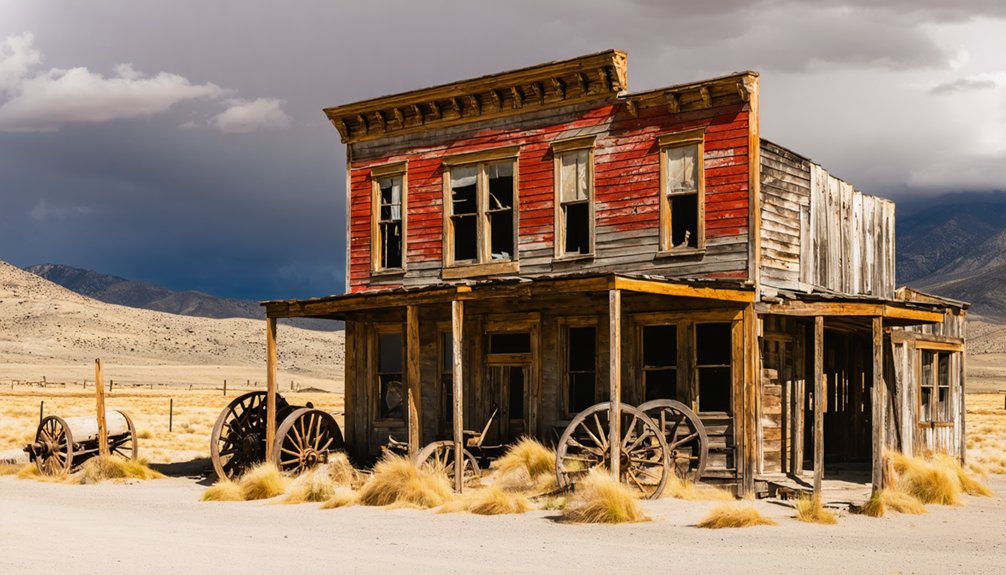
You’ll find numerous ghost towns scattered along Great Plains rail-trails and historic routes, where abandoned mining camps and agricultural settlements preserve westward expansion history. Converted railway corridors provide easy access to former town centers, while state highways connect to documented locations via gravel spurs. Sites like Bannack offer visitor centers with maps and interpretive programs, including ranger-led tours and living-history demonstrations. However, you’ll need to prepare for extreme weather, altitude challenges, and seasonal access restrictions that markedly impact your exploration opportunities.
Key Takeaways
- Great Plains ghost towns are accessible through converted rail-trails that lead directly to former town centers.
- The proposed Great Plains Trail provides foot access to remote ghost sites across the region.
- State highways serve as primary vehicular access with gravel spurs reaching documented ghost town locations.
- River approaches via canoe can reach floodplain ghost sites along major Great Plains waterways.
- Trail access varies due to infrastructure differences and weather-dependent dirt road conditions affecting ghost town accessibility.
Historic Mining Towns Accessible by Trail Networks
When stagecoaches carved their treacherous routes through Colorado’s high country during the 1800s, they connected isolated mining camps that would eventually become some of the state’s most fascinating ghost towns.
You’ll discover Independence Ghost Town at nearly 11,000 feet, where trail history intersects with the Independence Gold Lode legend along steep passages toward Leadville and Aspen.
Explore Tomboy Ghost Town via mountain biking trails from Telluride, where mining relics scatter among abandoned buildings.
Pedal through Telluride’s rugged mountain trails to discover Tomboy’s scattered mining artifacts and weathered structures frozen in time.
The Social Tunnel access reveals high-alpine networks threading through historic mining districts.
Alta’s preserved structures from 1877 to the 1940s await your discovery along Alta Lakes Road, while Vicksburg’s Clear Creek Canyon location offers outdoor audio guides detailing 1800s prospector life through accessible trail systems. These sites provide a unique glimpse into Colorado’s mining heritage for modern explorers. Historic towns like Morrison, Evergreen, and Golden served as vital supply points for miners and trappers throughout the 1850s boom.
Transportation Methods and Route Types for Ghost Town Access
Accessing Great Plains ghost towns requires careful consideration of transportation methods, as these abandoned settlements scatter across vast grasslands where infrastructure varies dramatically from well-maintained highways to primitive two-tracks.
You’ll find trail access through converted rail-trails that lead directly into former town centers, while long-distance routes like the proposed Great Plains Trail provide foot access to remote ghost sites.
State highways offer primary vehicular access, followed by gravel spurs to documented locations. For the most isolated ruins, you’ll need high-clearance vehicles on unimproved ranch roads.
Historic emigrant trail corridors maintain interpretive access where preserved ruts guide you to adjacent abandoned settlements. Major supply points like Council Bluffs served as critical jumping-off locations for westward travelers.
River approaches via canoe reach floodplain ghost sites along major waterways like the Platte and Missouri tributaries. Planning your route several hundred miles in advance becomes essential given the remote distances between locations and limited services across the region.
Visitor Services and Interpretive Programs at Preserved Sites
Once you reach these preserved ghost towns, the quality and extent of visitor services varies dramatically across the Great Plains, with major state parks offering extensive facilities while remote sites provide minimal infrastructure.
Bannack State Park exemplifies thorough visitor accessibility with staffed centers providing maps, exhibits, and restrooms during peak season. You’ll find interpretive programs ranging from 45-90 minute ranger-led walking tours to living-history demonstrations that bring mining technology and daily life into focus.
Most sites feature interpretive panels summarizing historical timelines and safety guidelines, though basic amenities like restrooms and potable water remain inconsistent. The town’s reputation as the Toughest Town in the West adds dramatic context to these educational programs.
QR codes increasingly deliver extended narratives through mobile devices, while volunteer guides supplement ranger capacity. At some locations, artifacts like broken crockery and bottles can still be discovered scattered around former building foundations. Special-event programs, including re-enactments and ghost tours, create visitation spikes during weekends and festivals, enhancing your exploration experience.
Safety Considerations and Seasonal Access Challenges
You’ll face unique safety challenges when exploring Great Plains ghost towns, from extreme temperature swings in Mars-like badlands to dust-amplified heat exhaust risks in abandoned Texas settlements.
Seasonal access restrictions limit your exploration windows, as water level fluctuations at sites like Bluffton expose ruins only during specific periods each year.
Mining hazard awareness becomes critical when traversing areas with hidden relics and tripping hazards, particularly around old mining camps where historical extraction activities left dangerous remnants scattered across wide trail systems. Essential items should be packed for unpredictable weather conditions that can change rapidly during exploration. High-altitude destinations require additional preparation, as limited cell service above 12,000 feet can leave you unable to call for emergency assistance.
High Altitude Preparedness
While the Great Plains are generally characterized by lower elevations than mountain ranges, several ghost town trails reach altitudes above 8,000 feet where acute mountain sickness becomes a legitimate concern.
Colorado’s eastern plains contain abandoned mining settlements that require proper altitude acclimatization and medical preparedness strategies.
Essential high-altitude preparation includes:
- Gradual ascent planning – Limit sleeping elevation gains to 1,000 feet daily above 10,000 feet
- Medical kit assembly – Pack pulse oximeter, portable oxygen, acetazolamide, and emergency medications
- Communication backup – Carry satellite messenger since cellular coverage won’t exist in remote areas
- Evacuation planning – Establish clear descent thresholds and emergency contact protocols before departure
You’ll need to recognize AMS symptoms like headache, nausea, and dizziness while maintaining hydration and avoiding overexertion during exploration. Always leave a detailed trip plan with someone reliable before departing for these remote ghost town locations. Afternoon thunderstorms are common in these elevated areas, so plan to be off exposed ridgelines by noon to avoid lightning strikes.
Seasonal Weather Barriers
Beyond altitude concerns, seasonal weather patterns create the most significant barriers to accessing Great Plains ghost towns safely.
Winter snow accumulation blocks trails and roads, rendering sites like those in High Plains completely inaccessible. Ice creates deadly slip-and-fall hazards on crumbling structures, while freezing temperatures cause adobe ruins to collapse. Blizzards reduce visibility and strand visitors without cell service in remote areas.
Summer brings different seasonal challenges. Temperatures exceeding 100°F damage transportation infrastructure, isolating trail sites. Drought dries up water sources like seasonal creeks in Dearfield, creating dehydration risks.
Weather impacts extend year-round – dust storms reduce visibility and irritate respiratory systems, while high winds damage remaining structures and whip dangerous debris. Many ghost towns remain accessible only seasonally due to weather-dependent dirt roads and seasonal closures.
Mining Hazard Awareness
Mining operations across the Great Plains left behind thousands of hazardous sites that pose serious risks to ghost town explorers.
When you’re planning visits to abandoned mining communities, understanding environmental hazards becomes vital for your safety and freedom to explore responsibly.
Mining safety requires recognizing these primary threats:
- Unstable underground structures – Room and pillar mining created caverns with deteriorating supports that can collapse without warning.
- Toxic chat piles – Mountains of contaminated waste reaching 200 feet high contain lead, zinc, cadmium, and arsenic.
- Contaminated groundwater – Over a century of tailings disposal poisoned local water supplies with heavy metals.
- Dangerous gases – Accumulated toxic gases in mine workings can quickly overcome visitors.
You’ll find EPA-mandated evacuations occurred in places like Picher due to severe contamination, making access restrictions necessary.
Cultural Heritage and Archaeological Preservation
You’ll encounter significant responsibilities when visiting Great Plains ghost towns, as these sites contain irreplaceable archaeological evidence spanning from Indigenous occupation through the 1930s Dust Bowl era.
Mining structures, homestead foundations, and subsurface features like privy pits preserve stratified cultural deposits that require careful protection from disturbance or artifact collection.
Your approach to these locations must balance historical curiosity with respectful interpretation, particularly at multi-component sites where settler remains overlay precontact Native American landscapes documented in tribal oral histories and archaeological records.
Mining Heritage Preservation
While ghost towns across the Great Plains face constant threats from weathering and neglect, federal preservation frameworks provide essential protection for these mining heritage sites.
You’ll find the National Historic Preservation Act‘s Section 106 review process safeguards mining-era structures when federal actions are involved. State Historic Preservation Offices coordinate surveys and National Register nominations, while tribal consultation requirements create co-stewardship opportunities where mining landscapes intersect Indigenous cultural resources.
Effective mining heritage preservation requires:
- Systematic documentation through baseline photography, measured drawings, and condition assessments
- Digital cultural-heritage projects using GIS and 3D photogrammetry for dispersed sites
- Stabilization techniques including roof repair, structural shoring, and materials-appropriate treatments
- Adaptive reuse strategies converting select structures into interpretive centers or museums
However, regulatory gaps persist, making heritage funding and preservation partnerships vital for abandoned mining sites.
Archaeological Site Protection
Beyond mining structures, archaeological sites throughout the Great Plains demand rigorous protection under federal and state legislation.
You’ll find the Archaeological Resources Protection Act of 1979 prohibits excavation without permits on federal lands, while the National Historic Preservation Act requires impact assessments on historic properties. Sites like Alta receive National Register protection from alteration.
When you visit these locations, you’re contributing to archaeological monitoring efforts that track site conditions over time.
State laws in Colorado mandate reporting significant finds and restrict artifact collection on public lands. You must leave pottery shards, tools, and structural remains untouched to support artifact conservation.
The Antiquities Act empowers presidential designation of national monuments, ensuring these irreplaceable cultural resources remain protected for future generations seeking historical connections.
Respectful Historical Interpretation
Three fundamental principles guide respectful interpretation of ghost towns along Great Plains trails: inclusive storytelling, community collaboration, and cultural authenticity.
These principles can also be applied to the exploration of abandoned towns in horror films, where storytelling often intertwines with the supernatural elements of these lost places. By examining the narratives presented in these films, we can gain insights into the fears and histories of the communities that once thrived there. Through a respectful lens, we can appreciate how these cinematic representations reflect deeper cultural stories and the landscapes they inhabit.
You’ll discover these sites hold diverse histories beyond romanticized narratives when you engage descendant communities and primary sources.
Effective community engagement requires these essential practices:
- Center descendant voices in exhibit development and guided tours
- Document underrepresented experiences of African American, Indigenous, and immigrant communities
- Form partnerships between local museums, universities, and grassroots organizations
- Provide transparent interpretation that distinguishes documented facts from speculation
Narrative authenticity emerges when you incorporate multilingual materials, trigger warnings for sensitive topics, and layered storytelling that connects daily life to broader migration patterns.
You’ll strengthen heritage tourism while preserving intangible cultural values like family memories and labor histories that traditional preservation often overlooks.
Trail Planning Data and Mileage Information
Planning your journey along the Great Plains Trail requires careful attention to distance calculations and daily mileage targets.
Success on the Great Plains Trail demands meticulous distance planning and realistic daily mileage expectations.
The proposed 2,100–2,200 mile route includes a 250-mile pilot segment from Scottsbluff to Bear Butte, where organizers recommend 20–25 miles daily for supported thru-hiking.
You’ll encounter varying trail surface conditions—from purpose-built footpaths to significant road-walking sections where easements remain incomplete.
Elevation changes concentrate in corridors like the Black Hills, featuring 1,000–1,200 foot climbs within 3–4 mile stretches that’ll affect your daily achievable mileage.
Water sources prove variable across long prairie stretches, so you’ll need contingency plans between resupply points.
Consult the Great Plains Trail Alliance’s latest databooks for precise service distances and mile-by-mile notes before departing.
Frequently Asked Questions
Can I Camp Overnight Near Ghost Town Sites Along These Trails?
Like a compass needle, camping regulations point different directions depending on land ownership. You’ll face 14-day limits on BLM sites, designated-area requirements, and trail safety hazards from contamination and structural collapse.
Are Pets Allowed on Ghost Town Trail Routes and Historic Sites?
Pet policies vary by location. You’ll find Goldfield Ghost Town welcomes dogs, while Great Plains Nature Center prohibits them. Follow proper pet etiquette and maintain trail safety by researching specific regulations before visiting.
Do I Need Permits or Fees to Visit These Ghost Towns?
You’ll need permits or fees depending on ownership. Federal lands require park entrance fees, while private property demands landowner permission. Permit regulations and fee structures vary drastically—freedom requires following each manager’s specific rules.
What Photography Restrictions Exist at Preserved Ghost Town Archaeological Sites?
You’ll face strict photography ethics rules at preserved sites: don’t touch artifacts, avoid flash on fragile materials, get permits for commercial shoots, and follow site preservation guidelines to protect archaeological integrity.
Are Guided Ghost Town Tours Available for Inexperienced Hikers or Families?
Yes, you’ll find guided tours specifically designed for families and beginners. These family friendly activities include vehicle transport, short walks, safety briefings, and age-appropriate content, making ghost town exploration accessible.
References
- https://crazyaboutcolorado.com/hiking-around-colorado-ghost-towns/
- https://www.colorado.com/articles/colorado-ghost-towns
- https://www.backpacker.com/trips/great-plains-trail/
- https://www.garnetghosttown.org/things-to-do.php
- https://www.trailgroove.com/blogs/entry/582-hiking-exploring-the-great-plains-overlooked-wildness/
- https://claybonnymanevans.com/great-plains-trail-pilot-trail-episode-10/
- https://fhwaapps.fhwa.dot.gov/bywaysp/byway/49776
- https://www.islands.com/2055539/ancient-kansas-thrives-flint-hills-national-scenic-byway-charming-towns-great-plains/
- http://jealousyreloaded.com/thru-historic-rocky-towns-to-the-great-plains/
- https://www.greatplainstrail.org/gpt-map/