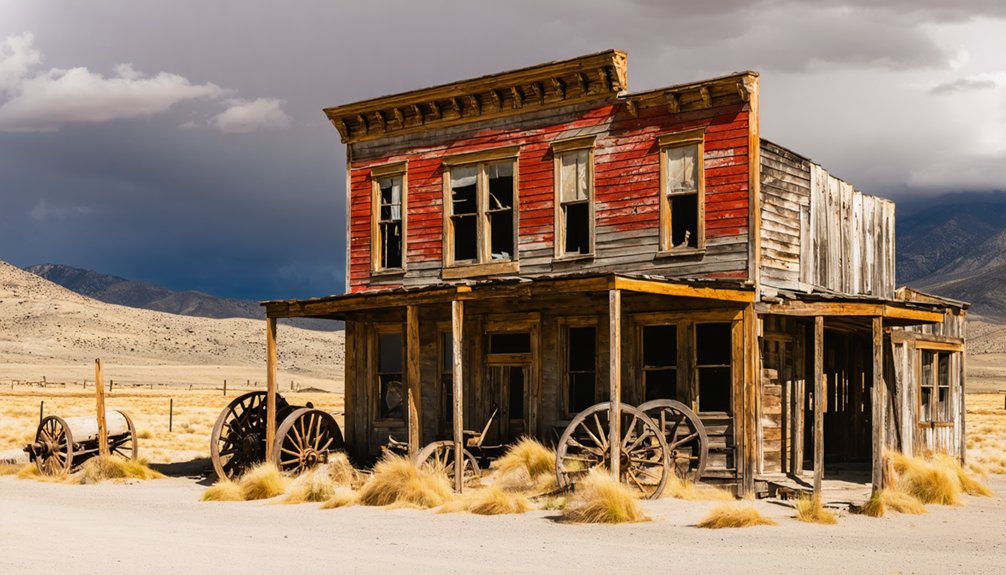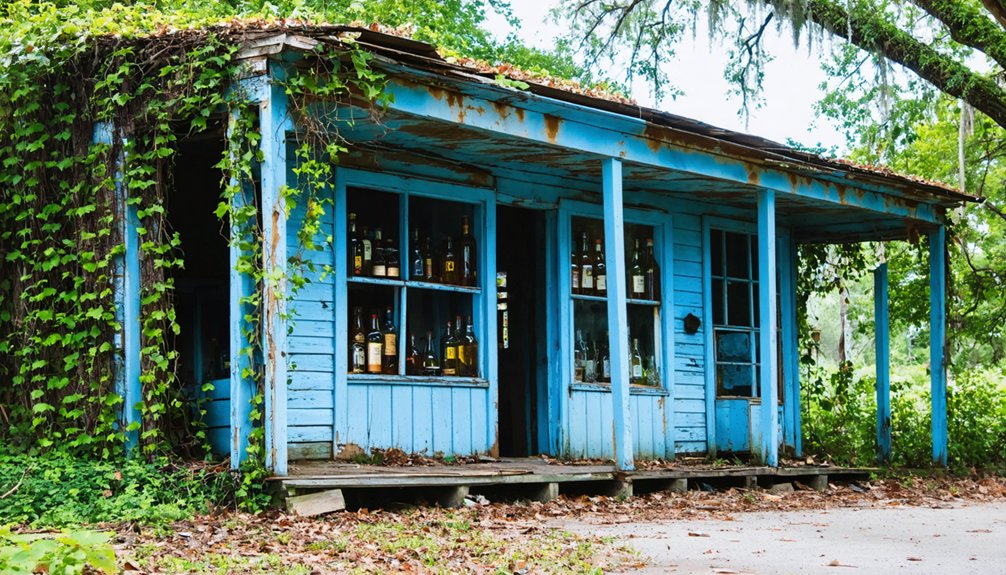
You’ll find several fascinating ghost towns along the South’s most popular hiking trails, where economic booms created thriving communities before inevitable decline. Elkmont’s exclusive resort cottages dot Great Smoky Mountains trails, while Proctor’s remnants peek above Fontana Lake’s waterline. Lost Cove hides Civil War-era ruins in Tennessee’s Nolichucky Gorge, accessible via railroad tracks. West Virginia’s New River Gorge reveals Thurmond’s railroad heritage and Kaymoor’s clifftop mining operations. Each location offers unique stories of prosperity, disaster, and preservation efforts that shaped these mountain communities.
Key Takeaways
- Elkmont in Great Smoky Mountains requires hiking to reach preserved cottage remnants from the 1910s railroad era.
- Lost Cove in Tennessee involves a three-mile hike along active railroad tracks to Civil War-era foundation ruins.
- Thurmond in West Virginia’s New River Gorge connects to popular hiking trails near the former railroad boom town.
- Kaymoor mining town sits along clifftop trails with visible coke ovens and mining equipment from 1899-1962 operations.
- Proctor’s submerged ruins beneath Fontana Lake are accessible via hiking trails leading to remaining structures above waterline.
Elkmont: From Logging Boom to Abandoned Resort in the Smokies
By 1910, the same railroad that hauled timber transformed Elkmont into an exclusive destination.
Resort culture flourished as Knoxville’s elite formed the Appalachian Club and built seasonal cottages, while the Wonderland Hotel catered to wealthy tourists.
You’re walking through a landscape where sawmills once roared and exclusive social clubs hosted elaborate parties—until logging depletion and national park creation ended both industries by the 1930s. When the national park was established in 1934, residents faced a difficult choice between selling their homes for full value or accepting discounted prices to remain for their lifetimes. The area’s transformation from bustling resort to ghost town began when restoration efforts started in 2009 to preserve what remained of this mountain community.
Proctor: The Drowned Town Beneath Fontana Lake
The dam’s floodwaters displaced 1,200 families, submerging most structures beneath Fontana Lake.
Government promises for cemetery access roads remained unfulfilled—only six miles built before abandonment created the infamous “Road to Nowhere.”
Today, you can explore Proctor’s remnants above the waterline, including the Calhoun House and mill ruins, while descendants still paddle across the lake to visit their ancestors’ graves. The lumber town was originally established in 1886 and thrived until the Great Depression slowed its growth. The community’s decline paralleled the devastating loss of American Chestnut trees, which had provided crucial nutrition and income for local families.
Andersonville: South Carolina’s Submerged Settlement Under Lake Hartwell
While Proctor’s story unfolds in North Carolina’s mountains, South Carolina’s Lake Hartwell holds its own drowned settlement beneath its surface.
You’ll find Andersonville’s submerged history began in 1801 when South Carolina’s General Assembly established this riverside town honoring Revolutionary War hero Robert Anderson. Located where the Seneca and Tugaloo Rivers converged, it thrived as a textile hub with daily barge routes to Savannah.
However, devastating floods in 1840 and 1852 destroyed mills, while bypassing railroads killed river commerce. The post office closed in 1893, marking the town’s final economic decline. Lake Hartwell’s construction sealed Andersonville’s fate in 1963, flooding homes, farms, and cemeteries. The massive reservoir created 56,000 surface acres with 962 miles of shoreline, permanently burying the town’s remains.
Today, you can explore Andersonville Island’s crumbling ruins or visit Cemetery Island, where ghostly tales of legendary Serril Broin persist among sixty visible graves—remnants of freedom lost beneath progress.
Lost Cove: Civil War Era Community Hidden in Nolichucky Gorge
You’ll discover Lost Cove’s remnants hidden within North Carolina’s Nolichucky Gorge, where Morgan Bailey established this remote settlement just before the Civil War.
The community’s isolation above the Nolichucky River made it perfect for moonshine operations that supplemented farming income well into the 20th century. Bailey originally acquired the land from a Native American for $10 and a shotgun, beginning what would become a tight-knit community of families seeking refuge from war.
You can spot foundation stones and chimney ruins from river trails, though the forest has reclaimed most structures since the last family departed in 1958. The 95-acre parcel is now protected by the Southern Appalachian Highlands Conservancy as part of ongoing efforts to preserve this significant heritage site.
Civil War Era Origins
Hidden deep within the rugged Nolichucky Gorge along the boundary of Yancey and Mitchell Counties, Lost Cove emerged as a Civil War-era refuge when Morgan Bailey purchased 400 acres of fertile bottomland from a Native American for ten dollars and a shotgun shortly before the conflict erupted.
You’ll discover this remote settlement developed as families sought escape from wartime chaos, establishing themselves in Poplar Gorge above the Nolichucky River.
The community’s Community Resilience proved remarkable as approximately 100 mountain folk carved out independent lives through Agricultural Sustainability on loamy soil.
Connected only by footpaths, these self-sufficient families prioritized survival over politics, creating a thriving agricultural settlement that would endure harsh mountain conditions for nearly a century while maintaining complete isolation from external conflicts. The name “Lost Cove” itself reflects the multiple meanings associated with remote Appalachian settlements, as various geographic features throughout the South share similar designations. The logging industry eventually transformed Lost Cove’s economy when the Carolina, Clinchfield, and Ohio Railroad arrived in the 1890s, bringing unprecedented prosperity to this isolated mountain community.
Moonshine and Remote Location
The rugged Nolichucky Gorge location offered perfect conditions for illicit operations. Tax collectors couldn’t easily reach the secluded community straddling the North Carolina-Tennessee border, and jurisdictional confusion between Yancey, Mitchell, and Unicoi counties provided additional protection.
When authorities did attempt prosecutions, cases were dismissed due to boundary disputes.
Key advantages that made Lost Cove a moonshiner’s paradise:
- Natural fortress – Nested in Poplar Gorge with no connecting roads until 1912
- Jurisdictional confusion – Multi-county, multi-state location complicated law enforcement
- Community solidarity – Self-sufficient residents protected their neighbors’ enterprises
- Geographic isolation – Remote location deterred regular government intrusion
Trail Access and Visibility
While Lost Cove’s isolation protected moonshine operations from law enforcement, that same remoteness now creates both opportunities and challenges for modern trail users seeking to glimpse this historic settlement.
You’ll find the most accessible views from the Nolichucky River rafting corridor and nearby Appalachian Trail ridgelines, especially during leaf-off months when visibility increases dramatically through the deciduous canopy.
Reaching the settlement requires hiking three miles along active railroad tracks, then following a dirt road uphill—a journey demanding serious attention to trail safety given cliff exposure and train traffic.
The land’s patchwork ownership between Pisgah National Forest, Southern Appalachian Highlands Conservancy, and private parcels means you must verify access rights before exploring.
This careful approach guarantees both your safety and ongoing historical preservation efforts protecting this remarkable Civil War-era community.
Thurmond: Coal Railroad Capital of New River Gorge
Deep within West Virginia’s rugged New River Gorge, Thurmond emerged as an unlikely powerhouse after Captain W.D. Thurmond acquired 73 acres in 1873.
By 1910, this strategic railroad hub generated more freight tonnage than Cincinnati and Richmond combined, cementing Thurmond’s significance as the C&O Railroad’s crown jewel.
This small Appalachian town outpaced major American cities in railroad freight, becoming the C&O’s most profitable operation.
You’ll discover railroad heritage preserved throughout Main Street’s historic brick buildings and surviving depot structures.
The town’s dramatic rise and fall illustrates America’s industrial transformation:
- Peak operations: 95,000 passengers annually with 15 daily trains
- Economic dominance: Largest C&O revenue generator by 1910
- Workforce scale: 150+ railroad employees and 18 train crews
- Technological obsolescence: Diesel locomotives eliminated steam-era facilities
Today, you can explore this National Park Service-preserved ghost town and witness how technological change reshaped Appalachian communities.
You can also explore ghost towns in Washington state, where remnants of mining and logging operations tell stories of resilience and abandonment. These atmospheric sites offer a glimpse into the past, inviting visitors to imagine the lives once lived among their decaying buildings. As you wander through these historic landscapes, you’ll gain a deeper appreciation for the challenges faced by those who sought fortune and opportunity in the Northwest.
Kaymoor: Clifftop Mining Town Ruins in West Virginia
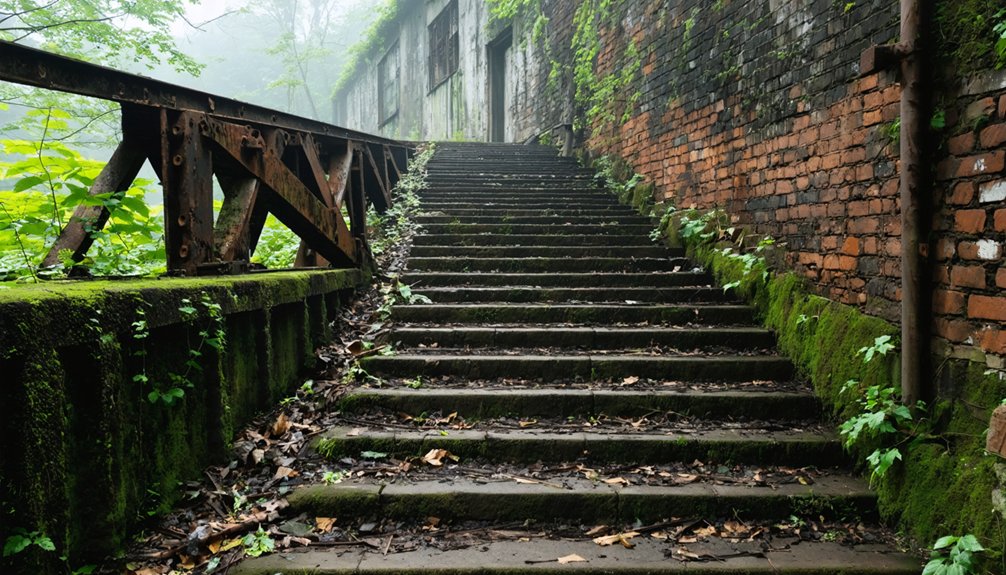
You’ll discover Kaymoor’s unique two-level layout when you explore the ruins scattered across both the gorge rim at Kaymoor Top and the river level at Kaymoor Bottom, connected by the remains of inclined railways that once transported workers and coal down the 1,000-foot slope.
The preserved mining equipment includes substantial remnants of the processing plant, coke ovens, and tipple machinery that processed over 16 million tons of coal between 1899 and 1962.
You can still trace the horizontal drift mine entrances cut into the cliffside 560 feet above the New River, where locomotives once carried miners deep into the coal seams.
Two-Level Town Layout
- Single-track incline transported workers over 1,000-foot slopes between levels.
- Double-track system moved coal to processing facilities below.
- 130 houses were strategically distributed across both camps.
- Continuous tramway operation maintained connections until 1962 closure.
Preserved Mining Equipment
The National Park Service has preserved an extensive collection of industrial artifacts and structural remains at Kaymoor since acquiring the site from Berwind-White in 1989.
You’ll discover 101 beehive coke oven remnants that once processed coal into fuel, alongside concrete tipple foundations where miners loaded coal cars.
Cable-haulage hardware still marks the single-track incline system, while rail fragments and corroded coupling fixtures lie scattered near processing areas.
Gated mine portals protect you from unsafe adits while preserving original timbering and metalwork.
Stone headhouse remnants and powerhouse ruins demonstrate the operation’s scale—this industrial heritage site produced 16-17 million tons of coal between 1899 and 1962.
The NPS’s historical preservation efforts include stabilization projects and interpretive installations that protect these fragile mining equipment remains.
Frequently Asked Questions
What Safety Precautions Should Visitors Take When Exploring These Ghost Town Ruins?
You’ll need proper gear, group travel, and hazard awareness when exploring ruins. Avoid structural hazards like unstable buildings and mine shafts, maintain distance during wildlife encounters, and verify land access before visiting these historical sites.
Are Camping Permits Required for Overnight Stays Near These Abandoned Settlements?
You’ll need permits for overnight stays near ghost towns, pilgrim. Campground regulations vary by managing agency—some require advance reservations with permit fees, while others allow dispersed camping following strict distance rules from ruins.
Which Ghost Towns Are Wheelchair Accessible or Suitable for Families With Children?
Bodie State Historic Park and Calico, California offer best wheelchair accessibility with paved pathways. For family friendly activities, you’ll find guided tours, gold panning, and short interpretive trails at these well-maintained sites.
What’s the Best Time of Year to Visit These Sites for Photography?
Photography’s sweet spot arrives in fall when you’ll capture stunning autumn colors and extended golden hour lighting. Visit October through February for ideal conditions—cooler temperatures, fewer crowds, and that magical 6 PM golden light.
Can Visitors Legally Take Artifacts or Souvenirs From These Historic Ghost Towns?
No, you can’t legally take artifacts from ghost towns. Federal laws like ARPA impose serious legal ramifications including fines and imprisonment. Artifact preservation protects cultural heritage—even “souvenirs” constitute theft under these statutes.
References
- https://roadtrippers.com/magazine/abandoned-ghost-town-smoky-mountains/
- https://www.thewanderingappalachian.com/post/the-underwater-towns-of-appalachia
- https://appalachian.org/lost-cove-ghost-town-in-the-national-forest/
- https://appalachianmemories.org/2025/10/16/the-lost-towns-of-appalachia-the-forgotten-mountain-communities/
- https://www.youtube.com/watch?v=4oHlJFXbrCk
- https://www.youtube.com/watch?v=oH1qzyHHxcI
- https://www.visitmysmokies.com/blog/smoky-mountains/about-elkmont-ghost-town/
- https://hikinginthesmokymountains.com/blog/elkmont-ghost-town-restoration/
- https://gatlinburghaunts.com/elkmont-tennessees-ghost-town/
- https://smokymountainnationalpark.com/blog/fun-facts-about-elkmont-ghost-town/