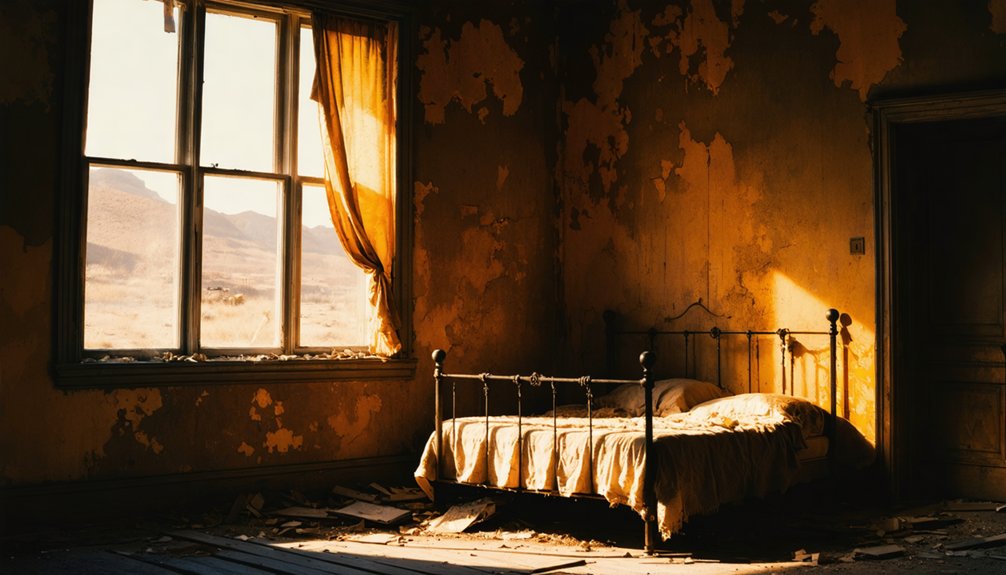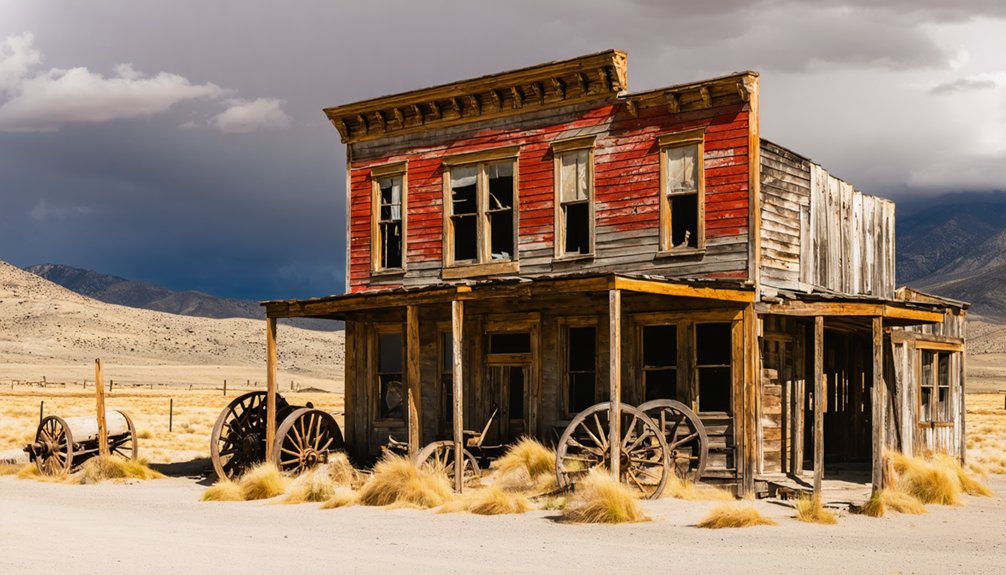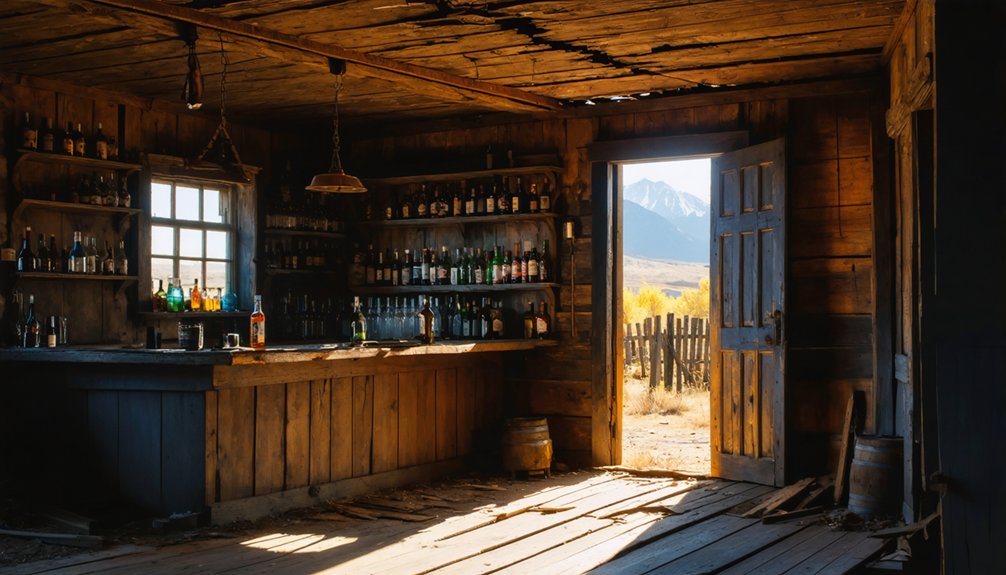
You’ll find haunting ghost towns scattered along the Southwest’s most popular trails, from Utah’s Grafton near Zion—featured in “Butch Cassidy and the Sundance Kid”—to Arizona’s 16-mile Ghost Town Trail connecting three mining camps outside Tombstone. New Mexico’s Turquoise Trail offers accessible ruins at Madrid and Cerrillos, while remote desert routes lead to Charleston’s crumbling adobe walls and Fort Bowie’s military remnants, where stories of frontier boom-and-bust cycles await your discovery.
Key Takeaways
- Grafton, Utah offers preserved Mormon pioneer structures including a schoolhouse, featured in “Butch Cassidy and the Sundance Kid.”
- Arizona’s Ghost Town Trail is a 16-mile gravel circuit connecting Pearce, Courtland, and Gleeson mining camps near Tombstone.
- New Mexico’s Turquoise Trail along Highway 14 provides access to Madrid, Cerrillos, and Golden ghost towns with mining heritage.
- Fort Bowie preserves thirty-eight military structures from the 1862 outpost where Apache leaders Cochise and Geronimo surrendered.
- Millville and Charleston ruins along San Pedro River showcase silver mining history with crumbling foundations and mill remnants.
Grafton: A Cinematic Ghost Town in Utah’s Zion Country
Silence blankets the red rock country where Grafton once thrived, its weathered adobe buildings standing as sentinels against the dramatic backdrop of Zion’s towering cliffs.
You’ll find this cinematic landscape irresistibly haunting as you wander through Utah’s most photographed ghost town. Mormon pioneers established this settlement in 1859, dreaming of cotton fields along the Virgin River.
Mother Nature had different plans—devastating floods repeatedly drove families away, while conflicts with Southern Paiute tribes forced temporary evacuations to safer ground.
Nature’s relentless floods and tribal conflicts ultimately conquered the Mormon settlers’ dreams of a thriving cotton community along the Virgin River.
Today, you can explore the preserved two-story schoolhouse and crumbling homes that Hollywood discovered decades ago. The town’s movie legacy includes filming locations for acclaimed films like “Butch Cassidy and the Sundance Kid” and “In Old Arizona.”
The Grafton Heritage Partnership works tirelessly to protect these remnants of frontier ambition, ensuring future generations can experience this powerful reflection of human resilience. The community once reached its peak with 168 residents by 1864, complete with a school, church, and community hall.
The Ghost Town Trail: Arizona’s Mining Heritage Circuit
You’ll discover three interconnected mining camps along southern Arizona’s Ghost Town Trail, where gold fever at Pearce and copper booms at Courtland and Gleeson created bustling communities that soared to 2,000 residents before crashing by the 1920s.
The 16-mile gravel circuit winds through Cochise County’s high desert, connecting scattered foundations at Courtland with Pearce’s restored buildings and Gleeson’s preserved jail-turned-museum. The trail starts outside Tombstone, offering easy access to this historic mining heritage circuit.
At Gleeson, you can explore the concrete jail built in 1910 to replace the original wooden structure, now serving as a museum showcasing mining artifacts and local history.
Plan your journey for dry conditions—this backcountry route demands respect for both its rough surface and the unstable ruins that mark where fortunes once rose and fell.
Pearce Mining District History
Deep beneath the rugged Dragoon Mountains of southeastern Arizona, twenty miles of tunnels snake through rock that once yielded over ten million dollars in precious metals.
You’ll discover Pearce mining began when Cornishman James Pearce struck gold in 1894, transforming desolate wilderness into Arizona’s silver powerhouse. The Commonwealth Mine‘s historical significance spans nearly a century of operations, processing over one million tons of ore and establishing a mining legacy that attracted fortune-seekers from across continents.
You can trace community development through Pearce’s evolution from tent camps to a thriving town of 1,500 residents by 1919. Railroad stations, schools, and saloons sprouted alongside mine shafts. Mine managers like Charles Knox oversaw the complex operations that sustained this bustling community through its most productive decades. The Pioneer Saloon opened its doors in March 1896, becoming a cornerstone of social life for miners seeking respite from their underground labors.
Today, scattered foundations and weathered structures whisper tales of boom-and-bust cycles that defined Arizona’s territorial frontier spirit.
Trail Access Conditions
Traversing Arizona’s ghost town circuit requires careful planning as road conditions shift dramatically between desert valleys and mountain passes.
You’ll encounter dirt roads with gentle grades that welcome most 4WD vehicles, while others demand high-clearance capability and experienced navigation.
Trail accessibility varies considerably—some routes like the Canelo Hills loop offer smooth gravel perfect for mountain biking, while mining access roads present active blasting zones and heavy truck traffic.
Weather creates unpredictable hazards across this rugged landscape. Many mining heritage routes feature wide flowing paths through juniper forests that accommodate two vehicles side by side, providing safer passage in these remote areas.
Flash floods carve new channels through canyon approaches, while freeze-thaw cycles trigger rockfall along mountain passages. Be aware that environmental hazards such as rock falls can pose serious safety risks to travelers exploring these historic mining areas.
Prolonged drought affects water sources at remote sites, making self-sufficiency essential.
Road conditions change without warning—what’s passable today might require specialized equipment tomorrow.
Check current reports before venturing into Arizona’s mining heritage backcountry.
Millville and Charleston: Forgotten Silver Processing Centers
You’ll discover the haunting remnants of Millville and Charleston scattered along the San Pedro River, where these forgotten twin towns once processed over a million dollars in Tombstone silver during their brief but explosive heyday.
The challenging trail access through rough terrain leads you to crumbling foundations and weathered stone walls—all that remains after the devastating 1887 earthquake and decades of scavenging reduced these once-thriving communities to ghostly ruins. At its peak, Charleston supported over 400 residents who worked the mills and sustained a vibrant community complete with schools, churches, and bustling mercantile establishments.
Standing among the San Pedro’s cottonwoods, you can still trace the outline of Charleston’s main street and imagine the thunderous stamp mills that made Millville the beating heart of Arizona’s silver empire. Richard Gird maintained strict control over his workers by implementing an alcohol prohibition policy throughout Millville to ensure order and productivity at the processing facilities.
Twin Towns Silver History
While Tombstone’s silver strikes captured headlines across the nation, the real treasure processing happened nine miles away along the San Pedro River, where twin settlements of Millville and Charleston transformed raw ore into gleaming bullion.
You’d have witnessed mule trains hauling 40,000 pounds of ore daily through desert heat, feeding the thunderous 10-stamp mills that crushed rock into fortunes.
The economic impact was staggering—$1.4 million in silver bullion during peak production alone. Charleston housed 400 souls supporting this silver mining empire, complete with schools and businesses.
But when Tombstone’s mines flooded in 1886, these riverside boomtowns vanished overnight, leaving only stone foundations as monuments to their brief, brilliant existence.
Trail Access Challenges
Though concrete foundations and scattered mill stones mark where fortunes once flowed, reaching Millville and Charleston’s haunting remains demands navigation through unmarked desert terrain that challenges even seasoned explorers.
You’ll find yourself trudging through arroyos where flash floods once threatened nineteenth-century miners, following faint paths that disappear into mesquite thickets.
The Bureau of Land Management oversees these sites, but don’t expect maintained walkways or directional signage. Ghost town preservation here means protecting ruins from vandalism while leaving nature’s reclamation process undisturbed.
Trail maintenance remains minimal by design, preserving the authentic isolation that defined these forgotten settlements.
You’re stepping into raw Arizona history, where crumbling adobe walls and rusted machinery tell stories of ambition swallowed by desert silence.
San Pedro Ruins
Where cottonwoods once rustled above the churning stamp mills of Arizona’s most productive silver processing hub, you’ll discover the scattered remnants of Millville and Charleston—twin boomtowns that transformed raw Tombstone ore into gleaming bullion along the San Pedro River.
Millville history unfolds through established BLM trails where you can explore:
- Gird Mill foundations – Stone remnants of the operation that produced $1.3 million in silver during 1881.
- Dam ruins – Engineering marvels that corralled precious water for the thundering stamp mills.
- Processing sites – Six mill locations that once pounded ore day and night.
Charleston ruins hide deeper in brush, their adobe walls shattered by the devastating 1887 Sonoran earthquake.
You’ll find freedom exploring these forgotten silver empires where fortunes rose and fell.
Fort Bowie and Southern Arizona’s Military and Mining Legacy
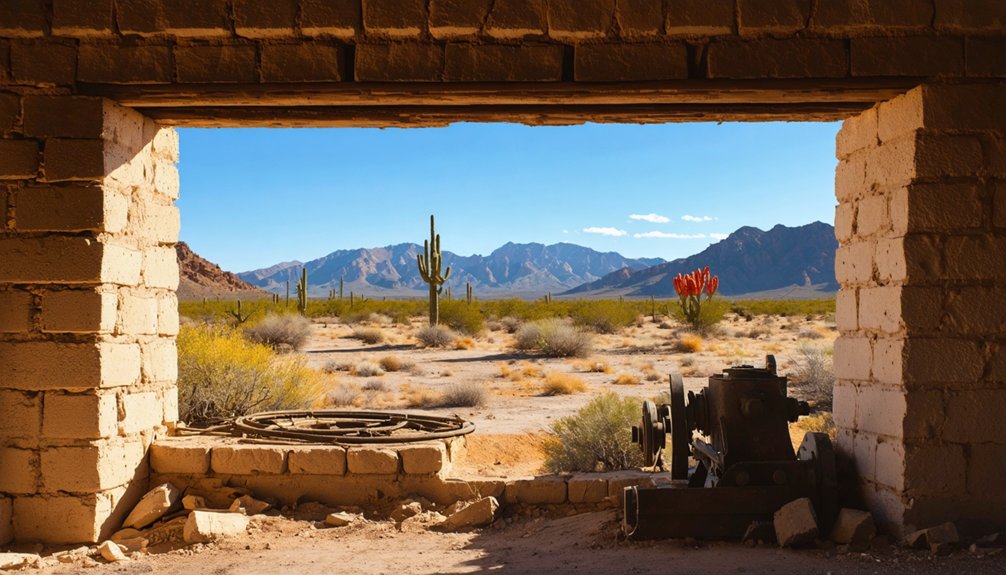
Perched on a windswept plateau overlooking Apache Pass, Fort Bowie’s crumbling adobe foundations tell the story of one of the American Southwest’s most pivotal military outposts.
You’ll discover where Colonel George Washington Bowie’s 5th California Volunteer Infantry established this frontier fortress in 1862, transforming thirteen humble tents into a strategic stronghold that controlled the region’s most precious resource—Apache Spring.
Walking among these weathered ruins, you’re tracing the footsteps of legendary figures like Cochise and Geronimo, whose final surrender here in 1886 ended the Apache Wars forever.
The archaeological significance of this windswept plateau extends beyond mere military conflicts—it represents the collision between two worlds fighting for the same untamed land.
Today, you can explore thirty-eight structural remains that once housed soldiers, officers, and the dreams of westward expansion.
New Mexico’s Trail-Accessible Ghost Towns
Between Santa Fe and Albuquerque, the legendary Turquoise Trail unfolds like a treasure map of New Mexico’s mining past, where you can explore three distinct ghost towns without leaving the comfort of paved Highway 14.
Highway 14’s paved comfort leads adventurers through three authentic ghost towns, each revealing New Mexico’s storied mining heritage along the scenic Turquoise Trail.
Madrid’s restored main street beckons with galleries housed in coal-mining buildings, while Cerrillos preserves its turquoise and silver legacy through accessible mine shafts.
Golden’s adobe San Francisco de Asis church stands sentinel over visible ruins.
For deeper adventures, venture into the Gila Wilderness region:
- Mogollon – High-elevation gold camp with preserved buildings at 7,000 feet
- Chloride – False-front structures with museum and interpretive signage
- Kingston/Fierro – Visible slag piles and cemetery remains
These sites showcase New Mexico’s mining heritage through dedicated historic preservation efforts, offering you authentic glimpses into the Southwest’s boom-and-bust cycles along well-maintained access routes.
Scenic Byway Ghost Towns: From the Apache Trail to Remote Canyons
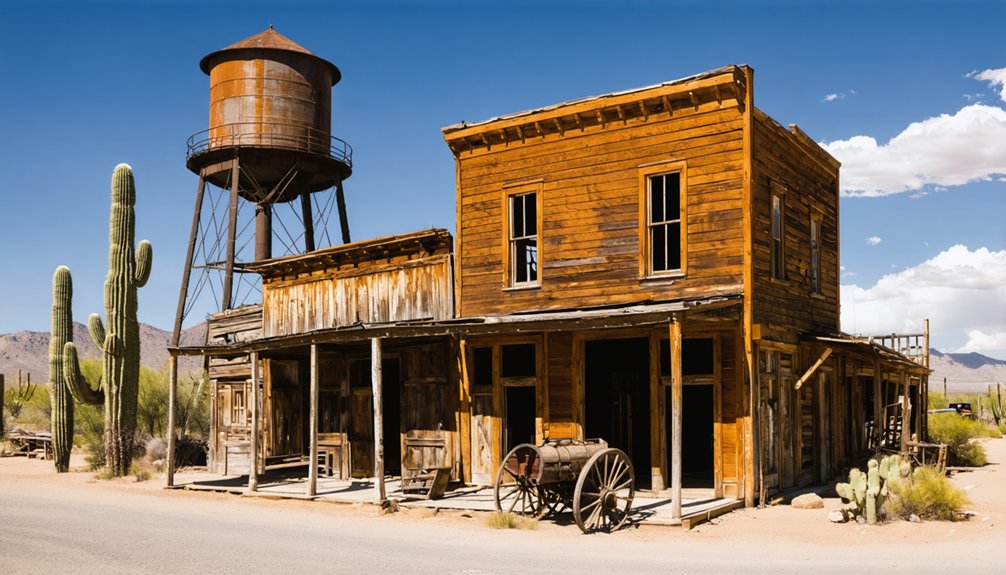
Moving beyond New Mexico’s preserved mining camps, Arizona’s Apache Trail reveals ghost towns wrapped in desert legends and volcanic drama.
You’ll discover Goldfield Ghost Town perched against the rugged Superstition Mountains, where 1890s gold fever once gripped desperate miners. The scenic byway delivers you straight into wild west authenticity—underground mine tours through steel head frames, gunfights erupting on dusty Main Street, and narrow gauge trains echoing mining-era transport.
You can pan for gold flakes while chain fruit cholla cacti frame volcanic peaks tied to Lost Dutchman folklore. At 108°F, you’ll taste the isolation original prospectors endured.
This isn’t sanitized history—it’s raw desert freedom where Apache curses linger and hiking trails disappear into wilderness canyons, connecting you to untamed landscapes that swallowed fortunes.
Planning Your Ghost Town Adventure: Access and Safety Considerations
While ghost towns promise authentic glimpses into forgotten frontier life, reaching these remote destinations demands careful preparation that separates successful explorers from stranded adventurers.
Your adventure begins with understanding ghost town regulations and land ownership. You’ll need to verify whether sites sit on federal, state, or private property, as trespassing can end your exploration before it starts.
Check seasonal road closures and obtain necessary permits for managed lands.
Essential planning elements include:
- Navigation redundancy – Pack offline digital maps, paper topos, and handheld GPS since cell coverage vanishes in remote canyons.
- Recovery capability – Bring winches, traction mats, and spare tires for unmaintained routes.
- Emergency communication – Carry satellite communicators and file detailed itineraries with emergency contacts.
Proper safety gear and route research transform potentially dangerous expeditions into memorable adventures where you’ll experience authentic Western solitude.
Preserving History: Respecting Ruins and Archaeological Sites
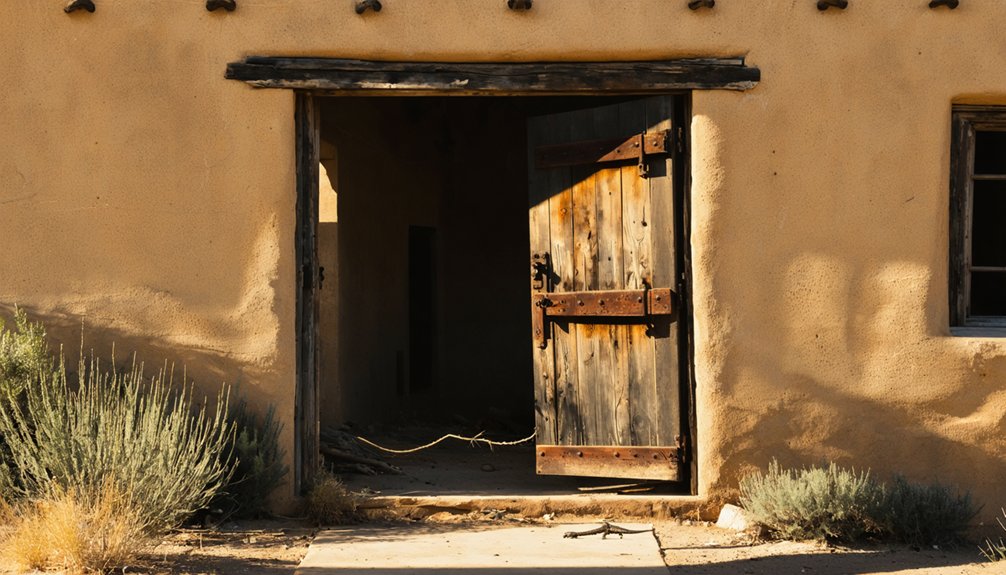
Beneath the weathered adobe walls and rusted mining equipment lies centuries of irreplaceable cultural heritage that demands your utmost respect and protection.
Weathered structures and abandoned tools conceal priceless historical treasures requiring careful stewardship and reverent exploration by modern visitors.
When you explore these haunting remnants, you’re walking through living museums where every artifact tells a story.
Don’t climb fragile structures or pocket “souvenirs”—these actions destroy archaeological context forever. Stay on designated trails, photograph respectfully, and leave everything exactly as you found it.
Archaeological ethics require preserving sites for future generations and scientific study.
Modern preservation techniques like photomonitoring and minimal excavation help researchers understand these places without causing harm.
You can contribute by reporting vandalism, following posted guidelines, and spreading awareness.
Your responsible exploration guarantees these windows into the past remain open for those who follow your footsteps.
Frequently Asked Questions
Are Pets Allowed on Ghost Town Trails and Historic Sites?
Yes, you’ll find most Southwest ghost town trails welcome pets. Practice solid trail etiquette by keeping dogs controlled, pack water for pet safety, and respect private property boundaries while exploring these haunting desert remnants.
In addition to the Southwest ghost town trails, you can also explore ghost towns in California’s Sierra Nevada, where crumbling structures tell stories of the Gold Rush era. With stunning mountain views and a rich history, these towns offer a unique adventure for both you and your furry companions. Make sure to bring your camera to capture the eerie beauty of these forgotten places.
What Photography Restrictions Exist at Ghost Towns and Archaeological Sites?
You’ll face permit requirements, tripod restrictions, and no-touch policies protecting crumbling adobe walls. Respect photography etiquette—no moving artifacts or climbing ruins. Site preservation depends on your restraint, keeping these weathered monuments intact for future wanderers.
Can I Camp Overnight Near Ghost Town Locations?
You can camp overnight near many ghost towns, but camping regulations vary dramatically by location. Check land ownership first—some offer developed ghost town amenities while others require dispersed camping on adjacent public lands.
Do Ghost Town Trails Have Restroom Facilities or Water Sources?
Nature’s calling becomes challenging—restroom availability remains scarce, limited to occasional vault toilets or seasonal portables. Water sources don’t exist; you’ll carry your freedom’s liquid lifeline through these abandoned outposts.
Are Ghost Town Sites Wheelchair Accessible or Suitable for Mobility Aids?
Ghost town wheelchair access varies dramatically—you’ll find some paved overlooks and visitor centers meet standards, but most sites feature rocky terrain, steep grades, and crumbling structures that challenge mobility aids considerably.
References
- https://www.visitutah.com/places-to-go/parks-outdoors/zion/outdoor-experiences/grafton-trail
- https://www.outsideonline.com/adventure-travel/destinations/north-america/most-adventurous-ghost-towns-u-s/
- https://www.arizonahighways.com/ghost-town-trail
- https://www.visittucson.org/blog/post/8-ghost-towns-of-southern-arizona/
- https://www.newmexico.org/places-to-visit/ghost-towns/
- https://www.youtube.com/watch?v=l_ogVgvyw7Y
- https://www.backpacker.com/stories/top-3-ghost-town-hikes-glorietta-ghost-town-nm/
- https://goldfieldghosttown.com
- https://graftonheritage.org/history-settlement/
- https://www.legendsofamerica.com/ut-grafton/