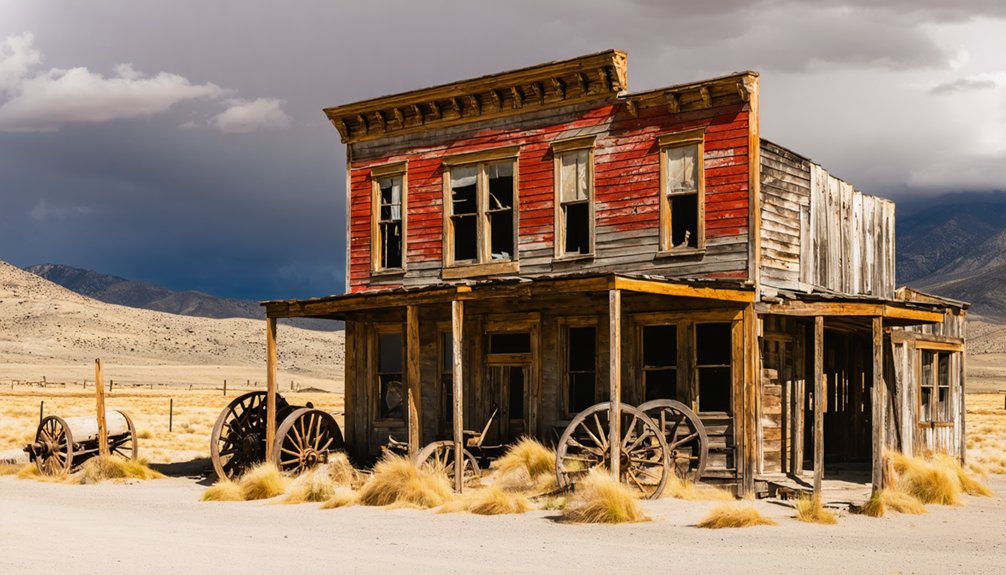
You’ll discover six fascinating ghost towns along Washington State’s established hiking trails, each telling stories of the Pacific Northwest’s industrial past. Monte Cristo’s silver mining boom attracted over 1,000 residents before 1896 floods forced abandonment, while coal towns like Melmont and Franklin operated from the 1880s through 1971. Northern State’s hospital campus housed 2,700 patients until 1973, and Moncton lies submerged beneath Rattlesnake Lake since 1915. These accessible sites reveal detailed histories spanning nearly a century of regional development.
Key Takeaways
- Monte Cristo offers accessible ruins from 1889 silver mining boom, featuring hotel and mining infrastructure remnants along established hiking trails.
- Melmont Trail follows abandoned railroad grades to coal mining ruins, with easy-to-moderate hiking and visible foundations from 1900-1920s operations.
- Franklin Ghost Town features a 2-mile easy trail along historic railroad route with sealed mine shafts, cemetery, and iconic coal cart marker.
- Northern State Hospital spans 700 acres of crumbling psychiatric facility buildings, accessible via trails through the abandoned 1912-1973 campus grounds.
- Fairfax Ghost Town in Carbon River canyon provides archaeological remnants including concrete foundations, brick coke ovens, and railroad infrastructure from 1890s-1941.
Monte Cristo Ghost Town: Historic Mining Camp Adventure
When silver and lead deposits sparked a frenzied rush to Washington’s Monte Cristo valley in 1889, few could’ve predicted the dramatic rise and fall that would unfold over the next three decades.
You’ll discover that this remote mining camp swelled to over 1,000 residents by 1894, attracting major investors including John D. Rockefeller’s syndicate.
The Monte Cristo mining history reveals fascinating characters like Frederick Trump, who operated the Royal Hotel during the boom years. Massive floods in 1896 and 1897 ultimately forced the abandonment of this once-thriving community.
Among Monte Cristo’s colorful boom-era figures was Frederick Trump, who ran the bustling Royal Hotel during the mining camp’s heyday.
However, nature proved unforgiving—catastrophic floods repeatedly destroyed infrastructure, while inconsistent ore yields undermined profitability. The massive United Company concentrator mill operated from the 1890s to 1912, featuring a five-story building capable of processing 300 tons of ore daily before being dismantled in 1917.
Melmont Ghost Town: Coal Mining Remnants Above Carbon River
You’ll discover Melmont’s coal mining heritage perched above Carbon River Canyon, where Northwest Improvement Company established operations in 1900 that produced 900,000 tons of high-grade blacksmith coal over sixteen years.
Your journey begins with a 3.8-mile round trip hike along an abandoned rail grade from Fairfax Bridge, following the same route that once transported coal to Northern Pacific Railroad. The easy-rated trail takes approximately 2-3 hours to complete and offers a suitable adventure for all ages.
You can explore concrete remnants of the hotel site, school basement foundations, and bridge abutments that mark where this bustling mining community thrived until operations ceased in 1918. The town’s decline occurred as diesel and electrical power replaced coal demand, marking the end of an era for this once-thriving mountain community.
Historic Coal Mining Legacy
Remnants of ambitious coal extraction efforts dot the Carbon River canyon where Melmont once thrived as a company town from 1900 to the early 1920s.
You’ll discover traces of mine infrastructure that included six underground levels reaching depths over 600 feet, producing approximately 900,000 tons of high-grade blacksmith coal. The Northwest Improvement Company, a Northern Pacific Railway subsidiary, orchestrated this operation until transferring ownership to Carbon Hill Coal Company around 1918.
Evidence of community life persists through scattered foundations, a surviving bridge abutment, and school basement remains. The site sits on White River School District property, preserving these historical remnants for future generations.
The town’s hotel, saloon, depot, and school supported mining families until operations ceased and fire consumed most structures in the early 1920s. Coal was transported to nearby Carbonado for processing before final distribution.
Melmont’s legacy contributed roughly 4% of Pierce County’s historic coal production.
Trail Access and Route
Multiple access routes lead to Melmont’s ruins, with the abandoned railroad grade serving as the primary corridor for reaching this historic coal mining site.
You’ll find several trailheads including the Fairfax Bridge’s north-side descent and SR-165’s western approach from Buckley/Carbonado. Pierce County Parks maintains pullouts along SR-165, offering an easy one-mile walk to the bridge junction.
Trail conditions remain consistently muddy year-round, so you’ll need sturdy boots and gaiters. The route’s rated easy to moderate with 180-304 feet elevation gain. User reports indicate ATV use creates rutted sections along the grade. Groups should limit their party size to 12 people maximum for optimal trail experience and conservation practices.
Eastern approaches via Manley-Moore Road face frequent washouts requiring careful navigation. The Fairfax bridge closure forces cyclists and hikers to add 17-20 additional miles to their journey via alternate routing.
You’ll navigate using distinct landmarks: mossy retaining walls, dynamite shed ruins, and schoolhouse foundations marking the townsite meadows.
Ruins and Artifacts
Once you reach the townsite meadows, concrete foundations and weathered infrastructure tell the story of Melmont’s coal mining heyday from 1902 to 1918.
You’ll discover remnants of the old bridge abutment where a wagon bridge once spanned the Carbon River, marking the former hotel site. Uphill from the main community area, the school basement remains offer glimpses into daily life when this bustling town housed coal workers for Northern Pacific Railway.
The historical significance of these ruins represents Washington State’s industrial heritage along the Carbon River. The town’s rapid transformation reflects the boom and bust cycles that characterized Washington’s early economic development patterns.
For proper artifacts preservation, leave all remnants undisturbed as you explore. The original school wood was recycled in the 1920s for Carbon River Ranch construction, now serving as the park’s visitor station.
Franklin Ghost Town: Green River Railroad Grade Exploration
You’ll discover Franklin’s coal mining legacy along the old railroad grade that once carried trains to one of Washington’s most productive mining operations from the 1880s through 1971.
The easy 2-mile trail follows the original Columbia & Puget Sound Railroad route, where you can explore sealed mine shafts, foundation remnants, and a historic cemetery marking the town’s peak population of over 1,000 residents. A large coal cart with the town’s name prominently marks the historic site.
Franklin’s mining history includes both tragedy and prosperity, from the devastating 1894 fire that killed 37 miners to the final explosions in 1971 that closed the last operating shaft.
Coal Mining History
While prospectors had scoured Washington Territory’s valleys for decades, the discovery of the McKay coal seam along the Green River in July 1880 marked a turning point that would transform this remote wilderness into one of the region’s most productive mining districts.
You’ll find Franklin’s coal mining techniques evolved rapidly after the Oregon Improvement Company assumed control in 1884. The operation extracted coal through tunnel systems, with the first shipment leaving on July 28, 1885.
Key mining milestones include:
- First coal extraction – July 28, 1885 from newly constructed tunnels
- Initial shipment – 96 tons transported via two railcars to San Francisco on July 21, 1885
- Peak production – Over 1,100 residents supported multiple mines by the 1920s
Mining techniques utilized extensive tunnel networks that extended across the Green River, maximizing coal seam extraction throughout Franklin’s operational period.
Railroad Grade Trail
Today’s Railroad Grade Trail preserves the exact route that carried Franklin’s coal from mine to market during the town’s productive decades.
You’ll follow this gentle grade for 2.5 miles roundtrip, gaining just 200 feet elevation while exploring authentic railroad history. The trail leads you past the iconic “Franklin” coal cart marking the central town site, then continues to the fenced 1,300-foot mine shaft where workers once extracted coal from deep underground.
You’ll discover iron rails on wooden ties spanning 20 feet above Green River—remnants of the original mining infrastructure. For hiking safety, wear long pants through overgrown sections of ferns and salal.
The preserved railroad grade connects you directly to Franklin’s industrial heritage while offering year-round access to this fascinating ghost town.
Historic Remnants Found
Scattered remnants of Franklin’s industrial past emerge from decades of forest reclamation as you explore the Railroad Grade Trail.
These weathered artifacts tell ghostly tales of mining techniques that once drove Western Washington’s coal industry.
You’ll discover three significant remnants along your journey:
- Sealed mine shafts – Visible coal carts and tracks emerge at low water levels in river pools, revealing underground mining techniques used throughout Franklin’s operational years.
- Donkey engine remains – Located beneath Green River Gorge Bridge, this partially hidden machinery powered coal extraction operations during peak production.
- Railroad infrastructure – The repurposed Cannon Mine bridge now serves Black Diamond’s water supply, while powerhouse foundations mark where steam-powered equipment once operated around the clock.
Northern State Ghost Town: Former Mental Hospital Grounds
Nestled among the rolling hills of Sedro-Woolley, Washington, Northern State Hospital’s abandoned campus stands as one of the Pacific Northwest’s most haunting institutional ghost towns.
You’ll discover remnants of a 700-acre self-sufficient community that housed 2,700 residents at its 1950s peak. Operating from 1912 to 1973, this facility served northern Washington counties through controversial decades of psychiatric care.
Walking these grounds, you’ll encounter evidence of historic treatments including hydrotherapy, electroconvulsive therapy, and lobotomy procedures that defined institutional medicine.
Patient experiences ranged from farm work and occupational therapy to documented abuses and frequent escapes from unlatched wards.
Today, crumbling buildings and overgrown farmland tell stories of America’s complex mental health history, preserving both therapeutic intentions and systemic failures within this registered historic site.
Fairfax Ghost Town: Moss-Covered Townsite Discovery
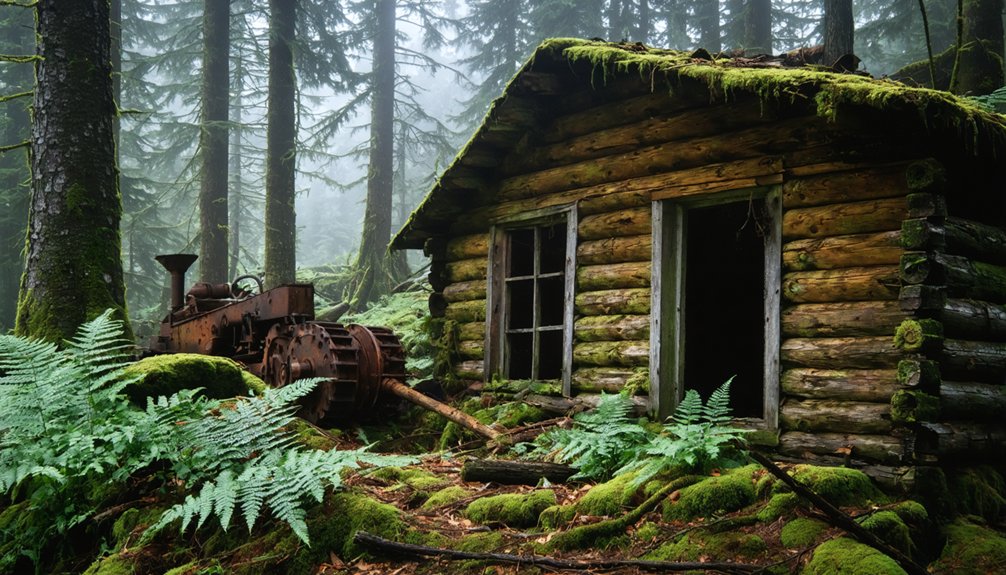
From institutional abandonment to industrial decay, Washington’s ghost towns reveal different chapters of the Pacific Northwest’s forgotten past.
You’ll discover Fairfax’s remnants hidden within Carbon River canyon, where coal mining once sustained over 500 residents from the 1890s through 1941. Archaeological findings reveal the town’s industrial backbone through concrete foundations, brick coke ovens, and railroad infrastructure now reclaimed by moss and forest.
What you can explore today:
- Mine infrastructure – Foundation fragments and a railroad turntable center post mark former operations
- Community remnants – Concrete walls from the heated pool and building foundations scattered across meadows
- Industrial archaeology – Earthen railroad berms and coke oven ruins documenting peak production years
The community dynamics reflected typical company-town hierarchies, with diverse immigrant workers facing labor tensions while building recreational traditions like baseball and seasonal celebrations before oil’s rise ended coal’s dominance.
Moncton Ghost Town: Submerged Railroad Stop at Rattlesnake Lake
Unlike most Pacific Northwest ghost towns that slowly declined over decades, Moncton vanished dramatically beneath rising waters in 1915 when Seattle’s new Masonry Dam triggered catastrophic seepage through glacial moraines.
You’ll find this railroad company town once thrived along Rattlesnake Lake’s northern shore, supporting over 200 residents by 1915 with homes, businesses, and a bustling depot serving eight daily freight trains.
When the dam raised Cedar Lake’s elevation eighteen feet, springs erupted from water-saturated moraines, lifting Rattlesnake Lake over a foot daily.
Motion picture operators filmed the town’s inundation on May 13, 1915.
Today, you can explore submerged foundations through scuba diving, discovering fireplaces, wooden floors, and concrete blocks resting in murky depths beneath Rattlesnake Lake.
Frequently Asked Questions
Are Dogs Allowed on Ghost Town Hiking Trails?
Dog access varies considerably—you’ll face “administrative challenges” at many ghost town trails. Research specific regulations beforehand, practice proper dog hiking etiquette, follow trail safety tips, and respect private property to avoid legal complications.
What Should I Bring for Safety When Exploring Abandoned Mining Sites?
You’ll need essential safety gear including sturdy boots, hard hat, flashlight, and respirator for toxic gases. Pack a thorough first aid kit, emergency communication device, and tell someone your exploration plans before entering abandoned mines.
Can I Camp Overnight Near Any of These Ghost Towns?
You can camp overnight near most Pacific Northwest ghost towns on public lands, but you’ll need to research specific camping regulations and secure permits for restricted areas or use nearby campgrounds during peak seasons.
Exploring ghost towns in the Great Plains offers a glimpse into the historical past of this vast region. Many of these abandoned settlements reveal stories of resilience and change, attracting adventurers and history buffs alike. Be sure to check local guidelines and weather conditions before planning your visit to ensure a safe and enjoyable experience.
Is It Legal to Take Artifacts From Ghost Town Sites?
No, you can’t legally take artifacts from ghost town sites. Artifact preservation laws strictly prohibit removing any historical items, with legal consequences including substantial fines and potential prison time for violations.
Which Ghost Towns Are Accessible During Winter Months?
You’ll find winter accessibility at low-elevation sites like Melmont and Moncton along maintained popular trails. Higher elevations including Monte Cristo require snowshoes or skis, while avalanche terrain demands proper safety equipment.
References
- https://www.themandagies.com/haunted-hikes-in-the-pacific-northwest/
- https://www.wta.org/go-outside/seasonal-hikes/fall-destinations/hidden-history-ghost-town-hikes
- https://www.mountaineers.org/activities/routes-places/northern-state-ghost-town
- https://stateofwatourism.com/ghost-towns-of-washington-state/
- https://hike2hike.com/day-hikes/monte-cristo-ghost-town-washington/
- https://www.youtube.com/watch?v=-HYxK40eeyc
- https://visitrainier.com/melmont-ghost-town-2/
- https://www.youtube.com/watch?v=FVveO9uJBvc
- https://1027kord.com/trump-ghost-town-washington-state/
- https://www.wta.org/go-hiking/hikes/monte-cristo-143