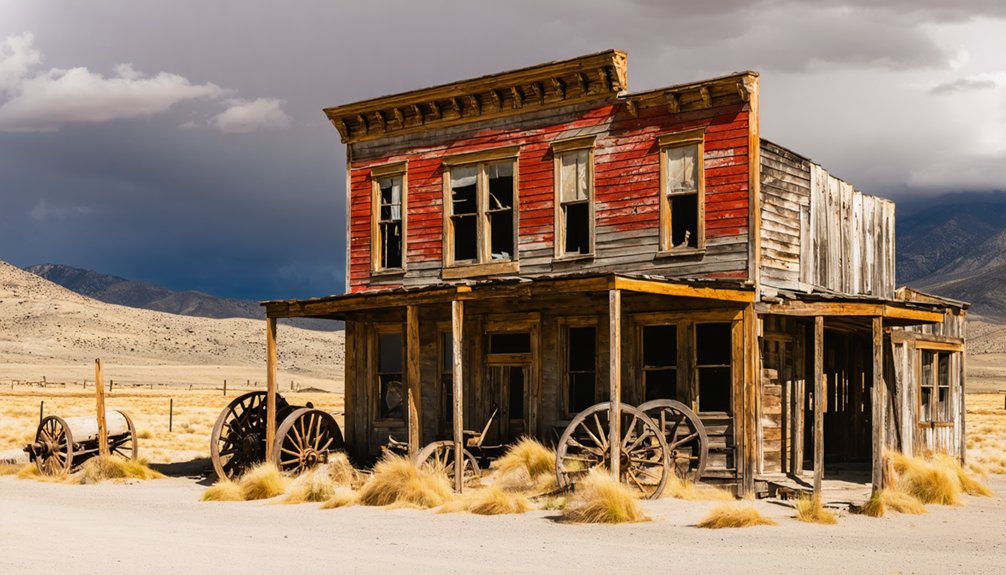
You’ll find exceptional ghost towns along West Coast trails, from Franklin’s coal mining ruins with sealed shafts and miners’ cemetery in Washington to California’s restored Calico silver boomtown featuring 22 historic saloons. Liberty preserves intact 1870s log cabins just two miles from Highway 97, while Independence sits at 10,900 feet near Aspen with accessible interpretive trails. Northern State’s abandoned psychiatric hospital requires 4×4 access through the North Cascades. Each destination offers unique mining heritage and varying difficulty levels to match your exploration goals.
Key Takeaways
- Liberty Ghost Town preserves intact 19th-century mining buildings from the 1870s gold rush, located just two miles from Highway 97.
- Independence Townsite sits at 10,900 feet near Aspen with preserved log cabins and accessible interpretive trails for hikers.
- Franklin Ghost Town features moss-covered foundations, sealed mine shafts, and miners’ cemetery from the 1887 coal mining boom.
- Calico Ghost Town offers restored buildings as a California Historical Landmark, emerging from an 1881 silver boomtown with 22 saloons.
- Northern State Ghost Town contains psychiatric hospital remains from 1910s-1980s, requiring high-clearance vehicles or multi-day hikes to access.
Franklin Ghost Town: Historic Coal Mining Heritage Along Green River
When you discover the coal seam that transforms a wilderness into a booming town of 1,100 residents, you’re witnessing the birth of Franklin—a story that began with the McKay coal seam’s discovery in July 1880 and the town’s formal establishment seven years later.
You’ll find Franklin heritage preserved within Green River Gorge’s protected parkland, where multiple numbered shafts once extracted coal shipped to San Francisco.
The mining technology included deep shaft operations like Franklin No. 10, which produced over 66,000 tons across seven years.
You can explore moss-covered concrete foundations, sealed mine shafts, and cemetery headstones marking miners’ graves. The town once featured essential amenities including a hotel and saloons that served the thriving mining community during its peak years. After mining ceased, spontaneous combustion created an underground fire that generated steam vents and a hot spring reaching 94 degrees.
This ghost town reminds you that industrial prosperity built communities—then left haunting remnants when coal operations ended in the 1970s.
Northern State Ghost Town: Abandoned Mental Hospital Ruins in the North Cascades
Deep in the North Cascades wilderness, where State Route 20 curves through Marblemount’s forested valleys, you’ll discover the haunting remains of Northern State Hospital—a massive psychiatric institution that housed over a thousand patients during its mid-20th century peak.
This abandoned architecture tells a stark story of mental health history, from its 1910s construction through deinstitutionalization policies that forced closure in the 1980s.
You’ll need high-clearance 4×4 vehicles or multi-day hikes to reach these crumbling multi-wing buildings, water tower foundations, and overgrown cemetery plots.
The site’s deteriorating masonry and timber structures contain serious hazards—asbestos, lead paint, and unstable ruins make exploration dangerous.
Federal laws prohibit camping and artifact removal, while seasonal snowpack limits access from late autumn through spring.
Liberty Ghost Town: 1870s Gold Rush Remnants at Blewett Pass
Nestled in the Cascade foothills near Blewett Pass, Liberty preserves one of Washington’s most intact 19th-century mining settlements from the Swauk Creek gold rush that began with Newton and Benton Goodwin’s 1867 discovery.
You’ll find authentic log cabins and wooden storefronts lining the main road, creating an unaltered streetscape from the 1870s-1890s boom years.
Liberty history reveals peak population reached several hundred miners during the bonanza period when high-grade quartz veins yielded exceptional ore. The camp was notorious for being one of the most disorderly mining settlements in Chelan County during its tumultuous early years.
During Liberty’s golden era, hundreds of prospectors flocked to work the rich quartz deposits that defined the mining boom.
Gold mining operations extracted coarse nuggets from placer deposits while stamp mills processed vein ore from surrounding claims. The area’s unique deposits include rare wire gold formations found in local streams, distinguished by their distinctive crystalline structure.
The town’s preserved structures, replica arrastra, and mining equipment offer unrestricted exploration just two miles from Highway 97, letting you experience authentic frontier mining culture without formal restrictions.
Calico Ghost Town: California’s Premier Silver Mining Destination
Rising from the colorful Calico Mountains that resembled the patterned fabric of their namesake, this silver boomtown emerged in 1881 when four prospectors from Grapevine Station struck rich ore deposits worth $400-$500 per ton.
You’ll discover a town that generated over $20 million through Calico Mining operations across 500 mines during its twelve-year heyday.
At its 1884 peak, you’d have encountered 2,500 residents supporting 22 saloons, schools, and a thriving Chinatown. The Silver King Mine became California’s top silver producer, cementing this location’s place in Silver History.
When silver prices crashed mid-1890s, miners fled for borax fields elsewhere. The discovery of colemanite deposits further boosted the town’s mineral wealth during its prime years.
Today, you’ll explore Walter Knott’s meticulously restored buildings, preserved as California Historical Landmark #782 and the state’s official Silver Rush Ghost Town. The town welcomes visitors daily from 9 AM to 5 PM, with admission fees starting at $8 for adults and additional costs for special attractions like mine tours.
Independence Townsite: High-Altitude Ghost Town Near Aspen
While California’s silver camps dominated the desert landscape, Colorado’s high-altitude mining ventures pushed the boundaries of human endurance in pursuit of precious metals.
You’ll find Independence Townsite perched at 10,900 feet near Aspen, where prospectors struck gold on July 4, 1879. This settlement exploded to 1,500 residents by 1882, producing $190,000 in ore before depletion forced abandonment by 1890.
Independence history reveals nature’s unforgiving grip—residents literally skied to Aspen on house planks during the devastating 1899 blizzard. The town was known by several names including Chipeta, Farwell, Mammoth City, Mount Hope, and Sparkill throughout its brief existence. The settlement featured three post offices, four grocery stores, boarding houses, and three saloons during its peak years.
Today, you can explore preserved log cabins, the Farwell Stamp Mill, and interpretive displays along accessible trails. Ghost town preservation efforts by the Aspen Historical Society maintain this National Register site, offering you authentic glimpses into Colorado’s mining legacy without the crowds of typical tourist destinations.
Panamint City: Remote Death Valley Mining Settlement
You’ll need to tackle a challenging 4-mile hike through Surprise Canyon’s rocky terrain to reach Panamint City’s weathered ruins, situated at roughly 6,000 feet elevation in Death Valley’s remote backcountry.
The arduous trail leads you past mine shafts and scattered foundations to the town’s most prominent landmark—a crumbling brick smokestack from the Surprise Valley Mill that processed silver ore during the 1870s boom. The mill’s 20-stamp operation began processing ore in June 1875, crushing rock that averaged $80 to $100 per ton before shipment to west coast markets and Europe.
These substantial remains mark what was once a notorious 2,000-resident mining camp that flourished briefly when the Panamint Mining Company invested $2 million in infrastructure before the district’s collapse by 1877. The region’s mining potential stemmed from approximately 100 silver lodes discovered by 1873, with ore values ranging from $200 to $1,200 per ton.
Extreme Hiking Trail Access
Deep within the Panamint Range at 6,500 feet elevation, Panamint City represents one of Death Valley’s most challenging ghost town destinations, requiring hikers to navigate the treacherous Surprise Canyon trail system.
You’ll face extreme hiking conditions through narrow, flash flood-prone terrain that historically destroyed much of the settlement. Trail navigation demands careful planning—the same washouts that claimed the town’s improved road in the 1870s still threaten modern adventurers.
Hiking safety becomes critical as you traverse the rugged canyon where the Surprise Valley Mill and Water Company once built infrastructure. The brutal heat and isolation that challenged 1870s miners persist today, making this remote mountain location accessible only to determined hikers willing to endure Death Valley’s unforgiving environment.
Historic Mining Town Ruins
Scattered across Surprise Canyon’s slopes at 6,200 feet elevation, the stone foundations and crumbling smokestack of Panamint City mark what remains of Death Valley’s most ambitious 1870s mining venture.
You’ll discover the historic significance of this boom-and-bust settlement through its substantial ruins—stamp-mill foundations, furnace remnants, and tramway anchor points that connected mines to processing facilities.
The Surprise Valley Company’s 20-stamp mill, built in 1875, employed advanced mining techniques for its era, processing silver ore from multiple claims including the Wyoming Mine.
By 1877, refractory ores and silver’s demonetization triggered rapid abandonment.
Today you’ll find artifact scatter, mine adits, and deteriorating masonry protected under National Park Service jurisdiction, preserving tangible evidence of frontier mining ambitions in one of America’s harshest landscapes.
Essential Gear and Safety Considerations for Ghost Town Exploration
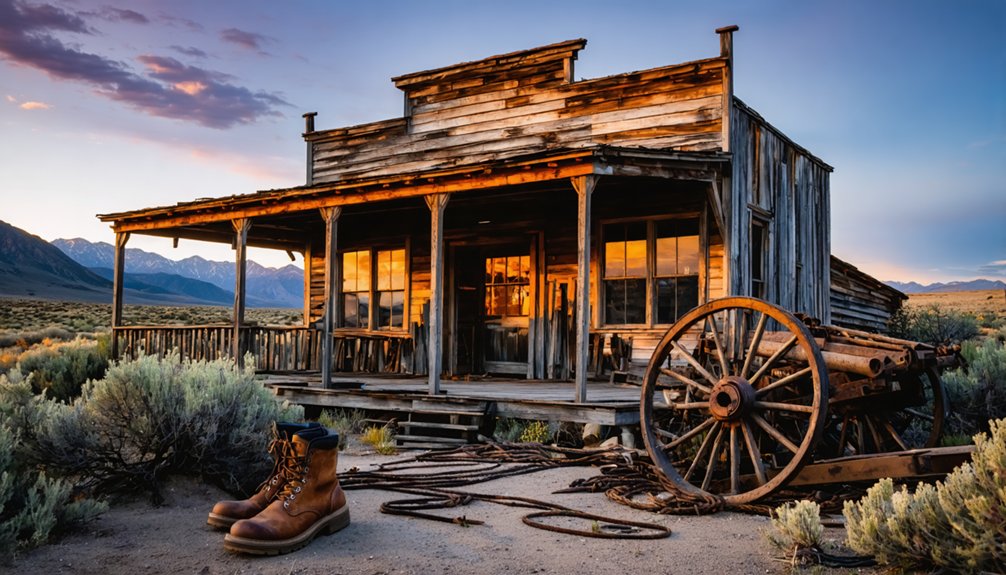
Proper preparation can mean the difference between a memorable adventure and a dangerous emergency when exploring abandoned settlements along remote trails. Your safety gear should include a hard hat, sturdy boots with ankle support, and respiratory protection against asbestos and dust particles.
The right safety equipment transforms potentially perilous exploration into an unforgettable journey through history’s forgotten places.
Pack cut-resistant gloves, long sleeves, and reliable lighting with backup batteries for dark structures.
Essential exploration tips include carrying GPS devices with offline maps and satellite communicators for areas lacking cell coverage. Always inform someone of your planned route and check-in times.
Verify land ownership and obtain written permission when necessary—trespassing penalties can be severe. Avoid entering sealed mines or locked structures, as these pose fatal risks including vertical shafts and unstable timbers.
Respect Leave No Trace principles by avoiding artifact removal and structural damage.
Best Seasons and Weather Conditions for West Coast Ghost Town Visits
While West Coast ghost towns remain accessible year-round, timing your visit according to regional climate patterns and elevation will determine both your safety and exploration success.
Seasonal planning becomes essential when you’re targeting different regions—California’s coastal and desert sites thrive during fall through spring (October–April), avoiding Death Valley’s brutal 110°F+ summer temperatures.
Sierra Nevada mining towns open up late spring through early fall (May–October) once snow melts and access roads clear.
Pacific Northwest locations offer ideal conditions during summer to early fall (June–September) with reduced rainfall and extended daylight.
Weather considerations include flash flood risks during changing seasons, high-elevation temperature swings exceeding 30°F between day and night, and sudden road closures from winter storms that’ll strand you unexpectedly.
Photography Tips for Capturing Historic Mining Structures
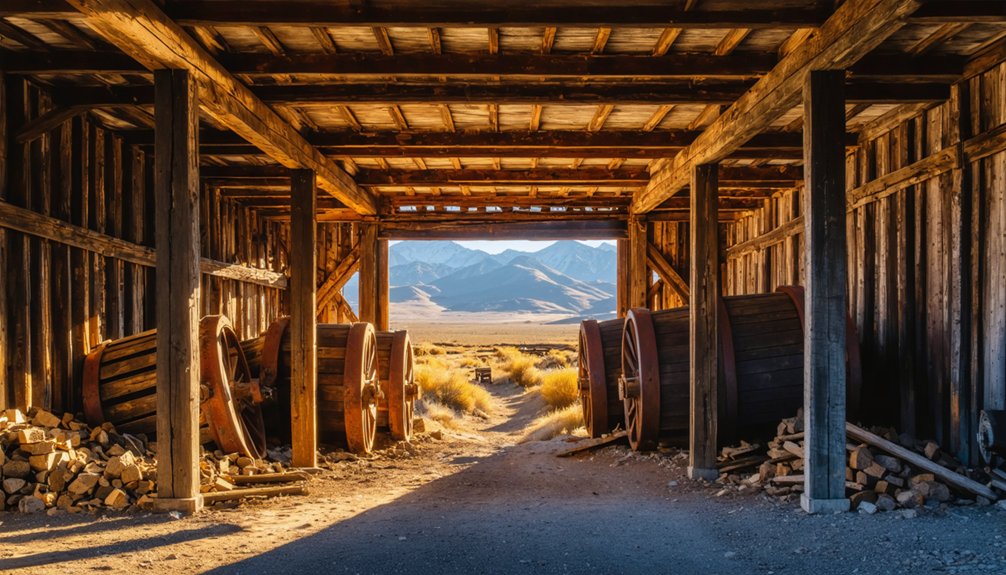
You’ll achieve the most compelling images of historic mining structures by timing your shots during golden hour when side lighting reveals the three-dimensional textures of weathered timber and corrugated metal.
Focus your lens on close-up details like peeling paint, rust patterns, and wood grain to document the material history these structures preserve.
Frame your compositions using natural elements such as surrounding vegetation or rock formations to create leading lines that guide viewers’ eyes toward key architectural features like headframes and ore processing equipment.
Golden Hour Lighting Techniques
As the sun settles into its golden hour trajectory, historic mining structures transform from mere documentary subjects into dramatically lit architectural monuments that reveal decades of weathering, craftsmanship, and decay.
You’ll want to scout compositions beforehand, mapping shadow patterns and reflective highlights on corrugated metal and weathered glass. Use side-lighting to emphasize texture—position yourself so sunlight grazes wooden beams and stone foundations with strong raking light.
East-facing structures work best at sunrise, west-facing at sunset. Bracket your exposures to capture both deep interior shadows and bright sky showing through broken rooflines.
Frame light shafts streaming through doorways and windows, adding visible dust or mist when possible. These lighting techniques turn abandoned mining camps into compelling visual narratives of America’s industrial heritage.
Weathered Texture Close-ups
Decay tells stories that distant shots can’t capture—every rust streak, splintered board, and corroded bolt holds evidence of decades spent battling mountain weather and industrial use.
You’ll reveal these narratives through deliberate close-up photography that emphasizes weathered patterns across mining structures.
Position yourself at low angles to accentuate rough timber surfaces, then shift to multiple distances for macro erosion details.
Side lighting during early morning or late afternoon creates dramatic texture contrasts, casting shadows that reveal cracks and crevices flat overhead light would miss.
Your camera should capture the intricate patterns in corroded iron and peeling paint layers.
Post-processing amplifies these discoveries—apply high pass filters for edge definition and adjust clarity sliders to enhance midtone contrasts without over-sharpening these authentic aged surfaces.
Framing With Natural Elements
Natural frames transform ordinary ghost town photographs into compelling compositions that draw viewers deeper into mining history.
You’ll discover doorways and archways create immediate rectangular borders that isolate historic structures while emphasizing their monumental scale.
Window frames offer dramatic silhouette opportunities when backlit, revealing interior machinery and weathered beams.
Vegetation provides organic natural framing that contrasts living growth against abandoned relics. Use overhanging branches, climbing vines, and foreground bushes to guide focus toward cabins and stamp mills.
Trails and fence lines create linear frames leading eyes to shuttered buildings.
Geological features add rugged context—position yourself behind boulders or use cliff openings to frame structures against sky.
This technique adds visual interest while situating mining relics within their harsh landscape, emphasizing the isolation these prospectors once endured.
Trail Difficulty Ratings and Family-Friendly Ghost Town Options
When planning your ghost town adventure, understanding trail difficulty ratings helps you select destinations that match your group’s abilities and interests. Most trails use easy/moderate/difficult classifications based on mileage, elevation gain, and terrain complexity.
For ideal trail accessibility, look for routes under two miles with minimal elevation gain—Grafton’s 0.4-mile interpretive loop and Franklin’s 2.5-mile railroad grade exemplify family-friendly options.
Family engagement thrives on shorter adventures where everyone can participate. Technical factors like stream crossings, route-finding challenges, and unstable mining debris increase difficulty regardless of distance.
Remote Sierra locations demand advanced skills, while maintained townsites offer interpretive signage and facilities. Consider seasonal conditions, emergency access, and cell coverage when choosing your destination.
Restored sites provide safer exploration without sacrificing historical authenticity.
Frequently Asked Questions
Are Camping Reservations Required at Ghost Town Locations During Peak Seasons?
Yes, you’ll need camping reservations at most ghost town locations during peak season. Camping regulations vary by managing agency—national parks require permits, while BLM lands typically don’t, though peak season often triggers quota systems.
Which Ghost Towns Allow Metal Detecting or Artifact Collection by Visitors?
You’ll find Wyoming ghost towns allow metal detecting near mine shafts and home sites, following metal detecting regulations. However, you must verify private versus public land ownership and follow artifact preservation guidelines before searching.
Do Any Ghost Towns Charge Entrance Fees or Require Special Permits?
Ironically, you’ll pay more to enter “free” ghost towns than their original residents earned daily. Most charge $1-20 entrance fees, though entrance policies vary and permit requirements aren’t typically needed for basic visits.
Are Pets Allowed on Ghost Town Trails and Historic Site Areas?
Yes, you’ll find most ghost towns welcome pets with leash requirements and cleanup responsibilities. Pet friendly policies vary by location, so check trail safety guidelines beforehand to guarantee you’re following site-specific regulations.
When exploring dogfriendly activities in Bodie, California, you and your furry friend can enjoy a scenic walk through the historic sites and beautiful landscapes. Many dogs love the fresh air and the chance to discover new smells, adding another layer of adventure to your visit. Always remember to bring fresh water and snacks to keep your pet comfortable during your exploration.
What Cell Phone Coverage Can Visitors Expect at Remote Ghost Towns?
Don’t expect reliable connectivity—cell service reliability drops dramatically at remote ghost towns. Rural network availability varies wildly, from spotty 4G near highways to complete dead zones in mountainous terrain where towers can’t reach.
References
- https://www.wta.org/go-outside/seasonal-hikes/fall-destinations/hidden-history-ghost-town-hikes
- https://www.youtube.com/watch?v=WCbhdQVaWA4
- https://crazyaboutcolorado.com/hiking-around-colorado-ghost-towns/
- https://parks.sbcounty.gov/park/calico-ghost-town-regional-park/
- https://www.newmexico.org/places-to-visit/ghost-towns/
- https://californiahighsierra.com/trips/explore-ghost-towns-of-the-high-sierra/
- https://www.natureoutside.com/quicksilver-hike-ghost-towns-part-2/
- https://www.outsideonline.com/adventure-travel/destinations/haunted-hikes/
- https://www.angelfire.com/film2/ronmcf/FranklinTown6-05.html
- https://www.historylink.org/File/22479