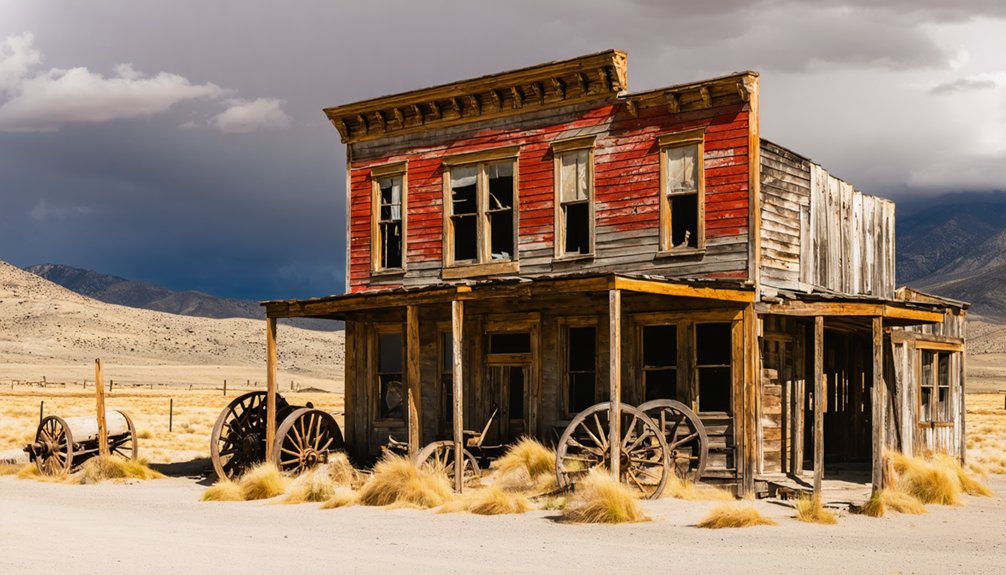
You’ll discover dozens of abandoned settlements scattered along Route 66’s 2,400-mile stretch, where crumbling gas stations, empty storefronts, and weathered signs tell the story of America’s boom-and-bust dreams. From California’s Calico Ghost Town with its 500 former mines to Arizona’s Oatman with roaming burros, these forgotten communities disclose tales of silver strikes, oil booms, and interstate bypasses that left entire towns behind. Each stop reveals deeper mysteries of the Mother Road’s forgotten chapters.
Key Takeaways
- California’s Mojave Desert features abandoned settlements like Calico Ghost Town, which housed 1,200 residents during the silver mining boom.
- Arizona’s ghost towns include Oatman with roaming burros and Goldroad, showcasing early 1900s mining heritage and boom-bust cycles.
- New Mexico has both revived towns like Madrid with 40+ galleries and truly abandoned places like Cuervo, evacuated in 2011.
- Texas Panhandle ghost towns Alanreed and Glenrio reflect oil boom declines, with Alanreed’s population dropping from 500 to 23.
- Interstate construction and railroad changes created an estimated 2,000 ghost towns, particularly affecting Oklahoma’s mining and oil communities.
California’s Desert Remnants
When you venture into California’s Mojave Desert along the historic Route 66, you’ll encounter a haunting landscape where silver-rich dreams turned to dust beneath the relentless desert sun.
Calico Ghost Town stands as a monument to boom-and-bust cycles, where 1,200 souls once extracted fortunes from over 500 mines. Its restored ghost town architecture reveals Walter Knott’s careful preservation using old photographs. The Silver King Mine operated as California’s largest silver producer during the mid-1880s, cementing the region’s mining legacy.
Beneath the Mojave sun, Calico’s weathered buildings echo with the whispers of 1,200 fortune-seekers who once called these dusty streets home.
You’ll discover Bagdad’s lonely tree marking civilization’s last remnant, while Goffs whispers tales of railroad glory days. The renovated 1914 schoolhouse in Goffs serves as a testament to the educational hopes that once flourished in this desert outpost.
These desert survival stories span 100 dusty miles of abandoned settlements. Each crumbling foundation tells of freedom-seekers who chased silver dreams from Eagle Mountain to Daggett, leaving behind Route 66’s revelrous heyday for wanderers seeking authentic adventure.
Arizona’s Mining Heritage Sites
Across Arizona’s sun-scorched landscape, the ghost of gold fever still haunts every weathered mine shaft and crumbling foundation where fortunes were made and lost in the blink of a prospector’s eye.
You’ll discover this mining legacy most vividly in Oatman, where descendants of pack burros roam freely through streets lined with Historic Structures from the early 1900s boom. These famous Oatman Burros, once essential for Gold Mining operations in the Black Mountains, now charm tourists along this iconic Route 66 Attractions corridor.
Beyond Oatman’s gunfighter shows and haunted hotel, you can explore Goldroad’s skeletal remains and navigate Sitgreaves Pass’s hairpin curves. The town’s prosperity reached its peak in the 1920s before the mines closed and transformed this once-bustling hub into the atmospheric ghost town that captivates visitors today.
Each site whispers tales of $10 million veins, abandoned dreams, and the relentless desert reclaiming humanity’s temporary victories over stone and sand. Nearby Hackberry stands as another testament to Arizona’s silver mining past, where weathered buildings tell stories of boom-and-bust cycles that defined the American West.
New Mexico’s Revived Communities
You’ll discover that not every Route 66 settlement surrendered to abandonment—some New Mexican communities clawed their way back from the brink of extinction.
Madrid transformed from a coal mining ghost town into a thriving artists’ colony where galleries and cafés now occupy buildings that once housed miners, while Golden maintains its frontier charm through restored mercantiles and trading posts.
These resurrection stories prove that with vision and determination, you can witness authentic Western towns that’ve successfully bridged their storied past with modern purpose. Santa Rosa stands as another example, maintaining its status as not a ghost town despite housing many abandoned buildings throughout the community. Meanwhile, Cuervo officially met its end in 2011 when the town was officially abandoned after Interstate 40’s construction decades earlier had split the community and caused its steady decline.
Madrid’s Business Revival
While most mining towns along Route 66 remain frozen in time as tourist curiosities, Madrid has undergone one of the Southwest’s most remarkable transformations from ghost town to thriving artistic community.
You’ll discover over 40 galleries and shops housed in former company buildings, where artists and free spirits have breathed new life into abandoned structures.
The Mine Shaft Tavern pulses with live music Thursday through Sunday, while Refinery 14 serves red-chile biscuits and plans a brewing operation by 2025. The community’s festive spirit shines during December when the Madrid Business Alliance organizes special Christmas events including a new Toyland display for visiting families.
You can catch drag shows, explore vintage stores, or simply wander through this unconventional haven where Vietnam veterans and creative souls found refuge in the 1970s, creating today’s vibrant tourist attractions. Madrid sits along the Turquoise Trail National Scenic Byway, making it easily accessible for day-trippers exploring New Mexico’s artistic communities.
Golden’s Historic Commerce
Tucked into the Ortiz Mountains south of Santa Fe, Golden represents a fascinating chapter in New Mexico’s mining heritage that predates Route 66 by nearly half a century.
You’ll discover remnants of a once-thriving community that emerged from 1820s placer-gold discoveries along Tuerto Creek. By 1879, golden mining had transformed this remote canyon into El Real de San Francisco, complete with multiple historic saloons, businesses, and even a school serving hundreds of prospectors.
Walking through Golden today, you’re exploring authentic Old West ruins where fortune-seekers once gathered after long days extracting ore from surrounding hills.
Unlike sanitized tourist attractions, these weathered adobe walls and collapsed mine shafts tell unvarnished stories of boom-and-bust cycles that shaped the American frontier long before highways brought different dreams of freedom. When Route 66 was established in 1926, it connected these isolated mining communities to the broader network of American road travel, breathing new life into forgotten settlements scattered across New Mexico’s challenging terrain. The highway served as a primary route for those seeking opportunities in the American West, much as it had during the Dust Bowl migration of the 1930s.
Texas Panhandle Stops
You’ll discover the Texas Panhandle’s forgotten communities where oil dreams and border intrigue once thrived along Route 66’s most challenging stretch.
Alanreed stands as a monument to the Panhandle Oil Boom‘s fleeting prosperity, its population of 52 watching over abandoned storefronts and a historic church that survived the town’s decline.
Meanwhile, Glenrio’s unique position straddling the Texas-New Mexico border created opportunities for travelers to exploit different state laws, leaving behind an eerie ghost town where you can still walk among the Catholic church ruins and imagine the border-town schemes that once flourished here.
Alanreed’s Oil Boom Legacy
The scent of crude oil once mingled with prairie dust as Alanreed transformed from a humble farming settlement into the Texas Panhandle‘s most prominent town during the roaring 1920s.
You’re witnessing the remnants of a classic American boom-and-bust story, where the oil industry’s arrival swelled population trends from 150 struggling residents to nearly 500 ambitious souls chasing black gold dreams.
However, prosperity proved fleeting. The same oil wealth that built Alanreed simultaneously strengthened competing towns, drawing away its newfound riches.
By the 1930s, I-40’s construction diverted traffic from Route 66, sealing the town’s fate as travelers bypassed this once-thriving hub.
- Peak population reached 500 during oil boom prosperity
- Competing towns ultimately captured Alanreed’s economic dominance
- Population plummeted to just 23 residents by 2020
Glenrio Border Town Mystery
Seventy miles east of Alanreed’s oil-stained memories, another peculiar chapter of Route 66 history unfolds where state lines create more confusion than clarity.
You’ll discover Glenrio’s borderline quirks immediately – the post office sat in New Mexico while the railroad depot operated in Texas. Smart entrepreneurs exploited this geographic oddity: thirsty travelers found bars on the wet New Mexico side, while cheaper gas flowed from Texas pumps avoiding higher state taxes.
During Route 66’s golden era, you’d have encountered “Last Stop in Texas” signs and Art Moderne diners capitalizing on the boundary’s novelty.
Today’s Glenrio folklore includes tales from The Grapes of Wrath filming and stories of the town’s final holdout residents, creating ghost-town mythology that draws freedom-seeking travelers to these haunting ruins.
Oklahoma’s Declining Towns

When you drive through northeastern and central Oklahoma today, you’ll encounter the haunting remnants of what were once thriving Route 66 communities. Among Oklahoma’s estimated 2,000 ghost towns, several tell devastating stories of population migration and environmental impact that stripped away entire ways of life.
Picher stands as the most dramatic example—a former lead-zinc mining town where EPA Superfund actions and federal buyouts eliminated nearly all residents after contamination made the area uninhabitable.
Environmental devastation and government intervention transformed a once-prosperous mining community into an uninhabitable wasteland requiring mass relocation.
Texola and nearby communities cling to survival with just handfuls of residents remaining.
- Contaminated groundwater and mine subsidence created health hazards forcing permanent evacuations
- Oil and gas boom-bust cycles left service towns abandoned when resources dried up
- Interstate bypassing killed Main Street businesses, leaving empty commercial cores behind
Railroad Origins and Interstate Bypasses
Long before Route 66 carved its legendary path across Oklahoma, railroad tracks had already scripted the geography of settlement and commerce that would shape America’s most famous highway.
You’ll discover that the Missouri, Kansas and Texas Railroad blazed Oklahoma’s first rail line in 1870, followed by the Atlantic and Pacific pushing westward from Arkansas. This railroad expansion created the backbone for future highway development, with Route 66 zigzagging along existing rail corridors from Quapaw to Oklahoma City.
But freedom-seekers face a harsh reality: progress devours its own children.
Towns like Quapaw, Calumet, and Bridgeport fell victim to bypasses decades before Interstate 40 delivered the final blow. Each realignment promised efficiency while abandoning communities that had faithfully served travelers along America’s highway.
Population Peaks and Modern Decline
The numbers tell stories that railroad maps and highway bypasses can’t capture—stories of boom, bust, and the stubborn human spirit that refuses to vanish entirely.
You’ll discover population dynamics that mirror America’s restless pursuit of opportunity. Calico’s silver rush swelled from zero to 3,500 souls in nine years before vanishing completely. Oatman’s gold fever created the same peak population within twelve months.
Meanwhile, cotton-rich Texola and oil-booming Alanreed watched their communities slowly bleed residents across decades rather than years.
- Texola’s cotton empire crumbled when Dust Bowl winds carried away both soil and dreams
- Times Beach’s 2,000 residents faced government evacuation due to toxic contamination
- Oatman’s 128 survivors now share streets with wild burros, embracing tourist-driven reinvention
Each town’s historical significance reflects America’s boom-and-bust cycles, where fortunes disappeared as quickly as they’d appeared.
Surviving Businesses and Attractions
Against all odds, dozens of businesses continue breathing life into Route 66’s ghost towns, transforming abandonment into adventure.
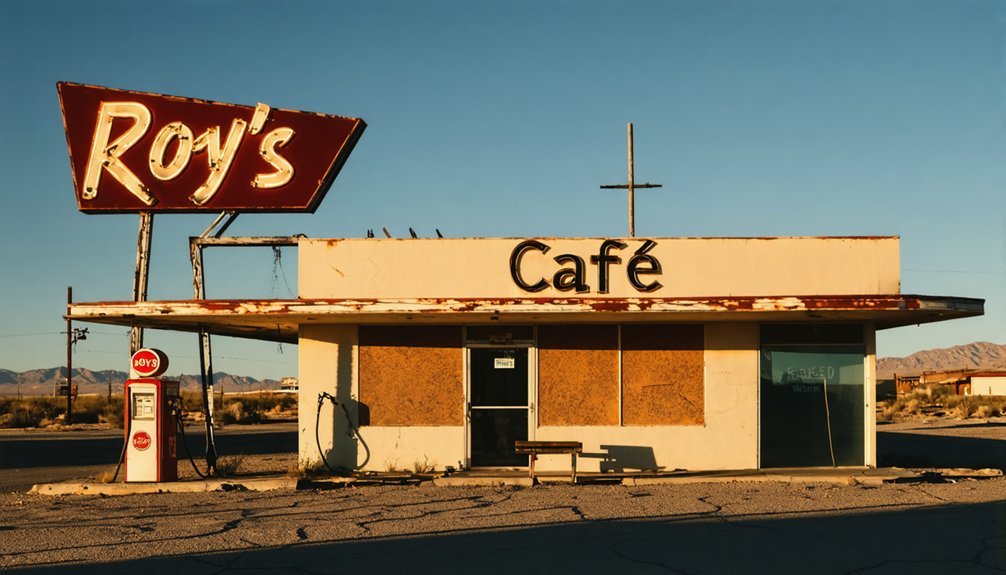
You’ll discover historic cafes like Roy’s in Amboy, where vintage neon still beckons travelers and the gas pumps actually work. The Midpoint Cafe serves legendary pies that’ll make your detour worthwhile, while Henderson Store in Golden offers authentic handmade treasures.
Iconic gas stations tell America’s automotive story through restoration. Shamrock’s conical station now welcomes visitors as a gift shop, and Alanreed’s Super 66 stands proud since 1930.
You’ll find unexpected gems too – art galleries flourish in revived Madrid, and Calico operates as a living desert museum.
Even ghost town Glen Rio surprises with modern enterprises, proving the Mother Road’s spirit adapts without surrendering its soul.
Preservation Efforts and Tourist Appeal

Behind every thriving ghost town business stands a network of passionate preservationists working tirelessly to save Route 66’s fading legacy.
You’ll discover organizations like the National Trust for Historic Preservation and local volunteer groups battling preservation challenges while transforming forgotten places into compelling destinations. Their efforts generate $38 million annually in heritage tourism, proving that tourist engagement drives both economic revival and cultural preservation.
Key preservation initiatives transforming ghost towns:
- Federal Support Programs – The National Park Service’s Corridor Preservation Program provides technical assistance and explores national historic trail designation
- Community Investment – Main Street programs have channeled $923 million into 25 Route 66 communities, creating sustainable preservation models
- Documentation Projects – Digital mapping and historical surveys capture disappearing landmarks before they’re lost forever
You’re witnessing history’s resurrection through dedicated preservation efforts.
Frequently Asked Questions
What Safety Precautions Should Visitors Take When Exploring Abandoned Route 66 Ghost Towns?
You’ll need sturdy safety gear like boots and gloves when exploring crumbling structures. Stay alert for wildlife awareness—rattlesnakes and coyotes claim these forgotten places. Watch your step, respect the ruins, and embrace the haunting freedom.
Are There Guided Tours Available for Multiple Ghost Towns Along Route 66?
Yes, you’ll find guided exploration tours from Las Vegas covering multiple ghost towns like Nelson and Oatman, where passionate guides share each site’s historical significance through enchanting stories of mining booms and Wild West adventures.
Which Ghost Towns Offer Overnight Accommodations for Route 66 Road Trip Travelers?
You’ll find ghost town accommodations are rare, but Oatman’s historic hotel still welcomes travelers in its mining remnants. Most Route 66 lodging exists in nearby towns like Kingman or Flagstaff when authentic ghost settlements can’t house you overnight.
What Is the Best Time of Year to Visit Route 66 Ghost Towns?
Like desert wildflowers blooming after rain, Route 66’s ghost towns shine brightest during spring and fall when best weather creates perfect exploration conditions. You’ll dodge crushing summer heat while catching seasonal events and festivals.
Do Any Ghost Towns Charge Admission Fees or Have Restricted Access Areas?
Most ghost towns welcome you freely, though Nelson charges $10-20 for mine tours while maintaining open streets. You’ll find admission policies vary—some request donations, others offer completely unrestricted access to explore.
Exploring historic ghost towns near Appalachian Trail can be a fascinating way to dive into the rich history of the region. Many of these towns have preserved buildings and artifacts that tell stories of the past, making them unique destinations for history enthusiasts and hikers alike. Whether you’re interested in the architecture or the tales of the people who once lived there, each ghost town offers a glimpse into a bygone era.
References
- https://blog.howlanders.com/en/usa/ghost-towns-route-66/
- https://www.routemagazine.us/stories/loneliest-places-along-route-66
- https://usghostadventures.com/americas-most-haunted-trending/ghost-towns-to-visit-on-your-summer-road-trip-along-route-66/
- https://www.youtube.com/watch?v=o9MTF3S_-Uk
- https://www.youtube.com/watch?v=DDroRIQDMsI
- https://en.wikipedia.org/wiki/Category:Ghost_towns_on_U.S._Route_66
- https://www.exploratography.com/blog-66
- https://www.arcgis.com/home/item.html?id=a5ff72d65faf46c29a999b800def44ad
- https://northtrotter.com/2017/09/14/driving-historical-route-66-through-ghost-towns-to-las-vegas/
- https://wanderwisdom.com/road-trips/Ghost-Towns-of-Route-66