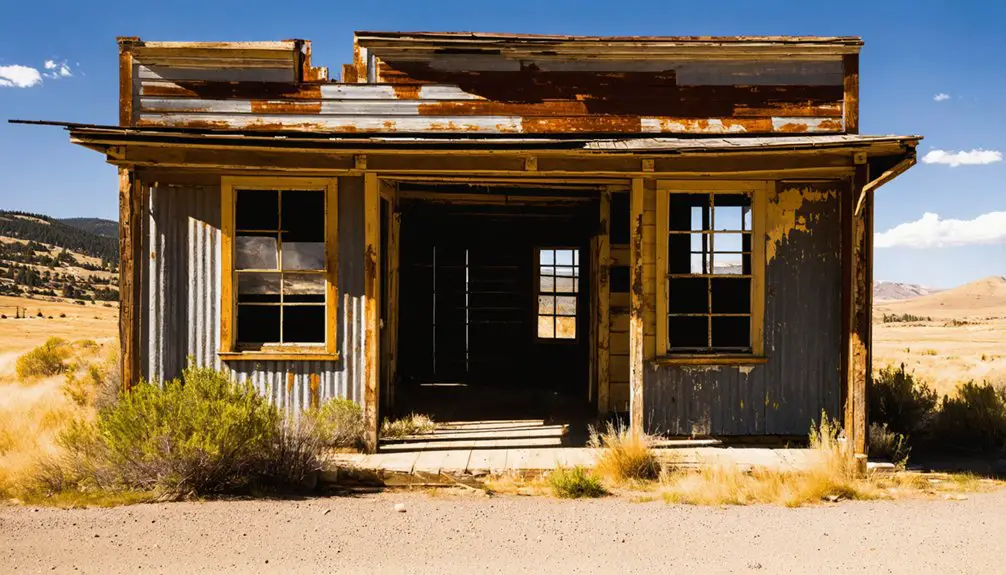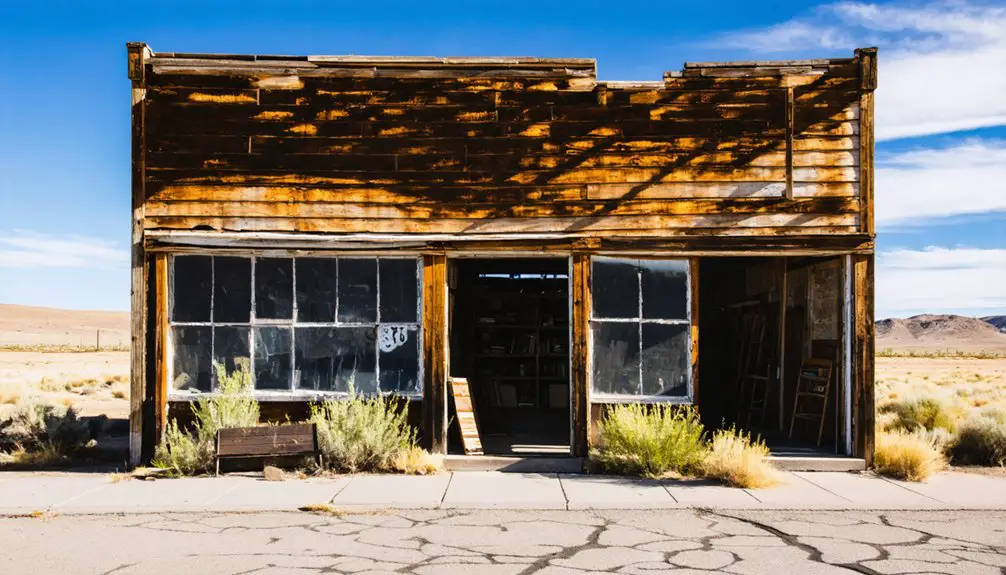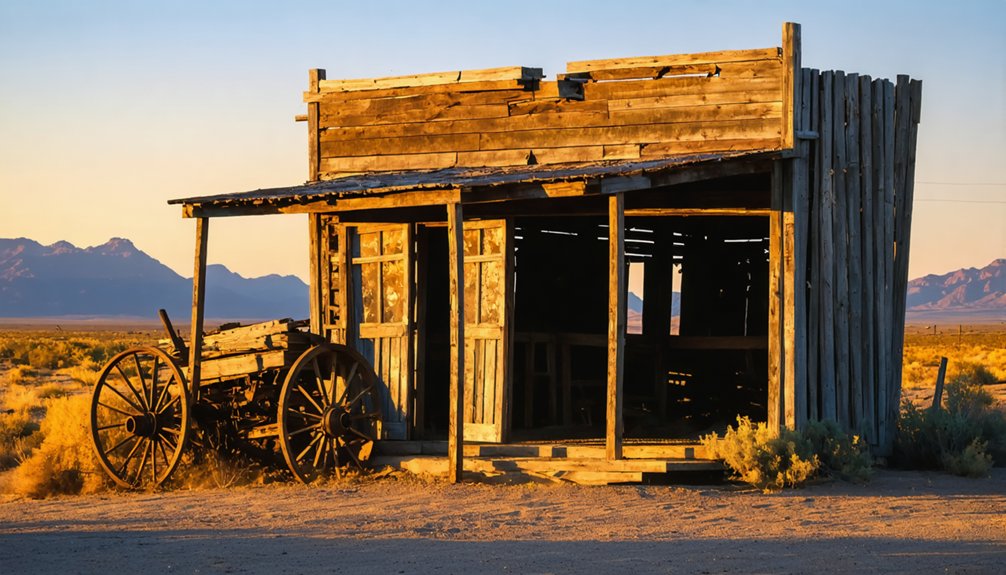
You’ll discover over 200 documented ghost towns scattered across Oregon, with many of the most historically significant settlements positioned along the original Oregon Trail routes that once carried thousands of pioneers westward during the mid-1800s. Towns like Shaniko, Hardman, and Canyon City emerged from gold rushes and timber booms between 1850-1920, creating bustling communities that eventually succumbed to resource depletion and economic downturns. These preserved settlements offer glimpses into America’s pioneering spirit and the stories behind their remarkable transformations.
Key Takeaways
- Oregon contains over 200 documented ghost towns that emerged during 19th-century gold rushes and timber booms along historic trail routes.
- Historic Oregon Trail routes US-20 and OR-78 connect multiple ghost towns between Jordan Valley and Bend for efficient exploration.
- Shaniko served as Oregon’s wool capital and strategic shipping hub before becoming the state’s most famous ghost town.
- Canyon City transformed from a gold strike location in 1862 into a county seat, extracting over $26 million during rushes.
- Most Oregon Trail ghost towns declined due to railroad bypasses, resource depletion, and devastating fires in early 1900s.
Oregon’s Legacy as America’s Ghost Town Capital
Anyone exploring America’s frontier history will discover that Oregon stands as the nation’s undisputed ghost town capital, with over 200 documented abandoned settlements scattered across its diverse landscape.
Professor Stephen Arndt’s research counted 256 ghost towns, including obscure sites that tell unique regional stories of pioneer determination and eventual abandonment.
Each abandoned settlement represents a chapter of resilience and loss, where ambitious pioneers built dreams that time ultimately reclaimed.
You’ll find these settlements emerged from Oregon’s explosive 19th-century growth, when gold rushes and timber booms created countless communities that disappeared just as quickly.
Mining camps and lumber towns vanished after resource depletion, while floods, fires, and epidemics triggered rapid abandonments.
The historical significance of these sites reflects Oregon’s role in westward expansion, and ghost town preservation efforts guarantee future generations can witness America’s untamed frontier spirit firsthand. Some towns have been transformed into state parks or historical sites, ensuring their stories continue to educate visitors about Oregon’s pioneering past. Modern visitors to these preserved locations must often complete human verification processes when accessing digital resources and interactive exhibits that document the settlements’ histories.
The Rise and Fall of Mining Boomtowns
If you’d traveled through Oregon’s mining regions between 1850 and 1920, you’d have witnessed the dramatic cycle that created and destroyed entire communities within decades.
Gold discoveries like those at Coyote Creek in the early 1850s sparked frenzied rushes that transformed empty valleys into bustling towns complete with opera houses, newspapers, and thousands of residents. Some communities like Golden stood apart from typical mining towns by maintaining a commitment to civilized development without the usual saloons, dance halls, and brothels.
Yet these same boomtowns—Golden, Sterlingville, Buncom, and Sumpter—couldn’t survive the inevitable depletion of easily accessible gold, competing strikes elsewhere, and the high costs of advanced mining technology. The establishment of these communities often displaced indigenous peoples, as seen when the Upland Takelma and Dakubetede were forcibly removed to reservations by 1856.
Gold Rush Beginnings
When James W. Marshall discovered gold at Sutter’s Mill in January 1848, you’d witness the spark that ignited America’s greatest gold rush.
News traveled swiftly along Oregon Trail routes, drawing over 80,000 fortune-seekers westward by 1849. You’d see California’s population explode from 15,000 to 93,000 in just two years.
The mining techniques you’d encounter ranged from simple gold pans to rockers and sluice boxes for placer mining.
By 1853, hydraulic mining revolutionized extraction using high-pressure water jets. Oregon joined the frenzy with Jacksonville’s 1851 strike and Canyon City’s 1862 boom following John Owen’s discovery.
You’d watch boomtowns materialize overnight—Auburn, Placerville, and Nevada City became thriving centers where fortunes were made and lost daily.
Peak Prosperity Years
As gold strikes transformed scattered mining camps into thriving commercial centers between 1850 and 1880, you’d witness boomtowns reach their peak prosperity with populations swelling from dozens to thousands within months.
These demographic changes created male-dominated transient populations that drove rapid economic fluctuations and cultural conflicts, particularly involving Chinese immigrants and Native Americans.
Mining infrastructure expanded dramatically during boom periods:
- Transportation networks developed with wagon roads, stage routes, and telegraph lines connecting remote camps to distant markets
- Mining technologies like stamp mills, smelters, and hydraulic operations required substantial capital investment and skilled labor
- Service industries flourished as saloons, general stores, assay offices, and hotels captured miners’ expenditures
You’d see seasonal workforce fluctuations peak during summer months when weather permitted access to remote claims. The establishment of Fort Hall and other trading posts provided crucial supply points for miners venturing into remote territories. Eastern Oregon emerged as a mining epicenter by the 1860s, with communities like Baker City and Sumpter developing into major regional mining towns that anchored the territory’s growing gold economy.
Economic Decline Factors
While boomtowns flourished during peak extraction periods, their economic foundations proved fragile and temporary once the initial high-grade ore deposits became exhausted.
Resource depletion forced miners deeper underground, dramatically increasing extraction costs while ore quality declined.
Mining failures accelerated after financial panics in 1873 and 1893, when price volatility made marginal operations unprofitable and credit disappeared.
You’d witness speculative booms collapse as silver prices crashed, creating economic disparities between those who escaped early and trapped residents.
Labor challenges emerged as mechanized mining required expensive equipment and skilled workers, straining undercapitalized companies. Hydraulic mining began targeting ancient gold-bearing gravel beds but caused significant environmental pollution that further damaged local economies.
Infrastructure neglect followed as railroads reduced service to unprofitable routes. The Yukon gold rush of 1897 drew prospectors away from established mining camps, further depleting local populations and economic activity.
Community decline became inevitable when supporting businesses—banks, stores, sawmills—failed after losing their primary mining customers, leaving ghost towns scattered across the frontier.
Shaniko: The Wool Trade Empire That Time Forgot
Rising from the high desert plateau forty miles northeast of Madras, Shaniko emerged in 1900 as a meticulously planned railroad terminus that would dominate the Pacific Northwest’s wool industry for over a decade.
You’ll discover a town that earned the title “Wool Capital of the World” in 1903, where the railroad impact transformed this remote location into Oregon’s second-largest commerce center after Portland.
The Columbia Southern Railroad‘s arrival created unprecedented economic opportunities, shipping millions of pounds annually. The town’s origins trace back to pioneer August Scherneckau, who first settled the area after the Civil War.
Key achievements that defined Shaniko’s dominance:
- Five million dollars in wool sales during 1904 alone
- Massive warehouse capacity storing 4 million pounds of wool
- Strategic shipping hub serving territories extending into California
The town’s remarkable growth attracted 172 residents by 1900, transforming the remote plateau into a bustling commercial center.
However, economic sustainability proved elusive when competing railroads and devastating fires tested the community’s resilience, ultimately leading to its designation as Oregon’s most famous ghost town.
Hardman: A Prairie Outpost Lost to Progress

Perched at 3,600 feet on eastern Oregon’s high plateau, Hardman began as a collection of rough frontier settlements in the 1870s, including Dairyville and the colorfully named Raw Dog.
You’ll discover Hardman history traces back to David N. Hardman, the postmaster who gave the town its formal name in 1881. This prairie outpost thrived as a stagecoach stop and agricultural shipping center, supporting three general stores, two hotels, meeting halls, and even a racetrack by the turn of the century.
Community decline struck when railroads bypassed Hardman in the 1920s, routing through Heppner instead.
Transportation patterns shifted away from this remote plateau, drawing businesses and residents to larger towns.
Today, you’ll find about two dozen historic structures scattered across the windswept grassland, silent witnesses to a once-bustling frontier community.
Sumpter: Gold Rush Glory in the Elkhorn Mountains
You’ll find Sumpter’s story begins in 1862 when gold discoveries in the Blue Mountains triggered a massive prospector influx that transformed this remote valley into a bustling mining center.
By the late 1890s, you’re looking at a town that housed nearly 2,000 residents who’d built a thriving community around placer mining, complete with rail service and regional supply operations.
However, you’ll discover that Sumpter’s golden era couldn’t withstand the devastating fires and economic shifts that would eventually reduce this once-prosperous settlement to a shadow of its former glory.
Gold Discovery and Settlement
- Prospectors employed placer mining and small-scale sluicing methods to work river gravels along Powder River tributaries.
- Rough wagon roads connected the remote valley to supply networks, though transportation remained challenging until railroad construction.
- Provisional businesses emerged to serve mining camps, including saloons, boarding houses, and general stores.
- Business displacement triggered job losses and sharp tax revenue decline
- Transient migration accelerated as workers relocated to towns with intact services
- Limited rebuilding efforts reduced the commercial footprint permanently
- Over $26 million in gold extracted during the 1862-1880 rush period
- County seat designation during peak mining years, concentrating legal and administrative power
- Commercial hub serving miners, traders, and travelers along major western corridors
- Vehicle preparation: Use high-clearance or 4WD vehicles with extra fuel, spare tires, and recovery gear
- Safety essentials: Pack emergency communications, multiple water sources, and layered clothing for temperature swings
- Site selection: Balance accessible preserved towns like Shaniko with remote locations like Danner for varied experiences
- https://www.visitoregon.com/oregon-ghost-towns/
- https://corvallisadvocate.com/exploring-oregons-ghost-towns/
- https://thatoregonlife.com/2016/04/road-trip-ghost-towns-eastern-oregon/
- http://www.photographoregon.com/ghost-towns.html
- https://www.pdxmonthly.com/travel-and-outdoors/2025/10/oregon-ghost-towns-history
- https://www.nationaldaycalendar.com/lists/12-oregon-ghost-towns
- https://traveloregon.com/things-to-do/culture-history/ghost-towns/
- https://en.wikipedia.org/wiki/List_of_ghost_towns_in_Oregon
- https://kids.kiddle.co/List_of_ghost_towns_in_Oregon
- https://www.salemreporter.com/2023/10/30/salem-history-moment-fairfield-the-willamette-valleys-own-ghost-town/
This community development laid the foundation for Sumpter’s eventual boomtown status, as Northern-sympathizing miners renamed the settlement and established lasting infrastructure.
Peak Population and Prosperity
The gold strikes that drew Northern-sympathizing settlers to rename and rebuild the community soon transformed Sumpter into one of Oregon’s most prosperous mining boomtowns.
You’d witness population shifts from sparse settlement to an estimated 2,000-5,000 residents during the early 1900s peak. Mining infrastructure dominated the landscape—massive bucket-line dredges, sluices, and gravel operations created the economic impact that sustained multiple saloons, boarding houses, and general stores.
Labor demographics reflected the boom’s cultural diversity: itinerant miners, experienced dredge crews, out-of-state prospectors, and Civil War deserters all sought fortune here.
Today’s ghost town architecture preserves wood-frame commercial blocks and miners’ cabins through historic preservation efforts. The contrast between peak prosperity and current seasonal tourism highlights dramatic population shifts—from thousands of residents to just over 200 permanent inhabitants.
Fire Devastation and Decline
While Sumpter’s mining operations were already showing signs of decline, the devastating fire of August 13, 1917, delivered a catastrophic blow that would accelerate the town’s transformation from bustling boomtown to ghost town.
The blaze originated at the Capital Hotel around 1:00 p.m. and rapidly consumed downtown’s wooden structures.
You’ll notice the fire aftermath eliminated essential infrastructure loss including hotels, saloons, and the opera house that defined Sumpter’s commercial heart.
The economic repercussions were immediate and severe:
Despite community resilience attempts, Sumpter’s population plummeted from thousands to hundreds.
Today’s heritage preservation and tourism challenges reflect ongoing struggles to maintain remaining historic assets while honoring this gold rush legacy.
Antelope: From Stage Stop to Controversy
Named for the abundant antelope herds that roamed its vast plains, this small Oregon community emerged in 1863 as an essential stagecoach and freight stop along the road connecting The Dalles to the gold mines of Canyon City.
You’ll find Antelope history traces back to Howard Maupin’s cattle ranch, which supplied meat to weary travelers. The town officially incorporated in 1896, thriving as four-horse stages battled highwaymen along treacherous routes.
However, freedom-loving residents couldn’t have predicted the bizarre chapter ahead. The 1980s Rajneesh controversy shocked America when devotees took control, renaming the town Rajneesh.
Their nearby commune orchestrated the first biological terrorism attack on U.S. soil, poisoning restaurants in The Dalles with Salmonella to influence elections. After arrests and deportations, Antelope reclaimed its identity.
Canyon City: Where Gold Fever Built a County Seat
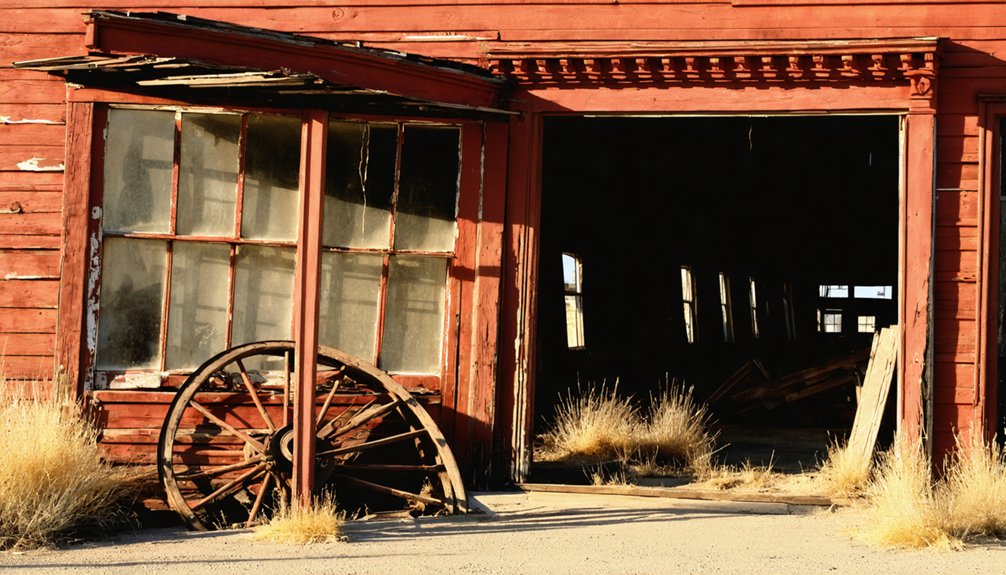
Before Canyon Creek‘s famous gold strike transformed this remote Oregon valley into a bustling county seat, Hudson’s Bay Company trappers and Applegate Trail pioneers had already recognized the strategic importance of this mountain pass.
When prospectors discovered gold in 1862, you’d witness Canyon City explode from trading post to regional powerhouse. Federal investment in the California-Oregon military road had already established vital infrastructure by 1858, setting the stage for boom-town success.
Canyon City’s mining legacy includes:
You’ll find this ghost town exemplifies how gold fever could elevate remote settlements to political prominence, then abandon them when easier fortunes beckoned elsewhere.
Millican: a Desert Store With a Dark Secret
Deep in Oregon’s high desert, a lonely gas station and general store once served as the final outpost for travelers heading into the vast emptiness beyond U.S. Route 20.
You’ll find Millican’s history rooted in cattle ranching when George Millican founded the settlement in the 1870s. The town established its post office in 1913, but highway realignment in 1930 began its slow decline.
Bill Mellin operated the relocated store and gas station for thirty-five years until tragedy struck. In 1988, an employee murdered Mellin during a robbery, marking Millican’s final chapter.
The remaining residents fled immediately, abandoning the town completely. Today, you’ll see only the derelict store building among Central Oregon’s ghost towns—a reminder of how quickly civilization can vanish in the desert.
Planning Your Ghost Town Adventure

Three essential components will determine your ghost town adventure’s success: route planning, site selection, and safety preparation.
Smart ghost town logistics start with following historic Oregon Trail corridors like US-20 and OR-78, connecting multiple sites daily while concentrating on areas between Jordan Valley and Bend.
As these routes are explored, a deeper appreciation for ghost town history in Wyoming emerges, revealing the stories of the people who once thrived in these now-quiet places. By incorporating these historical insights, planners can enhance tourist experiences and preserve the legacy of the American frontier. This approach not only benefits local economies but also fosters a unique connection to the past.
Follow historic Oregon Trail routes US-20 and OR-78 to efficiently connect multiple ghost towns between Jordan Valley and Bend.
Your navigation tools should include offline GPS tracks and cached satellite maps, since cellular coverage disappears across eastern Oregon’s high desert.
Preload county road data and verify seasonal closures with local departments.
Frequently Asked Questions
Are Any of Oregon’s Ghost Towns Actually Haunted by Spirits?
You’ll find numerous ghostly encounters reported at Oregon’s abandoned settlements, though no scientific evidence proves actual spirits exist. Visitors document haunted history at Shaniko, Bohemia Mountain, and Millican, where unexplained phenomena fuel ongoing legends.
What Safety Precautions Should Visitors Take When Exploring Abandoned Buildings?
Over 70% of urban exploration injuries occur from structural collapses. You’ll need proper safety gear including N95 respirators and puncture-resistant boots. Always assess structural integrity before entering and never explore alone.
Can Visitors Legally Take Artifacts or Souvenirs From Ghost Town Sites?
No, you can’t legally take artifacts from ghost town sites. Artifact preservation laws protect items over 100 years old on federal lands, with serious legal implications including fines, imprisonment, and equipment forfeiture for violations.
Which Ghost Towns Offer Overnight Camping or Lodging Accommodations Nearby?
You’ll find camping options like scattered stars across the landscape near Cornucopia’s off-grid lodge, Emigrant Springs’ rustic cabins, and Baker City’s full-service RV parks, all providing lodging availability for ghost town exploration.
What’s the Best Time of Year to Visit Oregon’s Ghost Towns?
You’ll find the best seasons are late spring through early fall, May to October. Summer weather conditions provide clear roads and mild temperatures, while winter snow makes many ghost towns inaccessible without specialized equipment.