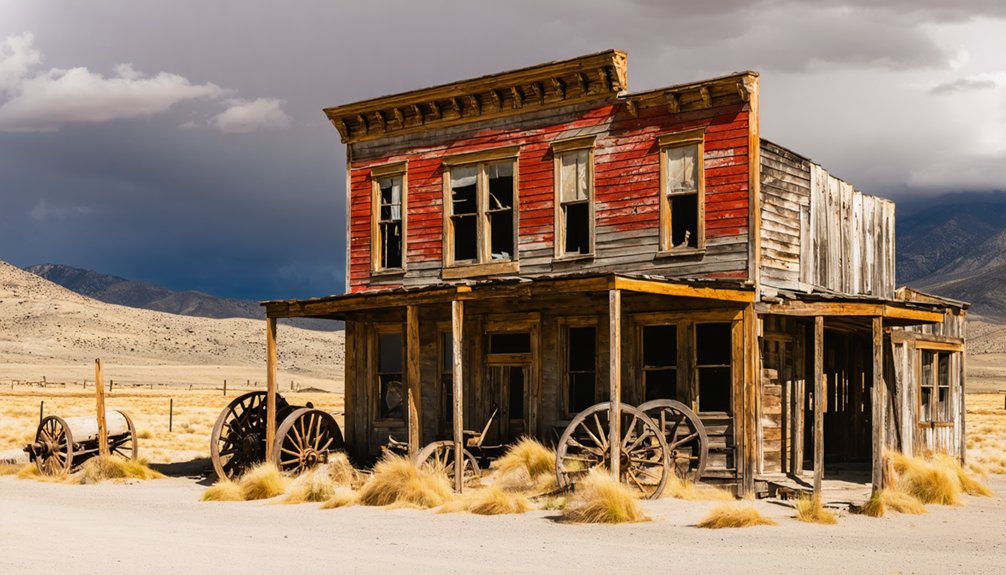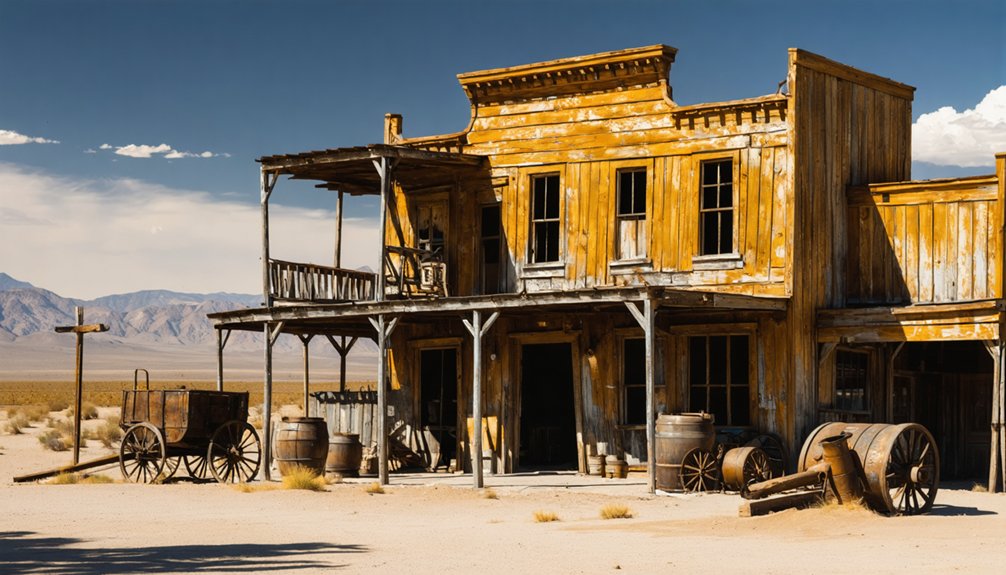
When you explore ghost towns and gold trails across the American West, you’re witnessing the remnants of predictable boom-and-bust cycles that transformed wilderness into thriving communities before abandonment. These settlements followed discovery phases like the Comstock Lode, experienced rapid infrastructure development with sawmills and general stores, then faced decline when resources depleted. Today, over 160,000 abandoned mining sites dot Western states, with archaeological documentation using 3D scanning and heritage tourism efforts working to preserve these cultural landmarks for future generations.
Key Takeaways
- Ghost towns formed when mining communities were abandoned after gold deposits were exhausted and economic opportunities disappeared.
- Gold trails connected remote mining camps to major cities, with transportation companies creating vital supply and communication networks.
- Successful mining towns that diversified into agriculture or commerce survived, while isolated single-industry communities became ghost towns.
- Archaeological preservation of ghost towns uses 3D scanning, GPS mapping, and non-destructive techniques to document mining heritage.
- Heritage tourism at ghost town sites requires balancing visitor access with safety concerns from contaminated mines and structural hazards.
The Anatomy of a Mining Boom
When miners struck the Comstock Lode in Nevada—the largest American silver discovery of its time—they triggered a pattern that’s defined resource booms for over 150 years.
You’ll find mining economics follows predictable boom cycles across every major discovery. First, you witness the discovery phase, where bonanza finds like California’s 1849 gold rush spark exploration waves.
Next comes price surge, driven by demand while supply remains fixed—copper jumped from $1 to $4 per pound during China’s industrialization.
Supply constraints meet surging demand, creating explosive price movements—copper quadrupled as China’s industrial appetite outpaced global mining capacity.
Then exploration expansion floods markets with new projects and workers. Investment mergers follow, with companies like Rio Tinto spending $38 billion acquiring Alcan.
Finally, production decline hits when new mines open after delays, often finding prices crashed and operations unprofitable. These mono-industrial economies become particularly vulnerable as entire regions depend solely on mining operations. Debt-burdened operations continue producing despite losses to cover cash costs, creating further downward pressure on commodity markets.
Building Communities in the Wilderness
While fortune-seekers scattered across the American West chasing mineral wealth, they faced the immediate challenge of creating livable communities from scratch in harsh, isolated environments.
You’d witness settlers prioritizing water access and transportation routes when establishing camps, understanding these factors determined long-term survival. Community resilience emerged through rapid construction of essential infrastructure—sawmills, blacksmith shops, and general stores that anchored settlements economically.
Social dynamics reflected the diverse population mixing single miners, families, and immigrant groups from various nations. Transportation companies like the U.S. Mail Steamship Company generated substantial wealth by connecting these remote communities to the outside world.
You’d observe informal governance evolving from miners’ meetings into formal town councils as permanence increased. Gender imbalances and ethnic stratification shaped neighborhood development, while ancillary industries like agriculture and services often outlasted the initial mining booms, creating sustainable economic foundations. These mining communities showed similarities to Aboriginal California settlements in how population density adjusted according to local resource abundance and water availability.
When the Gold Runs Out
As mineral deposits dwindled and easier pickings vanished, the boom-and-bust cycle that defined Western mining communities entered its inevitable decline phase.
You’ll find that towns within five miles of mining sites experienced the most dramatic population migration patterns. San Francisco’s population exploded from 1,000 to 25,000 residents between 1848-1850, while smaller settlements like Portuguese Flat simply disappeared.
Economic decline hit hardest in isolated communities that couldn’t diversify beyond mining. Those towns that survived possessed vital agglomeration economies – they’d developed agriculture, commerce, or manufacturing to sustain themselves. The transformation of mining camps into cities wasn’t limited to California, as rapid growth turned places like Johannesburg and Denver from temporary settlements into permanent urban centers.
Mining towns that diversified into agriculture, commerce, or manufacturing survived the inevitable bust cycles that devastated single-industry communities.
The Yukon’s 6.8% population drop after mine closures demonstrates this pattern’s persistence. California’s non-Indian population peaked at 300,000 by 1853, then scattered as opportunities dried up, leaving ghost towns scattered across the landscape. Meanwhile, the most successful mining regions developed extensive manufacturing of mining machinery to support hydraulic operations, creating industrial foundations that outlasted the initial gold discoveries.
Western Landscapes of Abandonment
Across the American West, you’ll discover stark reminders of boom-and-bust economics etched into desert valleys and mountain slopes where entire communities once thrived.
These abandoned settlements reveal ghost town geology shaped by ore deposits that determined where thousands settled and why they left. In California’s Malakoff Diggins, you’ll find a 600-foot canyon carved by hydraulic mining before 1884 regulations ended the practice.
Nevada’s Eldorado Canyon displays mine shafts and rusted equipment amid barren hills where millions in precious metals once emerged. Mining folklore echoes through Masonic’s crumbling stone walls and skeletal ore trams, while Utah’s Frisco preserves beehive charcoal kilns and weathered wooden structures that housed 6,000 residents before the 1885 collapse. Arizona’s Vulture Mine City stands as testament to the era’s violent legacy, where 18 miners met their end at the gallows despite the mine’s extraordinary success yielding over $200 million in gold. The majority of these ghost towns date from the period between 1880 and 1940, when westward expansion and industrialization drove thousands to seek fortune in remote locations.
Preserving Mining Heritage
You’ll encounter three critical challenges when working to preserve abandoned mining sites across the American West.
First, you must systematically document archaeological remains using measured drawings and 3D scanning before deterioration erases technological evidence of hydraulic pits, stamp mills, and processing facilities.
Second, you’ll need to balance heritage tourism development with site protection, as increased visitor access can accelerate structural damage while generating essential funding for long-term conservation efforts. Mining railway networks like those connecting extraction sites to processing facilities require special attention as rail infrastructure often represents the most vulnerable yet historically significant transportation heritage.
Third, you must maintain ongoing community engagement with local knowledge holders throughout the preservation process to ensure cultural information about traditional practices and site significance remains accurate and accessible for future generations.
Archaeological Site Documentation
When documenting abandoned mining sites, you’ll need rigorous recording standards that capture both the physical remains and their archaeological context.
Site surveys begin with standardized forms recording UTM coordinates, dimensions, and cultural affiliations using differential GPS for permanent baselines.
Documentation techniques include LiDAR scanning and Structure-from-Motion photogrammetry to create accurate 3D models without disturbing fragile structures.
Archaeological methods emphasize non-destructive approaches—ground-penetrating radar maps subsurface features while multispectral imaging detects buried remains.
You’ll capture multi-scale imagery from drone overheads to close-up artifact photos with proper scale references.
Preservation standards require minimal excavation guided by research questions, meticulous stratigraphic recording, and proper conservation protocols for unstable materials like waterlogged timber supports.
Heritage Tourism Challenges
While mining heritage sites offer compelling narratives for cultural tourism, they present complex preservation challenges that demand careful balance between access and conservation.
You’ll find that 40% of historic structures have already been replaced by modern concrete buildings, demonstrating how development pressures threaten authentic heritage.
When you develop tourism around these sites, you’re confronting the reality that over 160,000 abandoned mines across Western states lack adequate cleanup resources, creating safety hazards for visitors.
Your cultural preservation efforts must address contamination from uranium and gold extraction while maintaining historical integrity.
You’ll need to establish economic sustainability through tourism revenue that funds ongoing site maintenance, environmental remediation, and infrastructure improvements.
This requires strategic planning that protects both cultural assets and visitor safety without compromising the authentic mining heritage experience.
Adaptive Structure Reuse
As mining communities grapple with economic decline and environmental degradation, adaptive reuse of historic mining structures offers a proven pathway to preserve cultural heritage while generating sustainable revenue streams.
You’ll find successful transformations like Butchart Gardens, where a limestone quarry became a nationally recognized botanical destination, and Cornwall’s Eden Project, converting a china clay crater into educational biomes.
Economic revitalization occurs through diverse applications—limestone mines becoming mushroom farms, sugar refinery silos transforming into climbing gyms, and quarries evolving into recreational lakes.
These projects preserve original features like brickwork and timber while integrating contemporary elements.
You’re witnessing communities create vibrant public spaces, affordable housing, and research facilities that honor industrial heritage while fostering sustainable development and local employment opportunities.
Uncovering the Past Through Research
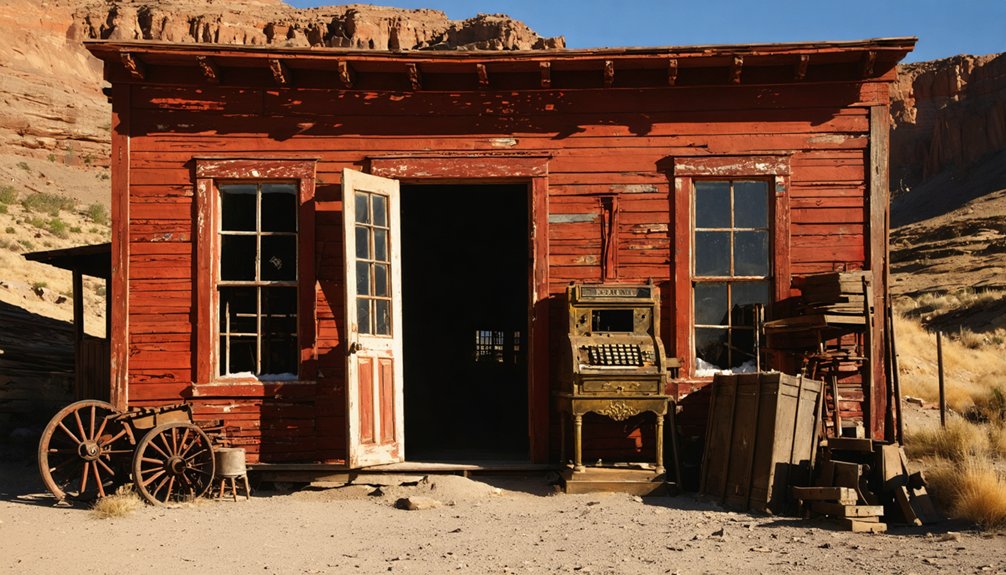
Research into abandoned mining settlements requires systematic examination of multiple documentary sources that reveal the legal, economic, and social frameworks underlying these communities.
You’ll find historic land patents and mining claims provide essential ownership timelines, while government archival reports from the BLM and National Park Service contain mapped trails and excavation records that reconstruct settlement chronology.
Contemporary newspapers and miners’ journals offer demographic statistics and daily gold production data that official records often miss.
Personal accounts from mining camps reveal production figures and population details that government records frequently overlooked or never documented.
Archaeological field surveys document building materials and artifact assemblages, helping you date occupation phases.
Don’t overlook oral histories and genealogical records—they fill significant gaps about labor composition and immigrant groups, particularly Chinese placer crews whose contributions were frequently omitted from government documentation.
Frequently Asked Questions
How Dangerous Was Daily Life in Mining Boomtowns for Ordinary Residents?
You’d face constant mining hazards including cave-ins, machinery accidents, and toxic dust exposure, while overwhelmed law enforcement couldn’t control rising crime, violence, and social chaos plaguing these unstable boomtown communities.
What Happened to Families and Children When Mining Towns Were Abandoned?
You’d witness families’ migration into poverty and isolation when mines closed abruptly. Children’s education suffered dramatically—89.3% attended school irregularly while facing malnutrition, health risks from contaminated sites, and broken family structures.
Can You Still Legally Prospect for Gold in Ghost Town Areas?
You can legally prospect in many ghost town areas, though over 2,000 acres require claim verification first. Gold prospecting regulations vary by location, while ghost town preservation laws protect historic structures from disturbance.
Exploring abandoned settlements near Denver can reveal hidden treasures and relics of the past, enticing adventurers and history enthusiasts alike. However, it’s essential to research the legalities of prospecting in these areas to ensure compliance with local regulations. Visitors should also be mindful of the environmental impact their activities may have on these delicate sites.
How Do Modern Property Laws Affect Ownership of Abandoned Mining Claims?
Your property rights depend on patent status—unpatented claims revert to federal ownership when abandoned, while patented claims remain private property, creating complex claim disputes requiring legal verification before prospecting.
What Wildlife Now Inhabits These Former Mining Settlements and Surrounding Areas?
You’ll discover bears, elk, and deer have reclaimed abandoned mining settlements through wildlife adaptation, restoring historical ecosystems where prospectors once extracted precious metals from these now-wild territories across Colorado’s mountains.
References
- https://iditarod.com/2018/03/08/iditarod-gold-rush-to-ghost-town/
- https://jamessiodla.com/wp-content/uploads/2024/03/ghost_towns_big_cities-1.pdf
- https://www.blackhillsbadlands.com/blog/post/old-west-legends-mines-ghost-towns-route-reimagined/
- https://savingplaces.org/stories/explore-wild-west-mining-history-in-nevada-ghost-towns
- https://findingnevadawild.com/goldfield-the-old-west-lives-in-nevadas-best-ghost-town/
- https://www.uchealth.org/today/ghost-towns-abound-in-colorado/
- https://www.youtube.com/watch?v=VAFXMvICKh4
- https://en.wikipedia.org/wiki/Gold_Trails_and_Ghost_Towns
- https://www.headcountcoffee.com/blogs/american-frontiers/the-gold-rush-towns-that-still-have-residents
- https://atlasfunds.com.au/the-mining-cycle-booms-and-busts/