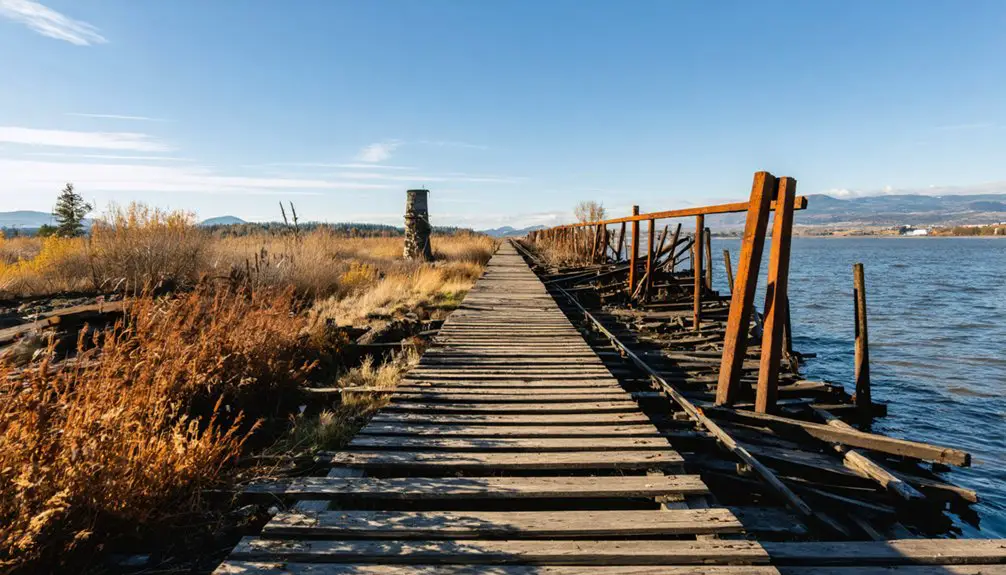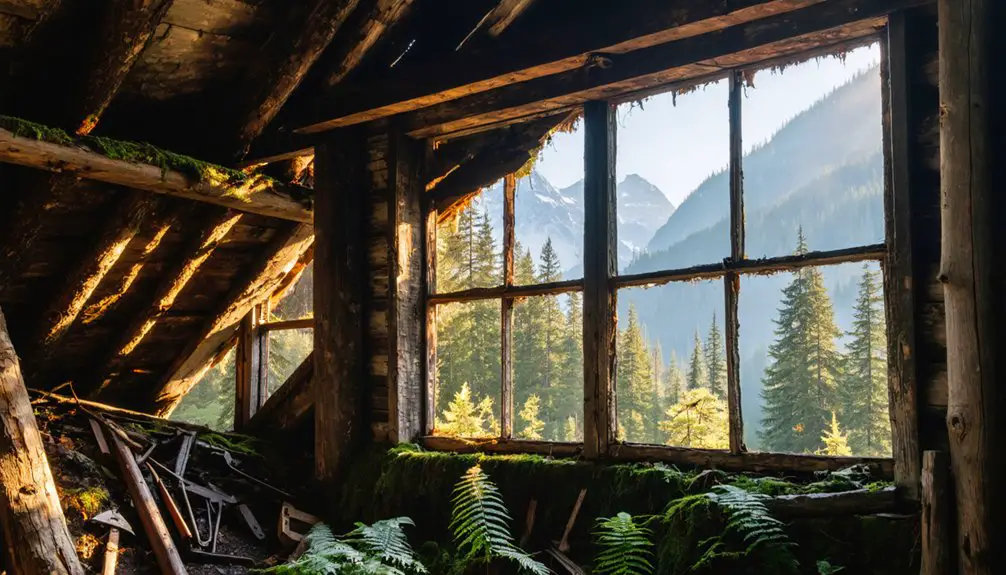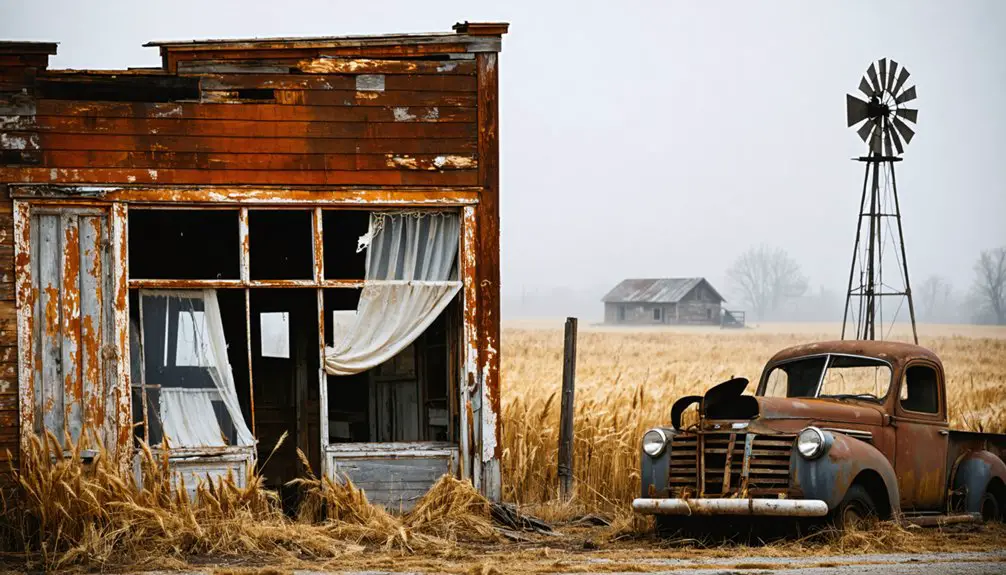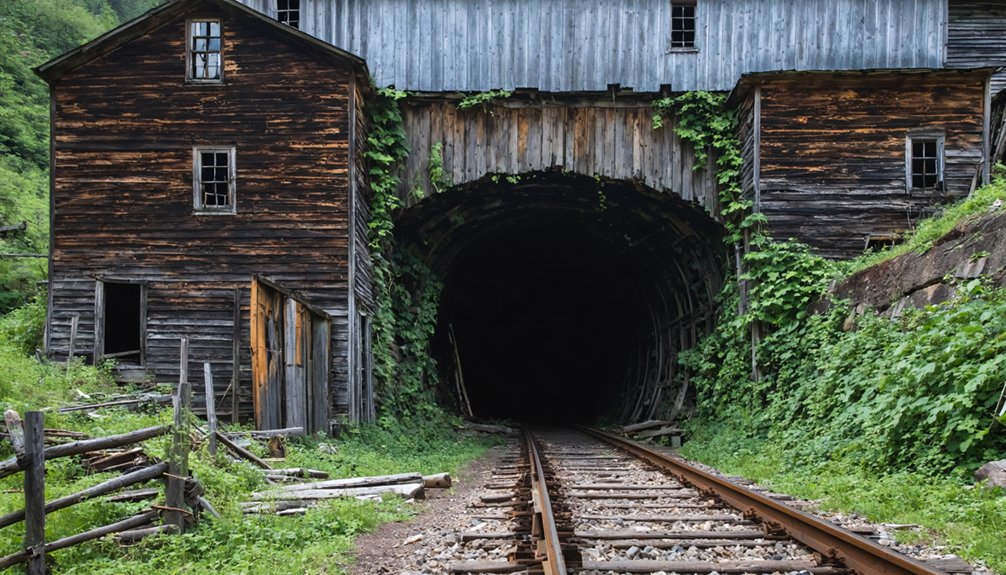
You’ll discover dozens of abandoned mining towns scattered across Washington’s mountains, remnants of the state’s dramatic boom-and-bust mining frontier from the 1880s-1900s. Major districts like Republic, Metaline, and Monte Cristo once bustled with thousands of miners extracting gold, silver, coal, lead, and zinc. Towns like Monte Cristo peaked at 1,000 residents before complete abandonment by 1907, while others like Franklin ended tragically with mining disasters. These preserved ghost towns offer hiking adventures to weathered structures, abandoned machinery, and historic artifacts that reveal the complex stories of resource depletion, economic cycles, and rapid community decline that shaped Washington’s mining heritage.
Key Takeaways
- Washington’s major mining districts included Republic (gold), Metaline (lead/zinc), and Black Diamond (coal) established in the 1880s-1890s.
- Monte Cristo, Ruby City, and Ainsworth represent iconic ghost towns that experienced rapid boom-bust cycles during mining rushes.
- Resource depletion, economic downturns, and competition from imports led to widespread abandonment of mining communities after WWI.
- Preserved sites like Liberty, Molson, and Nighthawk offer mining artifacts, historic buildings, and equipment accessible to visitors.
- Over 160,000 abandoned mining sites exist statewide, creating both environmental challenges and archaeological preservation opportunities.
Major Mining Districts That Shaped Washington’s Frontier
Five major mining districts transformed Washington’s rugged frontier into bustling centers of extraction and settlement during the late 19th and early 20th centuries.
Republic Mining district kicked off when prospectors discovered ore deposits in the early 1890s, then exploded after 1896 when the northern Colville Indian Reservation opened. Hundreds flocked to strike it rich in gold.
You’ll find the Metaline district became Washington’s largest lead and zinc supplier during the second quarter of the 1900s.
George Linton’s 1887 claims, including the silver-rich Oriole, launched the first hard-rock operations. The Pend Oreille River provided crucial transportation access when the federal government improved it for freight in 1889.
Meanwhile, Black Diamond earned its “King Coal” reputation when the first train arrived in the 1880s, cementing its place in Washington’s industrial heritage. Coal from Roslyn mines powered the Northern Pacific Railroad trains throughout the mid-1880s.
Iconic Ghost Towns and Their Stories
You’ll find Washington’s ghost towns scattered across remote valleys and mountainsides, each preserving fragments of boom-and-bust cycles that defined the state’s mining frontier.
These abandoned settlements tell stories ranging from Monte Cristo’s gold rush peak of 1,000 residents in the 1890s to Ruby City’s brief reign as county seat before economic collapse. Towns like Ainsworth, settled in October 1879 but abandoned by 1885, exemplify the rapid rise and fall of frontier communities.
Whether you’re exploring preserved mining camp foundations, examining failed railroad ventures, or walking through towns that couldn’t survive mineral depletion, each site reveals how quickly frontier dreams transformed into historical ruins. In places like Loomistown, you can still find historic homes that remain occupied today, bridging the gap between past and present in these once-thriving communities.
Boom to Bust Stories
Across Washington’s rugged terrain, dozens of communities experienced dramatic rise-and-fall cycles that defined the state’s mining era.
These boom-to-bust stories reveal how quickly fortunes changed when ore deposits dwindled or investors withdrew. You’ll find that economic cycles drove entire populations from prosperity to abandonment within decades.
Monte Cristo exemplifies rapid growth followed by financial collapse. Peak population reached several thousand by the early 1890s, but costly infrastructure and falling metal prices led to abandonment by 1907.
Republic sustained longer through consistent gold production before yields declined. Franklin’s 1894 coal mine disaster killed 37 miners, accelerating the town’s demise. The town’s integrated union helped ease earlier tensions between striking miners and strike breakers following violent confrontations in 1891.
Molson’s speculative founding crumbled within years as mining yields disappointed investors. Some communities like Liberty became living ghost towns where a handful of residents preserve the historical legacy while maintaining the town’s spirit.
- Monte Cristo’s Rockefeller syndicate investment couldn’t prevent eventual abandonment
- Republic pivoted from mining to heritage tourism after ore exhaustion
- Franklin’s coal disaster became Washington’s worst mining tragedy
- Molson lost $170,000 in private investment within one year
- Economic cycles determined whether mining legacies survived or vanished
Preserved Mining Camp Remnants
Weathered structures and abandoned machinery mark Washington’s preserved mining camps, where visitors can witness authentic remnants from the state’s gold and silver rush era.
You’ll discover Molson’s remarkable historic preservation, where John Molson’s $170,000 investment created a town that’s remained accessible since 1960. The site displays original offices, farming equipment, and cabins with viewable interiors. Positioned at high elevation of 3,708 feet, the ghost town requires visitors to dress warmly outside of summer months.
At Liberty, you’ll find mining artifacts preserved through oral histories and family documents.
Monte Cristo showcases the Cascades’ first major mining camp, while Republic’s tent city photos document frontier settlements. The Eureka district was established in 1896 as a mining location initially composed mostly of canvas tents.
The 1890s Cascade mines offer you authentic experiences with century-old tools, original timbers, and a 3,000-foot tunnel.
These preserved sites protect Washington’s mining heritage through careful documentation and community stewardship.
Railroad Dreams Gone Wrong
When railroad companies pushed through Washington’s challenging terrain in the late 1800s and early 1900s, they created dozens of boomtowns that would vanish almost as quickly as they appeared.
These settlements thrived on railroad nostalgia but couldn’t survive dramatic economic shifts that transformed transportation and industry.
- Wellington’s deadly avalanche in 1910 killed 96 people, forcing a town rename and eventual abandonment
- Corfu’s Grant County location served Milwaukee Road Railroad before becoming desert ruins
- Govan’s unsolved murders in Lincoln County added mystery to its railway decline
- Melmont’s coal operations collapsed when railroads switched from steam to diesel-electric engines
- Alpine’s temporary camps housed construction workers before disappearing after rail completion
Many of these abandoned settlements experienced their most devastating population decline during the Great Depression, with some towns losing half their residents in a single decade. Wellington was later renamed to Tye after the tragedy but was ultimately abandoned when the second Cascade Tunnel was completed in 1929.
You’ll find these ghost towns scattered across Washington, each telling stories of ambition meeting harsh reality.
The Rise and Fall of Mining Communities
You’ll find that Washington’s mining communities followed a predictable pattern of rapid growth fueled by mineral discoveries, then swift abandonment when resources depleted or became unprofitable.
These boom towns sprouted around coal strikes like Cowlitz River in 1833 and gold rushes throughout the 19th century, creating temporary economic hubs with company-built infrastructure and seasonal workforces.
The same forces that built these communities—mineral depletion, falling commodity prices, and competition from larger mechanized operations—ultimately sealed their fate as ghost towns.
Boom Town Economics
Although Washington’s mining communities followed predictable economic patterns, the speed and scale of their rise and fall varied dramatically based on resource quality, capital access, and transportation infrastructure.
You’ll find that economic fluctuations hit these towns harder than traditional communities because they depended entirely on external investment and single commodities. When ore prices dropped or deposits exhausted, entire populations vanished within months.
Labor migration followed boom cycles—workers rushed to new strikes, then abandoned towns when wages disappeared.
- Transportation bottlenecks: Towns expecting rail connections expanded rapidly but collapsed when lines weren’t built
- Capital concentration: Outside investors controlled local economies, amplifying boom-bust cycles
- Fixed infrastructure costs: Mills and processing plants required sustained production to remain profitable
- Resource depletion: Shallow deposits often exhausted within years, ending communities
- Mobile workforce: Male-dominated, transient populations provided little community stability
Inevitable Decline Factors
Multiple interconnected forces drove Washington’s mining communities toward abandonment, creating a cascade of economic devastation that left entire towns empty within decades.
You’ll find resource depletion struck first—coal reserves diminished in Puget Sound after World War I, while uranium and hard rock deposits played out across the state.
Economic downturns followed as foreign coal flooded markets with lower duties, and Montana’s cheaper imports closed TransAlta mine in 2006.
Washington’s smaller operations couldn’t compete globally or afford mechanization—mines still relied on hand blasting for 50% of output versus the national 10% average.
Environmental consequences compounded these problems, with over 160,000 abandoned sites leaching toxins into watersheds, making recovery impossible without massive cleanup costs.
Planning Your Visit to Historic Sites
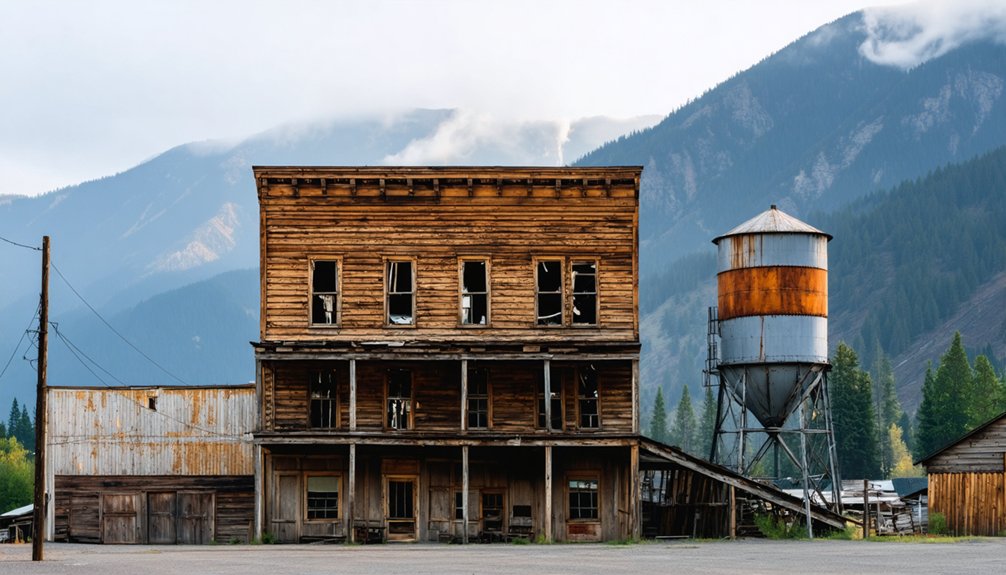
When planning your exploration of Washington’s ghost towns and historic mining sites, you’ll need to contemplate access routes, seasonal conditions, and safety requirements that vary dramatically across locations.
Ghost town access ranges from gentle 0.5-mile walks at Copper City to challenging 8-mile roundtrip hikes reaching Monte Cristo. Seasonal considerations affect your timing – Molson’s 3,708-foot elevation requires jackets outside summer, while Mowich Lake Road closures limit Melmont access during winter months.
- Prepare for varied terrain: From 4-mile closed road walks to abandoned railroad grades with minimal elevation gain
- Check seasonal road closures: Mowich Lake Road and Mountain Loop Highway access points close periodically
- Exercise caution around mining structures: Collapsed shafts and unstable buildings require vigilant awareness
- Pack weather-appropriate gear: High elevation sites demand layers regardless of season
- Respect historical preservation: These fragile sites depend on visitor responsibility for future generations
What Remains: Buildings, Equipment, and Ruins
After traversing the access routes and seasonal challenges, you’ll discover that Washington’s ghost towns preserve remarkably diverse remnants from their boom-era past.
At Claquato, you’ll find the state’s oldest Methodist church with its original bell, alongside a cemetery featuring a massive fir tree that sheltered pioneers.
Liberty offers the most complete experience—Thomas Meagher’s 1867 cabin still stands among scattered mining equipment and interpretive signs in this living ghost town.
You’ll encounter abandoned structures ranging from Nighthawk’s 1903 hotel and schoolhouse to Monte Cristo’s remaining buildings accessible by an 8-mile hike.
Historical relics include Melmont’s decaying vehicles along muddy trails, Franklin’s coal cart tracks, and Old Molson’s preserved farming equipment and restored classroom artifacts.
Cultural Heritage and Archaeological Significance
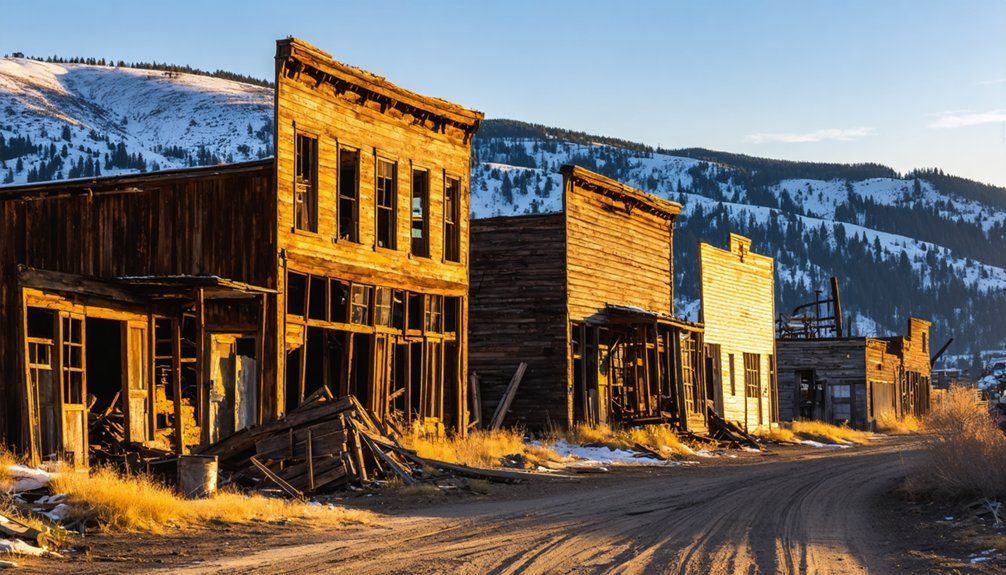
Beyond their visible ruins, Washington’s ghost towns represent complex cultural landscapes where archaeological evidence reveals layered histories of settlement, displacement, and adaptation.
You’ll discover that these sites often overlay traditional Indigenous territories, creating multi-component archaeological records that span millennia. The material culture tells stories beyond mining booms—household ceramics reveal socioeconomic gradients, while architectural remains document supply chains and building technologies.
Key Archaeological Discoveries:
- Subsurface features like cisterns and cellars preserve organic materials showing diet and health patterns
- Industrial waste deposits create distinct stratigraphy for dating mining operations
- Trade goods document Indigenous-settler interactions and economic networks
- Architectural materials reveal construction techniques and lumber supply sources
- Domestic artifacts indicate access to transcontinental and Pacific Coast trade routes
Indigenous heritage requires respectful research approaches, as these cultural landscapes hold sacred significance beyond their Euro-American history.
Resources for Further Exploration
Where can you turn to deepen your understanding of Washington’s ghost towns beyond initial site visits?
Philip Varney’s “Ghost Towns of Washington State” provides extensive statewide coverage with detailed maps and histories. You’ll find peer-reviewed research through Washington State Historical Society publications and USGS mining district reports that document ore production and geological contexts.
Master archival techniques by accessing the Washington State Digital Archives for government records and land patents.
The Library of Congress’s Chronicling America offers contemporary newspaper accounts from boom periods.
Digital mapping becomes essential through USGS historic topographic maps and Washington State Geologic Survey GIS datasets.
County historical societies maintain local property records and cemetery transcriptions for micro-level research.
LiDAR imagery reveals buried foundations invisible in standard photography, while mobile field apps standardize your onsite documentation efforts.
Frequently Asked Questions
Are There Any Ghost Towns in Washington That Still Have Residents?
Yes, you’ll find current residents in Liberty and Curlew, Washington’s living ghost towns. Their historical significance attracts tourists while small populations maintain these communities through preservation efforts and scenic tourism rather than complete abandonment.
What Safety Gear Should I Bring When Exploring Abandoned Mines?
You’ll need essential mine safety protective equipment: helmet with headlamp, backup flashlights, first aid kit, rope, whistle, compass, multi-tool, water, and emergency food. Don’t enter without proper gear—abandoned mines contain serious hazards.
Can I Camp Overnight Near Ghost Town Sites?
You can camp overnight near some ghost towns, but camping regulations vary drastically by land ownership. Federal lands often allow dispersed camping, while private property requires permission. Ghost town amenities don’t exist—you’re completely self-sufficient.
Are Metal Detectors Allowed at Washington’s Historic Mining Sites?
No, you can’t use metal detectors at Washington’s historic mining sites. Metal detector regulations classify these areas as protected archaeological sites under federal law, requiring historic site preservation through special permits for scientific research only.
Which Ghost Towns Are Accessible During Winter Months?
Despite winter’s reputation for blocking access, you’ll find excellent winter accessibility for ghost town exploration at Northern State, Okanogan Country towns, and Monte Cristo—all remaining open year-round for your unrestricted adventure.
References
- https://www.islands.com/1988063/washington-off-radar-abandoned-mining-ghost-town-molson-free-visit-history/
- https://stateofwatourism.com/ghost-towns-of-washington-state/
- https://www.youtube.com/watch?v=FVveO9uJBvc
- https://okanogancountry.com/ghost-towns
- https://en.wikipedia.org/wiki/List_of_ghost_towns_in_Washington
- https://www.wta.org/go-outside/seasonal-hikes/fall-destinations/hidden-history-ghost-town-hikes
- https://www.cascadeloop.com/ghost-towns-and-haunted-places-in-the-washington-cascades
- https://www.ghosttownsofwashington.com
- https://www.worldatlas.com/cities/6-old-timey-mining-towns-in-washington.html
- https://www.historylink.org/file/9216