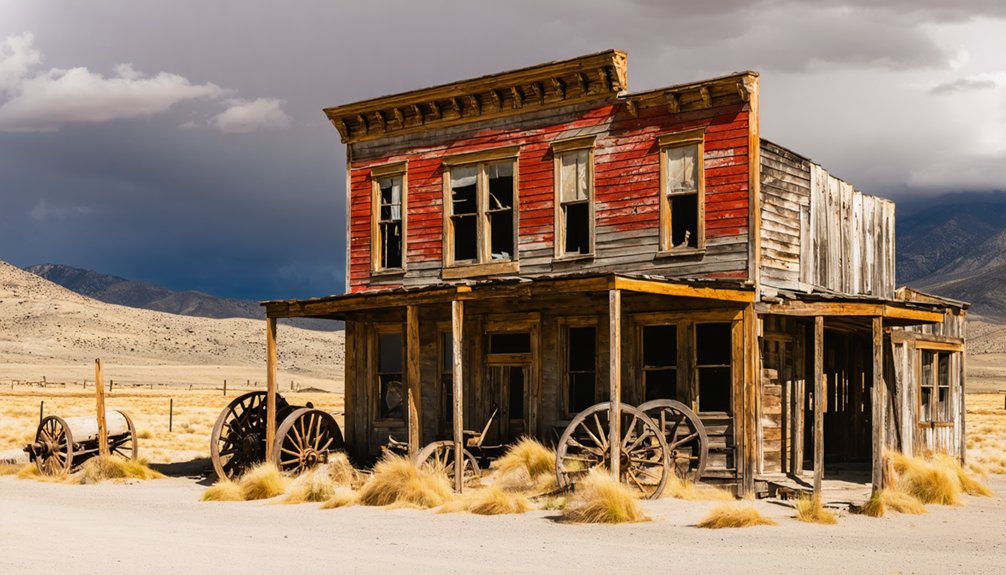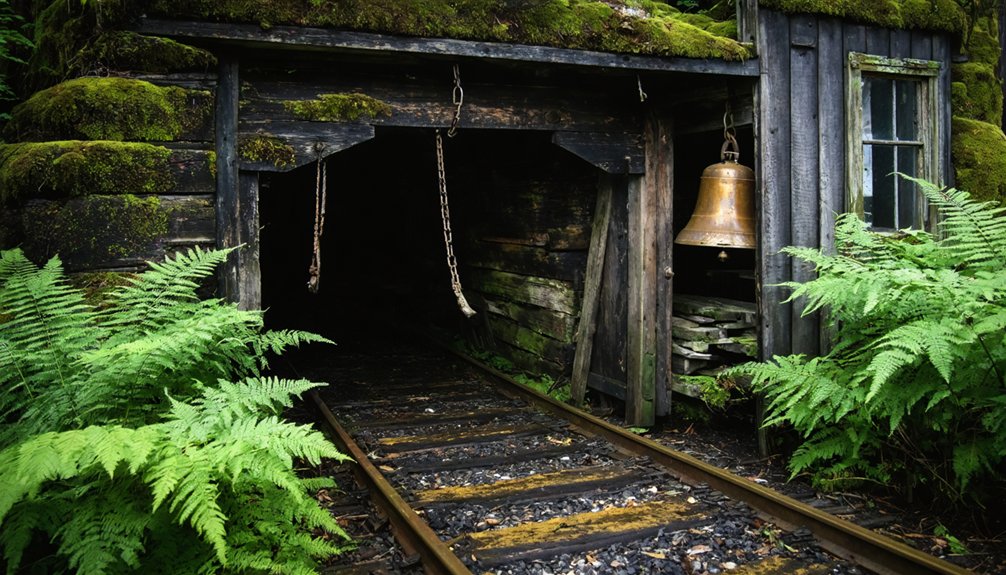
When you explore Vancouver Island’s abandoned mining settlements, you’re walking through remnants of over a century of resource extraction that once supported nearly 10,000 miners across dozens of operations from the 1850s gold rushes to the final coal mine closure in 1951. You’ll find everything from Leechtown’s depleted gold diggings to Mount Sicker’s copper empire ruins, Nanaimo’s coalfield communities, and industrial ghost towns like Bamberton with its massive cement plant remains. These sites preserve stories of mining disasters, labor struggles, and the often-overlooked contributions of Chinese miners who developed innovative extraction techniques.
Key Takeaways
- Leechtown experienced a gold rush in 1864 with 1,200 miners before surface deposits depleted by 1868.
- Mount Sicker operated copper mines from 1895-early 1900s, supporting nearly 2,000 residents in company towns.
- Nanaimo coalfields featured multiple mining communities from 1862-1951, including Wellington and Extension mines.
- Bamberton and Union Bay became industrial ghost towns after cement plant operations ceased, leaving impressive ruins.
- Mining disasters killed nearly 400 miners before 1912, sparking labor disputes and union formation struggles.
Leechtown: From Gold Rush Boom to Forest Reclamation
When the Vancouver Island Exploring Expedition struck payable gold on Leech River on July 18, 1864, they released a localized gold rush that transformed virgin wilderness into a bustling mining camp within weeks.
You’d have witnessed over 220 mining licenses issued by mid-August as experienced Fraser Canyon veterans flooded the valley. At its peak, Leechtown housed 1,200 miners with six stores, three hotels, and thirty saloons serving thousands in surrounding camps.
The rush extracted roughly $100,000 in its first year, but surface placers quickly exhausted. By 1868, most miners had departed for new strikes.
Like most gold rushes, Leech River’s fortune proved fleeting—rich surface deposits vanished within four years, scattering miners to distant prospects.
Small-scale operations and logging sustained intermittent activity through the 1950s, yet forest reclamation eventually claimed most structures. Active placer claims continue to dot the area where prospectors still seek their fortune.
Today, you’ll find only equipment remnants and commemorative plaques marking where this boomtown once thrived. The historic site is now preserved within Kapoor Regional Park, named after pioneer Kapoor Singh Siddoo.
Mount Sicker’s Copper Empire and Company Towns
While Leechtown’s miners chased alluvial gold in riverbeds, another mineral wealth lay hidden in the mountainous terrain thirty miles northeast. In autumn 1895, American prospectors F.L. Sullivan, T. McKay, and Henry Buzzard discovered copper, gold, and silver traces on Mount Sicker‘s 2,300-foot elevation. Their findings sparked Vancouver Island’s most significant copper extraction venture.
Henry Croft engineered the operation’s expansion, establishing the narrow-gauge Lenora, Mount Sicker Railway in 1899. Geared Shay locomotives conquered steep grades through six switchbacks, transporting ore from the Lenora and Tyee mines to tidewater. The railway stretched six miles from Lenora Mine to Westholme, with an additional eastern segment extending to Crofton.
These historical operations created bustling company towns supporting hundreds of workers. At its peak, the community featured two hotels, a school, homes, two post offices, and shops serving a population that neared 2,000 residents. Financial conflicts and transportation challenges eventually doomed the enterprise.
Today, you’ll find remnants of mine shafts, railway grades, and ghost town structures scattered across the mountain’s slopes.
The Nanaimo Coalfields: Wellington, Extension, and Mining Communities
As Mount Sicker’s copper miners battled transportation challenges in the island’s rugged interior, coal discoveries along Nanaimo’s accessible coastline were reshaping Vancouver Island’s industrial landscape.
When Robert Dunsmuir discovered coal in 1869, the Wellington Mine quickly outpaced established competitors, producing 16,000 tons in 1873 while Vancouver Island Coal Mining and Land Company managed only 45,000 tons total. The former HBC manager leveraged his mining expertise to build an empire that would produce 189,000 tons annually by 1880.
You’ll find the Extension Mine’s story equally compelling—acquired in 1862 and operating until 1938, it yielded 17 million tons despite suffering BC’s worst mining disaster when 150 miners died in the 1887 explosion.
The Dunsmuir empire expanded southward when Robert acquired the South Wellington Colliery in 1879, previously operated by a small coal mining outfit since the late 1870s.
These operations dominated Vancouver Island’s economy until California’s 1905 oil discovery ended the coal boom, closing the final major operation in 1951.
Industrial Giants: Bamberton, Union Bay, and Port Towns
You’ll find Vancouver Island’s industrial ghost towns differ markedly from the mining camps, as massive cement plants, coal ports, and processing facilities created permanent infrastructure that still dominates the landscape decades after closure.
Bamberton’s towering silos and Union Bay’s concrete pier remnants represent the scale of operations that once employed hundreds and shipped products across the Pacific. At its peak, Bamberton achieved recognition as one of the world’s most efficient industrial operations by 1962, with advanced control features unmatched anywhere in Canada.
These industrial giants experienced dramatic boom-and-bust cycles that left behind both impressive ruins and complex environmental legacies you can explore today. The Bamberton Historical Society has been preserving the heritage of these sites since 2005, collecting hundreds of historical items dating back to 1911.
Industrial Infrastructure Remains
Massive concrete silos and crumbling industrial structures mark where Vancouver Island’s largest cement operation once dominated the shoreline of Saanich Inlet.
You’ll find Bamberton’s industrial legacy scattered across the landscape—towering silos that once stored millions of barrels of Portland cement, abandoned quarry walls carved from Cobble Hill limestone, and deteriorating conveyor systems that moved raw materials from blast sites to processing facilities.
The community impact remains visible in donated parkland and marine infrastructure still serving modern aggregate operations.
Original cement silos continue functioning, now receiving barge-delivered cement from Vancouver.
You can explore permitted quarry operations under Coast Mountain Resources, where controlled blasting and crushing echo the site’s 68-year industrial history. The facility supplied cement for iconic structures like the Lions Gate Bridge and Peace River dams before closing in 1980. Today, the Malahat First Nation has transformed this industrial ghost town into the foundation for a major LNG facility development.
These remnants tell the story of BC’s sole cement producer that built the province’s major infrastructure projects.
Economic Boom and Bust
When coal discoveries near Comox Lake sparked a prospector rush in 1852, Vancouver Island’s industrial destiny was set in motion.
These economic cycles would define communities like Bamberton and Union Bay for decades.
Government incentives accelerated development through generous land grants—100 acres per $1000 invested.
The Dunsmuir empire capitalized on this, establishing eight Cumberland-area mines by 1900.
Labor dynamics brought international workers to fuel the boom, with Union Bay handling massive coal exports globally from the 1880s.
Four factors drove the inevitable bust:
- Oil substitution reduced coal demand in the 1930s
- Exhausted deposits halted successive mine operations
- Great Depression increased costs and economic downturn
- Labor strikes disrupted output, including 1912 union formation
You’ll find these ghost towns evidence of industrial rise and fall.
Granite Creek and Small-Scale Placer Operations
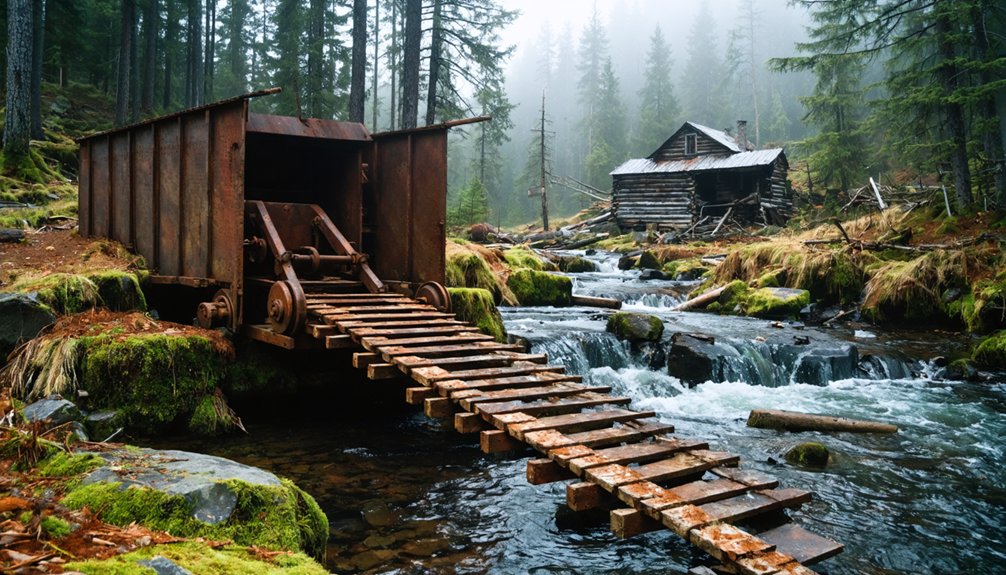
Granite Creek’s placer gold discovery in July 1885 triggered one of British Columbia’s most significant inland rushes, transforming a remote valley into the bustling settlement of Granite City within months.
You’d have witnessed a population explosion reaching 2,000 at its peak, making it one of BC’s largest inland settlements.
Miners employed straightforward placer techniques including ground sluicing, hydraulic methods, and hand-placer work targeting shallow gravels.
Miners used simple placer methods like ground sluicing and hydraulic techniques to extract gold from shallow creek gravels.
Historical production reached approximately 26,000 ounces from Granite Creek itself, with district-wide totals between 45,000-60,000 ounces.
Peak years generated $100,000-$203,000 in period dollars. Platinum accompanied gold in notable 2:1 to 3:1 ratios.
Physical Remnants and Archaeological Evidence
Although decades have passed since the last miners departed Vancouver Island‘s remote camps, the physical landscape retains compelling evidence of their industrial ambitions and daily lives.
You’ll discover archaeological layers containing stratified cultural deposits that record sequential occupation episodes spanning decades of mining activity.
When exploring these sites, you’ll encounter:
- Collapsed mine buildings – weathered timber frames and roofless structures marking former operations
- Tailings piles – visible landscape scars with multi-tonne waste impoundments near creek channels
- Stone foundations – hearth remains and cellar depressions outlining domestic structures
- Buried workings – subsurface adits and shafts preserved in excavation profiles
Ground-penetrating radar surveys detect subsurface masonry and metal concentrations where surface evidence has vanished, while soil geochemistry anomalies reveal buried metallurgical features through elevated lead and arsenic levels.
Mining Disasters and Labor History

You’ll find that Vancouver Island’s mining legacy carries a devastating human cost, with nearly 400 men dying in underground gas explosions during the three decades before 1912.
The worst disaster struck Nanaimo’s No. 1 Esplanade Mine on May 3, 1887, when an explosion 260 meters below sea level killed 150 miners and left seven bodies permanently entombed beneath the harbor.
These tragedies sparked intense labor struggles, culminating in the 1912 Vancouver Island coal strike that began when companies fired miner Oscar Mottishaw for reporting dangerous gas leaks.
Fatal Mine Accidents
When Vancouver Island’s coal mining industry reached its peak in the late 1800s and early 1900s, catastrophic accidents claimed hundreds of lives and devastated entire communities.
You’ll find these disasters exposed dangerous gaps in mining regulations and safety protocols that cost miners their lives.
The most devastating accidents included:
- 1887 Nanaimo No.1 Esplanade Mine explosion – 150 miners killed, creating 46 widows and 126 fatherless children
- 1915 South Wellington flooding – 19 miners drowned due to survey errors and improper mine plans
- Recurring gas explosions – Firedamp ignitions and poisonous afterdamp gases killed dozens annually
- High fatality rates – 1915 recorded 10.42 deaths per 1,000 employed miners
These tragedies decimated local workforces and triggered legal reforms, including manslaughter indictments against mine officials.
Union Formation Struggles
Following the deadly mine explosions and accidents that plagued Vancouver Island’s coal operations, miners’ desperation for workplace protections ignited the largest labor dispute in the region’s history.
You’d witness how this struggle began September 16, 1912, when workers protested Oscar Mottishaw’s dismissal for reporting gas leaks. Canadian Collieries responded by locking out 3,700 miners across multiple sites.
The United Mine Workers of America initially hesitated supporting these efforts, citing insufficient unionization enthusiasm.
You’d see how racist assumptions excluded Chinese workers despite their shared grievances. Company tactics proved ruthless—evicting families, importing strikebreakers, and demanding binding contracts.
Union solidarity emerged through island-wide expansion, with female relatives voicing support. This two-year battle for labor rights crippled Vancouver Island’s economy while establishing precedents for worker organizing.
Chinese Miners and Overlooked Heritage
While gold fever gripped Vancouver Island and the mainland goldfields during the 1858 Fraser Rush, thousands of Chinese miners began arriving from California’s exhausted diggings and directly from Guangdong Province, fundamentally reshaping the demographic landscape of British Columbia’s mining camps.
You’ll discover their significant contributions often remain hidden beneath layers of discrimination and regulatory barriers that forced them onto abandoned claims.
Yet these resilient prospectors developed innovative techniques, reworking tailings with specialized equipment like rockers and hydraulic methods.
Their Cultural Heritage includes:
- Establishing Chinatowns in Cumberland and Barkerville, sometimes comprising half the population
- Creating entrepreneurial networks through stores, tea rooms, and trading companies like Kwong Lee & Co.
- Building critical infrastructure including Cariboo Wagon Road sections and telegraph lines
- Extracting substantial wealth from “worthless” claims, including an 1885 Lillooet strike worth $7 million
Chinese Miners shaped Vancouver Island’s mining legacy despite facing systematic exclusion and wage discrimination.
Land Access, Safety Hazards, and Legal Considerations
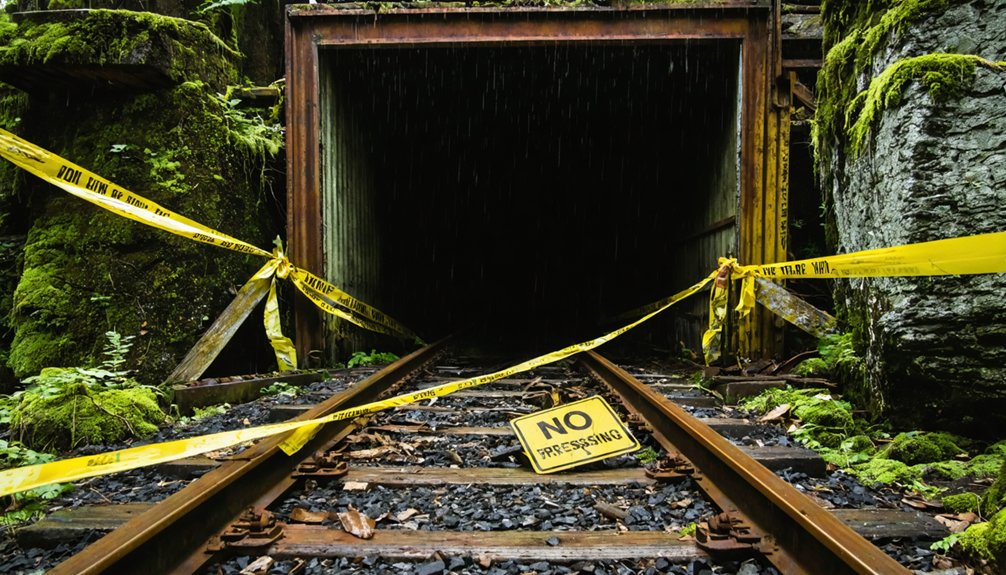
Though decades have passed since the last miners abandoned their claims, Vancouver Island’s ghost towns present modern explorers with significant access challenges and safety risks that require careful planning and legal awareness.
You’ll find many sites near Cowichan Lake, Port Alberni, and Nanaimo now require vehicle access through overgrown trails or costly helicopter transport.
Remote locations like Yellowcreek Mine feature closed-off tunnels, while unstable structures and toxic remnants pose serious hazards at elevated sites exceeding 6,000 feet.
Before exploring, you must check for no-trespassing signs and respect restricted areas.
Provincial inspectors oversee 1,171 historic sites, prioritizing larger workings for field assessments of metal leaching and structural risks.
These land reclamation strategies help balance mining heritage preservation with public safety requirements.
Preserving Heritage While Managing Tourism Impact
You’ll face complex decisions when visiting Vancouver Island’s ghost towns, as increased tourism threatens the very heritage sites you’re seeking to experience.
Safety risks from cave-ins, unmarked graves, and deteriorating structures require careful management while respecting Indigenous cultural sites that predate European mining operations.
Your access to these historic locations depends on balancing preservation efforts with sustainable visitation that won’t accelerate the decay of century-old mining infrastructure.
Balancing Access and Protection
As Vancouver Island’s ghost towns attract increasing numbers of heritage tourists and urban explorers, site managers face the complex challenge of providing meaningful access while protecting fragile historical remnants.
You’ll find that successful ghost town exploration requires careful planning and respect for historical preservation efforts. Back roads and overgrown pathways naturally limit visitor numbers while protecting sites like Beaufort’s logging remnants and Suquash Mine’s collapsed structures.
As you venture into these hidden places, be mindful of the growing trend of cities at risk of abandonment. Many once-thriving communities are now shadows of their former selves, offering poignant reminders of change and decay. These sites not only tell a story of economic shifts but also of the resilience of nature reclaiming its space.
Effective Access Management Strategies:
- Self-guided exploration using detailed maps and 104-page indexed resources
- Video tours for public awareness without physical site impact
- Natural barriers like forest reclamation protecting sensitive areas
- Educational documentation preserving Dunsmuirs and First Nations stories
Remote mines hidden deep in forests remain protected by their isolation, while accessible sites near Cowichan Lake balance visitor interest with environmental protection through nature’s own reclamation processes.
Managing Visitor Safety Risks
While heritage tourism brings valuable attention to Vancouver Island’s abandoned mining camps, these deteriorating sites present serious safety hazards that require careful management.
You’ll encounter collapsed structures hidden beneath forest overgrowth, old rail ties creating dangerous trip hazards, and unstable ground marked by unmarked graves from historic mining accidents. Cave-ins remain common threats at mine entrances, having caused fatalities throughout the sites’ histories.
Effective visitor safety protocols now limit access through locked gates and caretaker supervision.
You’ll find guided tours restrict numbers to just dozens annually, requiring two-hour drives on barely passable roads. Hazard awareness programs educate visitors about risks while overnight stays occur only in controlled environments.
This careful balance protects both heritage integrity and human life in these historically significant but physically dangerous locations.
Indigenous Heritage Considerations
You’ll need to navigate these essential protocols when visiting or managing these sites:
- Respect consultation requirements – Projects affecting cultural heritage must include Indigenous governments and knowledge-holders in decision-making processes.
- Follow access restrictions – Indigenous-led Cultural Use Plans establish clear conditions for photography, research, and site exploration.
- Avoid sensitive areas – Archaeological surveys identify unmarked graves, ancestral villages, and artifact concentrations requiring protection.
- Support Indigenous-led interpretation – Community-approved narratives center First Nations histories rather than settler-only ghost-town stories.
These partnerships create sustainable heritage tourism while honoring Indigenous sovereignty.
Frequently Asked Questions
What Specific Equipment or Tools Should I Bring for Ghost Town Exploration?
You’ll need essential safety gear including dust masks, cut-resistant gloves, sturdy boots, and headlamps for traversing dark structures. Bring photography equipment, GPS devices, first-aid kits, and multi-tools for documenting your discoveries safely.
Are There Guided Tours Available for Vancouver Island’s Mining Heritage Sites?
Mining history explorations unfold like treasure maps across Vancouver Island. You’ll discover guided heritage tours at Britannia Mine Museum offering 75-minute underground experiences, plus commercial operators providing bundled regional tours with hands-on gold-panning adventures.
Which Ghost Towns Are Most Suitable for Families With Young Children?
You’ll find Leechtown and Bevan offer the best family friendly activities with excellent ghost town accessibility. Both feature short walks, minimal hazards, and clear pathways perfect for young children exploring Vancouver Island’s mining history safely.
What Is the Best Season to Visit These Abandoned Mining Communities?
Summer offers the best weather for visiting abandoned mining communities, with dry conditions ensuring safer access to unstable structures. You’ll enjoy extended daylight for exploration and seasonal activities like photography, though book accommodations early.
How Can I Distinguish Between Different Types of Mining Operations From Remnants?
You’ll identify mining techniques through distinct surface features: open-pit operations leave stepped excavations, underground mines show shaft collars and adits, while processing sites reveal concrete foundations with historical significance spanning Vancouver Island’s industrial heritage.
References
- https://www.janinethomson.net/blog/83710/exploring-the-hidden-ghost-towns-of-vancouver-island
- https://www.youtube.com/watch?v=jVSw7PT4RIM
- https://books.google.com/books/about/Ghost_Towns_Mining_Camps_of_Vancouver_Is.html?id=OCUlDDBTU8sC
- https://www.abebooks.com/9781895811803/Ghost-Towns-Mining-Camps-Vancouver-1895811805/plp
- https://archive.org/details/ghosttownsmining0000pate
- https://openlibrary.org/works/OL11586320W/Ghost_towns_mining_camps_of_Vancouver_Island
- https://fvrl.bibliocommons.com/v2/record/S21C1224037
- https://www.rarenonfiction.com/product/231578/Ghost-Towns-Mining-Camps-of-Vancouver-Island
- https://curiocity.com/leechtown-bc/
- https://www.leechtownhistory.ca