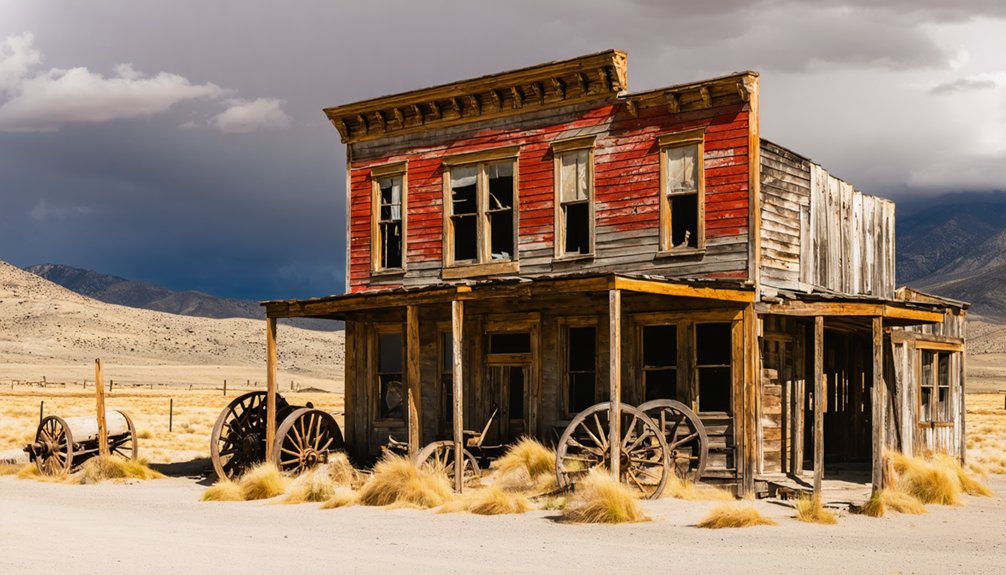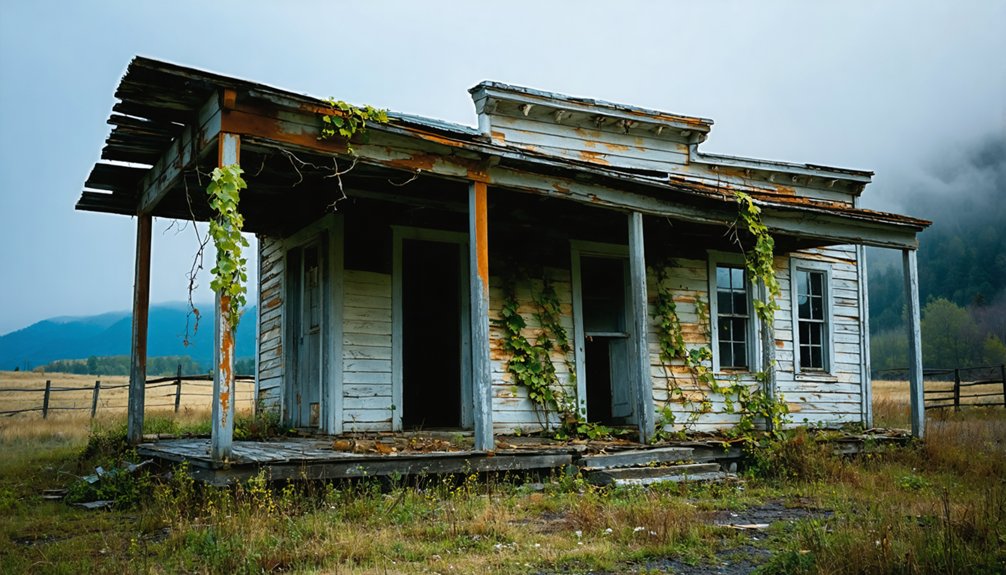
You’ll discover Appalachia’s ghost towns emerged from boom-and-bust cycles driven by coal mining, timber harvesting, and railroad operations from the late 1800s through mid-1900s. Companies established isolated settlements in narrow hollows along rail corridors, creating economic dependencies that trapped communities. When coal seams depleted, timber moved on, or transportation shifted to highways, entire towns emptied rapidly. Notable examples include Lost Cove, which vanished by 1957, and countless mining camps that couldn’t diversify their economies, leaving behind crumbling foundations and forgotten stories waiting to be uncovered.
Key Takeaways
- Appalachian ghost towns emerged from coal industry collapse, mine automation, and economic shifts that eliminated thousands of jobs in single-industry communities.
- Railroad companies dictated mining town locations along track corridors, creating isolated settlements in narrow hollows that rapidly emptied when coal seams depleted.
- Central Appalachia’s coal production peaked at 294 million tons in 1990 before projected 86% decline by 2020 due to reserve depletion.
- Notable abandoned settlements include Lost Cove (200 residents in 1870, abandoned 1957) and Gary, West Virginia (38% population drop 1955-1960).
- Rugged terrain and single-access transportation routes trapped remaining residents, preventing economic diversification and new industry attraction after coal operations ceased.
When Mountain Communities Rose and Fell: The Economic Forces Behind Abandonment
Before coal companies transformed Appalachian mountains into extraction sites, thriving communities had already established diverse economies built on commerce and small-scale manufacturing.
You’d have found bustling towns where multiple industries competed for workers, driving wages up through natural market forces. However, coal companies systematically dismantled this economic freedom by establishing monopsony power—becoming sole employers who could suppress wages and bar competing industries from entering their territories.
Coal companies destroyed economic competition by becoming sole employers, systematically suppressing wages and blocking other industries from entering their territories.
This economic exploitation followed predictable patterns. Companies built towns like Gary, West Virginia, and Bramwell, creating early prosperity that masked underlying vulnerabilities. The growth of the coal industry came at the expense of mining households’ financial well-being, with wealth systematically drained from local communities. Out-of-state companies extracted natural resources while leaving locals with limited economic benefits.
When coal production inevitably declined—Gary’s fell 28% between 1955-1960—these single-industry communities couldn’t adapt. Despite community resilience efforts, the concentrated resource economy prevented diversification, leaving ghost towns when extraction became unprofitable.
Boom to Bust: How Extractive Industries Shaped Settlement Patterns
You’ll find that railroad companies didn’t just transport coal—they determined where entire communities would spring up, as mining towns clustered along track corridors that connected remote Appalachian hollows to national markets.
When seams ran dry after decades of extraction, you’d witness these same settlements rapidly emptying as companies pulled out their equipment and abandoned worker housing.
The mountains’ rugged terrain that once protected these boom towns from outside competition ultimately trapped remaining residents, making it nearly impossible to attract new industries or maintain basic services after the coal was gone. Lumber firms similarly exploited the region’s virgin forests before moving on, leaving behind depleted landscapes and abandoned mill towns across southern Appalachia. By the 1930s, the coal industry faced complete collapse due to overproduction and technological advances that reduced demand for workers in remote mining communities.
Railroad Routes Drive Growth
As surveyors completed routes throughout the 1800s—initially for canals and roads before shifting to railroads by the 1850s—they faced a formidable challenge: how to cross Appalachia’s formidable terrain without bankrupting their companies.
You’ll find fewer than ten viable routes existed across 600 miles from northern Virginia to Nashville, with less than five preferred paths through river valleys and mountain gaps.
Railroad expansion followed these natural corridors religiously. The Baltimore & Ohio completed its route in 1852, followed by Pennsylvania Railroad in 1853.
By 1892, five major lines had conquered the mountains, each claiming strategic river passages and gaps. The Southern Railway remained the only east-west line threading through the Appalachian valleys during this period.
This scarcity sparked fierce competition and drove resource extraction deeper into previously inaccessible coalfields, timber stands, and mineral deposits throughout Appalachia’s remote valleys. Railroad companies often relied on private funding with subsidiary companies to finance these expensive mountain crossings.
Coal Depletion Triggers Decline
The very railroad routes that opened Appalachia’s mineral wealth eventually carried away its economic future.
You’ll witness how coal depletion transformed thriving mining communities into abandoned settlements across the region.
Central Appalachia’s coal mining peaked at 294 million tons in 1990, but resource management failures accelerated decline:
- Reserve Depletion – Easily accessible coal seams exhausted after extracting 45 billion tons historically.
- Production Collapse – Tennessee dropped 55%, eastern Kentucky fell 44%, Virginia declined 37% since 1997.
- Employment Crisis – Labor productivity plummeted while extraction costs soared in remaining reserves.
- Regional Shift – Appalachia’s share fell from 80% to 40% as western mines gained dominance.
EIA projects Central Appalachian production will plummet 86% by 2020, leaving communities economically stranded. Coal sulfur content significantly affects marketability, with high-sulfur deposits from western Pennsylvania and Ohio experiencing particularly low demand in modern energy markets. The collapse devastated mining families already struggling with black lung disease, creating a public health crisis alongside economic displacement.
Geographic Isolation Accelerates Abandonment
When Appalachian coal companies carved settlements into narrow mountain hollows, they created communities destined for abandonment.
You’ll find these ghost towns clustered along single stream corridors where steep slopes forced linear development patterns. Geographic vulnerabilities multiplied as companies built the only roads and rail spurs connecting isolated hollows to outside markets.
Once coal operations ceased, you’d witness rapid community collapse. Single-access transportation routes became too expensive for governments to maintain without company support.
Economic dependencies deepened the crisis—residents couldn’t commute to distant jobs over deteriorating mountain roads. Seasonal closures and landslide damage further severed already tenuous connections.
The geography that made extraction profitable ultimately sealed these communities’ fate, transforming bustling mining towns into abandoned relics scattered throughout Appalachia’s remote valleys. These forgotten settlements challenge romantic perceptions that view Appalachian isolation as pristine and timeless rather than economically devastating. Today, moss and ivy slowly consume the remnants of these former settlements, creating haunting landscapes where nature reclaims what industry left behind.
Railroad Towns Left Behind: Transportation Changes and Community Decline
During the early 1900s, railroad companies carved ambitious rail lines through Appalachian wilderness, transforming remote hollows into bustling industrial hubs overnight.
You’ll find that places like Thurmond, West Virginia, became the nation’s busiest freight station, while Kenova hosted thirty passenger trains daily.
Mining companies built entire communities—wooden houses, schools, churches—around these transportation arteries.
However, transportation shifts beginning in the 1950s devastated these railroad-dependent towns:
- Interstate Highway System replaced passenger rail service across Appalachia
- Mine automation and energy market changes eliminated thousands of jobs
- Population exodus left once-thriving communities nearly empty
- Economic collapse shuttered stores and abandoned entire main streets
Despite limited community resilience efforts like converting abandoned routes into recreation trails, most railroad towns couldn’t survive without their industrial lifeline.
Notable Abandoned Settlements: From Lost Cove to Thurmond

You’ll find that railroad towns across Appalachia followed strikingly similar patterns of rapid decline once transportation needs shifted in the mid-20th century.
Lost Cove’s abandonment in 1957 mirrors what happened to countless communities when the CC & O Railway halted passenger service and focused on coal transport, leaving isolated settlements without economic lifelines.
Timber camps faced even more dramatic collapses, as entire communities disbanded within years once logging operations moved on or depleted local forest resources.
Railroad Towns’ Rapid Decline
As coal companies carved rail lines through Appalachian wilderness in the early 20th century, they constructed entire settlements within weeks to support their extraction operations.
You’ll find these railroad towns experienced meteoric rises and devastating collapses that mirror America’s broader economic transformations.
The decline followed predictable patterns:
- Resource depletion – Mines ran dry or automation eliminated jobs, cutting Gary, West Virginia’s workforce 38% from 1955-1960.
- Transportation shifts – Interstate highways ended passenger rail service in the 1950s, isolating communities.
- Economic migration – New Deal road-building enabled workers to seek factory jobs northward.
- Market forces – Foreign competition and deindustrialization reduced demand for coal transport.
Despite this railroad legacy of boom and bust, community resilience persists in preserved sites like Thurmond, where fewer than five residents maintain connections to Appalachian heritage.
Timber Camp Abandonment Patterns
While railroad towns followed predictable boom-bust cycles, timber camps displayed more erratic abandonment patterns that often defied logical explanation.
You’ll find evidence of this chaotic logging legacy across Appalachia, where thousands of workers vanished alongside entire settlements. In October 1891, twenty-one loggers entered Augusta County’s timber camp—only seven returned, their disappearances unexplained.
Lost Cove housed 200 souls in 1870, existing without deeds or tax records before vanishing completely. Harrow’s End shifted from populated settlement to uninhabited wilderness overnight.
These camps relocated constantly as forests depleted, creating temporary communities that lasted years before sudden abandonment. Despite such volatility, community resilience emerged through local families who provided logistical support, maintaining connections even as the camps disappeared into Appalachian folklore.
What Remains: Physical Evidence and Archaeological Traces
The scattered remnants of Appalachia’s ghost towns tell stories through stone, metal, and earth that span millennia of human occupation.
You’ll discover evidence ranging from ancient burial mounds to rusted mining artifacts that reveal how successive waves of settlers shaped these mountain hollows.
Archaeological layers show distinct periods of abandonment and resettlement. In Nacoochee Valley, thirty-eight Indian mounds evolved from single graves to ceremonial platforms before sudden abandonment around 1700 AD.
Above these ancient sites, you’ll find 18th-19th century Anglo-American artifacts scattered through alluvial sand.
Physical evidence includes:
- Structural foundations – Crumbling stone footers and tall wall remnants hidden beneath overgrowth
- Mining equipment – Rusted tools, machinery, and gated entrances marking former extraction sites
- Preserved buildings – Metal framework reconstructions and original cabins in museum settings
- Burial sites – Forgotten cemeteries and ancient mound complexes documenting generational occupation patterns
Crumbling Foundations: How Time and Nature Reclaim Ghost Towns

Beyond cataloging what survives, understanding how these remnants disappear reveals the relentless forces transforming Appalachia’s abandoned settlements back into wilderness.
You’ll witness natural reclamation beginning immediately after abandonment—freeze-thaw cycles crack mortar while rainfall erodes foundation soil. Within years, vegetation infiltrates building joints as root systems wedge apart masonry and lift floor slabs.
Nature begins its takeover the moment humans leave—frost splits stone while roots pry apart what once seemed permanent.
Structural decay accelerates through biological agents: wood-decay fungi hollow timber frames while termites and carpenter ants weaken load-bearing members from within.
Seasonal flooding saturates basements, undermining footings as corroded metal fasteners lose their grip. Salt crystallization from road treatments disintegrates brick surfaces while UV radiation degrades protective coatings.
Eventually, these combined forces—weathering, hydrology, and biological colonization—systematically dismantle human construction, returning these spaces to forest.
Human Stories: The Social Impact of Community Abandonment
When coal mines shutter and manufacturing plants close their doors for the final time, entire communities face a cascade of social devastation that extends far beyond immediate job losses.
You’ll witness families fracturing as members scatter across states seeking work, leaving elderly relatives behind without traditional support systems. Churches and schools consolidate or close entirely, dismantling the institutional backbone that once fostered community resilience.
The demographic transformation proves particularly stark:
- Population aging accelerates as working-age adults flee, leaving behind disproportionate elderly populations.
- Cultural transmission breaks down when younger generations abandon ancestral homelands and local traditions.
- Mental health crises emerge from solastalgia—grief over environmental and social landscape destruction.
- Civic institutions collapse, eroding social networks essential for collective problem-solving.
Despite these challenges, some communities pursue cultural revival through heritage tourism and artisan cooperatives.
Protecting the Past: Preservation Efforts and Public Access

Across Appalachia’s abandoned settlements, preservation efforts navigate complex webs of ownership, funding constraints, and environmental decay that threaten to erase centuries of cultural heritage.
You’ll find the National Park Service acquiring properties through purchase or eminent domain, while National Register listings restrict demolition and reveal federal grants. Conservation groups like Southern Appalachian Highlands Conservancy transfer parcels into protected status, preserving historical significance despite preservation challenges.
Funding comes through Historic Preservation Fund grants, nonprofit endowments like Friends of the Smokies’ $9 million commitment, and volunteer labor reducing costs.
Preservation funding relies on federal grants, nonprofit commitments, and volunteer contributions to maintain Appalachian heritage sites despite economic constraints.
Stabilization techniques include structural shoring, historically appropriate materials, and site conservation protecting foundations and cemeteries.
Managed access through guided hikes and interpretive programming lets you experience these sites safely while limiting damage to fragile remnants.
Uncovering Hidden History: Research Methods and Documentation Challenges
Although decades of abandonment have left Appalachian ghost towns seemingly erased from the landscape, modern research methods are revolutionizing how historians uncover their hidden stories.
You’ll find researchers breaking free from traditional constraints by employing innovative approaches that challenge archival challenges and transform digital documentation.
These methods reveal previously inaccessible narratives:
- LIDAR remote sensing maps hidden foundations beneath overgrown vegetation in southwestern Garrett County, Maryland.
- Archaeological excavation uncovers material culture that contradicts historic poverty narratives through everyday artifacts.
- Oral history collection preserves personal stories from former residents before they’re lost forever.
- Historical GIS mapping overlays past and present data to track settlement evolution.
The Kempton Historical Archaeology Project exemplifies this revolution, where Frostburg State University students discovered remnants contradicting exploited imagery, proving you can reclaim authentic mountain community histories through persistent documentation efforts.
Frequently Asked Questions
Are There Any Ghost Towns in Appalachia That People Can Visit Today?
Yes, you can visit several Appalachian ghost towns today. Elkmont’s preserved cabins offer hiking trails, while Thurmond provides walkable streetscapes. Submerged towns like Proctor create unique visitor experiences through ghost town history exploration and photography opportunities.
Explorers can also find abandoned mines in ghost towns, serving as a haunting reminder of the region’s rich industrial past. These remnants not only attract history enthusiasts but also adventurers looking for a glimpse into the challenging lives of those who once worked there. Guided tours often provide insights into the mining operations that shaped the local economy and culture.
What Safety Precautions Should Visitors Take When Exploring Abandoned Appalachian Settlements?
Don’t let adventure become tragedy—pack essential safety gear including first-aid supplies, navigation tools, and sturdy boots. Maintain wildlife awareness for snakes and ticks. Always inform someone of your planned route and expected return time.
Can You Legally Metal Detect or Collect Artifacts From Ghost Town Sites?
You can’t legally metal detect or collect artifacts from most ghost towns without permits. Metal detecting laws protect archaeological sites, and artifact preservation regulations classify unauthorized collecting as felonies on public lands.
How Do You Find the Exact Locations of Lesser-Known Abandoned Communities?
You’ll combine mapping techniques like georeferenced USGS topos with historical resources including county deeds, newspaper archives, and cemetery records. Start with documented coordinates, then use LIDAR data and field verification to pinpoint exact locations.
What’s the Difference Between a Ghost Town and a Ruins Site?
You’ll find ghost town characteristics include economic abandonment with possible skeleton populations, while ruins site history emphasizes physical decay from disasters or time, focusing on structural remnants rather than inhabitant displacement.
References
- https://appalachian.org/lost-cove-ghost-town-in-the-national-forest/
- https://appalachianmemories.org/2025/10/16/the-lost-towns-of-appalachia-the-forgotten-mountain-communities/
- https://smokymountainnationalpark.com/blog/fun-facts-about-elkmont-ghost-town/
- https://www.geotab.com/ghost-towns/
- https://www.blueridgeoutdoors.com/go-outside/southern-ghost-towns/
- https://en.wikipedia.org/wiki/Appalachia
- https://www.100daysinappalachia.com/2018/02/qa-writer-explores-appalachias-economic-system-keeps-people-poor-sick-stuck-coal/
- https://www.youtube.com/watch?v=TU0kKfVj97I
- https://ageconsearch.umn.edu/record/132433
- https://www.richmondfed.org/publications/research/econ_focus/2023/q3_economic_history