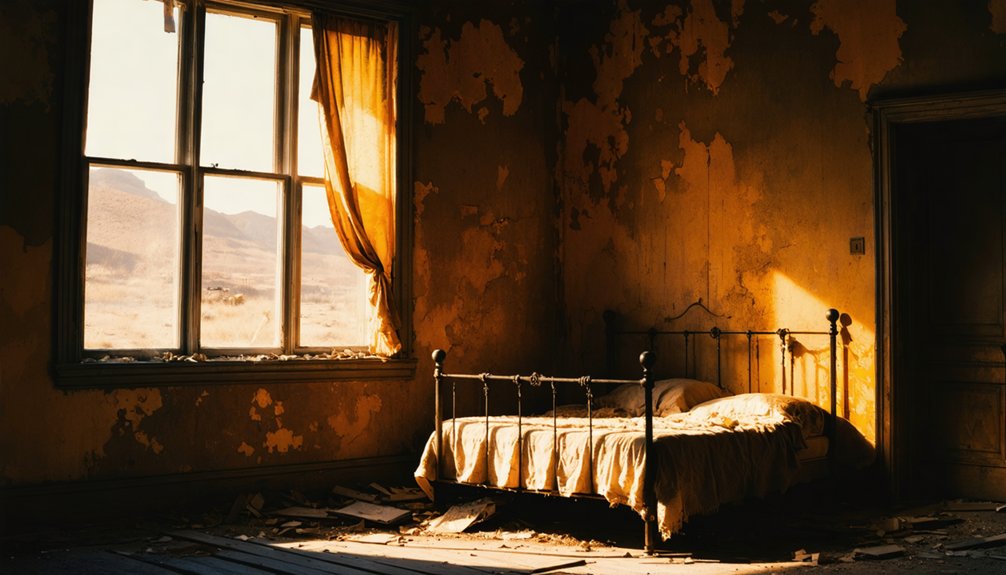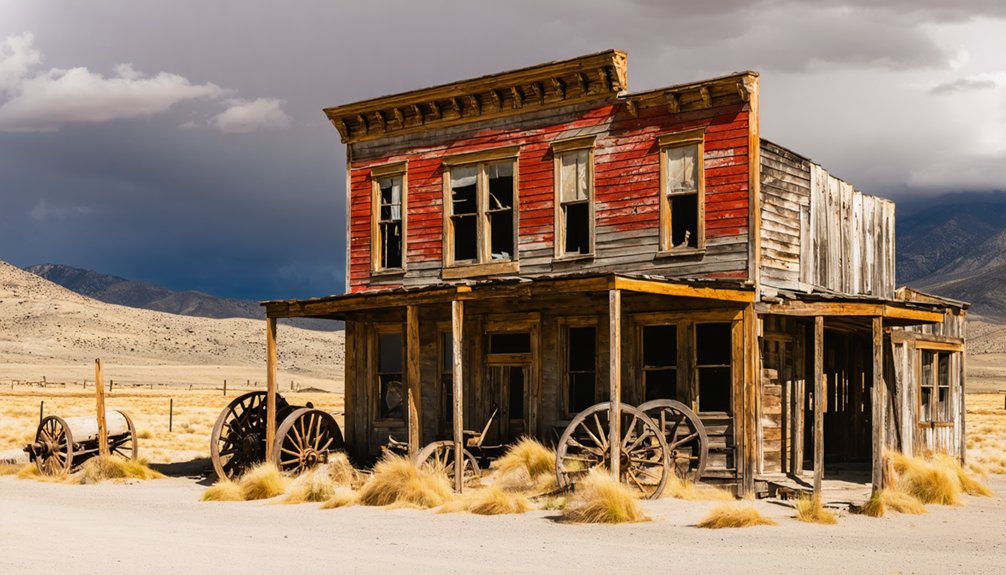
You’ll find remarkable ghost towns scattered across Death Valley, remnants of the region’s volatile mining boom from the 1870s through early 1900s. Rhyolite, discovered in 1904, peaked at 5,000 residents before rapid decline, while Panamint City’s silver rush created a lawless community of 2,000 before flash floods destroyed it. Ballarat, Chloride City, Leadfield, and Greenwater each tell unique stories of ambition and abandonment. These weathered settlements offer fascinating insights into America’s mining frontier legacy.
Key Takeaways
- Death Valley ghost towns like Rhyolite, Panamint City, and Ballarat showcase boom-and-bust mining cycles from the late 1800s to early 1900s.
- Rhyolite peaked at 5,000 residents in 1904 with notable structures including the Cook Bank Building and Tom Kelly’s Bottle House.
- Panamint City was a lawless silver mining town founded in 1872 that ultimately was destroyed by flash floods.
- Accessing these remote ghost towns typically requires four-wheel-drive vehicles along unmarked dirt roads with proper safety preparation.
- Visitors must respect legal boundaries, avoid removing artifacts, and carry emergency supplies due to harsh desert conditions and limited cell service.
Rhyolite: The Crown Jewel of Death Valley Ghost Towns
Gold fever struck the eastern edge of Death Valley in 1904 when prospectors Frank “Shorty” Harris and Ernest L. Cross discovered ore in the Bullfrog Hills.
You’ll find Rhyolite named after the volcanic rock that dominates this desert landscape. Within months, tent camps transformed into a planned town supporting 5,000 residents.
You can still explore remarkable Rhyolite architecture including the iconic Cook Bank Building‘s stone walls and Tom Kelly’s unique Bottle House constructed in 1905.
The Montgomery-Shoshone mine fueled rapid development—electric plants, schools, hospitals, and rail connections appeared seemingly overnight. Charles M. Schwab bought the Montgomery Shoshone Mine in 1906, investing heavily in infrastructure development. The town’s prosperity included over 2000 mining claims within a 30-mile radius of the Bullfrog district.
By 1911, financial panic and mine closures triggered mass exodus.
Today, you’ll discover fascinating Rhyolite artifacts scattered throughout ruins that tell tales of America’s last great gold rush.
Panamint City: A Remote Silver Mining Legacy
While Rhyolite captured headlines with its gold discoveries, silver fever struck the remote Panamint Range when prospectors found rich ore in Surprise Canyon during 1872.
You’ll discover that Panamint City’s lawless reputation stemmed from its founding by outlaws and bandits who’d been using the canyon as their hideout.
By 1874, you’d have encountered a bustling camp of 2,000 residents stretched along a mile-long main street.
Silver mining operations like the Marvel and Hemlock claims drove the economy, supported by saloons, hotels, and even a bank. The town also established a post office to serve the growing mining community. The Surprise Valley Mill opened in 1875 with a 20-stamp mill to process the valuable ore.
The town’s violent atmosphere included:
- Dozens of shootings during its brief heyday
- Vigilante executions in place of formal law
- A hard-boiled red-light district atmosphere
Flash floods ultimately destroyed this remote silver mining legacy, washing away buildings and dreams alike.
Ballarat: The Living Ghost Town Experience
Unlike most Death Valley ghost towns that vanished completely, Ballarat offers you a rare glimpse into a “living ghost town” where remnants of the past coexist with present-day caretakers.
Founded in 1896 at the base of the Panamint Mountains, this adobe settlement supported nearby mines with seven saloons, three hotels, and essential services for 400-500 residents during its 1897-1905 heyday.
At its peak, this thriving desert settlement boasted multiple saloons, hotels, and essential services for hundreds of mining-era residents.
You’ll discover Ballarat history through crumbling post office ruins, wooden morgue buildings, and Shorty Harris’s visible cabin north of the main road.
Ghost town legends live on through colorful characters like Seldom Seen Slim and gunman Jim Sherlock who called this desert oasis home. The town notably lacked any churches, reflecting its wild and lawless nature during the mining boom years.
Today, one full-time resident maintains this atmospheric site where Death Valley’s mining legacy remains tangible. Visitors receive clear communication about site access and safety protocols to enhance their exploration experience.
Short-Lived Boom Camps: Chloride City, Leadfield, and Greenwater
You’ll encounter Death Valley’s most dramatic examples of boom-and-bust cycles in camps like Chloride City, Leadfield, and Greenwater—settlements that blazed to life and died within months or just a few years.
These camps rose during different eras, from Chloride City’s 1905 formation during the Bullfrog excitement to Leadfield’s infamous 1926 promotion scheme, each following similar patterns of rapid construction, infrastructure challenges, and swift abandonment. Chloride City’s origins trace back to silver ore discovered by August J. Franklin in 1871, though operations ceased by 1873 due to prohibitive transport costs from San Bernardino. The remote location required pack mule transportation from San Bernardino, 180 miles away, with supply trains arriving only every three months during the early 1870s.
When you visit their scattered remains today, you’re witnessing the physical evidence of mining ventures that couldn’t overcome the harsh realities of water scarcity, transportation costs, and marginal ore values in one of America’s most unforgiving environments.
Rise and Fall
Though the discovery of valuable ore could spark immediate excitement across Death Valley, the region’s most notorious boom camps proved that initial promise rarely translated into lasting success.
You’ll find these three settlements followed remarkably similar trajectories from fortune to abandonment.
Chloride City emerged after A.J. Franklin‘s 1871 silver discovery, with initial ore assaying up to $1,000 per ton.
Yet transport costs from San Bernardino—180 miles away—killed operations by 1875. Revival came in 1905, but the camp died again by 1906.
Leadfield experienced its brief moment when C.C. Julian’s promotion machine drove investment in 1924-1926, only to collapse when low-grade ore couldn’t support profitability. The town’s decline led to a state investigation into promotional practices.
Greenwater followed a similar pattern after a rich copper strike in 1905, reaching a peak population of about 2,000 before water sold at $15 a barrel and all mining operations collapsed by 1909.
The Leadfield Legacy mirrors broader Death Valley patterns:
- Remote locations amplified operational costs
- Initial ore samples often misleadingly rich
- Poor infrastructure doomed sustainable mining
Mining Camp Infrastructure
Three distinct mining camps across Death Valley’s eastern reaches reveal how quickly entrepreneurs could establish basic infrastructure during boom periods, yet how rapidly these settlements crumbled when ore yields disappointed.
Chloride City perched in the Funeral Mountains saddle at 4,800 feet, where A.J. Franklin’s 1871 discovery sparked construction of essential facilities: assay offices, bunkhouses, blacksmith shops, and cookhouses.
Leadfield’s 1926 development showcased modern mining techniques with Western Lead Mines Company’s boarding house and 1,749-lot town layout.
Greenwater’s copper boom featured three stamp mills and a prominent smelter chimney.
You’ll find these camps demonstrate how mining infrastructure adapted to terrain and ore types.
Today’s ghost town preservation efforts protect these remnants, letting you witness how entrepreneurs rapidly built—then abandoned—entire communities based on fluctuating mineral prices and evolving extraction methods.
Access and Preservation
While these three mining camps shared similar boom-and-bust trajectories, each presents distinct access challenges and preservation states that reflect their unique geographic positions and historical timelines.
Chloride City requires four-wheel drive navigation 3.5 miles east of Hell’s Gate, perched 4,800 feet above Death Valley in the Funeral Mountains.
You’ll find substantial remains scattered across a four-mile area, including mining dumps and the Franklin Mine group’s adits.
Leadfield sits along Titus Canyon Road’s challenging one-way route, often requiring high-clearance vehicles and routinely closed during summer months.
These ghost towns offer varying rewards for the adventurous:
- Chloride City – Most intact ruins with visible mining infrastructure
- Leadfield – Accessible wooden buildings and cement foundations
- Greenwater – Complete disappearance, offering only historical imagination
Industrial Mining Sites: Skidoo, Keane Wonder, and Scotty-Era Locations
Beyond the scattered camps and transient settlements that dotted Death Valley’s perimeter, several locations developed into substantial industrial mining operations that left behind impressive mechanical infrastructure and engineering works.
Skidoo history reveals one of the region’s most sophisticated operations, beginning with a 1906-1907 gold strike that attracted 700 residents and $1.5 million in production. You’ll find its remarkable 15-stamp mill powered by a gravity-fed water pipeline—rare engineering for this arid environment.
Skidoo’s 15-stamp mill and gravity-fed pipeline represented remarkable engineering ingenuity in Death Valley’s harsh desert environment.
Bob Montgomery and prominent financiers like Charles Schwab funded the mechanized operation until ore depletion ended activity around 1917.
Keane production on the Panamint Range’s eastern flank similarly demonstrates the scale these mining ventures achieved, leaving behind mill foundations and extensive underground workings that showcase early 20th-century industrial ambition.
Planning Your Ghost Town Adventure: Access, Safety, and Preservation
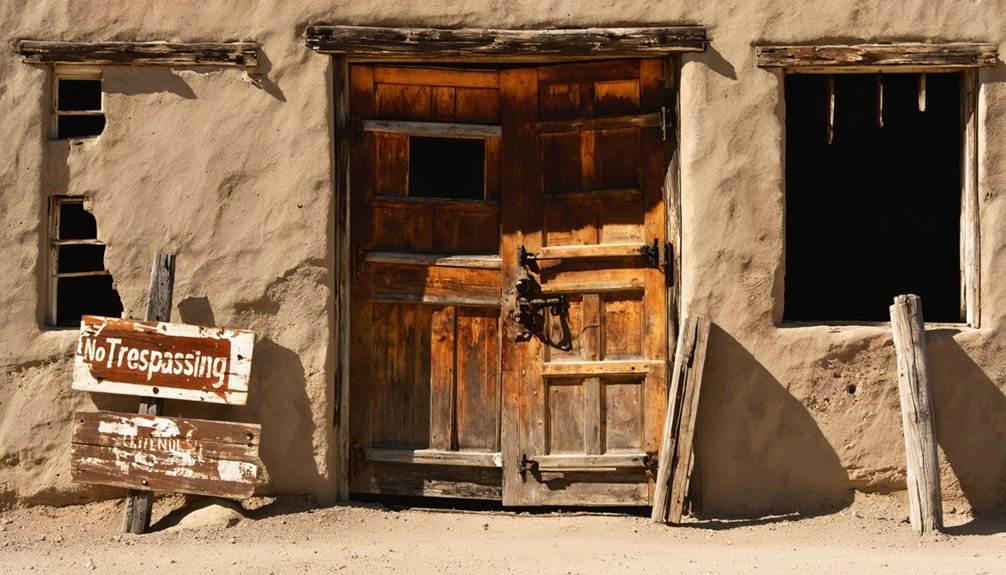
Before you venture into Death Valley’s remote ghost towns, you’ll need proper vehicle preparation and route planning since many sites require four-wheel-drive access along unmarked dirt roads without cell service.
Your exploration must balance historical curiosity with respect for these fragile archaeological sites, as many structures remain on private land or require special permissions for visits.
Desert conditions demand extensive safety preparation including emergency water, self-rescue equipment, and offline navigation tools since help can be hours away from these isolated locations.
Vehicle and Route Preparation
Since Death Valley’s ghost towns scatter across some of America’s most challenging terrain, your vehicle choice determines which historical sites you’ll reach safely.
exploring ghost towns on the continental divide offers a unique glimpse into the past, revealing stories of those who once thrived in these remote locations. the journey through this rugged landscape provides not only breathtaking views but also an adventure filled with historical intrigue. each stop along the way can spark imagination about the lives and times of the settlers who once called these towns home.
SUVs work best for rough dirt roads like Mosaic Canyon, while Titus Canyon’s one-way route to Leadfield ghost town requires 4-wheel-drive capability. Your driver skill matters more than vehicle build on these remote desert roads.
Essential vehicle maintenance includes:
- Two full-size spare tires – because single flats can strand you miles from civilization
- Recovery gear with winch and earth anchors – your lifeline when stuck in sand or rocks
- Three days of survival supplies – water, food, shelter for unexpected delays
Route mapping starts with checking nps.gov/deva/planyourvisit/conditions.htm for current road closures.
Top off your gas tank before departing—these backcountry adventures demand complete self-sufficiency.
Historical Site Ethics
When you explore Death Valley’s ghost towns, understanding legal boundaries and preservation ethics protects both historical sites and your safety.
Check land ownership before entry—many areas span National Park Service, BLM, state, and private property boundaries. Obtain required permits for backcountry access and respect seasonal closures.
Practice strict site preservation by never removing artifacts or climbing fragile structures. Follow Leave No Trace principles: stay on durable surfaces, pack out trash, and avoid creating new trails. Document discoveries through notes and maps rather than collecting items.
Maintain ethical photography standards by avoiding staged shots that move artifacts or alter scenes. Treat mine openings as lethal hazards—maintain wide standoffs from shafts and unstable tailings.
Carry emergency communication devices since remote locations often lack cell service.
Desert Safety Essentials
Death Valley’s extreme environment demands rigorous safety preparation that can mean the difference between a successful exploration and a life-threatening emergency.
You’ll need strategic hydration techniques including frequent water consumption and electrolyte replacement drinks, even when you don’t feel thirsty. Store extra water in your vehicle and avoid alcohol or caffeine that accelerate dehydration.
Essential safety measures include:
- Inform others of your exact route and return time – rescue depends on searchers knowing where to look
- Plan morning or evening expeditions – midday temperatures can exceed 120°F and prove deadly
- Maintain vigilant awareness of desert wildlife – rattlesnakes and scorpions pose serious threats in ghost town ruins
Check weather forecasts, carry navigation tools, and stay on designated trails.
Your freedom to explore depends entirely on respecting the desert’s unforgiving nature.
Frequently Asked Questions
Are There Any Ghost Towns With Overnight Camping or Lodging Facilities Nearby?
You won’t find lodging facilities directly at these ghost towns, but you’ll discover excellent camping options nearby. Beatty offers hotels four miles from Rhyolite, while BLM dispersed camping surrounds most sites.
What’s the Best Time of Year to Visit Death Valley Ghost Towns?
Visit Death Valley ghost towns mid-October through December for best visiting times with pleasant weather. Seasonal weather considerations favor fall through spring, avoiding summer’s extreme heat while you’ll find moderate temperatures and clear skies.
Can I Bring My RV or Large Motorhome to These Ghost Town Sites?
Your freedom machine can absolutely navigate these desert destinations! RV accessibility varies by site—Rhyolite and Calico welcome large motorhomes easily, while Bodie requires nearby camping. Motorhome restrictions apply only to remote Inyo’s rugged terrain.
Are There Guided Tours Available for the More Remote Ghost Town Locations?
Yes, you’ll find specialized guided exploration options for remote locations through 4×4 outfitters and adventure companies. These tours provide vehicle capability, route knowledge, and interpretation of each site’s historical significance while ensuring desert safety compliance.
Which Ghost Towns Are Suitable for Visiting With Young Children or Elderly Visitors?
You’ll find Rhyolite, Ballarat, and Keeler most suitable for family friendly activities with young children or elderly visitors. These locations offer excellent accessibility features including flat terrain, minimal walking, and passenger car access without strenuous hiking requirements.
References
- https://www.legendsofamerica.com/ca-deathvalleyghosttowns/
- https://www.pbssocal.org/living/travel/excursions/5-great-death-valley-ghost-towns.html
- https://dvnha.org/info-trip-planning/ghost-towns/
- https://www.visitcalifornia.com/road-trips/ghost-towns/
- https://www.moontravelguides.com/travel/national-parks/five-death-valley-ghost-towns-worth-the-trek/
- https://yesterdaysamerica.com/death-valley-ghost-towns-where-to-find-forgotten-boomtowns/
- https://www.tripadvisor.com/Attractions-g143021-Activities-c47-t14-Death_Valley_National_Park_Inyo_County_California.html
- https://www.oasisatdeathvalley.com/connect/stories/discover-the-eerie-ghost-towns-of-death-valley/
- https://www.destination4x4.com/list/death-valley-ghost-towns/
- https://www.rhyoliteghosttownnevada.org/explore/rhyolite-ghost-town