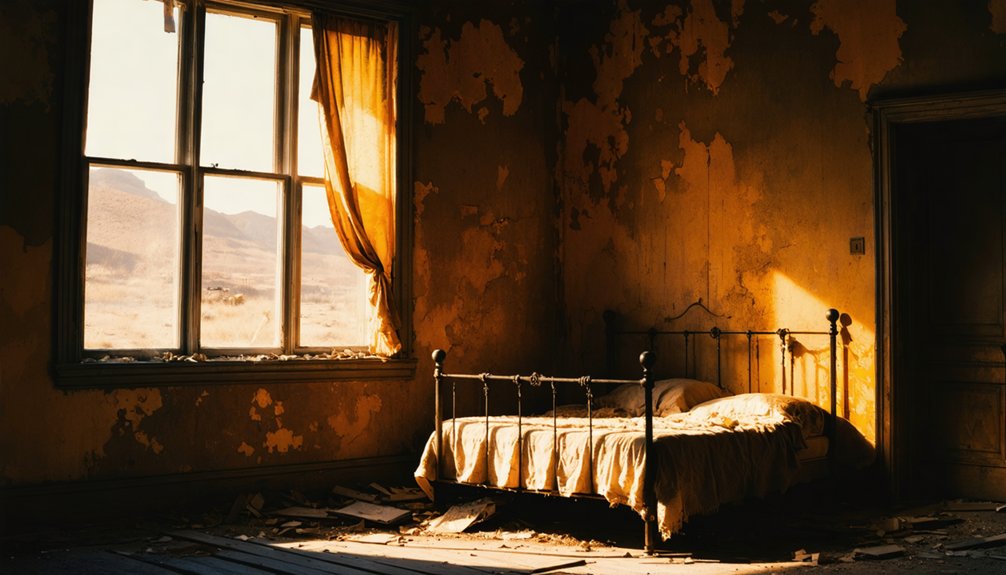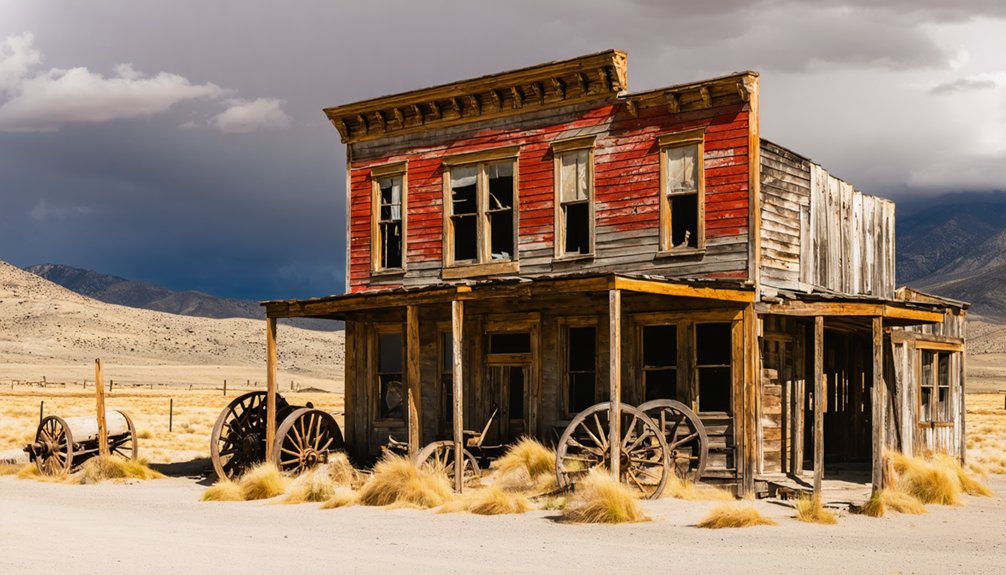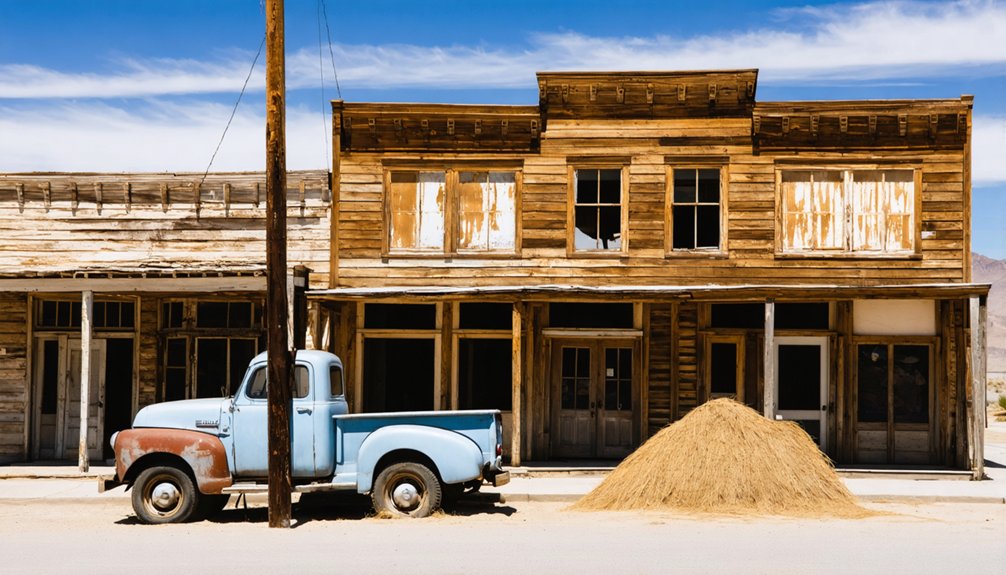
You’ll find over 600 fascinating ghost towns within a two-hour drive of Las Vegas, remnants of Nevada’s gold and silver mining booms from the 1860s through early 1900s. Notable destinations include Nelson’s historic Techatticup Mine, Rhyolite’s impressive ruins in Death Valley, Goodsprings with Nevada’s oldest operating saloon, and the submerged Mormon settlement of St. Thomas. These abandoned communities showcase the dramatic rise and fall of mining fortunes that shaped the region’s rich heritage and cultural landscape.
Key Takeaways
- Nelson features the historic Techatticup Mine and reflects the lawless mining era of the 1800s near Eldorado Canyon.
- Rhyolite became a thriving city of 10,000 residents during the 1904 gold rush before declining by 1920.
- Goldfield grew from 20 tent-dwellers in 1903 to Nevada’s largest city with over 20,000 residents by 1907.
- Goodsprings houses Nevada’s oldest operating saloon and processed precious metals until a devastating 1929 fire.
- Over 600 Nevada ghost towns exist within two hours of Las Vegas, offering accessible day trip exploration opportunities.
Nelson and the Historic Techatticup Mine
Discovery sparked a legend that would define one of southern Nevada’s most notorious mining districts. When Spanish explorers found gold in Eldorado Canyon in 1775, they couldn’t have predicted the chaos that would follow.
Spanish gold seekers in 1775 unwittingly ignited decades of violence and chaos in what became Nevada’s most infamous mining district.
You’ll find Eldorado history began with formal claims in 1861, launching sustained hard-rock operations that made this one of the region’s most successful 19th-century districts.
The Techatticup Mine became the area’s flagship operation, producing millions of dollars in gold, silver, copper, and lead until the 1940s. Its Paiute-derived name means “hungry” or “bread.” The mining community remained active until 1945 when operations were finally deactivated.
You’ll discover Techatticup legends intertwined with violence—gunfights were nearly daily occurrences during peak conflicts. The settlement, originally called Eldorado, was renamed Nelson after Charles Nelson’s notorious 1897 murder. The area’s lawless reputation was compounded by having the nearest sheriff stationed 200 miles away.
Rhyolite: Death Valley’s Famous Gold Rush Town
When Frank “Shorty” Harris and Ernest L. Cross discovered high-grade gold on August 9, 1904, they sparked Death Valley’s most spectacular gold rush.
You’ll find Rhyolite’s story remarkable—a tent camp that transformed into a sophisticated city of 5,000-10,000 residents within months.
By 1907, this boomtown featured impressive infrastructure:
- Concrete sidewalks, electricity, and telephone lines
- Stock exchange, banks, and opera house
- Dozens of saloons and two railroad depots
- Over eighty-five mining companies operating locally
The Rhyolite architecture reflected serious investment, with three-story concrete buildings and modern amenities.
However, the Panic of 1907 and depleted surface ore doomed the community. The 1906 San Francisco earthquake further destabilized the region’s economic prospects and investor confidence.
By 1920, you’d find only ruins where thousands once pursued fortune.
Today, the skeletal remains of the Cook Bank building stand as a monument to dreams that couldn’t outlast reality. The famous Bottle House, constructed from 50,000 beer and liquor bottles, was later restored for a movie set and remains a popular historical attraction.
Goodsprings and the Pioneer Saloon
While Rhyolite’s story ended in abandonment, Goodsprings offers a different tale of Nevada’s mining heritage—one where echoes of the past still serve drinks to modern visitors.
Named after rancher Joseph Good, who discovered silver here in 1861, this ghost town transformed from cattle watering hole to boomtown. The 1911 railroad arrival sparked explosive growth, swelling the population to 800 by 1918.
You’ll find pioneer history preserved in Nevada’s oldest operating saloon, where Clark Gable once waited after Carole Lombard’s tragic 1942 plane crash. The venue gained additional fame for its Ghost Burger, which was featured on Food Network. The Yellow Pine Mill, built in 1908, once processed the town’s precious metals until fire destroyed it in 1929.
Though mining ceased after WWII and fires claimed most buildings, Goodsprings refuses to die completely. Today’s 200 residents maintain the Pioneer Saloon’s legacy, complete with bullet holes and Gable’s cigarette burns on the Brunswick bar counter.
St. Thomas: The Submerged Mormon Settlement
Today’s drought conditions reveal St. Thomas’s archaeological significance:
- Foundation ruins and street layouts exposed by receding waters
- National Park Service interpretive trails documenting the site
- 3-D imaging technology capturing structural remains
- Relocated cemetery preserving community heritage
- The Mormon settlement was established in 1865 and abandoned in 1938 due to flooding
- At its peak, the town supported 500 residents with essential amenities including a post office
You’ll find this underwater ghost town within Lake Mead National Recreation Area.
Belmont and the High Desert Mining Camps
You’ll find Belmont’s 1876 Nye County courthouse standing intact in Nevada’s high desert, a remarkable survivor from the silver boom that peaked around 2,000 residents in the 1870s.
The courthouse anchors a scattered landscape of mining ruins accessible via dirt roads roughly 50 miles northeast of Tonopah. During its heyday, the town operated six mills that processed ore from the surrounding silver deposits. The settlement featured two local newspapers that chronicled daily life during the mining boom.
These remote camps require high-clearance vehicles and careful navigation through the Toquima Range’s rugged terrain.
Historic Courthouse Ruins
Deep in Nevada’s high desert, approximately 50 miles northeast of Tonopah, the imposing stone ruins of the Belmont Courthouse stand as the most significant remnant of what was once Nye County‘s bustling governmental center.
You’ll find this remarkable courthouse architecture defying ghost town myths about flimsy frontier construction.
Built in 1876 for $3,400, the courthouse served until 1905 when the county seat moved to Tonopah.
You can explore:
- Foundation stones quarried locally with 25,000 bricks fired on-site
- Original design by Carson City architect J.K. Winchell
- Jail cells that were removed, transferred to Gabbs, then returned
- Nevada State Parks preservation efforts since 1974
The structure’s survival demonstrates the permanence early settlers intended for their desert communities.
High Desert Access
While most Nevada ghost towns succumbed to complete abandonment, Belmont’s strategic position in the high desert northeast of Tonopah has preserved both its physical remains and accessibility since its 1865 founding.
You’ll find Belmont mining remnants scattered across rugged terrain accessible via unpaved roads requiring high-clearance vehicles. The Monitor-Belmont mill’s towering brick chimney served as an aerial reference for WWII pilots from Tonopah Air Force Base, marking this remote location’s continued relevance.
You can reach Belmont from Tonopah in roughly 45 minutes, though sparse infrastructure means no cell coverage or municipal services.
Ghost town preservation efforts maintain courthouse tours during limited weekends from May through September. Mining-era trails connect various mill sites throughout the district, offering adventurous exploration opportunities for those seeking authentic high desert history.
Goldfield’s Boom and Bust Legacy
You’ll find Goldfield’s story represents one of Nevada’s most dramatic mining booms, with its population exploding from 20 tent-dwellers in 1903 to over 20,000 residents by 1907, making it the state’s largest city.
The town’s incredible wealth from shallow, high-grade ore deposits funded elaborate infrastructure including multi-story buildings, banks, and stock exchanges before the mines played out and major disasters struck.
Today, you can explore what remains of this once-mighty mining metropolis, where preservation efforts maintain glimpses of its spectacular rise and equally dramatic fall.
Peak Population Glory Days
During the explosive boom years of 1906-1907, Goldfield’s population swelled to approximately 20,000 residents, transforming this Nevada mining camp into the state’s largest city virtually overnight.
You’d have witnessed a remarkable transformation from a few dozen prospectors in 1902 to a thriving metropolis with sophisticated urban infrastructure rivaling established cities.
The Goldfield economy attracted diverse populations seeking fortune and opportunity:
- Miners and mill workers extracting $10,000+ in daily gold ore production
- Service professionals including bankers, journalists, and merchants supporting five newspapers and five banks
- Investors and speculators trading mining stocks in the local exchange
- Entertainers and laborers filling hotels, saloons, and boarding houses
Three railroads connected this boomtown to the outside world, while theaters, athletic clubs, and churches provided cultural amenities you’d expect in any major city.
Mining Fortune Collapse
As quickly as Goldfield’s meteoric rise had captivated investors and fortune-seekers, the mining camp’s collapse proved equally dramatic and inevitable.
You’d witness the economic collapse unfold through multiple devastating blows that sealed the town’s fate.
Ore depletion struck first—surface deposits exhausted rapidly while no new discoveries emerged. By 1910, smaller mines had played out completely.
The Goldfield Consolidated Mining Company’s 1908 formation centralized operations but reduced labor needs, ending small-scale gold mining opportunities that had drawn thousands.
Labor disputes erupted in 1906, culminating in federal troops restoring order by December 1907.
Natural disasters delivered final crushing blows: the 1913 flash flood, 1923 fire destroying 53 city blocks, and Florence Mine’s destruction.
Population plummeted from peak levels to under 5,000 by 1910, then 1,500 by the early 1920s.
Historic Preservation Efforts
Though Goldfield’s population dwindled to fewer than 300 residents by the 1980s, dedicated preservationists have mounted increasingly sophisticated efforts to save the town’s architectural remnants from complete deterioration.
The Goldfield Historical Society, led by President John Ekman, initiated ambitious restoration projects in 2005. They’ve secured hundreds of thousands in state and federal grants over two decades, tackling preservation challenges through strategic funding and community involvement.
Key preservation achievements include:
- Goldfield High School’s exterior restoration completed by 2022, with ongoing interior work
- Florence Mine maintaining Nevada’s best-preserved historic mining structures
- $80,000 grant secured from Commission for Cultural Centers & Historic Preservation
- National Register recognition identifying 106 contributing buildings across 35 blocks
You’ll find donation-generating tours and educational events sustaining these efforts, though deteriorating foundations and roof leaks continue threatening these irreplaceable structures.
Calico: California’s Restored Silver Town
About 150 miles northeast of Las Vegas lies Calico, California’s most thoroughly restored silver rush ghost town.
Calico history began in 1881 when silver discoveries at the Silver King Mine sparked rapid development. During its 1880s boom, the town housed 3,000 residents and operated over 500 mines, producing $20 million in silver ore before economic collapse in the mid-1890s.
From silver strike to ghost town in just over a decade, Calico’s meteoric rise and fall epitomized the boom-bust cycle of America’s mining frontier.
Walter Knott’s restoration techniques in the 1950s transformed the abandoned site into an authentic historical preserve. Using period photographs and survivor accounts, he rebuilt most structures on original foundations while preserving five original buildings.
Restoration techniques emphasized accuracy over commercialization, resulting in period-appropriate reconstructions rather than theme park attractions.
Today you’ll find California Historical Landmark No. 782 operating as a 480-acre county regional park offering mine tours, museums, and educational programs.
Planning Your Ghost Town Adventure
Several ghost towns within a two-hour radius of Las Vegas offer diverse experiences for desert explorers, from quick day trips to multi-state adventures.
For those seeking a different kind of adventure, the lost mining towns near Phoenix feature remnants of a bygone era, with their crumbling structures and rich histories waiting to be uncovered. Exploring these towns not only provides a glimpse into Arizona’s mining past but also allows visitors to immerse themselves in the stunning desert landscape. Each town tells its own story, making every visit a unique journey into the heart of the American West.
You’ll find over 600 Nevada ghost towns accessible for weekend exploration, each carrying distinct historical significance from mining booms and frontier settlements.
Essential planning resources include:
- Interactive Nevada Ghost Towns map featuring 800+ locations with photos and historical details
- TravelNevada.com highlighting off-grid adventures to Rhyolite, Gold Point, and Candelaria
- SmarterVegas.com providing maps and quick guides for sites within two hours
- County-organized alphabetical lists and Top 10 regional recommendations
For ideal ghost town exploration, you’ll want to combine nearby destinations like Nelson and Goodsprings for efficient day trips, or pair St. Thomas visits with Valley of Fire adventures.
Safety Tips and Preservation Guidelines
While ghost towns offer fascinating glimpses into Nevada’s mining heritage, they present serious safety hazards that demand careful preparation and respect for preservation laws.
You’ll encounter unstable structures, rotting floors, and exposed debris that can cause serious injuries. Never enter abandoned mines or boarded buildings without proper permits and professional guidance.
Essential safety precautions include wearing sturdy boots and gloves, carrying sufficient water for desert conditions, and maintaining awareness of wildlife threats like rattlesnakes.
Bring reliable navigation tools and inform someone of your itinerary before departing.
Preservation ethics require following “Take Only Memories” principles—removing artifacts violates federal and state laws.
Stay on designated paths, respect private property boundaries, and avoid climbing fragile structures.
Report vandalism to authorities to protect these irreplaceable historical sites.
Frequently Asked Questions
Are Pets Allowed at Ghost Town Sites Around Las Vegas?
Yes, most ghost town sites allow pets on 6-foot leashes with fees like Calico’s $1 charge. You’ll find pet policies vary by site, so check ghost town regulations before visiting with your companion.
Which Ghost Towns Offer the Best Cell Phone Coverage for Emergencies?
Nelson offers your best cell coverage for emergency signals, located forty minutes from Vegas. Goldfield and Pioche provide intermittent service along major highways. Avoid Delamar and Extraterrestrial Highway sites—they’re notorious dead zones.
Can You Camp Overnight Near Any of These Ghost Town Locations?
Like stars scattered across desert darkness, you’ll find camping regulations allow dispersed overnight stays on surrounding BLM lands near Nelson, Goodsprings, and Rhyolite ghost towns, with nearby campsites offering fourteen-day freedom limits.
What’s the Best Time of Year to Photograph Ghost Towns for Lighting?
You’ll capture ghost towns best during fall and spring when golden hour lighting’s ideal. Seasonal changes bring cooler temperatures, clearer skies, and stable weather patterns that enhance dramatic shadows and warm tones on abandoned structures.
Are There Any Ghost Town Tours That Include Transportation From Las Vegas?
Four companies offer ghost town transportation from Vegas Strip hotels. You’ll find guided ghost tours departing Saturdays, with Bindlestiff and Howlanders exploring multiple Arizona towns, while TakeTours and LV Tours focus on specific mining sites.
References
- https://en.wikipedia.org/wiki/List_of_ghost_towns_in_Nevada
- https://pinatravels.org/ghost-towns-near-las-vegas/
- https://www.maxtour.co/historical-ghost-towns-to-explore-around-las-vegas/
- https://nvtami.com/2023/12/05/las-vegas/
- https://www.revealedtravelguides.com/las-vegas-blog/ghost-towns-to-visit-near-las-vegas/
- https://www.vegas4locals.com/resources/las-vegas-ghost-towns/
- https://travelnevada.com/ghost-town/
- https://brocarde.com/nelson-nevada-visiting-an-abandoned-ghost-town-and-finishing-ghosts/
- https://www.exploratography.com/blog-nv/eldorado-canyon-nelson-ghost-town-nevada
- https://travelnevada.com/ghost-town/exploring-eldorado-canyon/