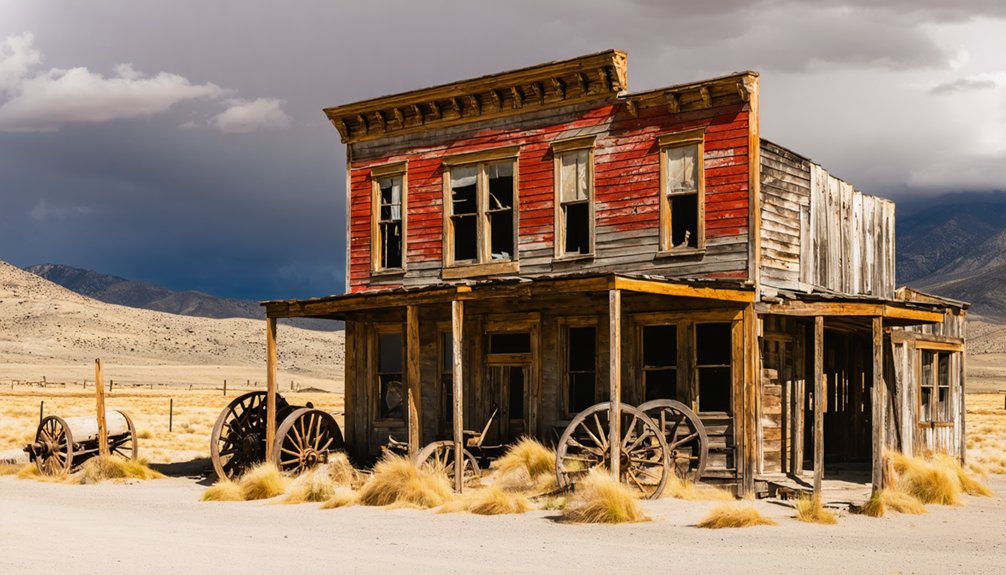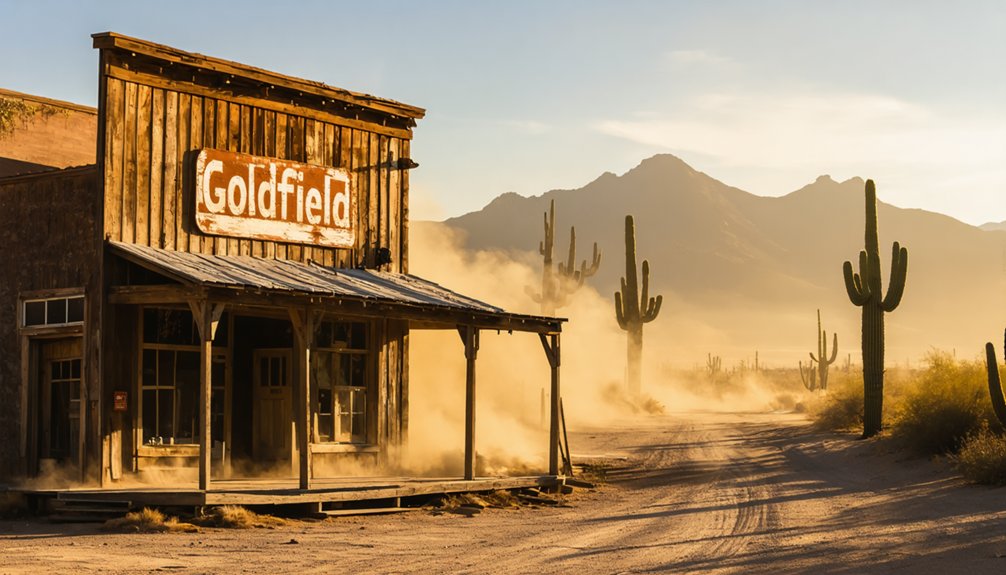
You’ll find Arizona’s authentic Wild West legacy in several ghost towns near Phoenix, each telling unique stories of boom-and-bust mining cycles. Jerome clings to Cleopatra Hill as a thriving tourist destination after producing $800 million in copper, while Vulture City offers restored 19th-century buildings from Arizona’s largest gold rush. Tip Top and Congress showcase weathered silver mining ruins in remote canyon terrain, and Swansea displays crumbling smelter foundations from early 1900s industrial dreams. These sites reveal the complete story behind Arizona’s mining heritage.
Key Takeaways
- Vulture City, west of Phoenix, offers restored 19th-century buildings, gold mining workshops, and guided tours seven days weekly.
- Jerome sits on Cleopatra Hill as a former copper mining town now transformed into a popular tourist destination.
- Goldfield features Wild West attractions including mine tunnel exploration, gunfight reenactments, and narrow-gauge train rides through desert.
- Tip Top and Congress showcase silver mining ruins in Yavapai County with weathered structures and deep mining shafts.
- Swansea displays crumbling adobe buildings and smelter foundations from an early 1900s copper operation in western Arizona.
Jerome: From Copper Boom to Tourist Destination
When you stand on the winding mountain roads approaching Jerome today, it’s hard to imagine that this perched Arizona town once thundered with the constant din of copper mining operations that began when prospectors first staked claims on Cleopatra Hill in 1875-1876.
You’ll discover a copper legacy worth over $800 million that transformed this mountainside into a bustling community of thousands. Miners from Ireland, Italy, Poland, and over 30 nationalities carved out lives here, creating ethnic neighborhoods that reflected America’s immigrant spirit.
The mining heritage shaped everything—from the famous “Sliding Jail” that moved due to underground blasting to the environmental challenges that tested residents’ resilience. A series of catastrophic fires in the 1890s repeatedly devastated the wooden structures, earning Jerome the reputation as the “wickedest town in America.”
Underground blasting moved buildings and challenged lives, but Jerome’s miners persevered through environmental hardships that would have broken lesser communities.
By 1899, Jerome had become the fifth-largest city in the Arizona territory, demonstrating the remarkable growth driven by copper wealth and railroad connections.
Today, you’re witnessing freedom’s triumph over economic abandonment.
Vulture City: Arizona’s Golden Legacy West of Phoenix
You’ll discover Arizona’s most legendary gold rush story at Vulture City, where Henry Wickenburg’s 1863 discovery sparked the territory’s largest and richest mining operation.
The sprawling complex once crushed ore with 80 stamps while supporting 5,000 residents, producing 340,000 ounces of gold worth $200 million in today’s currency before closing during World War II. Operations faced constant challenges from Apache raids that began in 1868, forcing the mining company to implement increased security measures to protect workers and equipment.
After decades of abandonment and deterioration, restoration efforts beginning in 2017 have meticulously rebuilt the town’s key buildings with a focus on historical accuracy and authenticity.
Today you can explore this remarkably preserved ghost town‘s restored buildings, infamous Hanging Tree, and original mine structures that still contain gold flecks in their rock walls.
Historic Mining Operations
Following vultures circling overhead in 1863, prospector Henry Wickenburg discovered what would become Arizona’s most storied gold mine—a gleaming quartz outcrop that sparked the legendary Vulture Mine and birthed a bustling desert town.
You’ll find this wasn’t your typical pick-and-shovel operation. The mine’s sophisticated mining techniques evolved from early quarrying to complex underground stoping and tunneling systems that extracted ore from quartz porphyry veins.
Stamp mills crushed the hard rock, while ore extraction methods advanced to include cyanide processing by 1897, allowing operators to rework tailings for additional gold recovery. The operation required massive infrastructure investments, including a six-inch pipeline from the Hassayampa River that cost $2,400 per mile to supply essential water for mining operations.
The operation produced an impressive 340,000 ounces of gold and 260,000 ounces of silver before wartime restrictions ended formal mining in 1942. At its peak, Vulture City thrived with a population of 5,000 residents who built a complete community around the mining operation.
Tourist Attractions Today
Today, Vulture City stands as Arizona’s most authentic ghost town experience, where you can walk through over 18 meticulously restored 19th-century buildings that once housed the dreams and desperation of gold rush settlers.
Open October through May, this preserved mining camp invites you to escape into Arizona’s untamed past.
Your adventure includes:
- Self-guided exploration of Henry Wickenburg’s cabin, saloon, brothel, and Assay Office
- Hands-on gold mining workshops and blacksmithing experiences from $250
- After-dark flashlight tours featuring ghost stories about legendary spirits like Lizzy and Joseph
- Discovery of historical artifacts throughout cookhouse, blacksmith shop, and mining remnants
You’ll find the Hanging Tree, visible Nichol Mine Shaft entrance, and original adobe structures preserved since 2017. The historic mine produced over 340,000 ounces of gold during its operational years, making it one of Arizona’s most productive mining operations. Guided tours are available seven days a week for groups of all ages, providing an immersive educational experience into Arizona’s gold mining heritage.
Comfortable shoes and water are essential for traversing the desert terrain.
Tip Top and Congress: Silver Mining Ruins in Maricopa County
You’ll discover two fascinating silver mining camps that rose from Yavapai County‘s rugged terrain in the 1870s and 1880s, where fortune-seekers carved communities from desert rock and dreams of precious metal.
Tip Top’s abandoned shafts and Congress’s divided Mill Town and Lower Town layout tell stories of boom-and-bust cycles that defined Arizona’s early mining era. These mining communities reflected Arizona’s broader economic transitions as ore deposits became depleted and populations shifted to more promising locations.
These weathered ruins now offer glimpses into the harsh realities and brief prosperity that shaped the lives of miners who called these remote camps home. The region’s challenging terrain forced miners to construct ten-stamp mills directly at mining sites when transportation of ore became too difficult and costly.
Mining Camp History
While most prospectors chased gold dreams across Arizona’s rugged terrain, Jack Moore and Bill Corning struck something even more precious during the harsh winter of 1875–1877—silver ore so rich it reportedly yielded hundreds of ounces per ton.
You’d witness Tip Top‘s transformation from wilderness claim to Arizona’s premier mining camp, rivaling Tombstone and Wickenburg by the 1880s.
The camp’s rapid development showcased frontier mining techniques and created substantial economic impact:
- Mill operations produced documented bullion shipments worth millions in 19th-century valuations
- Shafts extended 500–800 feet deep during peak commercial operations
- Civil War veterans populated the community, defending against Native attacks
- Transportation networks connected remote workings to El Paso and San Francisco smelters
This silver bonanza attracted transient fortune-seekers and legendary figures traveling Arizona’s dangerous stage routes.
Ruins and Remains
Although time has weathered Tip Top’s silver empire into scattered ruins, the remnants of Arizona’s once-mighty mining camp still command the southern foothills of the Bradshaw Mountains at 2,799 feet elevation.
You’ll discover mud-and-rock structures where hundreds once lived, including remnants of the Burfind Hotel and mill foundations that showcase historical significance through their enduring presence.
The 50-ton flotation mill‘s concrete footings and ore bin remains reveal sophisticated mining techniques that processed millions in silver.
Multiple adits and shafts extend 500-800 feet deep, though you should respect current access restrictions.
Site preservation efforts face challenges from weather and trespassers, yet these authentic ruins offer you an unfiltered glimpse into Arizona’s silver boom without commercial tourist trappings.
Visiting These Sites
Planning your expedition to these historic silver camps requires careful preparation, as both Tip Top and Congress occupy remote canyon terrain in Yavapai County that challenges even experienced explorers.
Your exploration tips should include bringing a high-clearance 4×4 vehicle for traversing the rugged access roads leading to these sites. The historical significance becomes evident as you discover brewery foundations, mill ruins, and remnants spanning nearly two miles of canyon territory.
Essential preparation includes:
- Checking private property boundaries before entering semi-abandoned areas
- Evaluating terrain hazards while exploring the extensive ruins carefully
- Following Black Canyon Road from Prescott to reach Tip Top’s remote location
- Using AZOFFROAD.NET guides for detailed historical context and direction
You’ll find Congress more accessible at SR 71 and SR 89’s junction, while Tip Top demands serious off-road commitment to reach its $4,000,000 silver legacy.
Swansea and Castle Dome: Industrial Remnants in Western Arizona
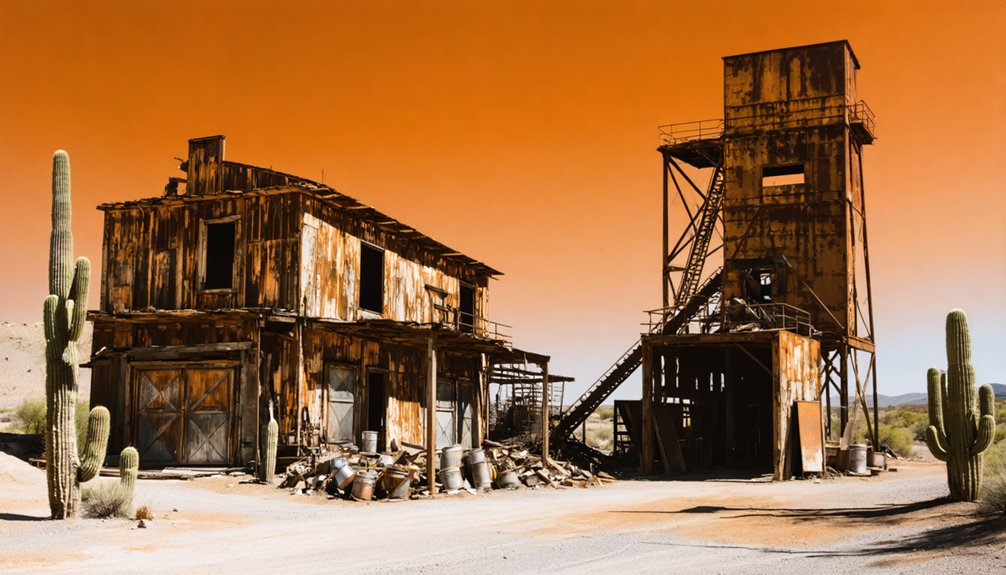
Deep in the desert hills of western Arizona, the ruins of Swansea stand as proof of an ambitious industrial dream that burned bright and brief in the early 1900s.
You’ll find crumbling adobe buildings, smelter foundations, and railroad depot remains scattered across this BLM-protected site.
George Mitchell’s vision transformed Signal Peak’s copper claims into a thriving Swansea smelting operation by 1909, complete with electric lighting and a half-mile water pipeline from the Bill Williams River.
By 1909, Mitchell’s ambitious vision had transformed remote desert copper claims into a modern industrial operation with electricity and engineered water systems.
The town peaked with 500-1,000 residents before copper prices crashed after World War I.
Today, you can explore preserved structures, walk among two historic cemeteries, and witness where millions of pounds of copper once flowed through massive furnaces.
Castle Dome’s mining legacy echoes similar boom-and-bust cycles throughout this unforgiving yet enchanting landscape.
Goldfield and Oatman: Reconstructed Wild West Experiences
Where most ghost towns crumble into forgotten dust, Goldfield rose from its ashes through sheer determination and nostalgic vision. Bob Schoose purchased the abandoned mill site in 1984, transforming barren foundations into today’s Wild West attraction just 25 minutes from Mesa.
Your Goldfield experiences blend authentic history with family entertainment:
- Explore the reconstructed Mammoth Gold Mine tunnel and try gold panning
- Watch gunfight reenactments by the Goldfield Gunfighters on Main Street
- Ride the narrow-gauge train through desert landscapes beneath Superstition Mountains
- Browse historic buildings, saloons, and the museum displaying 19th-century artifacts
While Oatman adventure awaits further exploration, Goldfield delivers accessible Old West nostalgia.
You’ll discover how one man’s vision rescued a forgotten boom town, creating lasting memories against Arizona’s rugged volcanic backdrop.
Hidden Gems: Lesser-Known Mining Sites Near the Valley
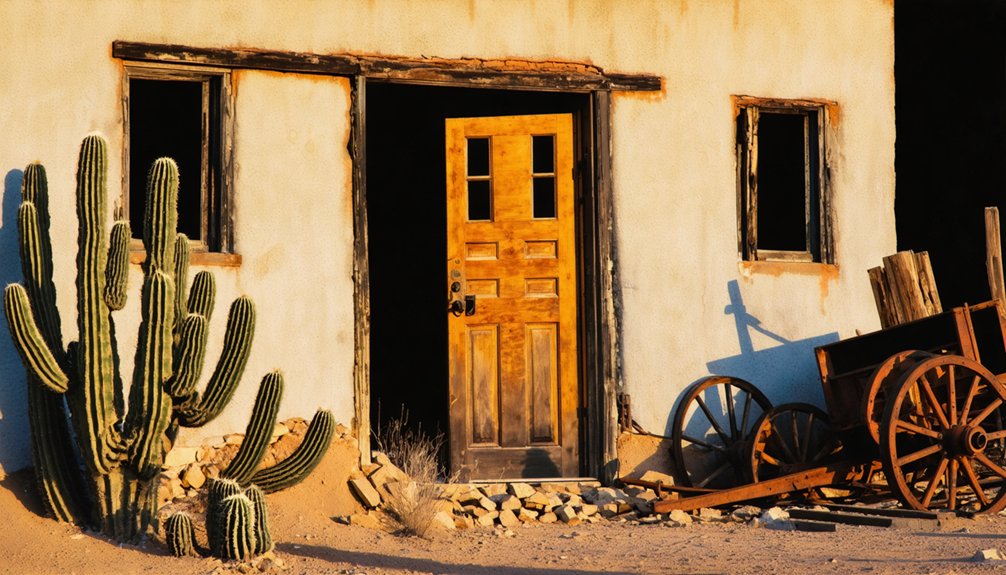
Beyond the reconstructed attractions and tourist-friendly experiences, Arizona’s wilderness conceals dozens of authentic mining sites where prospectors once carved their dreams into solid rock.
You’ll discover hidden treasures within South Mountain Regional Park, where Lost Ranch Mine‘s tight squeeze leads to collapsing tunnels and mysterious lower entrances.
The Golden Standard Mine offers multiple shafts and remnants of what locals believe was an elaborate investor scheme from the early 1900s.
De Soto Mine stands as Arizona’s most visited abandoned site, featuring 800-foot tunnels with copper mineral formations and dripping flowstone.
This mining history surrounds Phoenix with 1,439 mapped sites statewide.
However, remember that these locations pose serious dangers—many shafts remain unmarked and unstable throughout the region.
Planning Your Ghost Town Adventure: Access and Safety Tips
While Phoenix’s ghost towns beckon with tales of forgotten fortunes, successful exploration demands careful preparation and respect for both the desert’s dangers and these sites’ fragile histories.
The allure of ghost towns in the desert southwest often draws adventurous souls eager to uncover the stories hidden within their crumbling walls. Each site offers a glimpse into a bygone era, where the hopes and dreams of settlers clash with the harsh realities of desert life. Careful exploration can reveal artifacts and structures that speak volumes about the resilience and hardships faced by those who once called these places home.
Route planning starts with US-60 toward Apache Junction, but you’ll need high-clearance vehicles for unpaved spurs leading to remote sites. Download offline maps before departure—cell coverage vanishes quickly in the Superstitions.
Essential safety precautions include:
- Carrying 1-2 liters of water per person and starting early to beat afternoon heat
- Wearing sturdy boots for rattlesnake protection and thorny desert vegetation
- Avoiding unstable structures and marking open mine shafts immediately
- Packing satellite communication devices for areas beyond cell towers
Respect private property boundaries and never remove artifacts from federal lands.
These weathered remnants deserve preservation for future adventurers seeking their own taste of Arizona’s untamed past.
Frequently Asked Questions
Are Pets Allowed at Ghost Town Sites Around Phoenix?
Yes, you’ll find pet policies vary by location. Commercial ghost town regulations typically welcome leashed dogs outdoors, while federal lands require stricter control. Always confirm specific ghost town regulations before visiting these nostalgic desert destinations.
What’s the Best Time of Year to Visit Arizona Ghost Towns?
You’ll find the best weather during shoulder seasons—March through May and September through November—when temperatures stay moderate, seasonal events enliven historic sites, and you’ll escape summer’s punishing heat while avoiding winter’s peak crowds.
Do Any Ghost Towns Near Phoenix Offer Overnight Camping or Lodging?
You’ll find camping options at Goldfield Ghost Town’s on-site campground and dispersed BLM camping near Congress area sites. Jerome and Oatman offer lodging facilities within historic mining towns for authentic overnight experiences.
Which Ghost Towns Are Wheelchair Accessible or Suitable for Elderly Visitors?
Vulture City and Goldfield offer wheelchair ramps and elderly amenities with paved paths through restored mining buildings. You’ll find accessible restrooms, level walkways, and guided tours that capture Old West atmosphere without challenging terrain.
Are There Ghost Town Tours Available From Phoenix Hotels or Airports?
You’ll find ghost town tours with Phoenix transportation through private charter services and bespoke tour companies, though they require advance booking. Most operators offer downtown hotel pickup rather than direct airport departures for these nostalgic adventures.
References
- https://en.wikipedia.org/wiki/List_of_ghost_towns_in_Arizona
- https://www.elitevrs.com/blog/discover-these-top-10-ghost-towns-arizona
- https://www.visitarizona.com/like-a-local/4-arizona-ghost-towns-you-may-have-never-heard-of
- https://www.arizonahighways.com/article/arizona-ghost-towns
- https://www.tripadvisor.com/Attractions-g28924-Activities-c47-t14-Arizona.html
- https://www.geotab.com/ghost-towns/
- https://goldfieldghosttown.com
- https://westernmininghistory.com/towns/arizona/jerome/
- https://www.legendsofamerica.com/az-jerome/
- https://thelittledaisyjerome.com/history/