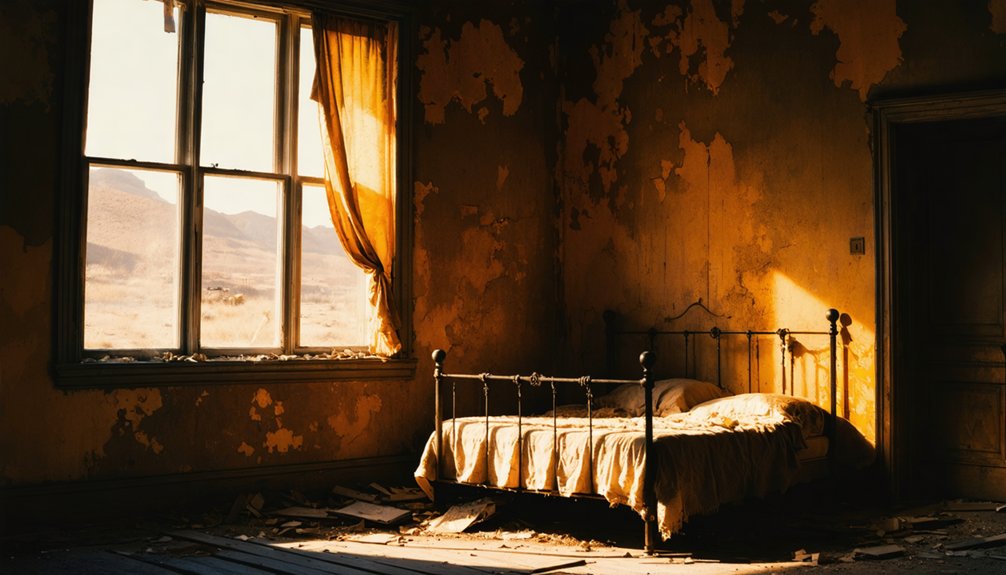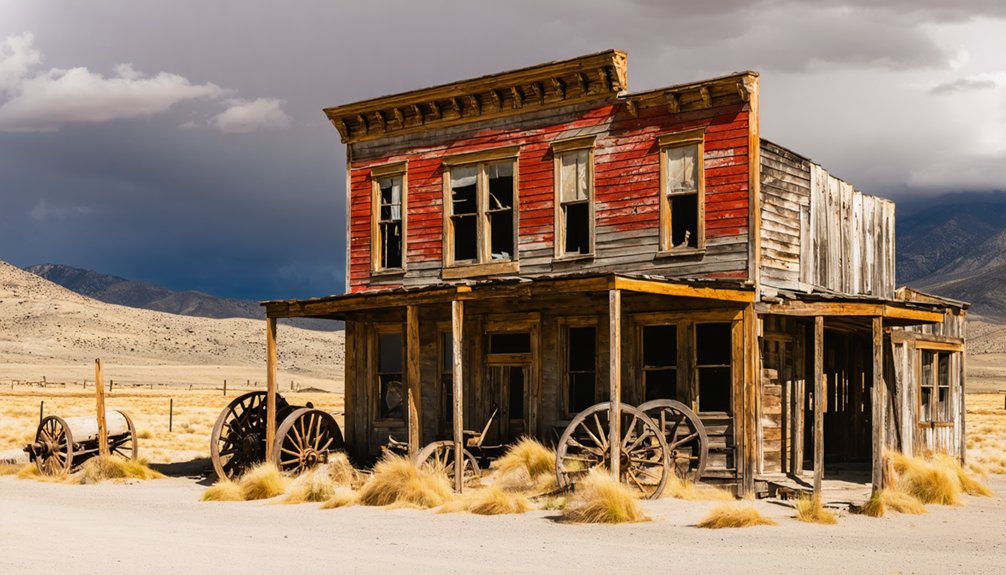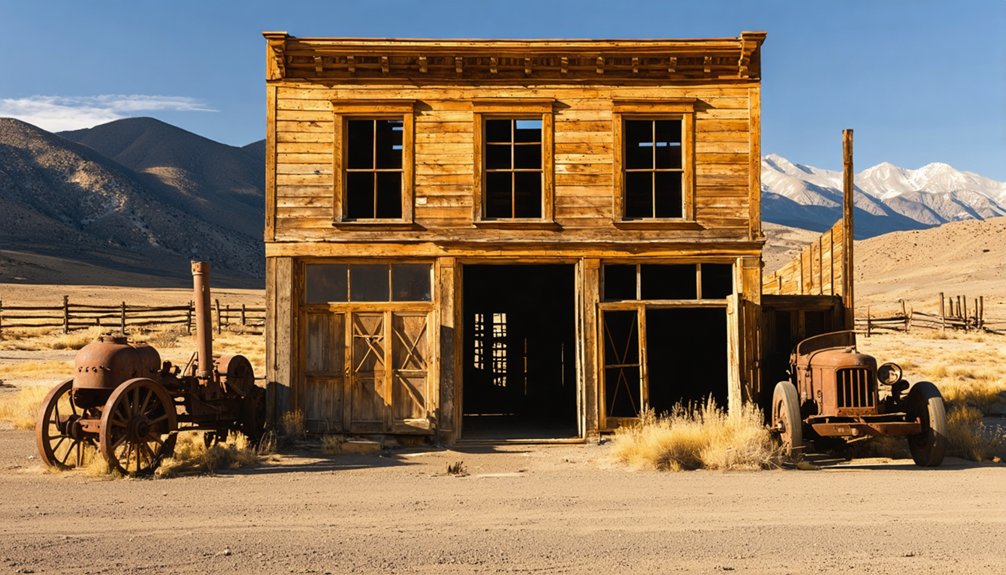
You’ll find ghost towns on every continent, each telling a story of dramatic collapse—whether from resource depletion like California’s Bodie gold rush relic, natural disasters that emptied Italy’s medieval Craco, or failed industrial ambitions such as Ford’s jungle-reclaimed Fordlândia. These abandoned places range from Tasmania’s brutal penal settlement at Port Arthur to Namibia’s diamond-wealthy Kolmanskop, now surrendered to desert sands. They’re laboratories revealing how quickly human civilization crumbles when economics shift, environments rebel, or visions fail—and what these ruins expose about progress, exploitation, and impermanence.
Key Takeaways
- Port Arthur, Tasmania, served as Britain’s harshest penal colony from 1830, now a World Heritage site symbolizing systematic oppression.
- Bodie, California, preserved in “arrested decay,” peaked at 10,000 residents in 1879 before gold depletion caused abandonment.
- Kolmanskop, Namibia, flourished after 1908’s diamond discovery, featuring luxurious amenities before being reclaimed by desert sands.
- Hashima Island, Japan’s concrete coal-mining hub, housed 5,000 workers in high-rises before closure in 1974 due to oil.
- Ghost towns reveal humanity’s fragile ambitions, offering insights into resource dependency, environmental forces, and societal collapse.
Port Arthur: Tasmania’s Haunting Penal Settlement
When the British Empire established Port Arthur in September 1830 on Tasmania’s isolated Tasman Peninsula, they created what would become the strictest penal facility in their colonial system.
You’ll find this wasn’t just another prison—it was a deliberate experiment in breaking human will through psychological control and harsh discipline.
Convict life here meant total surveillance: hooded prisoners forbidden to speak, flogging for infractions, and bread-and-water diets.
The desperation grew so intense that some convicts committed murder simply to face execution rather than continue their torment.
The site’s historical significance extends beyond its 12,000-14,000 inmates.
Today, as part of Australia’s World Heritage–listed Convict Sites, Port Arthur’s ruins stand as evidence of empire’s capacity for systematic oppression disguised as reform.
Hashima Island: Japan’s Concrete Ghost on the Sea
While Port Arthur confined thousands within stone walls, Japan’s industrialization created an entirely different kind of prison—one built from economic necessity rather than imperial punishment.
Hashima Island, nicknamed Gunkanjima for its battleship silhouette, rose from the sea in 1890 when Mitsubishi pioneered undersea coal mining. You’d find Japan’s first reinforced concrete high-rises here, housing over 5,000 workers by the 1960s—the world’s most densely populated place.
The island’s historical significance extends beyond its technological innovation. After producing 410,000 tons of coal annually during WWII, mines closed in 1974 when oil replaced coal. The Hashima Elementary and Junior High School, completed in 1958, served as a central part of the community for miners’ children until the island’s abandonment. Workers descended through narrow elevator shafts to mines deep under the sea, where accidents claimed four to five lives monthly.
Today, this UNESCO World Heritage site stands as a monument to urban decay, where concrete structures crumble into the ocean—testament to modernization’s price and labor’s exploitation.
Bodie: California’s Authentic Gold Rush Relic
Bodie’s transformation from California’s most notorious mining boomtown to a frozen-in-time relic illustrates the rapid boom-bust cycle that defined Gold Rush settlements.
The town peaked at 10,000 residents in 1879 with over 2,000 structures before gold depletion and devastating fires reduced it to fewer than 200 buildings by the 1940s.
California’s decision to preserve the remaining structures in “arrested decay”—leaving buildings exactly as abandoned with goods still on shelves—has created the nation’s most authentic Gold Rush ghost town experience. The town’s violent reputation during boom years earned inhabitants the label “bad man from Bodie”, reflecting the frequent murders, shootings, and lawlessness that characterized daily life. The name Bodie has become associated with multiple places and people, though the ghost town remains its most recognized reference.
Peak Era and Decline
The Standard Company’s 1876 discovery of a profitable gold-bearing ore deposit transformed Bodie from a struggling outpost into one of California’s most notorious boomtowns.
You’ll find this gold rush peaked spectacularly between 1876-1882, when population surged to over 10,000 residents and twenty-two mines operated steam-powered machinery.
The Syndicate mill’s 1878 processing of 1,000 tons yielding $601,103 in a single month demonstrates the extraordinary wealth extraction that defined this era.
The town’s wild reputation included over sixty saloons operating by 1879, with no churches present to counter the lawless atmosphere.
Mining decline arrived swiftly in the early 1880s as deposits diminished.
By 1915, observers described Bodie as a ghost town. The 1932 fires devastated remaining structures, and the last mine closed in 1942.
Throughout its existence, Bodie produced approximately $34 million in gold and silver, leaving behind an authentic reflection of boom-and-bust economics. Perched at an elevation of 8,379 feet, the town’s remote location and harsh conditions contributed to its eventual abandonment.
Preservation in Arrested Decay
Unlike most historic sites where restoration aims to recreate a building’s original glory, Bodie exists in “arrested decay”—a preservation philosophy that maintains structures exactly as they appeared when abandoned.
You’ll find 110 buildings frozen in time, their interiors still stocked with original goods, furniture, and artifacts from the mid-20th century. California designated this authentic gold rush ghost town a State Historic Park in 1962, earning National Historic Landmark status for its cultural significance.
Park rangers stabilize structures without improvements or modernizations, while strict rules prohibit visitors from removing even china shards or nails. Perched at 8,379 feet elevation in the Sierra Nevada Mountains, Bodie’s remote location has helped protect it from development and vandalism.
The Bodie Foundation funds ongoing stabilization projects through their Save Bodie campaign, ensuring you experience an unaltered glimpse into America’s mining past without commercial intrusions. Daily tours of the Standard Stamp Mill demonstrate the gold extraction processes that once drove this frontier community’s economy.
Kolmanskop: Namibia’s Sand-Swallowed Diamond Town
In April 1908, railway worker Zacharia Lewala stumbled upon a stone while clearing tracks in German South West Africa—a discovery that would transform barren desert into one of the world’s wealthiest diamond towns within months.
His supervisor August Stauch recognized the diamond’s value, triggering a rush that produced 5 million carats. By 1909, authorities declared a Sperrgebiet—forbidden zone—as production soared to 1.5 million carats annually.
From barren wasteland to forbidden treasure: 5 million carats sparked a diamond rush that transformed desert into Germany’s most guarded colonial possession.
This ghost town once boasted Africa’s first tram and southern hemisphere’s first x-ray station.
The diamond discovery created extraordinary infrastructure:
- Hospital with cutting-edge medical equipment
- Ballroom and casino for entertainment
- Ice factory in scorching desert heat
- 119-kilometer electrified railway network
- German-style architecture with modern amenities
Craco: Italy’s Abandoned Medieval Village
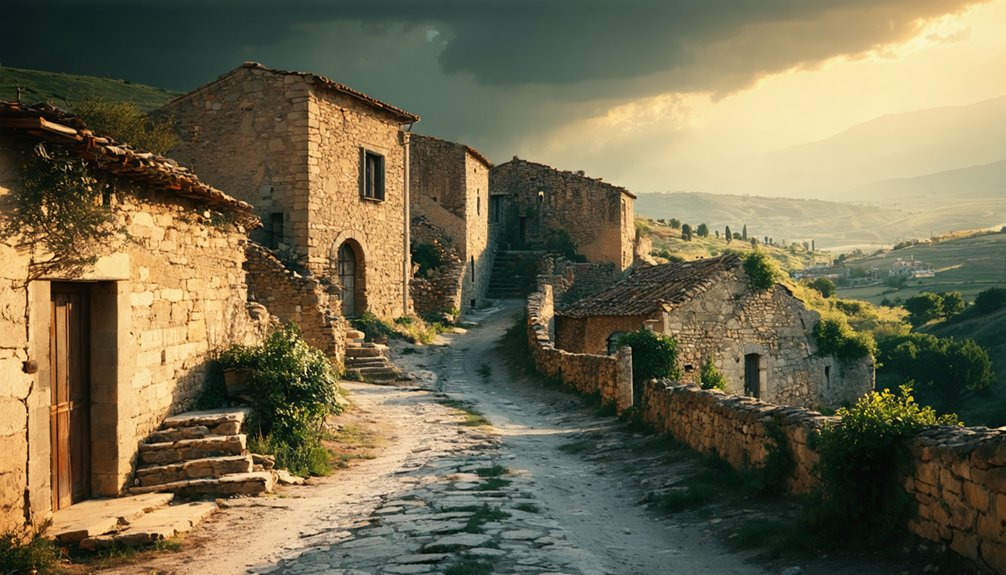
Perched dramatically atop a 1,300-foot cliff in Italy’s Basilicata region, Craco presents a haunting silhouette of stacked medieval houses and stairways that from a distance resembles an ancient painting frozen in time.
Craco history reveals a settlement dating to the 8th century BC, though Greeks formally established Montedoro around 540 AD. The town thrived through Norman rule, which added defensive watchtowers, but geological instability sealed its fate.
Built on unstable Pliocene sands over clay—a problem identified in 1910—landslides progressively destroyed the village from the 1950s onward. The devastating 1980 Irpinia earthquake forced final evacuation.
Today, Craco architecture endures as a tourist destination where you’ll explore medieval plazas and weathered structures on guided hard-hat tours, walking through Italy’s most photogenic ghost town.
Fordlândia: Henry Ford’s Lost Amazon Dream
Deep in the Brazilian Amazon, Henry Ford’s 1920s industrial utopia stands as a monument to ambition colliding with ecological reality.
What began as a solution to East Asian rubber monopolies—complete with white picket fences and a golf course—quickly devolved into worker riots, crop-devastating diseases, and architectural structures wholly unsuited for tropical conditions.
You’ll find in Fordlândia’s vine-covered ruins a stark lesson: imposing Midwestern American values on the rainforest ignored both the jungle’s biological complexities and its people’s cultural autonomy.
Ford’s Ambitious Rubber Vision
When Henry Ford looked toward the Amazon basin in 1927, he saw more than a jungle—he envisioned an industrial empire that would free his automobile manufacturing from British rubber monopolies. A 1923 U.S. government survey had identified the Amazon as prime territory for rubber production, and Ford’s economic ambitions drove him to acquire 2.5 million acres along the Tapajós River. He negotiated with Pará’s governor, securing tax exemptions in exchange for profit sharing.
The scale reflected Ford’s characteristic audacity:
- Half a million rubber seedlings awaiting transformation into latex
- A planned city for 10,000 residents carved from rainforest
- A tire factory designed to process 38,000 tons annually
- Water towers rising above the jungle canopy
- American machinery shipped thousands of miles upriver
Ford invested millions, betting everything on Amazonian self-sufficiency.
Tropical Diseases and Rebellion
Ford’s tropical ambitions collided with Amazonian reality as malaria swept through Fordlândia by the late 1920s.
The disease impact devastated operations—a cemetery established by 1931 testified to mounting deaths among workers and managers alike.
Close-planted rubber trees eliminated natural resistance, while leaf blight destroyed crops without botanical expertise.
You’ll find this environmental catastrophe compounded by cultural friction: American work discipline clashed violently with local customs, breeding resentment among indigenous laborers despite decent wages.
Jungle Reclaims American Architecture
By 1945, the Amazon rainforest began its inexorable advance on Fordlândia’s American-style infrastructure.
You’ll find urban decay manifesting as jungle vines strangling bungalows and fire hydrants, while ecological reclamation transforms Ford’s colonial experiment into living archaeology.
Nearly 2,000 descendants of former workers now inhabit these ruins, farming cassava and raising livestock where rubber plantations once stood.
What you’d encounter wandering through Fordlândia today:
- Abandoned furniture and silverware scattered inside overgrown American bungalows
- Hospital structures destroyed by looters, stripped of valuable doorknobs and fixtures
- Light fixtures from 1928 still clinging to vine-covered walls
- Cassava fields sprouting between century-old concrete foundations
- Durable American equipment protected by early squatters, now rusting monuments
The site demonstrates nature’s superiority over industrial hubris—a reflection of ecological adaptation Ford never understood.
What Draws Us to These Abandoned Places
Ghost towns captivate us through a complex interplay of psychological and cultural forces that transform desolation into attraction.
Exploring ghost towns near Reno area offers a unique glimpse into the history of a bygone era, where stories of miners and pioneers linger in the crumbling structures. These locations serve as reminders of the dreams and struggles that once filled these now-silent streets. Visitors often find themselves enchanted by the eerie beauty and the underlying narratives that each deserted building holds.
Urban Exploration satisfies your innate curiosity about forbidden spaces—you’ll find Pripyat’s rusting Ferris wheel and Hashima Island’s collapsing sea walls offering controlled danger.
Historical Reflection drives you deeper: Oradour-sur-Glane’s preserved massacre site and Fordlândia’s industrial folly reveal humanity’s triumphs and failures without sanitization.
Ghost towns strip away the comfortable narratives of progress, forcing confrontation with raw historical truth and the fragility of human ambition.
You’re drawn to visual drama—Kolmanskop’s sand-buried rooms and Bodie’s “arrested decay” provide unparalleled photographic opportunities.
Cultural media amplifies fascination; HBO’s Chernobyl transformed Pripyat into pilgrimage destination.
These sites offer unmediated encounters with time’s passage, letting you confront mortality and impermanence while experiencing landscapes liberated from contemporary constraints.
They’re laboratories for understanding resource dependency, environmental forces, and societal collapse.
Frequently Asked Questions
Are Ghost Towns Safe to Visit Without a Guide?
Unlike wandering Pompeii’s preserved ruins, you’ll face real dangers at ghost towns—deteriorating structures, unstable ground, and hidden hazards. While guided tours aren’t legally required everywhere, they’re essential safety precautions given remote locations and unpredictable conditions.
Can People Legally Purchase Property in Abandoned Ghost Towns?
You can legally purchase property in ghost towns if ownership’s verifiable through county records. However, legal considerations include title searches, zoning restrictions, environmental assessments, and historic preservation ordinances that’ll affect your property ownership rights.
What Wildlife Typically Inhabits These Abandoned Locations?
Nature abhors a vacuum—you’ll find wildlife adaptation drives urban ecology in ghost towns. Mammals like hares and badgers reclaim industrial sites, while seabirds colonize abandoned military infrastructure, transforming human spaces into thriving ecosystems.
How Do Preservation Efforts Get Funded for Ghost Towns?
You’ll find preservation efforts funded through governmental grants like the Historic Preservation Fund’s matching programs, recreation user fees under federal enhancement acts, and increasingly through crowdfunding initiatives that empower communities to directly support restoration projects they value.
Are Overnight Stays Permitted at Any of These Sites?
You’ll find overnight accommodations permitted only at Chernobyl’s outer zone and near Bodie, California. However, camping regulations strictly prohibit staying inside most ghost towns themselves. Varosha, Belchite, and Hashima Island allow daytime visits exclusively.
References
- https://www.loveexploring.com/gallerylist/66971/frozen-in-time-the-worlds-most-fascinating-ghost-towns
- https://en.wikipedia.org/wiki/List_of_ghost_towns_by_country
- https://www.youtube.com/watch?v=EfgUki1ZtGQ
- https://www.atlasobscura.com/users/guylarocque/lists/ghost-towns
- https://en.wikipedia.org/wiki/Port_Arthur
- https://www.britannica.com/place/Port-Arthur-inlet-Tasmania-Australia
- https://thr-public-datasheets.heritage.tas.gov.au/Report_Handler.ashx?heritagePlaceID=6
- https://woollydays.wordpress.com/2023/11/02/port-arthur-penal-settlement/
- https://www.youtube.com/watch?v=ySSclMqfp_Q
- https://www.japan-travel-note.com/posts/357