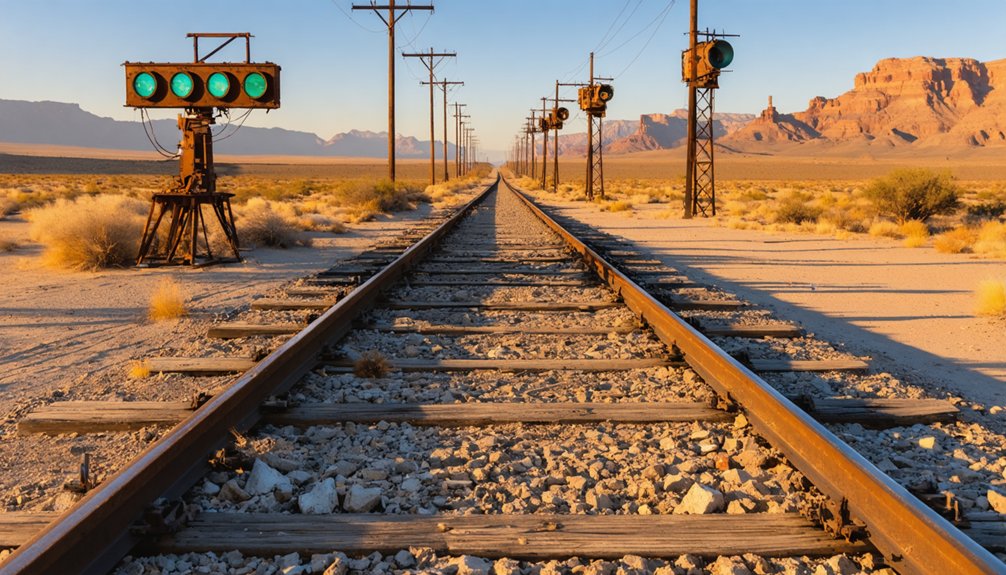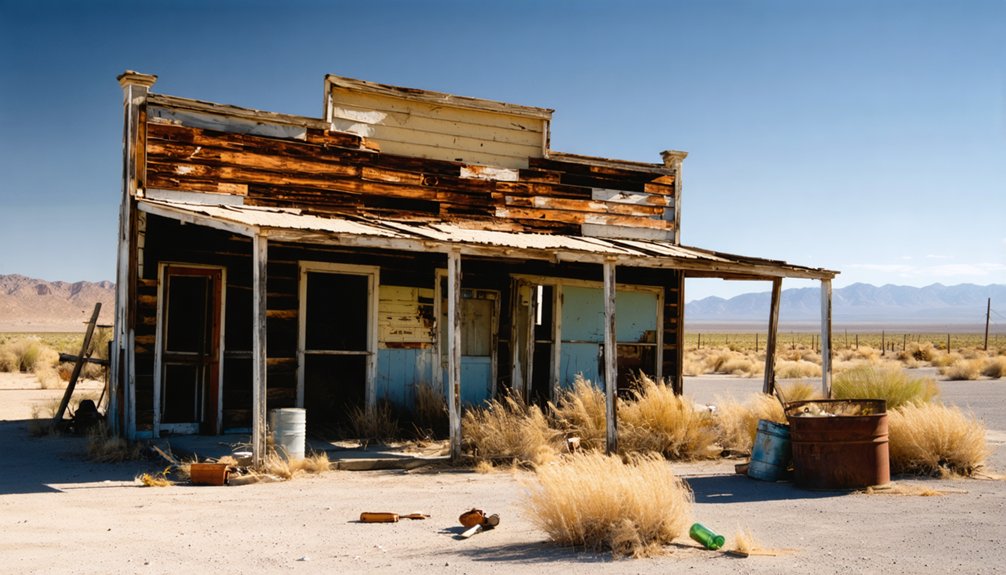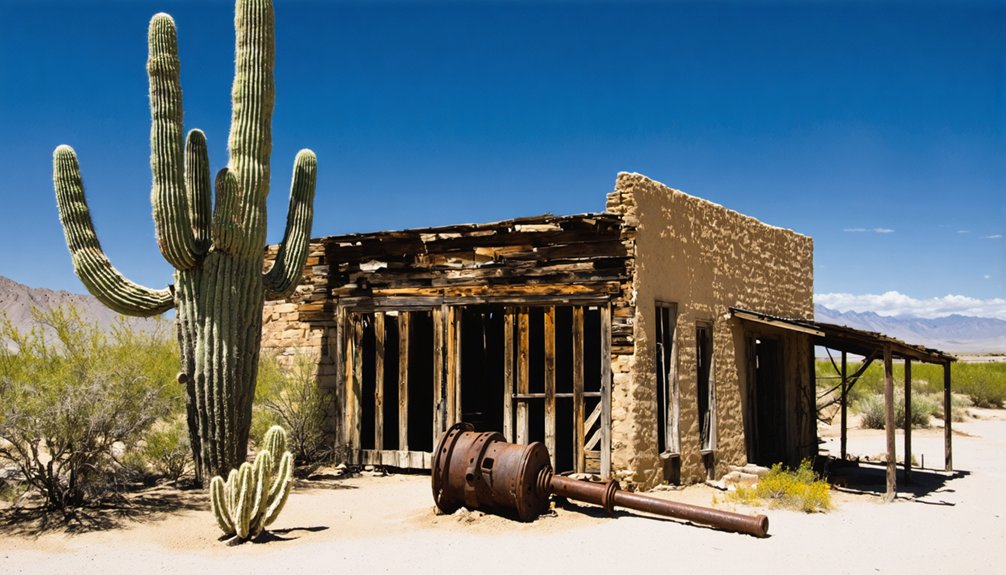
You’ll find five significant ghost towns scattered across Yuma County’s desert landscape, each marking a distinct chapter in Arizona’s mining history. Castle Dome, operating from 1864 to 1979, stands as the state’s longest-lived mining district and now houses a museum preserving historic artifacts. Gila City launched Arizona’s first gold rush in 1858 before flooding destroyed it in 1862. The Kofa area, once home to the King of Arizona Mine, became a wildlife refuge in 1939. Fortuna flourished briefly after its 1894 gold discovery, while La Laguna’s existence remains historically unconfirmed. The county’s 195 documented mines offer extensive opportunities for exploration.
Key Takeaways
- Gila City, Arizona’s first boomtown with 1,200 prospectors, was destroyed by flooding in 1862 and gold depletion by 1865.
- Castle Dome City had 3,000 residents by 1878 and now features a mining museum preserving historic artifacts.
- Fortuna thrived from 1894 to 1904 with saloons and a schoolhouse before gold depletion ended operations permanently.
- Kofa transitioned from a prosperous mining site to a 547,719-acre wildlife refuge protecting hundreds of bighorn sheep.
- Yuma County contains 195 documented mines, with northern areas offering accessible ore deposits for exploration today.
Castle Dome: Arizona’s Longest-Lived Mining District
Deep in the Castle Dome Mountains, 30 to 40 miles northeast of Yuma, lies what became Arizona’s longest-lived mining district—a site where mineral extraction spanned an extraordinary 115 years from 1864 to 1979.
The Snively brothers discovered high-grade silver galena near Castle Dome in 1864, launching continuous operations that outlasted every other Arizona mining district. By 1878, Castle Dome City’s 3,000 residents outnumbered Yuma’s population, producing 200,000 ounces of silver from 5,000 tons of ore.
By 1878, Castle Dome City’s 3,000 residents outnumbered Yuma itself, extracting 200,000 ounces of silver from just 5,000 tons of ore.
Mining techniques evolved as operators dug shafts 700 feet deep across 300 developed mines. New York and San Francisco capital funded operations that yielded silver, lead, and zinc—particularly from the Hull Mine, Arizona’s leading zinc producer. The Hull Mine also became known for its colorful minerals including fluorite, calcite, and willemite.
During both World Wars, mines shipped hundreds of tons for lead ammunition production before silver prices finally ended operations. Today, the site functions as a museum with over 50 preserved buildings, including seven original structures from the mining town’s heyday.
Gila City: A Gold Rush Settlement Lost to Time
September 1858 marked Arizona’s first major gold rush when Colonel Jacob Snively discovered rich placers along the Gila River, twenty miles above its junction with the Colorado.
This gold discovery transformed empty desert into Gila City, Arizona’s first boomtown, where 1,200 prospectors sought fortune within seven years.
Peak Activity Indicators:
- Daily earnings ranged from $30 to $215 per miner
- Lieutenant Mowry witnessed $20 extracted from just eight shovelfuls
- Complete economic ecosystem emerged with merchants and craftsmen
You’ll find Gila City’s remains 13 miles east of Yuma off Highway 95.
The placer deposits formed on a narrow gravel-mantled pediment at the north end of the Gila Mountains, where gold accumulated in gulch and bench gravels.
Miners faced significant challenges in the region, including hostile tribes that threatened prospecting operations throughout the territory.
The settlement met its demise when flooding destroyed structures in 1862, La Paz discoveries lured miners away, and richest gravels depleted by 1865.
Today, scattered ruins mark where Arizona’s pioneering mining community once thrived.
Kofa: From Prosperous Mine to Protected Wildlife Refuge
While most Arizona ghost towns vanished without leaving a lasting legacy, Kofa’s transformation tells a different story—from gold mining hub to one of the Southwest’s most important wildlife sanctuaries.
Visitors to the area can explore the historic mining towns near Yuma, which offer a glimpse into the region’s rich past. These towns, once bustling with activity, now stand as silent witnesses to a bygone era of opportunity and adventure. As tourists wander through the remnants of these historic sites, they can appreciate the intricate stories woven into the fabric of Arizona’s history.
The King of Arizona Mine dominated operations during the late 1800s and early 1900s, its acronym “Kofa” permanently naming these mountains.
When mining declined, you’d witness an unprecedented shift. Arizona Boy Scouts initiated conservation efforts in 1936 after Major Frederick Russell Burnham discovered fewer than 150 bighorn sheep remaining statewide.
President Franklin D. Roosevelt signed Executive Order 8039 on January 25, 1939, establishing the refuge. The refuge officially opened on April 2, 1939, with Burnham’s dedication speech marking the formal protection of this crucial habitat.
In 1990, the Arizona Desert Wilderness Act further strengthened protections by designating 547,719 acres as wilderness, preserving the natural conditions for future generations.
Today, you’ll find over 665,400 acres protecting 400-800 bighorn sheep—a remarkable recovery demonstrating how economic exploitation can evolve into environmental stewardship across southwestern Arizona’s rugged terrain.
Fortuna and La Laguna: Remote River Settlements
On December 22, 1894, three cattlemen searching for stray livestock stumbled upon one of Yuma County’s richest gold discoveries in the Gila Mountains.
William Halbert, Charles Thomas, and Albert Laurent filed seven claims on that rose-colored quartz vein, launching Fortuna’s brief prosperity.
Fortuna history reveals remarkable desert engineering:
- A 14-mile pipeline pumped Gila River water 20 miles to the waterless mine site.
- Hundreds inhabited the remote camp with saloons, a schoolhouse, and regular social gatherings.
- Operations ceased in 1904 when gold depleted; revival attempts failed through the 1940s.
Today you’ll find only mining scars and scattered debris accessible by 4WD near Camino del Diablo.
The settlement served as a critical stagecoach stop for drivers navigating the treacherous desert routes.
While Fortuna thrived, Yuma itself prospered as travelers crossed the Colorado River via rope ferry during the Gold Rush era, with over 50,000 people making the journey.
The La Laguna mystery persists—no archival records confirm this settlement’s existence near Yuma, suggesting possible confusion with forgotten Gila River outposts.
Exploring Yuma County’s Mining Heritage Today
Yuma County’s 195 documented mines represent one of Arizona’s most extensive and enduring mining legacies, spanning from the 1850s California gold rush prospectors through operations that didn’t cease until 1979.
You’ll find the Castle Dome Mining District particularly significant—Arizona’s longest continuously operating district, where silver, gold, lead, copper, and zinc extraction supported 3,000 residents at its peak.
Today’s Castle Dome Mining Museum preserves historic artifacts salvaged by the Armstrongs after 1993, including ore cars, stamp mills, and an 1905 machine shop lathe. These collections showcase mining techniques that extracted high-grade silver galena ore from mountains now within Kofa National Wildlife Refuge.
Northern Yuma County’s documented ore deposits between parallels 33°30′ and 34°30′ remain accessible for geological exploration and historical research. Visitors should plan 2-3 hours to fully explore the museum and read the interpretive signs throughout the restored buildings. Arizona’s copper mining heritage extended throughout the territory, with United Verde becoming the largest copper producer by the early 20th century.
Frequently Asked Questions
Are There Camping Facilities Available Near Yuma’s Ghost Town Sites?
You’ll find no developed campground options at Yuma’s ghost town sites—they’re purely primitive. Castle Dome and surrounding areas offer free dispersed BLM camping without nearby amenities, requiring complete self-sufficiency and preferably high-clearance vehicles for access.
What Safety Precautions Should Visitors Take When Exploring Abandoned Mining Areas?
Stay clear of abandoned structures—they’ll collapse without warning. Don’t touch old explosives or equipment. Watch for wildlife hazards like snakes and predators. Avoid flooded areas and open shafts. You’re responsible for your own safety out here.
Can Artifacts or Minerals Be Collected From Ghost Town Locations?
No, you can’t collect artifacts or minerals from these sites. Over 300 mines contributed to Castle Dome’s collection, but artifact preservation laws and mineral regulations protect everything within Kofa National Wildlife Refuge boundaries.
Which Ghost Towns Are Best Suited for Family Visits With Children?
Castle Dome Mines Museum offers the best family-friendly attractions with its 1.8-mile walking tour and audio stories. You’ll find educational experiences at Fairbank’s schoolhouse museum, while Tombstone provides interactive ghost tours and miniature town replicas for children.
Are There Guided Ghost Town Tours Available Year-Round in Yuma County?
You’ll find guided tours aren’t available year-round—Castle Dome operates October through April only, closing May-September due to extreme heat. However, you can book private guided tours and underground mine experiences through advance appointments anytime.
References
- https://www.arizonahighways.com/article/arizona-ghost-towns
- https://southernarizonaguide.com/ghost-towns-southern-arizona/
- https://www.visitarizona.com/like-a-local/arizonas-ghost-town-getaways
- https://www.geotab.com/ghost-towns/
- https://www.tripadvisor.com/Attraction_Review-g31418-d2651085-Reviews-Castle_Dome_Mines_Museum_Ghost_Town-Yuma_Arizona.html
- https://www.visityuma.com/things-to-do/museums/castle-dome/
- https://www.ghosttowns.com/states/az/azyuma.html
- https://www.islands.com/1897773/longest-working-mining-town-arizona-abandoned-mountain-ghost-castle-dome-landing/
- https://www.avoidingregret.com/2020/05/photo-essay-slice-of-arizonas-longest.html
- https://azoffroad.net/castle-dome-city