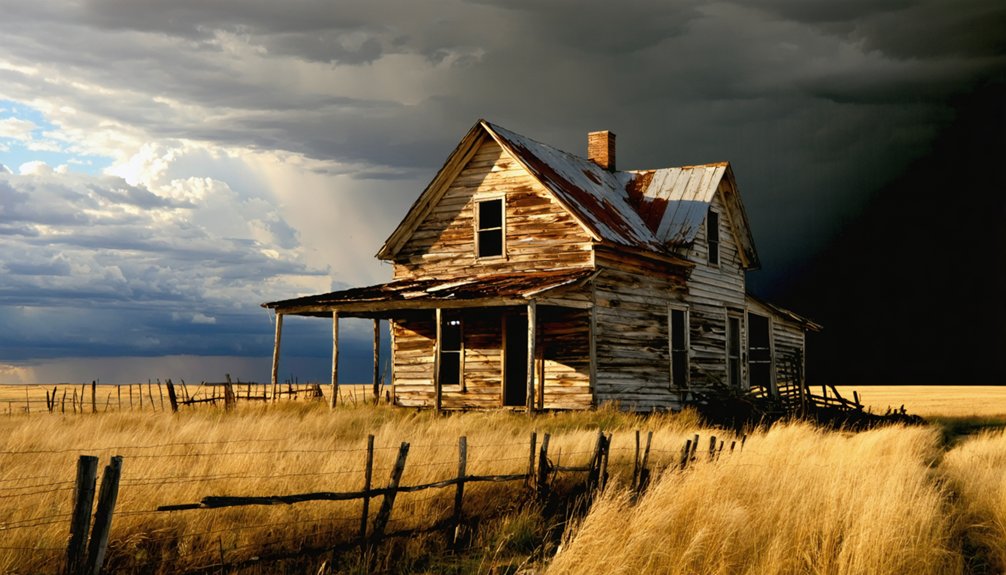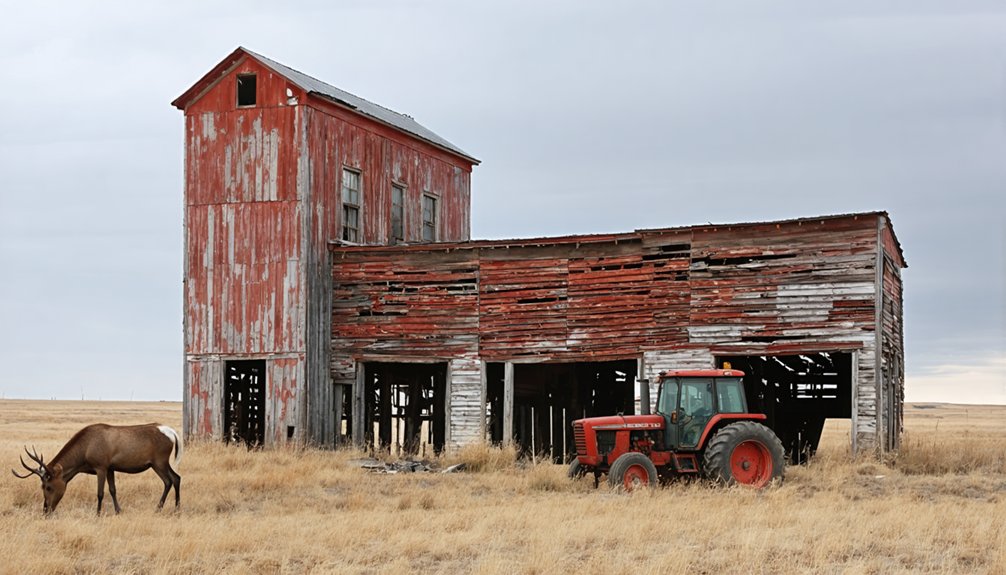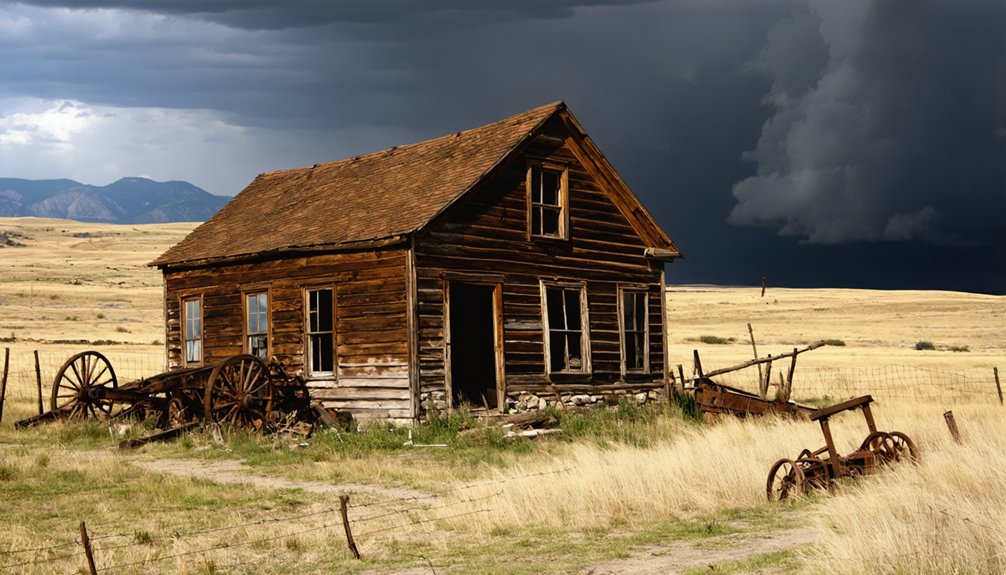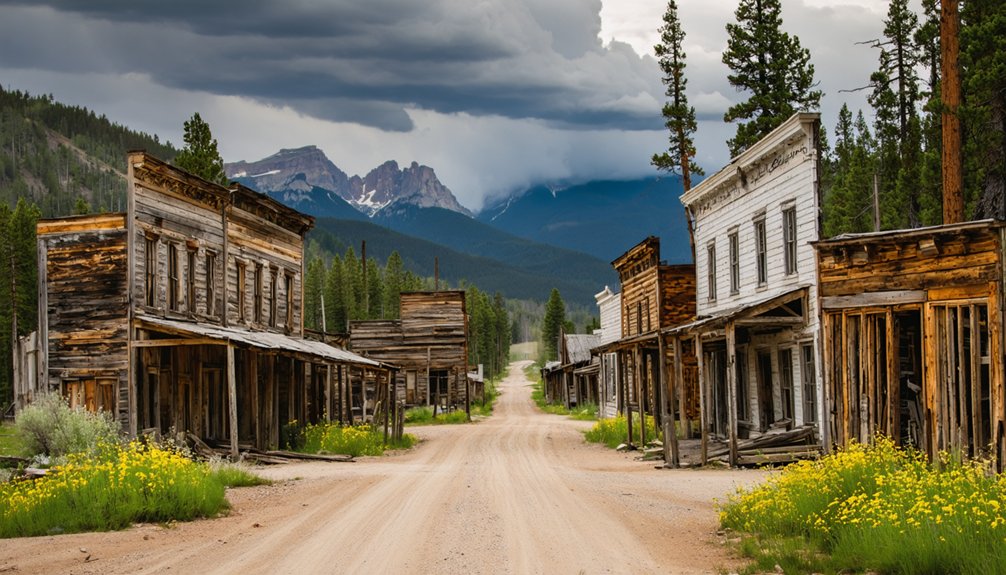
You’ll find over two dozen ghost towns scattered across South Dakota’s Black Hills, remnants of the 1874-1876 gold rush that violated Sioux treaty land and drew 7,000 miners to settlements like Deadwood. Galena preserves accessible architecture including an intact schoolhouse, while Camp Crook lies submerged beneath Pactola Lake. The Homestake Mine produced 40 million ounces before closing in 2000, marking the region’s boom-and-bust cycle. Access these sites via Highway 385 and designated gravel roads, though you’ll need to verify property boundaries and explore further details about specific locations.
Key Takeaways
- Black Hills ghost towns originated from the 1874-1876 gold rush, violating the 1868 Fort Laramie Treaty with the Sioux Nation.
- Notable sites include Galena with accessible architecture, Spokane with most standing structures, and Mystic with National Register status.
- Homestake Mine produced over 40 million ounces of gold before closure in 2000, marking the end of major operations.
- Access these towns via US Highway 385 and Interstate 90, with gravel roads leading to remote settlements.
- Visitors must respect private property boundaries, secure permissions, and observe sites from designated public access points only.
The 1876 Gold Rush That Built a Region
In August 1874, prospectors accompanying Lieutenant Colonel George Armstrong Custer‘s expedition discovered gold in French Creek near present-day Custer, South Dakota, igniting a chain of events that would transform the Black Hills from protected Sioux territory into one of America’s most productive mining regions.
Despite the Fort Laramie Treaty granting these lands to the Sioux, news spread rapidly, and illegal prospectors flooded in by the thousands. By late 1875, approximately 4,000 non-Native Americans unlawfully occupied the Black Hills.
The Manuel brothers’ April 1876 discovery of the Homestake Mine near Lead—which would produce over 40 million ounces of gold—marked the rush’s zenith. Within months, miners had claimed every profitable acre around Deadwood and Whitewood Creeks, establishing settlements that would soon become ghost towns. By April 1876, Deadwood’s population had swelled to 7,000 residents, making it the bustling center of the Black Hills goldfields.
The Homestake Mine was sold for $70,000 to out-of-state investors including George Hearst, transforming it from a prospector’s claim into an industrial operation that would ultimately provide 10% of the world’s gold supply over the next 125 years.
Most Notable Abandoned Settlements to Explore
Scattered across the Black Hills landscape, over 600 ghost towns stand as proof to the region’s turbulent mining era, though only a handful preserve enough physical evidence to warrant exploration.
You’ll find Galena’s abandoned architecture accessible via ATV trails, where 140-year-old relics and historic homes dot the terrain alongside Vinegar Hill Cemetery, final resting place of Civil War veterans and miners.
Silver City maintained its post office until 1964, outlasting most contemporaneous settlements.
At Spoke Ghost Town, old houses await your investigation, while Cambria’s coal-mining heritage differs from typical precious metal operations—its manager’s home still overlooks remaining structures.
Camp Crook’s complete submersion beneath Pactola Lake in the 1950s created the region’s most unusual ghost town legends, preserved underwater rather than abandoned to the elements.
Mystic, originally called Sitting Bull, was founded in 1876 but never exceeded 100 residents before miners departed for more lucrative prospects.
Rochford, established in 1878, continues to preserve historic facilities including the Moonshine Gulch Saloon and Irish Gulch Dance Hall.
What Remains Standing Today
Today’s Black Hills ghost towns exist along a spectrum from complete disappearance to partial preservation, with physical remnants varying dramatically based on each settlement’s abandonment timeline and subsequent human intervention.
These ghost towns of Black Hills often tell stories of the people who once thrived in these areas, offering a glimpse into a bygone era. Exploration of these sites reveals the impact of mining booms and busts on the local economy, illustrating both the allure and the harsh realities of frontier life. Many of these towns now attract tourists and history enthusiasts eager to uncover their rich, yet troubled, pasts.
You’ll find Spokane offers the most standing structures, including the mine manager’s house occupied until the 1970s, alongside cassiterite mill ruins and lithium mine remains.
Galena’s intact schoolhouse provides photographic opportunities near modern residences.
Dumont’s cattle pens mark where settlers once thrived, while its section house crumbles into prairie soil.
Rockerville maintains commercial operations despite 2016’s deliberate building fires.
Mystic preserves nothing vertical—its 1986 National Register designation protects only historical memory along Mickelson Trail’s former railroad route.
Ghost town hunters rely on early maps and geological surveys to locate these settlements, as name changes and inaccurate historical documentation complicate identification efforts.
Etta’s largest spodumene crystal discovery put the mining settlement on the map before its 1959 closure left only the lithium mine and cassiterite mill standing.
These historic remnants demonstrate nature’s patient reclamation versus human preservation efforts across abandoned mining settlements.
How to Access These Historic Sites
You’ll find the Black Hills ghost towns accessible via a network of highways, gravel roads, and historic trails, with US Highway 385 serving as the primary north-south corridor connecting multiple sites.
The Mickelson Trail provides hiking access to Mystic and Englewood, while destinations like Spokane require moderate hiking from Forest Service Road 330 or Iron Mountain Road approaches.
Before exploring, verify property boundaries and access restrictions, as some sites like Crook City are viewable only from public roads while others welcome visitors through designated trailheads and campground parking areas. Always respect private property boundaries and adhere to Forest Service regulations to avoid legal consequences for trespassing. For current road construction updates, call 866-697-3511 or visit www.sd511.org to ensure safe passage on your ghost town exploration route.
Road and Trail Routes
Accessing the Black Hills’ ghost towns requires traversing a network of modern highways, historic mining roads, and backcountry trails that wind through the same rugged terrain prospectors traversed during the 1876 Gold Rush.
Interstate 90 provides primary access points, with Exit 32 leading to Galena via Vanocker Canyon and Exit 30 connecting to Deadwood through Boulder Canyon.
Highway 44 and US-385 north direct you toward Rochford Road for reaching Mystic and Rochford.
For ghost town exploration beyond paved routes, you’ll navigate gravel roads like those accessing Mystic 12 miles north of Hill City.
Trail safety becomes paramount when hiking to remote sites like Spokane, where you’ll park at designated campgrounds before trekking to coordinates N43.840657, W103.376041.
Some ghost towns in the region have deteriorated into empty pasture land, while others retain standing structures in various states of disrepair.
Black Hills Ghost Town Maps CD sets document 386 sites with waypoint overlays and aerial photos. The comprehensive mapping system features 365,420 aerial photo images that create a seamless mosaic covering the entire Black Hills region from north of Spearfish to the South Dakota-Nebraska border.
Exploring ghost towns in South Dakota offers a glimpse into the state’s rich history and the legacies left behind by former inhabitants. Each ghost town tells a unique story, reflecting the boom and bust cycles that defined many areas in the American West. Visitors can experience a sense of nostalgia and intrigue as they wander through the remnants of these once-thriving communities.
Respecting Property Boundaries
Before setting foot on any ghost town site, you must determine the property’s legal status, as many of these abandoned settlements rest on privately owned land where trespassing carries genuine legal consequences.
Documentation and signage typically indicate ownership at site entrances, though historical records and local historical societies provide verification when markers aren’t present.
Property rights remain fully enforceable at these locations—owners can pursue charges against unauthorized visitors.
Visitor etiquette demands observing sites only from designated public access points like Crook City Road or Maitland Road unless you’ve secured explicit permission.
Some locations show no visible evidence remaining, making unauthorized entry particularly problematic.
Research specific sites beforehand using verified sources, respecting boundary markers and posted guidelines that protect both your legal standing and these historic resources for future documentation.
The Rise and Fall of Black Hills Mining Communities
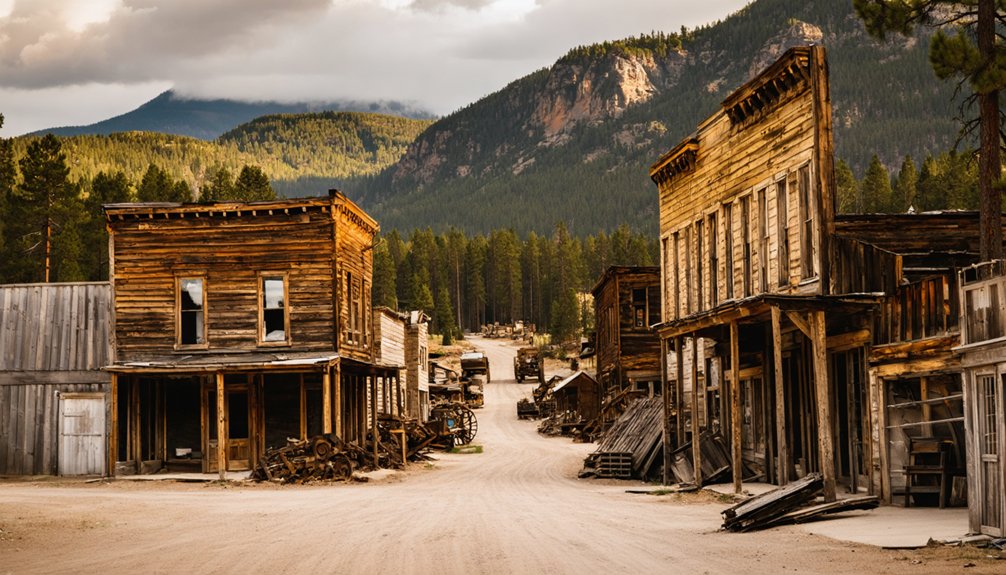
You’ll find that the Black Hills mining communities emerged rapidly following the 1874 Custer Expedition’s discovery of gold in French Creek, with the 1875-1876 rush to Deadwood Gulch’s rich placer deposits creating instant boomtowns across what was then still Sioux treaty land.
These settlements thrived through the 1880s as technological advances—from stamp mills to cyanide processing—enabled extraction of increasingly complex ores, with operations like the Homestake Mine sustaining communities for over a century.
Gold Rush Origins 1876
The discovery of gold in the Black Hills began with Lieutenant Colonel George Armstrong Custer’s 1874 expedition from Fort Abraham Lincoln, when his party of over 1,000 men located gold deposits in French Creek near present-day Custer.
This gold discovery violated the 1868 Treaty of Fort Laramie, which granted the Sioux ownership of these lands.
Despite treaty protections, miners flooded the region.
Economic Decline and Abandonment
When gold production began declining in the 1990s, the Black Hills mining communities you’ll encounter today started their gradual transformation into ghost towns.
The economic impact became undeniable as production dropped 8% between 1990 and 1991, falling from 570,648 to 525,479 ounces. Low gold prices averaging $279.11 per ounce combined with rising operational costs forced the Homestake Mining Company’s closure announcement on September 11, 2000.
This community displacement followed predictable patterns:
- Northern Black Hills output plummeted 17% by 2000
- South Dakota dropped from leading U.S. producer to fourth rank
- Homestake’s underground operations declined from 187,287 to 170,906 ounces
- Total mineral production value decreased 6% to $290 million
- Mining companies halted expansions, prioritizing basic maintenance
The abandoned settlements you’ll find scattered throughout these hills stand as direct evidence of mining’s economic collapse.
Preserved Structures and Industrial Artifacts
Scattered across the Black Hills landscape, mining relics and historic structures from the 1870s gold rush era stand as tangible records of South Dakota’s boom-and-bust cycles.
You’ll find Maitland’s shaft houses and ore bins from operations like the Penobscot and Gold Eagle mines—too decrepit for salvage after their initial value diminished.
Mystic earned National Register status in 1986, preserving its restored schoolhouse and railroad route along the Mickelson Trail.
Galena’s remnants include the Catholic church site and Vinegar Hill Cemetery, where volunteers re-mark Civil War veterans’ graves.
Cascade’s ornate stone bank reflects unrealized spa town ambitions, while Trojan’s enormous cyanide vats demonstrate industrial heritage.
At Astoria, the Golden Reward Mine’s mill and hoist showcase architectural significance accessible to canyon visitors.
Frequently Asked Questions
Are Ghost Town Artifacts Legal to Collect or Remove?
No, you can’t legally collect or remove ghost town artifacts from Black Hills sites. Legal regulations prohibit taking items from public lands under ARPA, while artifact preservation requires landowner permission on private property.
Which Ghost Towns Are Best for Photography?
Frozen in time, Spokane offers you striking ghost town photography with 1940s-era cars and decaying structures, while Galena’s rustic cabins and Pactola’s lakeside vantage points deliver haunting scenic landscapes perfect for capturing authentic frontier atmospheres.
Do Any Ghost Towns Have Reported Paranormal Activity?
Yes, several Black Hills ghost towns report paranormal activity. You’ll find ghost sightings at submerged Pactola and documented haunted history throughout abandoned mining sites like Hornblend, Galena, Rochford, Spokane, Dumont, and Clifton with shadowy figures reported.
What Wildlife Might Visitors Encounter at These Sites?
You’ll encounter typical Black Hills wildlife sightings near ghost towns: white-tailed deer, coyotes, and wild turkeys frequent these areas. Animal behavior remains unchanged by human ruins—prairie dogs, bobcats, and raptors adapt readily to abandoned structures.
Are Guided Ghost Town Tours Available in the Area?
You’ll find several guided tours available, from GeoFunTrek’s customizable Black Hills Ghost Towns & Gold Mines experiences to private tours through ToursByLocals. Local guides share documented mining history along Highway 385’s historic routes.
References
- https://en.wikipedia.org/wiki/List_of_ghost_towns_in_South_Dakota
- https://www.trailhoundcabins.com/ghost-towns-of-the-black-hills/
- https://www.sdhspress.com/journal/south-dakota-history-2-2/some-black-hills-ghost-towns-and-their-origins/vol-02-no-2-some-black-hills-ghost-towns-and-their-origins.pdf
- https://blackhillsatvdestinations.com/ghost-towns/
- https://www.sdpb.org/rural-life-and-history/2023-08-21/some-black-hills-ghost-towns-and-their-origins
- https://www.blackhillsbadlands.com/blog/post/old-west-legends-mines-ghost-towns-route-reimagined/
- https://www.blackhillshikingbikingandmore.com/old-mining-ghost-towns
- https://mad-peak.com/blog-posts-and-info/f/black-hills-ghost-towns-are-real—and-you-can-ride-through-them
- https://www.americanhistorycentral.com/entries/black-hills-gold-rush/
- https://blackhillsvisitor.com/learn/history/the-black-hills-gold-rush/