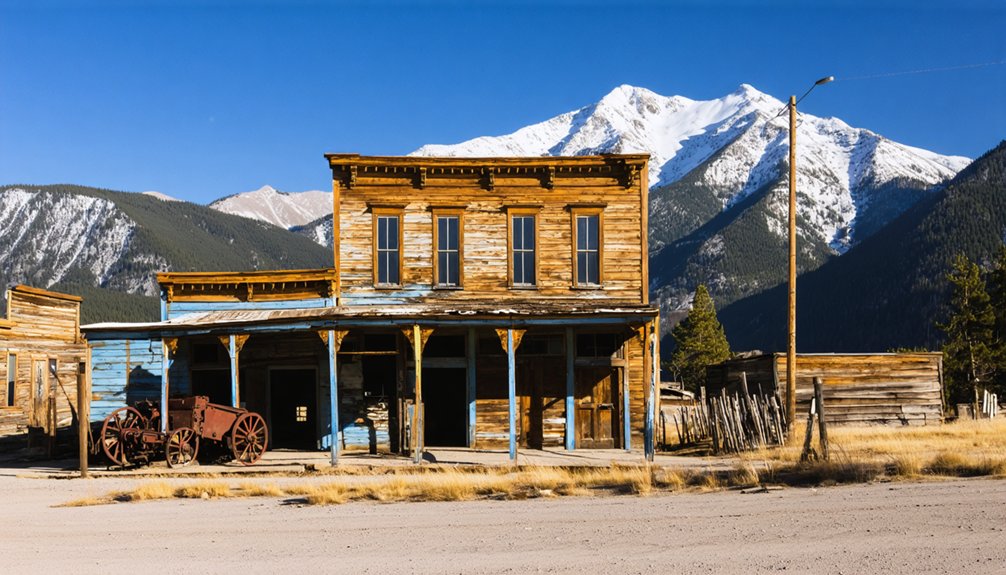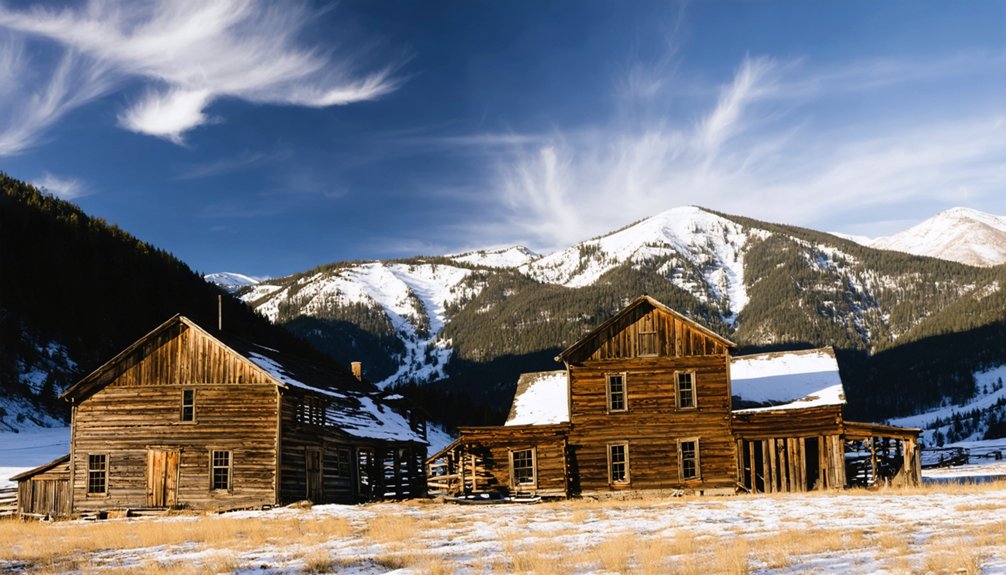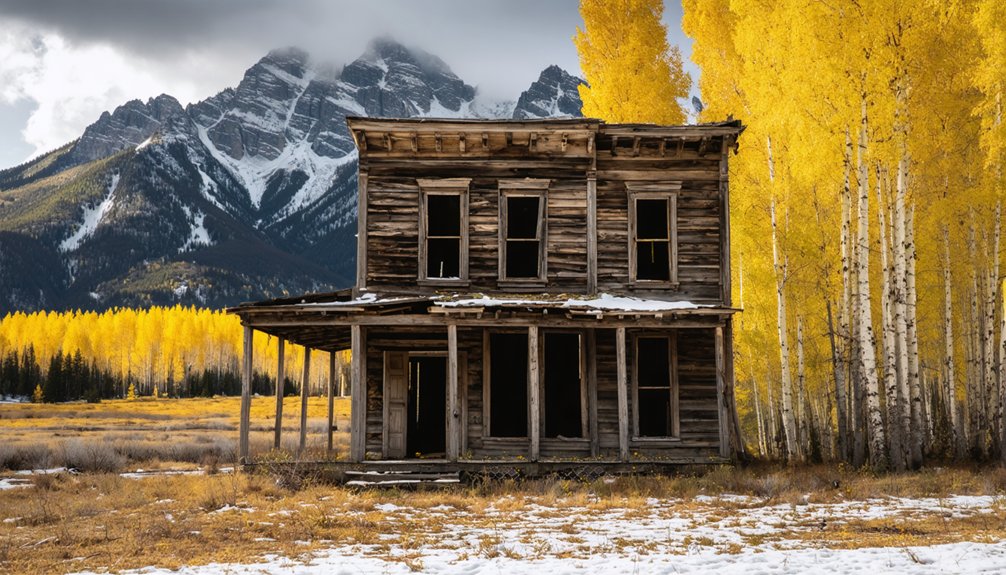
You’ll find Breckenridge’s ghost towns scattered throughout Summit County’s high valleys, where gold and silver fever created—then destroyed—entire communities. Parkville, once home to 1,800 residents and the county seat, vanished beneath hydraulic mining operations, leaving only Valley Brook Cemetery. Tiger Town, a self-sufficient company settlement, collapsed during the 1930s economic crisis. Montezuma evolved from silver-processing hub to near-abandonment after ore depletion. The Country Boy Mine and historic dredge operations document this extractive legacy, while supernatural encounters in abandoned tunnels suggest these sites retain echoes of their violent pasts.
Key Takeaways
- Parkville, founded in 1859, was a thriving mining town that served as county seat before being buried by hydraulic mining operations.
- Tiger Town was a self-sufficient company settlement created by Royal Tiger Mines that collapsed in the early 1930s economic downturn.
- Valley Brook Cemetery preserves Breckenridge’s pioneer legacy with historic headstones and is listed on the National Register of Historic Places.
- Montezuma became Summit County’s ore-processing center by 1865 after silver discoveries in 1863 and was officially incorporated in 1881.
- Country Boy Mine and Historic Dredge sites remain as preserved historic locations, offering educational tours of Colorado’s mining heritage.
The Rise and Fall of Mining Towns in the Blue River Valley
When gold appeared in the Blue River drainage in 1859, prospectors from the waning Pikes Peak Gold Rush flooded into Colorado’s high country under the leadership of General George Spencer, who’d guide the founding of Breckenridge.
By summer 1860, 8,000 fortune-seekers packed the valley, establishing Parkville near Georgia Gulch with its saloons and dance halls. Over 1,000 active mines extracted placer gold until shallow gravels depleted around 1870.
The mining legacy evolved through hydraulic operations, silver-lead discoveries in 1879, and eventually gold dredging from 1898 to 1942. Between 1859 and 1946, area mines produced over one million ounces of gold. This transformation spawned numerous settlements across the district, yet most didn’t survive the industry’s decline.
Towns like Valdoro were literally dredged away, leaving behind Colorado’s ghost towns as monuments to boom-and-bust cycles that defined mountain freedom. By 1916, nine dredges operated as the “Breckenridge navy,” recovering approximately 20,000 troy ounces annually until wartime restrictions halted operations in 1942.
Montezuma: A Silver Mining Settlement Frozen in Time
While prospectors scoured the Blue River Valley for placer gold in the early 1860s, John Coley ventured up the Snake River drainage and discovered silver deposits in 1863, constructing a crude smelting furnace from a hollow log, rocks, and clay.
This Montezuma history began when Colorado’s first silver discovery near the future townsite in 1864 sparked additional strikes.
Silver mining operations established Montezuma as Summit County’s ore-processing center by 1865, with road improvements in 1868 cementing its strategic position.
The abundant mineral deposits offered miners the prospect of financial independence, contrasting sharply with the structured employment found in Colorado’s emerging cities.
The town’s official incorporation occurred in 1881, marking its transition from a rough mining camp to an established community with formal governance.
Tiger: The Company Town That Vanished in Flames
As the twentieth century dawned, mining companies across Colorado’s high country faced a persistent challenge: retaining skilled workers in remote mountain locations where harsh winters and isolation made stable employment difficult.
The Royal Tiger Mines Company’s solution was Tiger Town, a complete settlement in Swan Gulch near Breckenridge where company-paid utilities and housing created self-sufficient living.
Tiger Town offered miners company-paid utilities and housing in Swan Gulch, creating a self-sufficient mountain settlement near Breckenridge.
The town’s infrastructure included:
- Company store extending credit through mining chits
- School and post office serving resident families
- Entertainment venues including bowling alley and movie theater
- Slop Chute bar where miners gathered after shifts
This Mining Legacy ended abruptly when economic collapse halted operations in the early 1930s. The Denver, South Park, and Pacific Railroad had reached Breckenridge in 1882, providing vital transportation connections for mining communities like Tiger throughout the region. During the severe winter of 1899, supply issues forced residents across the area to snowshoe over mountain passes for essential provisions when trains couldn’t reach the isolated towns.
Country Boy Mine and the Dredging Era
Just two miles east of downtown Breckenridge in French Gulch, the Country Boy Mine emerged in 1887 as one of Summit County’s oldest and most productive mineral operations.
You’ll find evidence of its century-long legacy in the extracted gold, silver, lead, and zinc that shaped Western prosperity. The mine operated through two world wars before ore depletion forced closure in the 1940s, with workings extending 1,000 feet underground.
French Gulch’s dredging era transformed the landscape dramatically. The Reiling Gold Dredge, built in 1908, employed innovative dredging techniques that left distinctive rock pile formations still visible today.
These industrial operations, combined with sophisticated mining machinery, extracted gold-bearing ore on an unprecedented scale. The restored site now operates as a historical venue, offering you direct access to authentic mining infrastructure and interpretive tours. The mine’s production of high-grade lead and zinc proved particularly valuable during WWI and WWII wartime efforts.
The 1991 restoration efforts by the Tomlinson Brothers preserved the mine’s original workings and historic structures for educational tours.
Breckenridge: From Gold Rush Camp to Modern Survivor
Unlike the Country Boy Mine and countless other Summit County operations that faded into archaeological remnants, Breckenridge itself survived the boom-bust cycles that destroyed neighboring camps.
While neighboring mining camps vanished into archaeological footnotes, Breckenridge’s economic adaptability transformed boom-bust vulnerability into enduring prosperity.
Your understanding of its economic resilience requires examining specific adaptation periods:
- 1859-1889: Initial placer deposits and hydraulic mining sustained 75-100 to thousands of residents.
- 1879-1908: Silver and lead discoveries diversified revenue streams beyond gold dependence.
- 1908-1942: Industrial dredging operations extracted 20,000 troy ounces annually, establishing Colorado’s most productive placer district.
- Post-1942: Infrastructure investments and geographic advantages enabled transformation from extraction economy to modern commerce. The 1973 Eisenhower Tunnel completion dramatically improved accessibility, connecting Breckenridge to Front Range populations and accelerating its transition to a tourism-based economy.
This mining heritage produced over one million ounces of documented gold.
You’ll find Breckenridge represents exceptional continuity—settlement patterns established in 1859 persist today, unlike forgotten camps that returned to wilderness. The town’s survival contrasts sharply with Summit County’s over 18,000 abandoned mines that mark Colorado’s extensive but often ephemeral mining history.
Valley Brook Cemetery: Resting Place of Pioneer Legends
When Breckenridge established Valley Brook Cemetery in 1882, it created the town’s only burial ground that continues operation today—a distinction that sets it apart from abandoned mining camp graveyards scattered throughout Summit County.
You’ll find pioneer burials dating to 1876, when infant Yingling was interred in the Catholic section. The cemetery’s ornate gravestones reveal the town’s earliest historic artistry, with elaborate carvings documenting the lives of miners, widows, paupers, and influential residents who shaped Breckenridge’s character.
Listed on the National Register of Historic Places, the grounds feature distinctive headstones, decorative fences, and natural streams. The Town of Breckenridge maintains the site and offers Tombstone Tales tours, where you’ll explore written histories etched in stone by Summit County’s founding generation.
Parkville and the Lost County Seat
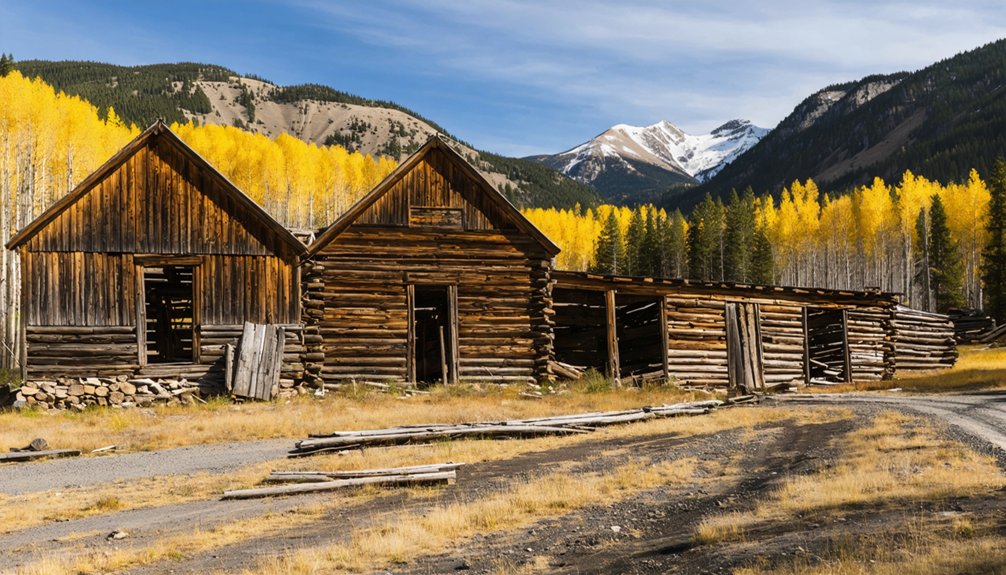
While Valley Brook Cemetery preserves Breckenridge’s pioneer legacy in perpetuity, the nearby townsite of Parkville vanished so completely that you’ll find only a cemetery and stone monument marking where Summit County’s first seat of government once stood.
Parkville history reveals a swift rise and catastrophic fall:
- Founded in 1859 during Georgia Gulch’s placer gold boom, reaching 1,800 residents by 1860.
- Served as county seat from 1861, even considered for Colorado’s territorial capital.
- Featured mint, brewery, theaters, post office, and Colorado’s first western-slope Masonic Temple.
- Buried entirely by hydraulic mining operations that destabilized mountainsides with high-pressure hoses.
Breckenridge residents allegedly raided Parkville in 1862, accelerating its decline.
Today, you’ll discover nothing but monuments where this governmental center once dominated Summit County’s political landscape.
Supernatural Encounters in Historic Mining Buildings
Beyond the documented historical records and preserved structures, Breckenridge’s mining sites harbor a darker legacy that tour guides and visitors have documented through decades of supernatural encounters.
At Country Boy Mine, established in 1887, guides report being physically shoved inside the tunnels, while mysterious phone calls occur underground despite zero cell reception. Your camera might capture what your eyes can’t—ghostly encounters appear as apparitions, orbs, and auras in photographs taken throughout the complex.
Guides at Country Boy Mine experience unexplained physical contact and phantom phone calls deep underground where modern technology fails.
The dredge boats’ deadly history fuels persistent mining legends. Between 1898 and 1942, drownings, electrical failures, and conveyor accidents claimed numerous lives across nine dredge operations.
Historic Dredge Ollie’s Pub, which operated from 1918 to 1937, maintains its haunted reputation tied directly to these documented fatalities and the environmental devastation left behind.
Frequently Asked Questions
What Hiking Trails Lead to Ghost Town Sites Near Breckenridge?
You’ll find ghost town remnants on Mayflower Gulch, Boreas Pass Road, and Montezuma-area trails. Consider trail difficulty and hiking safety—elevations exceed 10,000 feet. Historic mining camps and structures await your exploration along these documented routes.
Are Visitors Allowed to Explore Inside the Remaining Ghost Town Structures?
No, you can’t enter ghost town structures. Safety regulations prohibit interior access due to compromised structural integrity. You’re expected to observe historic cabins and mining ruins externally only, respecting preservation guidelines while exploring Colorado’s backcountry heritage sites.
Where Can I Find Authentic Mining Artifacts From Breckenridge’s Ghost Towns?
You’ll find authentic mining artifacts from Breckenridge’s ghost towns at Jessie Mill and Mine’s preserved site, Country Boy Mine’s underground tours, and Lomax Placer Mine, where artifact preservation showcases the region’s documented mining history.
What Months Offer the Best Weather for Visiting High-Altitude Ghost Towns?
The best months for exploring high-altitude ghost towns are June through August, when weather conditions provide 70-degree days, minimal snow obstruction, and accessible trails. You’ll navigate terrain freely under bluebird skies, though afternoon showers require preparation.
Are Guided Ghost Town Tours Available in the Breckenridge Area?
Yes, you’ll find guided tours exploring Breckenridge’s haunted historical significance through multiple operators. Breckenridge Ghost Tours, established in 2010, offers year-round experiences covering the town’s mining-era past and paranormal locations using authentic ghost-hunting equipment.
References
- https://krystal93.com/breckenridge-is-teeming-with-ghost-towns-if-you-know-where-to-look/
- https://www.allsummitcounty.com/history_museums/montezuma_ghost_town.php
- https://coloradosghosttowns.com/Tiger Colorado.html
- https://gobreck.com/experience-breckenridge/the-town/breckenridges-most-haunted-buildings-and-their-history/
- https://breckhistory.org/the-history-of-breckenridge-co/
- https://www.colorado.com/articles/colorado-ghost-towns
- https://www.riverridgerentals.com/blog/activites/mysterious-and-spooky-history-summit-county
- https://www.goworldtravel.com/mine-breckenridge-history/
- https://www.rockngem.com/the-golden-history-of-breckenridge/
- https://westernmininghistory.com/towns/colorado/breckenridge/