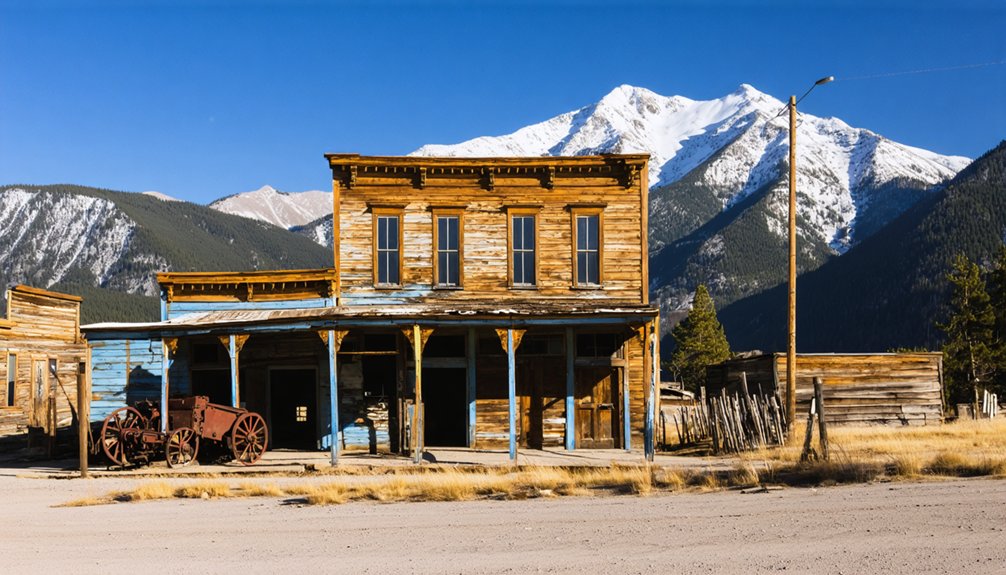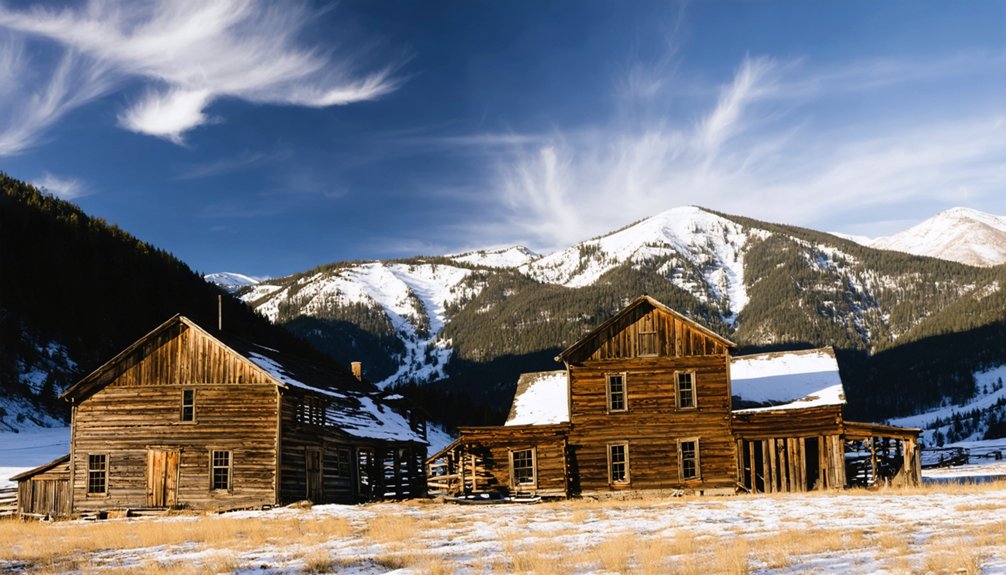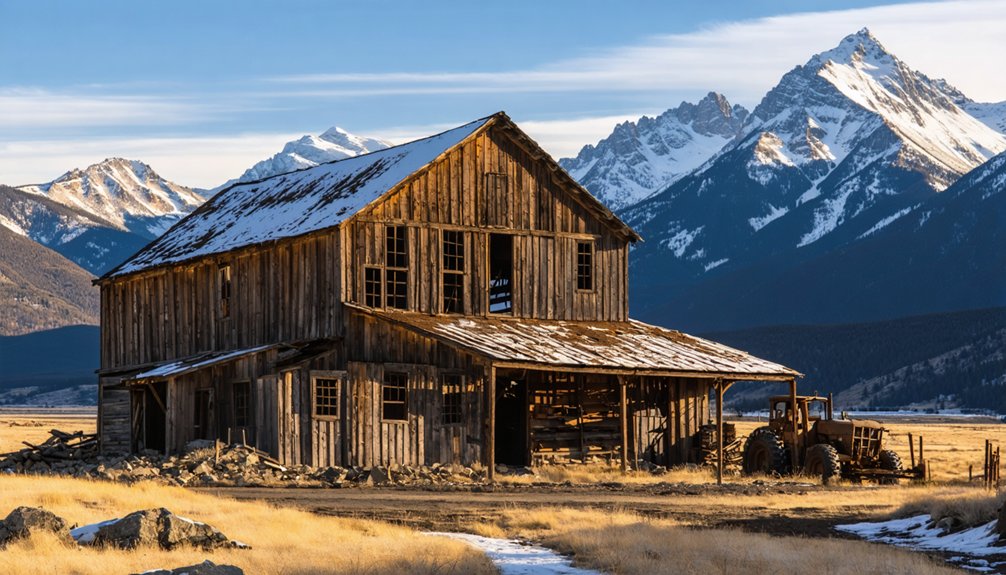
You’ll find several remarkable ghost towns within striking distance of Buena Vista, including St. Elmo—Colorado’s most authentic ghost town with over 40 preserved buildings from its 1880 founding. Nearby, Vicksburg and Winfield showcase mining-era structures from the 1860s-1890s boom, while remote Hancock and Romley require 4WD access along old railroad grades. Tin Cup, established in 1859, preserves evidence of its violent past in cemetery markers. Each settlement tells the story of Colorado’s explosive mining heritage through weathered cabins, abandoned ore facilities, and the infrastructure that once supported thousands of prospectors.
Key Takeaways
- St. Elmo, founded in 1880, is Colorado’s most authentic ghost town with over 40 preserved buildings and National Historic District status.
- Vicksburg, established in 1867, grew to 700 residents before abandonment in 1885; a historical society now maintains preservation efforts.
- Winfield peaked at 1,500 residents by 1890 but declined after the 1893 silver crash, with seasonal private cabins showcasing restoration.
- Tin Cup, originally named Virginia City, reached 2,000 residents during the 1880s boom following 1859 placer gold discovery in Willow Creek.
- Access ghost towns via County Road 295 from St. Elmo; high-clearance vehicles recommended, 4WD advised for upper sections.
Vicksburg: A Silver Mining Hub Frozen in Time
In 1867, prospectors from Leadville made camp in Clear Creek Canyon and lost track of their burros, an accident that would transform the remote wilderness into a thriving mining settlement. The wandering animals led miners down the creek to discover gold deposits in the streambed, sparking Vicksburg’s founding.
Understanding Vicksburg history reveals a community that swiftly evolved from tent camp to substantial town, reaching 700 residents by 1880. The mining legacy encompassed gold, silver, and lead extraction, supporting 40 buildings including two hotels, saloons, a schoolhouse, and an assay office.
Daily stagecoach service connected Vicksburg to Granite for just 50 cents. Named after general store operator Vick Keller, the town featured innovative water ditches that provided drinking water, refrigeration, and fire protection until dwindling ore deposits forced abandonment in 1885. A historical society was established in 1971 to protect and preserve the ghost town’s remaining structures and artifacts for future generations. Today, visitors can still see balsam poplar trees lining the street, originally transported by burros and planted by early miners who channeled water from Vicksburg Creek to sustain them.
Winfield: Historic Cabins and Mining Heritage
Silver-seekers established Winfield in 1861 when they constructed the first cabin on 120 acres at the junction of Clear Creek’s north and south forks, though serious mining wouldn’t begin until prospectors discovered silver deposits there in 1867.
By 1890, you’ll find this settlement peaked at 1,500 residents with three saloons, hotels, stores, and ore-processing facilities. The 1893 silver crash ended this prosperity, with the last wagon hauling ore out in 1918.
Today’s Winfield showcases historic restoration through seasonal private cabins preserving original log construction. You can explore mining artifacts at the 1889 schoolhouse and Ball cabin museum, both operated by Clear Creek Historical Society during summer months.
The town’s original layout offered free 50×100 foot lots to early settlers, attracting families to this remote mountain location. The cemetery quarter-mile north holds 26 burials documenting the era’s harsh realities—fires, avalanches, and mining accidents. Restoration efforts in 2016 added wooden crosses on graves, with only two original markers for children still remaining.
St. Elmo: Colorado’s Best-Preserved Ghost Town
You’ll find St. Elmo stands as Colorado’s most authentic ghost town, remarkably frozen in time since its 1880 founding as a gold and silver mining settlement.
The town swelled to nearly 2,000 residents at its peak before railroad closure in 1922 triggered a dramatic population collapse to just seven residents by 1930.
Today, approximately 10 permanent residents occupy this National Historic District, where the Stark family’s decades-long stewardship preserved over 40 original wood-frame buildings complete with period furnishings from the 1880s and 1890s. The Mary Murphy Mine alone produced 220,000 ounces of gold from 1870 to 1925, representing one of the area’s most productive mining operations.
Located at an elevation of 9,961 feet in the Sawatch Mountain Range, St. Elmo sits approximately three hours southwest of Denver in Chaffee County.
Historic Peak and Population
Prospectors arrived in Chalk Creek Canyon in 1878, drawn by gold and silver deposits that would transform the wilderness into one of Colorado’s most prosperous mining communities.
By the late 1880s, St. Elmo’s population swelled to nearly 2,000 residents, supported by over 150 patented mine claims in the district. The Murphy Brothers’ discovery of the Mary and Jenny mines in Cottonwood Gulch fueled this mining prosperity.
The Denver South Park & Pacific Railroad’s extension through Alpine Tunnel made St. Elmo a critical supply hub, with five hotels, saloons, dance halls, and a newspaper serving the mainly male population. The town’s name, St. Elmo, connected it to the broader tradition of communities adopting distinctive titles that would later require disambiguation from similarly named locations across the country.
At its peak in 1881, the Mary Murphy mine extracted 70-100 tons of ore daily while employing over 250 men and producing approximately 220,000 ounces of gold. However, town decline began in the early 1920s when silver veins depleted. The railroad ceased operations in 1922, and by 1930, only seven residents remained in this once-thriving community.
Preservation and Modern Status
While St. Elmo stands at 9,961 feet in the Sawatch Range as Colorado’s best-preserved ghost town, you’ll find 43 original structures from the 1880s and 1890s still standing.
The Stark family descendants donated these wood-frame buildings to Historic St. Elmo, Inc., enabling focused preservation efforts. You can explore the blacksmith shop, livery, American House Hotel, undertaker’s parlor, and schoolhouse—survivors of the devastating 2002 fire that claimed six buildings including the old town hall.
History Colorado’s designation under C.R.S. 24-80-1201 protects this National Register site, though modern challenges persist. St. Elmo was nominated to the National Register of Historic Places on September 17, 1979, by a descendant of the town’s owners. The rugged road closes with heavy snow until May or June.
Approximately 10 permanent residents maintain the town’s authenticity, while summer tourism supports ongoing restoration work funded through federal assistance and private donations to Buena Vista Heritage. The St. Elmo General Store operates year-round, providing supplies and historical exhibits for visitors exploring this remote mountain community.
Rockdale and Beaver City: Hidden Mining Settlements
Along the junction where the north and south forks of Clear Creek meet, Rockdale emerged in 1881 as part of the wave of mining settlements that climbed up Clear Creek Canyon.
You’ll find Rockdale history preserved in four restored cabins—two original structures the Forest Service rents during summer months without amenities.
The town also bore the names Silverdale and Crescent Mining Camp before silver’s 1893 crash ended its brief existence. The last ore wagon departed in 1918.
Today, beaver ponds have buried most of Rockdale’s remains.
As the first settlement in Clear Creek Canyon, Beaver City attractions include scattered original buildings beyond Vicksburg and Winfield.
These ghost towns once drew 50,000 residents combined, accessible via County Road 390 past Clear Creek Reservoir.
Hancock and Romley: Remote Remnants South of St. Elmo
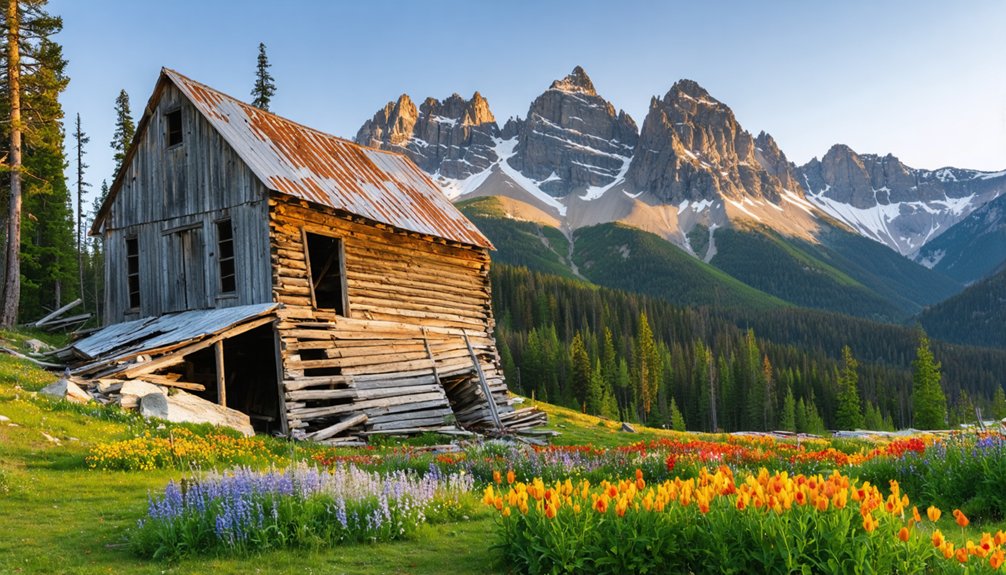
To reach Hancock and Romley, you’ll drive 5 miles south from St. Elmo on County Road 295, a rutted dirt route requiring 4WD and high clearance.
Along this remote passage, you’ll encounter Romley’s scattered mining camp remnants—ore shoots, a mine office, and foundations marking where the post office and schoolhouse once stood.
Hancock sits at the road’s terminus, where only a single saloon foundation survives from the railroad town that housed 200 residents during the Alpine Tunnel’s operation from 1881 to 1910.
Accessing the Town Sites
Reaching Hancock and Romley requires following County Road 295 south from St. Elmo for five miles.
You’ll turn left onto CR 295 just before entering St. Elmo from CR 162. This ghost town access route traces the old Denver, South Park and Pacific railroad grade, passing Romley’s ruins approximately three miles along the road.
While some sources list the road as 2WD-accessible, you’ll want a high-clearance vehicle for rutted dirt conditions.
Careful drivers in passenger vehicles can reach Hancock, though 4WD is advised for safety and accessing upper sections like Mary Murphy Mine.
Remote routes to Alpine Tunnel require 4×4 capability, or you’ll face a two-mile hike from Hancock’s town site at GPS coordinates 38.641009, -106.361904.
Historical Structures and Features
Once you arrive at these remote sites, you’ll discover remarkably few structures have survived the harsh alpine conditions. Hancock’s ruins consist primarily of one collapsed saloon foundation marking the original townsite.
The Alley Belle Mine, precariously positioned on the hillside, stands as the most photographed structure and represents the area’s significant mining remnants. You’ll find scattered abandoned cabins throughout the settlement, though most exhibit severe deterioration.
Along County Road 295, Romley’s ruins include building foundations and mining infrastructure positioned below the railroad grade. The Mary Murphy Mine remains visible on your final approach, requiring 4WD access for closer inspection.
These weathered structures demonstrate how extreme elevation, persistent snow, and decades of abandonment systematically erased nearly all evidence of communities that once housed 200 residents.
Tin Cup: the Rowdy Mining Camp With a Violent Past
When prospectors discovered placer gold in Willow Creek in October 1859, they unknowingly set in motion the creation of one of Colorado’s most notorious mining camps.
Jim Taylor panned gold and carried it back in a tin cup, giving the valley its name. Originally called Virginia City, the settlement earned its rowdy reputation during the 1880s boom when 1,400-2,000 residents flooded in seeking fortunes.
The camp’s violent history is well-documented in Tincup cemetery, where markers tell tales of a lawless frontier.
Saloons and conflicts dominated daily life in this rough alpine setting. The silver crash of the 1890s triggered widespread abandonment, yet the town refused full ghost status.
Today, you’ll find almost all original structures preserved.
Goldfield: The Rise and Fall of a Gold Mining Community
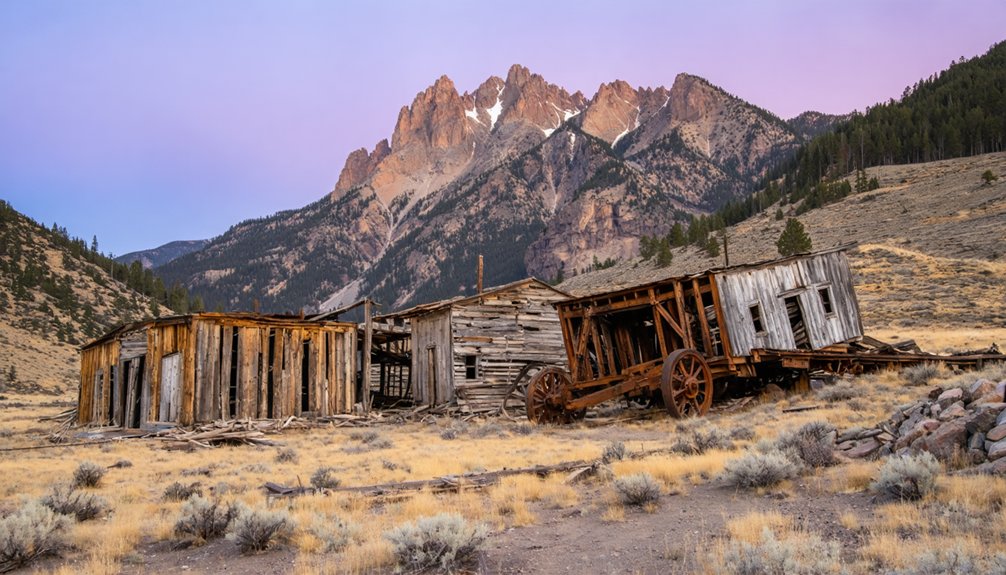
While Tin Cup attracted prospectors to the mountains west of Buena Vista, the Cripple Creek District on the opposite side of South Park witnessed Colorado’s largest gold discovery.
Goldfield history began in 1894 when James Doyle, James Burns, and John Harnan struck rich at Portland Mine. They established the Gold Knob Mining and Townsite Company on fire-cleared pasture, platting lots in January 1895.
The town exploded with seven boardinghouses, nine saloons, Clark’s Opera House, and three railroads shipping 20,000 tons of ore annually. By 1895, the district produced half of Colorado’s 660,000 ounces of gold.
The mining legacy crumbled after the 1904 strike emptied half the homes. World War I closed gold operations, and houses shipped to Wyoming’s oil boom, leaving Goldfield virtually abandoned.
Planning Your Ghost Town Adventure Near Buena Vista
The rugged mountains surrounding Buena Vista conceal multiple ghost town sites accessible within a 30-mile radius, each requiring different vehicle capabilities and time commitments.
the ghost town history of buena vista offers intriguing glimpses into the lives of those who once sought fortune in these remote areas. Visitors can explore well-preserved buildings and mining ruins that tell stories of ambition and hardship. Guided tours provide in-depth narratives that enhance the experience, allowing travelers to truly appreciate the rich past of this unique region.
The history of San Miguel, Colorado, is equally rich, with its own tales of adventure and conflict during the mining boom. As visitors wander through the remnants of this once-bustling area, they can uncover the fascinating stories behind the gold prospectors and settlers who shaped its legacy. Each corner of San Miguel reveals a blend of natural beauty and historical significance that captivates all who venture into its depths.
You’ll find St. Elmo southwest via Highway 24 and CR 162—a 30-minute drive to 43 standing buildings, accessible year-round by 2WD.
North lies Vicksburg through Clear Creek Canyon on CR 390, featuring 10-12 structures and weekend museum access.
Continue deeper to Winfield’s four log buildings and Ball Cabin museum.
For ghost town photography enthusiasts, seasonal visits during summer reveal the General Store at St. Elmo and guided audio tours at Vicksburg.
Combine sites efficiently: pair St. Elmo with Hancock/Romley, or Vicksburg with Winfield.
You’ll need 4×4 capability for extended exploration beyond Tincup Pass.
Respect private property boundaries and posted signage throughout.
Frequently Asked Questions
Are Pets Allowed When Visiting Ghost Towns Near Buena Vista?
Pet policies vary by location, but most ghost towns near Buena Vista allow leashed dogs. You’ll find dog-friendly areas throughout public sites, though private properties may restrict access. Always verify current regulations before visiting these historic destinations.
What Is the Best Time of Year to Visit These Ghost Towns?
You’ll find summer (May-September) offers the best experience with operational businesses and seasonal activities, though winter provides unmatched solitude for exploring St. Elmo’s historical significance with year-round road access.
Do I Need a 4WD Vehicle to Reach All the Ghost Towns?
You won’t need 4WD for St. Elmo, Vicksburg, or Winfield—standard 2WD vehicles handle maintained county roads year-round. However, vehicle recommendations include 4WD for certain rougher routes like Hancock’s rutted tracks and alternative backcountry exploration.
Are There Guided Tours Available for the Ghost Towns Near Buena Vista?
Yes, you’ll find guided history tours through operators like Colorado eBike Shop and ADV Collective, covering St. Elmo’s mining heritage and local legends. GetYourGuide offers three-hour e-bike excursions, while private full-day tours explore multiple ghost towns.
Can You Camp Overnight Near Any of These Ghost Town Sites?
Looking for overnight freedom near historic sites? You can camp at St. Elmo’s rental cabin or Ghost Town Guest House, while dispersed camping near Hancock/Romley and Winfield follows standard camping regulations without ghost town amenities.
References
- https://www.uncovercolorado.com/ghost-towns/vicksburg/
- https://www.uchealth.org/today/ghost-towns-abound-in-colorado/
- https://getlostinamerica.com/history-buena-vista-colorado/
- https://www.colorado.com/articles/colorado-ghost-towns
- https://mtprinceton.com/project/st-elmo/
- https://www.colorfulcolorado.com/museums-historical-tours/
- https://www.ariverhouselodge.com/blog/3-ghost-towns-to-check-out-this-fall/
- https://kubcthecanyon.com/colorado-ghost-town-prospectors-lose-their-burros-and-find-gold/
- https://www.fs.usda.gov/r02/psicc/recreation/vicksburg-mining-camp-interpretive-site
- https://leadville.com/the-ghost-towns-of-leadville-and-beyond/