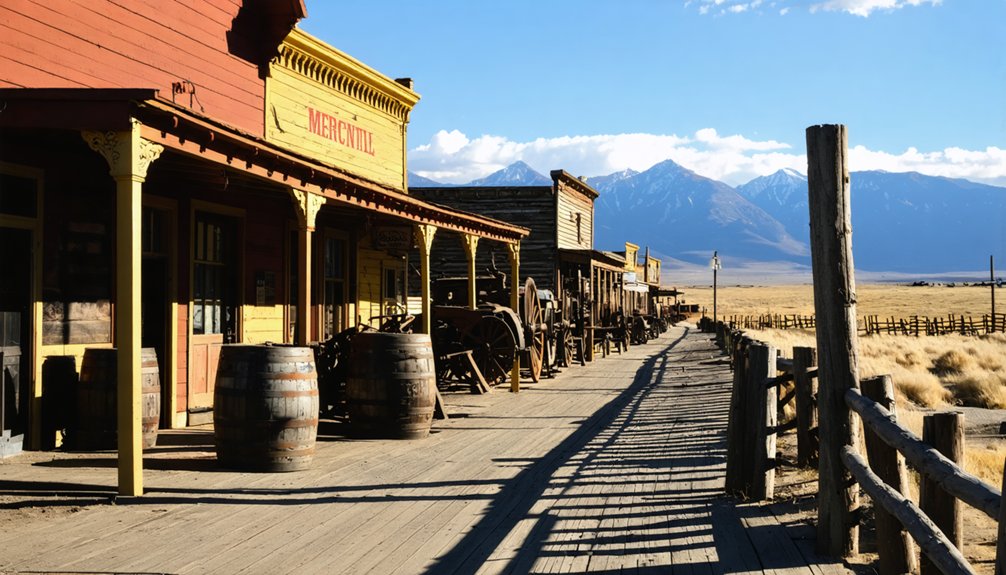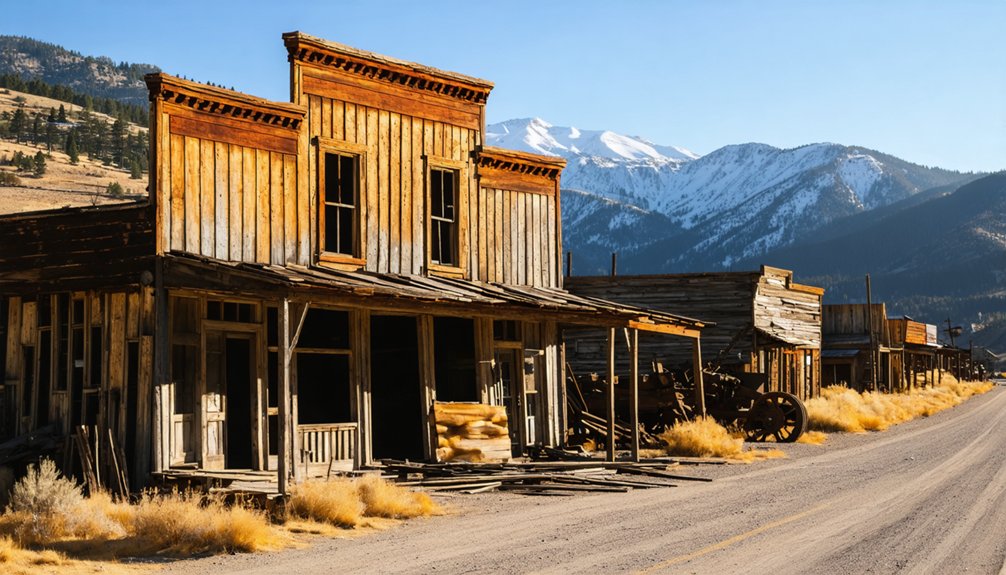
California’s Gold Rush ghost towns emerged when mining communities collapsed after precious metal deposits depleted, typically between 1852 and the 1880s. You’ll find famous examples like Bodie, which once housed 10,000 residents at 8,379 feet elevation, and Calico, where five original 1880s buildings still stand. These settlements thrived briefly—miners earned $20 daily and towns sprouted saloons and businesses—but most were abandoned when strikes failed or laws like the 1884 hydraulicking ban devastated operations. Today, these preserved sites offer you tangible evidence of the era’s dramatic boom-bust cycle and the architectural remnants that reveal deeper stories about ambition, hardship, and California’s transformative period.
Key Takeaways
- Ghost towns emerged after 1852 when placer gold deposits depleted, causing miners to abandon settlements and move to new strikes.
- Notable ghost towns include Bodie with 10,000 former residents, Calico with preserved 1880s buildings, and Shasta’s half-ruined brick structures.
- The 1884 hydraulicking ban and shift to capital-intensive hard-rock mining operations accelerated the decline of individual mining settlements.
- Ghost towns now serve as tourist attractions costing around $8 admission, preserving Gold Rush history and cultural heritage.
- Foreign Miners Tax and violence expelled 15,000 Mexican miners, contributing to population decline and eventual abandonment of mining communities.
From Boom to Bust: The Rise and Fall of Mining Settlements
James Marshall’s discovery of gold at Sutter’s sawmill on January 24, 1848, triggered one of history’s most dramatic population surges.
You’d witness California’s non-Indian population explode from 14,000 to 250,000 within four years as economic migration reshaped the territory. Boomtown culture flourished across Sierra Nevada camps where miners earned up to $20 daily during peak years, extracting $81 million in gold by 1852.
California’s population surged from 14,000 to 250,000 in just four years as gold fever transformed the territory into a boomtown empire.
Yet prosperity proved fleeting.
After 1852, you’d see earnings plummet as placer deposits depleted. The Foreign Miners Tax expelled 15,000 Mexican miners while violence drove out international workers. Hard-rock operations replaced individual prospectors, demanding capital most couldn’t afford.
Communities that sprouted overnight—complete with roads, churches, and schools—faced abandonment as fortune-seekers chased new strikes elsewhere, leaving ghost towns throughout California’s interior. San Francisco itself experienced the exodus firsthand when male population rushed to the goldfields between May 12-20, 1848, leaving the port city nearly deserted. Sacramento emerged as the trading center for northern mines, connecting prospectors with essential supplies and services.
Famous Ghost Towns and Their Locations Across California
The abandoned settlements scattered across California’s interior stand as physical evidence of the Gold Rush’s boom-and-bust cycle.
You’ll find Bodie history preserved at 8,379 feet in Mono County, where over 10,000 residents once extracted $30 million in gold.
Calico restoration by Walter Knott in the 1950s saved five original 1880s buildings from California’s largest silver strike.
Shasta architecture showcases half-ruined brick buildings near Redding, earning its “Queen City” designation.
Ballarat ruins dot Panamint Valley, where 500 miners supported seven saloons before abandonment.
Empire Mine reveals the scale of industrial extraction—367 miles of underground tunnels producing 5.6 million ounces over a century.
Bodie’s reputation as the most lawless mining camp in the far west stemmed from its 65 saloons serving a population of 10,000 at its peak.
Malakoff Diggins showcases hydraulic mining’s environmental impact through its eroded hillsides and 600-foot canyon carved during the 1870s gold extraction operations.
These sites document how mineral wealth created communities that vanished when ore deposits depleted.
Life at the Peak: Population and Infrastructure in Mining Communities
Explosive demographic transformation reshaped California’s landscape as mining camps evolved into functioning municipalities within months of gold discoveries. You’d witness San Francisco’s population explode from 1,000 residents in 1848 to 36,000 by 1852, with construction crews building 30 houses daily.
This urban migration attracted approximately 90,000 people in 1849 alone, transforming wilderness into commercial centers.
The demographic diversity distinguished these communities from traditional American settlements:
- Chinese immigrants comprised 20,000 of the 67,000 arrivals in 1852, establishing California’s largest Asian population
- International migrants included tens of thousands of Mexicans, Britons, Australians, French, and Latin Americans
- San Francisco supported nearly 2,000 medical professionals by 1855, rivaling established Eastern cities
Wages surged as complex economic ecosystems emerged beyond mining itself, creating opportunities that attracted workers worldwide seeking financial independence. The rapid population increase enabled California achieved statehood in 1850, remarkably fast for a territory that had been acquired by the United States just prior to the gold discovery. Many of these thriving mining camps eventually became ghost towns as gold deposits were exhausted and miners moved on to more promising locations.
Mining Techniques and Economic Forces That Shaped the Towns
While individual prospectors initially swarmed California’s streams with simple gold pans, the evolution of mining technology fundamentally determined which settlements thrived and which vanished into obscurity.
Mining innovations progressed rapidly from cradles to Long Toms, then to hydraulic operations that extracted $100 million in gold by shooting high-pressure water at hillsides.
You’d witness this technological shift demanding greater capital investment and infrastructure—distant water diversions, enormous sluice systems, and eventually heavy equipment for hard rock mining.
Economic sustainability depended entirely on scale and resources. Towns supporting hydraulic and drift mining operations built substantial infrastructure, while camps relying on exhausted placer deposits collapsed.
When hydraulicking faced an 1884 legal ban after devastating landscapes, communities lacking alternative corporate mining operations simply disappeared.
Underground hardrock mining dominated by Grass Valley in the Northern Mines transformed gold extraction into a corporate enterprise requiring specialized expertise from imported Cornish and Welsh miners.
Dredging operations emerged successfully in 1895 with bucket dredges, typically running 18 hours daily and leaving characteristic tailing piles that marked former settlement areas.
Preservation Efforts and Visiting California’s Ghost Towns Today
Unlike conventional museum restorations that recreate idealized historical scenes, Bodie State Historic Park has maintained its 200 buildings under an “arrested decay” philosophy since 1962—preserving structures exactly as abandonment left them, with original furniture positioned where residents last used it and even fire damage deliberately retained.
You’ll encounter significant preservation challenges at these remote sites, where funding constraints and harsh weather conditions threaten structural integrity. At Bodie, year-round rangers stabilize at-risk buildings while the Bodie Foundation fundraises for cemetery headstones and the newly acquired railroad depot. The town endures harsh conditions at 8,375 feet above sea level.
Your visitor experiences across California’s ghost town network include:
- Walking through Miller House interiors and touring Standard Stamp Mill’s gold extraction equipment
- Exploring Nevada City’s Victorian architecture and Malakoff Diggins’ hydraulic mining scars
- Bringing your own provisions—no commercial facilities exist at preserved sites
These abandoned settlements reflect human ambition and the dreams of miners and settlers whose presence still echoes through California’s High Sierra landscape. Admission costs $8 for adults.
Frequently Asked Questions
What Happened to the Residents Who Left Ghost Towns After Mining Stopped?
You’d engage in economic migration, chasing rumors of new goldfields and abandoning your belongings to reach the next boomtown. This pattern of community rebuilding repeated across the West as miners pursued fresh opportunities wherever strikes occurred.
Were There Conflicts Between Miners Over Valuable Claims and Resources?
“Fortune favors the bold,” but you’d find claim disputes and resource competition sparked brutal violence during the Gold Rush. Without legal enforcement, miners settled conflicts personally—through fists, weapons, and mob justice rather than courts.
How Did Families and Children Experience Life in These Temporary Settlements?
Family dynamics centered on survival and opportunity—children panned gold alongside adults while attending makeshift schools, and you’d find mothers running boarding houses amid violence and hardship, creating tight-knit communities despite harsh conditions.
What Role Did Women Play in California Gold Rush Mining Communities?
Like compass needles pointing toward opportunity, women’s contributions reshaped social dynamics through entrepreneurial ventures—establishing boarding houses, laundries, and businesses that often outearned miners while challenging mid-19th century gender constraints through economic independence.
Did Ghost Towns Have Law Enforcement or Organized Government Systems?
You’d find ghost towns had minimal law enforcement and organized government during boom times. Most relied on vigilante justice or miners’ courts rather than formal systems. Authority collapsed entirely when populations abandoned these settlements.
Today, many of these historic locations have become ghost towns available in California, attracting tourists with their haunting stories and remnants of the past. Visitors can explore the ruins, gaining insight into the lives of those who once called these vibrant communities home. Each ghost town has its own unique tale, offering a glimpse into California’s rich history during the Gold Rush era.
References
- https://www.loveexploring.com/gallerylist/67994/americas-eeriest-gold-rush-ghost-towns
- https://www.camp-california.com/california-ghost-towns/
- https://www.visitcalifornia.com/road-trips/ghost-towns/
- https://patch.com/california/banning-beaumont/13-ghost-towns-explore-california
- https://www.eastwestnewsservice.com/three-ghost-towns-beguile-intrepid-visitors/
- https://dornsife.usc.edu/magazine/echoes-in-the-dust/
- https://www.atlasobscura.com/itineraries/the-wildest-west
- https://californiahighsierra.com/trips/explore-ghost-towns-of-the-high-sierra/
- https://asyaolson.com/the-best-gold-rush-ghost-towns-in-california/
- https://www.shmoop.com/study-guides/california-gold-rush/timeline.html