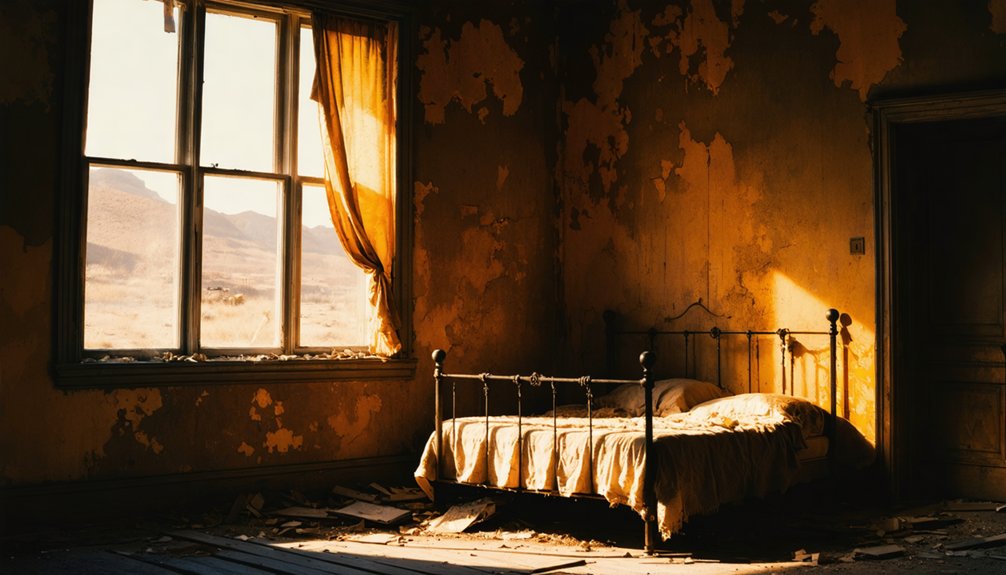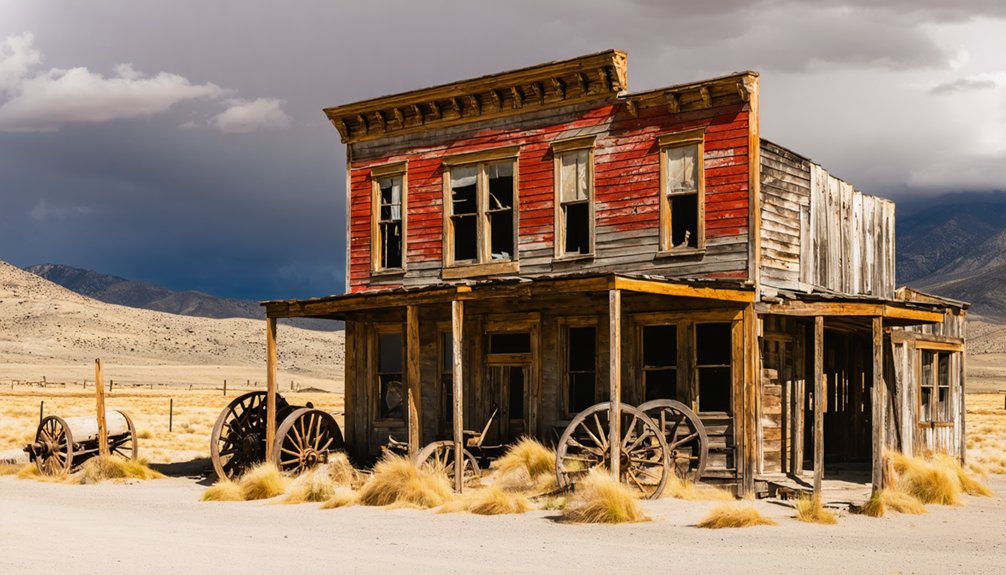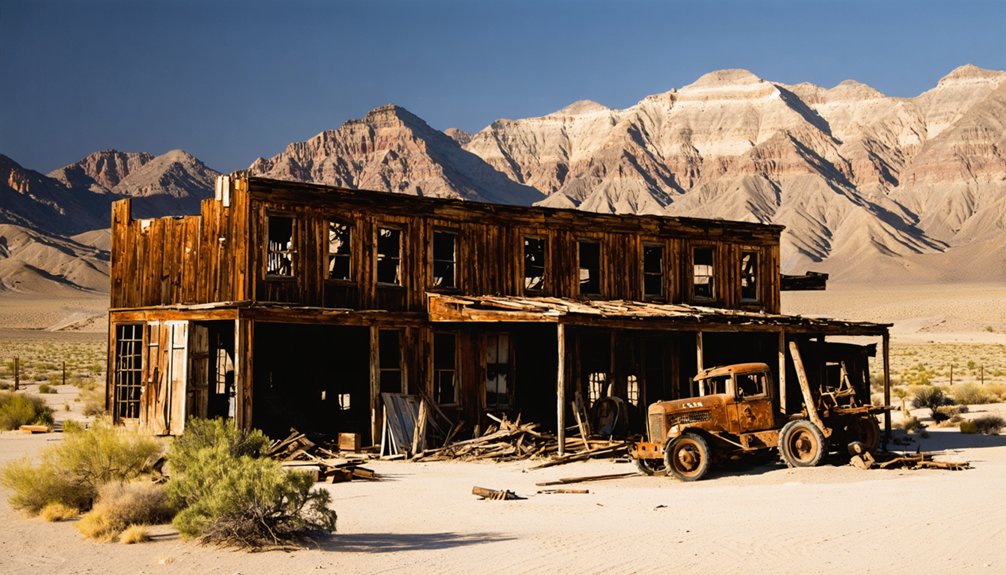
You’ll find several historically significant ghost towns within an hour of Las Vegas, each documenting Nevada’s mining legacy. Nelson, established in 1861 at Eldorado Canyon, represents the state’s oldest mining settlement and yielded $10 million from the Techatticup Mine by 1900. Goodsprings maintains approximately 200 residents alongside its 1913 schoolhouse and Pioneer Saloon. St. Thomas, founded by Mormon pioneers in 1865, periodically emerges from Lake Mead’s waters during drought conditions. The following sections examine each settlement’s archaeological features, architectural remnants, and accessibility for contemporary visitors.
Key Takeaways
- Nelson Ghost Town, Nevada’s oldest mining settlement, sits 45 minutes southeast of Las Vegas in Eldorado Canyon with historic buildings.
- Goodsprings, founded in 1904, remains a living ghost town with 200 residents and features Nevada’s oldest operating bar, Pioneer Saloon.
- St. Thomas, a Mormon settlement from 1865, lies submerged under Lake Mead but reemerges during droughts revealing archaeological remnants.
- Goldfield experienced a population boom to 20,000 by 1910 and features surviving structures like the Goldfield Hotel and Fire Station.
- Potosi represents Nevada’s first major mining discovery, with intermittent silver production until 1906 and critical zinc supply during WWI.
Nelson Ghost Town: Nevada’s Oldest and Most Haunted Mining Site
Nestled in the rugged Eldorado Canyon approximately 45 minutes southeast of Las Vegas, Nelson Ghost Town stands as Nevada’s oldest and most storied mining settlement, its origins predating even the state’s establishment.
Native Americans first extracted turquoise here before Spanish explorers possibly founded the Eldorado settlement in 1775. The 1861 discovery of the Techatticup Mine sparked Nevada’s first major gold strike, ultimately yielding $10 million through 1900.
You’ll find this isolated location attracted miners, outlaws, and Civil War deserters, creating a lawless frontier where disputes ended in gunplay—the nearest sheriff stationed 200 miles away. The Techatticup Mine operated continuously until the early 1940s, serving as the region’s most productive gold extraction site.
Today, mining relics like weathered buildings and rusted vehicles punctuate the landscape, while ghostly encounters persist among the canyon’s dark secrets, drawing adventurers seeking both historical depth and paranormal intrigue. The town’s eerie atmosphere attracts photographers and filmmakers who have used it as a backdrop in numerous productions.
Explorers often venture into the abandoned sites in West Virginia, captivated by the stories these remnants of the past hold. Each location presents a unique glimpse into the region’s rich history, revealing the challenges faced by its former inhabitants. These decaying structures serve as haunting reminders of the once-thriving communities that shaped the area.
Goodsprings Ghost Town: A Living Piece of Nevada History
You’ll find Goodsprings represents a rare “living ghost town,” where approximately 200 residents maintain continuous occupation of a settlement founded in 1904 following gold discoveries at the Keystone Mine in 1893.
The town’s architectural legacy includes the 1913 schoolhouse on the National Register of Historic Places and the Pioneer Saloon, Nevada’s oldest operating bar established the same year, both surviving the decline from 800 residents in 1918.
This population collapse stemmed from post-WWII mining exhaustion and devastating fires, including the 1966 hotel destruction, though preservation efforts now protect structures spanning Nevada’s evolution from Ancient Puebloan springs to WWI-era zinc and lead supplier. The Yellow Pine Mining District’s total economic contribution exceeded $30 million throughout its operational history, establishing Goodsprings as one of Nevada’s most productive early mining communities. The town is located 45 minutes south of the Las Vegas Strip near Jean, NV, making it an accessible day trip for visitors seeking authentic Western history.
Mining History and Origins
While most Nevada mining districts trace their origins to singular discoveries, Goodsprings evolved through multiple waves of exploration spanning over half a century.
Mormons pioneered underground mining techniques at Potosí in 1856, Nevada’s oldest such operation. Early silver-lead claims in 1868 proved disappointing, leading to abandonment until the 1893 Keystone gold strike reignited development.
You’ll find exceptional mineral diversity here—lead, zinc, gold, silver, copper, molybdenum, vanadium, nickel, cobalt, platinum, palladium, and uranium represent Nevada’s most varied mineral deposits. The district’s $25 million production ultimately comprised one-third of Clark County’s metal output. The Yellow Pine Mining Company dominated large-scale zinc production following significant ore discoveries in 1905.
Transportation revolutionized operations: the 1905 railroad to Jean quadrupled production, while the narrow-gauge Yellow Pine line enabled large-scale zinc extraction from previously discarded waste rock. The community reached its zenith in 1916 with 800 residents, marking the peak year of mining operations before activity gradually declined until final closure in 1957.
Historic Buildings and Landmarks
The physical infrastructure left behind by Goodsprings’ mining era provides documented evidence of the district’s evolution from remote prospecting camp to established industrial community.
Campbell Cabin, constructed in 1886, represents the town’s earliest surviving historic architecture as Clark County’s oldest building. The 1913 Pioneer Saloon maintains its original stamped tin ceiling and Brunswick bar counter, serving as the region’s oldest continuously operating establishment.
Goodsprings Schoolhouse, also built in 1913 and listed on the National Register of Historic Places, educated children from a population reaching 800 residents by 1918.
Yellow Pine Mill ruins, remnants of the 1908 processing facility destroyed in 1929, mark the industrial infrastructure that drove economic activity. The Good Springs Mission Church served the town’s spiritual needs until the 1930s, reflecting the community’s development beyond purely industrial functions. The area’s reliable natural spring, discovered by rancher Joseph Good in the late 1800s, provided the essential water source that made permanent settlement and mining operations viable in this harsh desert environment.
These structures collectively preserve tangible town heritage for those seeking authentic glimpses into Nevada’s independent frontier past.
Population Changes Over Time
Mining claims filed near Goodsprings as early as 1868 initiated cycles of boom and bust that would define the settlement’s demographic trajectory for over a century.
You’ll find that population trends fluctuated dramatically—soaring to 200 residents by 1892 when ore assayed over $1,000 per ton, then collapsing to a single inhabitant by 1896.
Settlement patterns transformed with the Nevada Southern Railroad‘s 1911 arrival, converting tent camps into a thriving boomtown of 1,000 people by 1915.
WWI’s demand for lead and zinc sustained 800 residents through 1918, but post-war decline proved irreversible.
The population contracted to 400 by 1920, then under 100 by the mid-1930s.
Despite WWII’s brief revival, Goodsprings stabilized around 200-229 residents, where it remains today. The Fayle Hotel burned in 1966, further reducing the town’s population to less than 200 permanent residents. Today’s residents engage in preservation of historical sites, maintaining the town’s connection to its mining heritage while welcoming visitors who seek to experience this unique piece of Nevada’s past.
Rhyolite Ghost Town: The Most Photographed Ruins in Nevada
You’ll find Rhyolite’s architectural remains clustered within the Bullfrog Mining District, where structures like the John S. Cook Bank building and the restored Bottle House have earned the site recognition as Nevada’s most photographed ghost town.
The Bureau of Land Management maintains these historically significant ruins approximately 120 miles northwest of Las Vegas, preserving tangible evidence of the boomtown’s brief existence between 1904 and 1916.
Adjacent to the historic townsite, the Goldwell Open Air Museum features large-scale outdoor sculptures that create a striking juxtaposition between contemporary art and early twentieth-century mining architecture.
Bullfrog District Historic Ruins
When Frank “Shorty” Harris and Ernest “Ed” Cross discovered high-grade gold ore in the Bullfrog District between August 4-9, 1904, they initiated one of Nevada’s most spectacular mining booms.
The distinctive mottled green-hued rocks inspired the deposit’s name, while Bullfrog history reveals eight established post offices emerged within months—extraordinary for frontier camps.
Beyond Rhyolite’s photogenic ruins, you’ll discover scattered mining relics throughout the district:
- Crumbling stone walls of the original Bullfrog jail stand on private property, alongside fragmented structural remains
- The 1904-1912 cemetery contains headstones, wooden crosses, and unmarked graves gradually disappearing into desert sand
- Multiple camp sites from Amargosa, Beatty, and Bullfrog offer archaeological evidence of rapid settlement
- Original mining infrastructure marks where Charles M. Schwab’s 1906 investment transformed operations
These dispersed ruins document freedom-seeking prospectors who built civilization from nothing.
Goldwell Museum and Sculptures
Adjacent to Rhyolite’s decaying mining infrastructure, the Goldwell Open Air Museum occupies 7.8 acres as Nevada’s most unexpected cultural juxtaposition—contemporary sculpture confronting nineteenth-century abandonment.
Belgian artist Albert Szukalski established this installation in 1984, with works appearing throughout the decade near Rhyolite’s abandoned railway station. The sculpture significance centers on “Last Supper,” Szukalski’s ghostly life-sized fiberglass tableau that anchors the collection.
Additional installations include the 25-foot “Pink Lady” cinderblock nude and Dre Peters’ “Icara”—a hand-carved interpretation reversing Icarus’s gender. Artistic influences here deliberately engage the post-apocalyptic landscape, creating dialogue between permanence and decay.
Following Szukalski’s 2000 death, the site reorganized as a nonprofit museum offering free 24-hour access, attracting visitors seeking both artistic intervention and historical authenticity in Nevada’s desert terrain.
St. Thomas Ghost Town: the Sunken Settlement Rising From Lake Mead
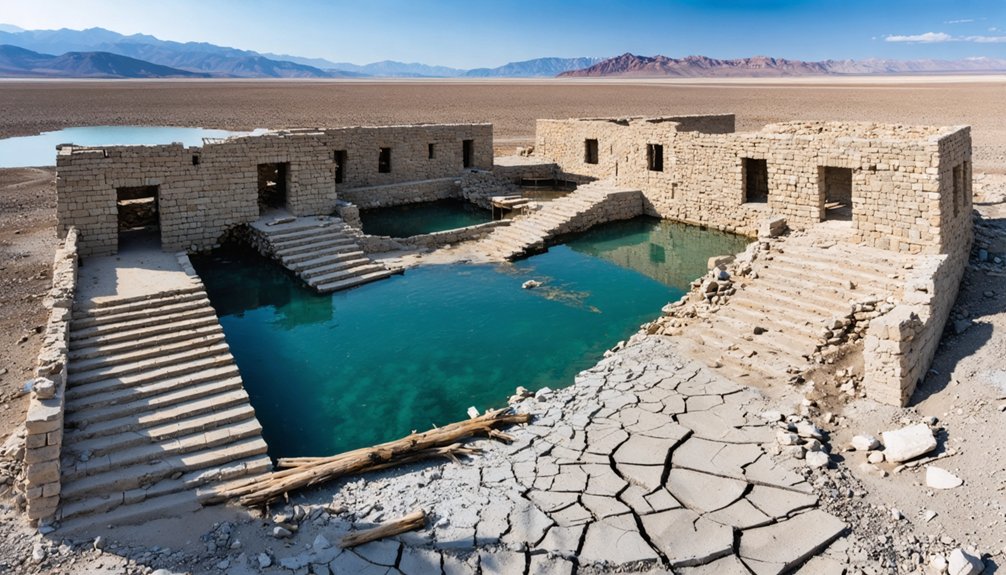
Situated at the confluence of the Virgin and Muddy Rivers, St. Thomas’s town history began in January 1865 when Mormon pioneers established what would become Nevada’s most fascinating submerged ruins.
You’ll discover a settlement that survived abandonment in 1871 due to Nevada tax disputes, only to flourish again as a trade hub and tourism stop along the Arrowhead Trail.
Key Historical Milestones:
- Founded by Thomas Sassen Smith with 600 acres cultivated by April 1865
- Served as endpoint for John Wesley Powell’s 1869 Colorado River expedition
- Fully submerged June 25, 1938, under Lake Mead following Hoover Dam construction
- Reemerged during 21st-century droughts, revealing foundations and tree-lined streets
The National Park Service now protects these archaeological remnants, offering you unrestricted access to explore authentic pioneer remnants.
Potosi Ghost Town: Nevada’s First Major Mining Discovery
Nevada’s inaugural mining venture began in August 1856 when Mormon settlers established operations at Potosi Mountain, thirty miles southwest of Las Vegas Springs.
Led by Nathaniel V. Jones, the expedition constructed the territory’s first smelter and recovered 9,000 pounds of lead before abandoning operations in February 1857. This short-lived enterprise created Nevada’s first ghost town.
The mine reopened in 1861 under California interests, with intermittent silver production continuing until 1906. The 1905 railroad expansion transformed Potosi mining operations—subsequent assays revealed substantial zinc deposits that made the site Nevada’s largest zinc producer by 1913.
During World War I, Potosi supplied critical zinc for military production, cementing its significance among Nevada ghost towns beyond its pioneering Mormon origins.
Goldfield Ghost Town: Where the Wild West Meets the Supernatural
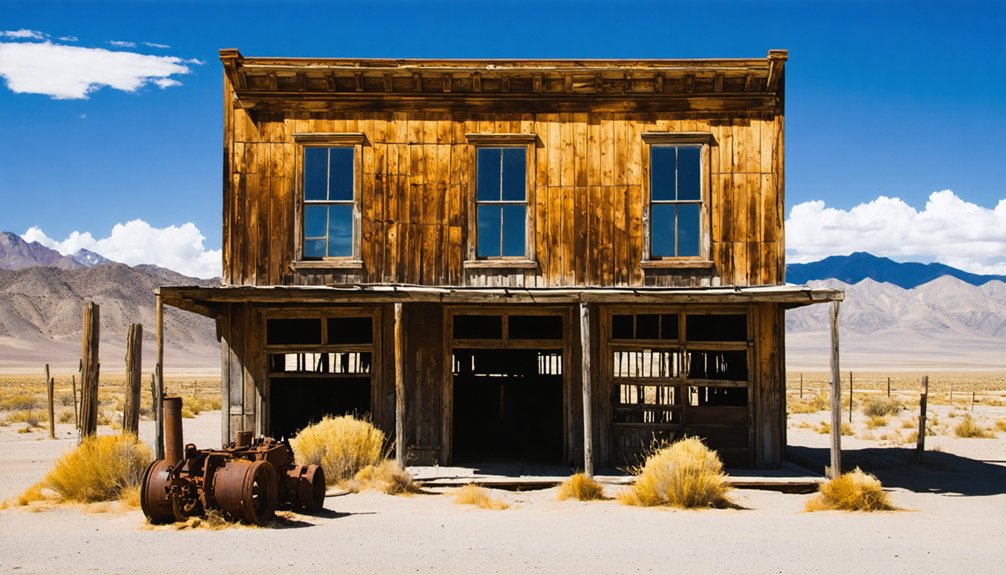
While Potosi represented Nevada’s tentative mining beginnings, the 1902 gold discovery in Esmeralda County catalyzed what would become the state’s most spectacular boomtown phenomenon. Goldfield’s population exploded to 20,000 by 1910, generating $86-90 million in ore production before its inevitable collapse.
From tentative mining camp to Nevada’s most explosive boomtown—Goldfield’s meteoric rise produced nearly $90 million before spectacular collapse.
The town’s historical significance persists through remarkable stone edifices that survived the devastating 1923 fire:
- Goldfield Hotel (1908): 150-room opulent structure now central to haunted legends, featured extensively on paranormal television programs
- Fire Station #1: Local ashlar stone construction, operational until 2002
- Consolidated Mines Building: Communications hub through 1963
- Courthouse and high school: Enduring civic monuments
Today’s 200 residents maintain this “living ghost town” three hours northwest of Las Vegas, where authentic Wild West architecture intersects with spectral folklore.
Best Times to Visit Ghost Towns Near Las Vegas
Strategic timing transforms ghost town exploration from punishing desert endurance tests into rewarding historical encounters.
You’ll find best visiting times concentrate in spring (March-May) and fall (September-November), when temperatures hover between 65-85°F rather than exceeding 100°F.
Nelson’s mine tours operate at 9:00 a.m., 12:00 p.m., and 2:00 p.m., requiring advance seasonal considerations for the 1-hour-20-minute underground experience.
Rhyolite demands sunset photography sessions, while morning hours suit Goldwell’s sculpture garden exploration.
Winter months offer Calico’s most comfortable conditions for full-day immersion.
Early morning departures from Las Vegas prove essential during summer months, particularly for sites like Goodsprings within one hour’s reach.
Spring visitors witness desert bighorn sheep births near Rhyolite, while fall avoids monsoon complications affecting unpaved access roads.
Tips for Exploring Nevada’s Abandoned Mining Towns
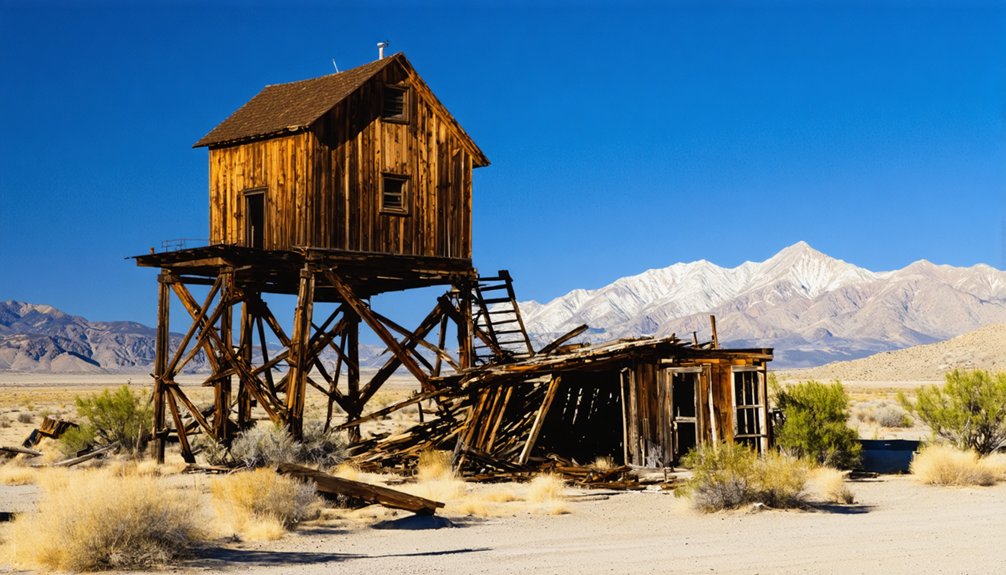
Before venturing into Nevada’s abandoned mining districts, you’ll need thorough preparation that accounts for the region’s harsh desert conditions and infrastructure absence. Fuel up in Mesquite, download offline maps, and pack one gallon of water per person daily. Sturdy boots are essential for traversing uneven terrain around abandoned structures.
Safety and preservation protocols include:
- Avoiding unstable mine shafts and buildings compromised by decades of exposure
- Watching for toxic silica dust remnants, particularly at Delamar’s “Widowmaker” sites
- Refraining from artifact removal to support historical preservation efforts
- Traveling with partners and sharing your itinerary before remote explorations
Download aerial views to locate scattered ruins like Thorpe’s Well, and follow historical society walking tours through sites like Goodsprings.
Respect gravesites and adhere to leave-no-trace principles throughout these fragile boomtown environments.
Frequently Asked Questions
Are Dogs Allowed at the Ghost Towns Near Las Vegas?
You’ll find welcoming dog-friendly policies at these historic sites. Both Calico and Nelson ghost towns permit leashed companions during ghost town activities, though you should avoid visiting during Nevada’s scorching summer months for your pet’s safety.
Can You Camp Overnight at Any of These Ghost Towns?
The available documentation doesn’t specify camping regulations or overnight permits for these ghost towns. You’ll need to contact each site’s management directly to determine if overnight camping is permitted and what requirements apply.
Do Any Ghost Towns Offer Guided Tours Instead of Self-Guided Exploration?
Yes, you’ll find guided exploration at all four ghost towns—Oatman, Chloride, El Dorado Canyon, and Nelson—where expert guides reveal each site’s historical significance through commentary, ensuring you’re free to absorb authentic Wild West narratives.
What Cell Phone Service Is Available at These Remote Ghost Town Locations?
Cell coverage remains inconsistent across these remote sites, with signal strength varying considerably by location and carrier. You’ll find Rhyolite and Goodsprings offer better connectivity than isolated Nelson, though you shouldn’t expect reliable service anywhere.
Are There Restroom Facilities Available at the Ghost Town Sites?
You’ll find virtually zero modern conveniences at most sites. Restroom access varies dramatically—Nelson offers facilities, Rhyolite provides limited options near the casino, while St. Thomas and Goldfield lack ghost town cleanliness standards entirely.
References
- https://travelnevada.com/ghost-town/ghost-towns-near-las-vegas/
- https://nvtami.com/2023/12/05/las-vegas/
- https://nobackhome.com/calico-ghost-town-perfect-stop-between-las-vegas-la/
- https://awesomeadventures.com/blog/haunted-las-vegas-adventures-ghost-towns-gold-mines-and-desert-legends/
- https://www.youtube.com/watch?v=mGkyVWaef30
- https://www.youtube.com/watch?v=SZnaiia63Jw
- https://www.tripadvisor.com/Attraction_Review-g1093759-d4446411-Reviews-Nelson_Ghost_Town-Nelson_Nevada.html
- https://travelnevada.com/ghost-town/
- https://www.exploratography.com/blog-nv/eldorado-canyon-nelson-ghost-town-nevada
- https://www.youtube.com/watch?v=MlH4SKnmgao