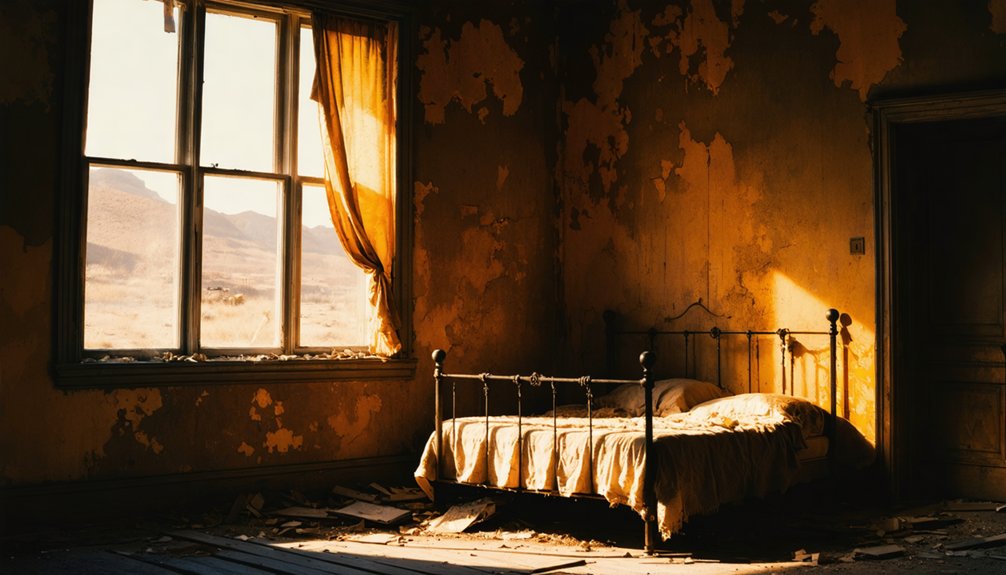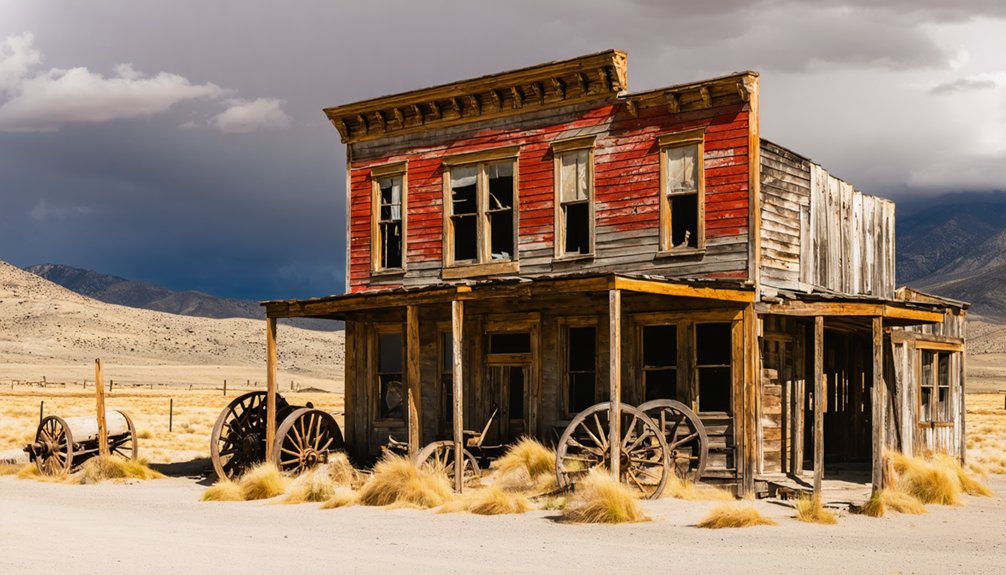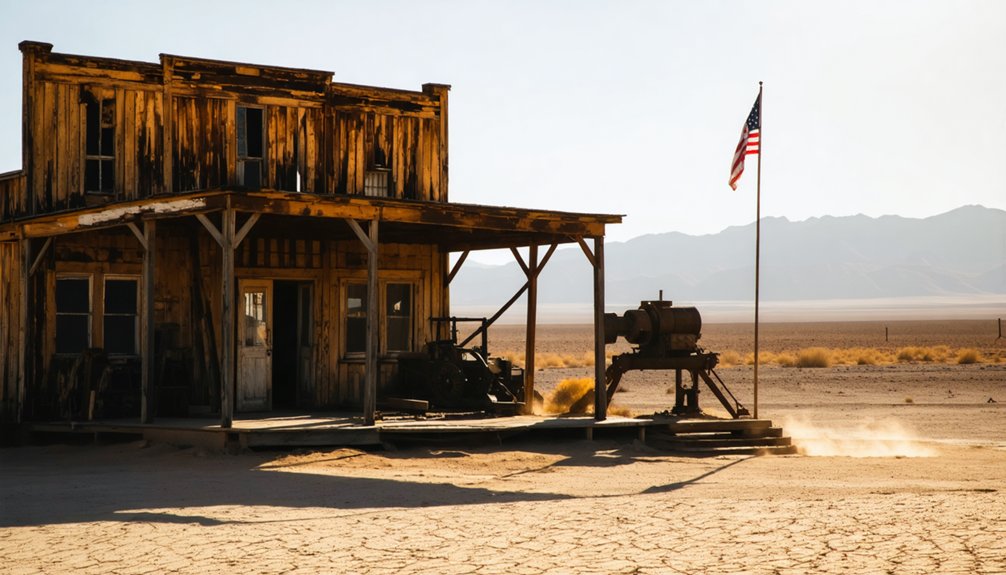
You’ll discover fascinating ghost towns within an hour of Las Vegas, each telling unique stories of the Old West. Rhyolite showcases iconic ruins like the Cook Bank and Bottle House from its 1905 mining boom. Nelson’s Techatticup Mine offers an open-air museum of violent mining history. Goodsprings remains a living ghost town with the historic Pioneer Saloon. St. Thomas emerges from Lake Mead‘s receding waters, revealing submerged foundations from its 1865 Mormon settlement. These desert monuments await your exploration with proper planning and essential supplies for desert conditions.
Key Takeaways
- Rhyolite features iconic ruins like the Cook Bank and Bottle House, once housing 5,000 residents during its 1905 mining boom.
- Nelson’s Techatticup Mine in Eldorado Canyon produced over $10 million in ore from 1861 to 1945, now an open-air museum.
- Goodsprings, 35 miles south of Las Vegas, remains a living ghost town with 200 residents and the historic Pioneer Saloon.
- St. Thomas, submerged beneath Lake Mead since 1938, emerges during droughts revealing foundations and street grids from 1865.
- Fall offers the best visiting conditions with comfortable temperatures; bring water, sturdy shoes, and GPS for remote locations.
Rhyolite: Nevada’s Most Photographed Ghost Town
The skeletal walls of the John S. Cook Bank stand as Rhyolite’s most iconic ruin, drawing photographers to this desert ghost town just outside Death Valley.
You’ll discover Rhyolite history etched in every crumbling structure—from the restored Bottle House to the old jail cells.
The mining boom exploded in 1905 after gold discoveries transformed a two-tent camp into a thriving city of 5,000 souls within months.
Gold fever struck fast—a dusty two-tent camp swelled to 5,000 residents almost overnight in 1905.
Fifty saloons, three-story banks, and a bustling stock exchange lined the streets.
Steel magnate Charles M. Schwab purchased the district in 1906, bringing three trains and modern amenities like electric street lights and concrete sidewalks.
But the 1906 San Francisco earthquake and dwindling high-grade ore triggered rapid decline.
By 1920, only fourteen residents remained.
The nearby Goldwell Open Air Museum features striking installations like Albert Szukalski’s “The Last Supper,” adding cultural significance to the historic site.
Today, you’re free to explore these Bureau of Land Management-preserved ruins, where Nevada’s wildest boom-and-bust story plays out in stone and shadow.
Nelson: A Lawless Mining Legacy in Eldorado Canyon
You’ll find the Techatticup Mine standing as the crown jewel of Eldorado Canyon‘s violent past, where daily killings once punctuated disputes over ownership and labor in one of southern Nevada’s most productive gold operations.
Active from the 1860s until the mid-1940s, this legendary mine produced millions in precious metals while operating 200 miles from the nearest sheriff.
Today, the 51-acre site operates as an open-air museum where you can explore weathered buildings, rusting equipment, and tour the same hard-rock tunnels that drew fortune-seekers into this lawless frontier. The mine has become a popular filming location, featured in movies and shows including “3,000 Miles to Graceland.” In 1994, Tony and Bobbie Werly purchased the property and spent five years restoring it into the tourist attraction you see today.
Techatticup Mine History
Deep within Eldorado Canyon, the Techatticup Mine stands as one of Nevada’s most enduring monuments to the Wild West’s brutal reality.
You’ll discover a mining legacy that operated continuously from 1861 to 1945, outlasting nearly every Nevada operation. The Salvage Vein produced over $10 million in ore between 1864 and 1900, fueling disputes so violent that law enforcement refused to enter the canyon.
You’ll walk through tunnels where claim jumpers fell and fortunes were carved from rock with dynamite and determination. The fifteen-stamp mill built in 1883 still echoes with machinery’s memory.
The mine’s establishment in 1863 made it the principal producer in an area where four separate townsites struggled against isolation and supply challenges. The mine’s name derives from Paiute words meaning ‘hungry’ and ‘bread’, reflecting the region’s indigenous heritage.
Today, you can explore these preserved passages yourself, standing where desperate men risked everything for gold that still glitters in these hills—untouchable only by modern economics.
Open-Air Museum Today
Violence shaped every inch of Nelson’s landscape, and that savage history remains visible in every weathered timber and bullet-scarred wall you’ll encounter today.
Tony and Bobbie Werly understood the historical significance when they purchased the 51-acre Techatticup site in 1994. After five years clearing debris and reviving crumbling structures, they transformed this lawless outpost into a living monument to Nevada’s wildest chapter.
You’ll explore authentic buildings where miners fought and died over fortunes. The ghost town preservation extends beyond simple restoration—you’re walking through genuine hard-rock mine tunnels and touching relics from an era when law meant nothing. The mines yielded an estimated $10 million worth of ore between 1864 and 1900, fueling decades of bloodshed over claims.
Located just 45 minutes south of Las Vegas, this photographer’s paradise attracts those seeking unfiltered frontier truth. Music videos and video games have captured its raw authenticity, but nothing compares to experiencing Nelson’s brutal legacy firsthand. The town originally bore the name Eldorado due to its proximity to Eldorado Canyon in the 1700s.
Goodsprings: a Living Ghost Town With Western Charm
Just 35 miles south of Las Vegas, Goodsprings sprawls across the Mojave Desert as a tribute to Nevada’s mining heritage—where weathered wooden structures stand alongside occupied homes, and locals still gather at the same saloon where Clark Gable once drowned his sorrows.
Where weathered wooden structures stand alongside occupied homes in the Mojave Desert, and Clark Gable once mourned at the historic saloon.
You’ll discover authentic Goodsprings history through its preserved landmarks. The Pioneer Saloon‘s cherry wood Brunswick bar still bears cigarette burns from Gable’s 1942 vigil after Carole Lombard’s fatal plane crash.
This living ghosttown pulses with roughly 200 residents who’ve chosen isolation over suburbia.
Wander past the National Register-listed schoolhouse and original General Store, immortalized in Fallout: New Vegas. The community museum and old post office welcome visitors on weekends from 11:00 AM to 3:00 PM, offering glimpses into the town’s storied past.
The Yellow Pine Mining District once extracted $30 million in precious metals, fueling WWI ammunition production before fires and depleted ore veins transformed prosperity into atmospheric decay. Adventure seekers can explore over 340 miles of trails that wind through historic mine sites and rugged desert terrain.
St. Thomas: the Sunken Settlement Rising From Lake Mead
You’ll find one of Nevada’s most unusual ghost towns beneath the surface of Lake Mead, where St. Thomas—a pioneer settlement founded by Mormon families in 1865—spent decades submerged after Hoover Dam’s construction flooded the valley.
Exploring ghost towns near Hoover Dam can reveal the remnants of other intriguing settlements that once thrived in this arid landscape. Many of these towns were abandoned due to the dam’s construction and the subsequent changes to the region’s water levels. The stories of their inhabitants offer a fascinating glimpse into the past and the challenges they faced in adapting to a transforming environment.
As prolonged droughts lower the reservoir’s water levels, the town’s foundations, street grids, and building remnants emerge from the muddy shoreline like archaeological treasures.
Walking among these exposed ruins offers you a rare chance to explore a community that thrived, drowned, and now rises again to tell its story of frontier ambition and nature’s power.
Mormon Settlement History
When Mormon pioneers arrived at the confluence of the Virgin and Muddy Rivers in January 1865, they believed they were building their new community on Utah Territory soil.
Thomas S. Smith led the original Mormon migration of a dozen settlers who transformed 600 acres into productive farmland, dividing it into five-acre lots.
The pioneer settlement flourished, growing to 500 residents by its peak.
Your understanding of St. Thomas’s founding requires knowing these pivotal moments:
- Brigham Young directed colonization of the Muddy River Valley
- Settlers divided land into manageable five-acre agricultural plots
- Population expanded from 12 pioneers to 45 families within one year
- The community operated without formal government organization
This territorial uncertainty would ultimately determine the settlement’s fate when surveyors redrew boundary lines.
Lake Mead Submersion
The territorial disputes that shaped St. Thomas’s early years pale against its ultimate fate.
When Hoover Dam’s gates closed in 1936, the Colorado River began its relentless rise. You’ll find that the Boulder Canyon Project Act of 1928 had already sealed the town’s destiny, placing it directly beneath the planned reservoir.
By June 11, 1938, Hugh Lord became the last resident to depart by boat, leaving behind a community the federal government had purchased for submersion. Lake Mead swallowed everything—homes, streets, dreams.
For decades, this submerged history remained hidden beneath the reservoir’s depths. Today, severe drought has exposed the ruins once more, allowing you to walk among foundations that emerged in 2002, approximately 6,000 feet from the current shoreline.
Exploring Visible Ruins
As drought exposes St. Thomas’s forgotten streets, you’ll walk where Mormon pioneers once cultivated their agricultural heritage along the Muddy River.
The National Park Service has transformed this submerged settlement into an accessible historic site with interpretive trails guiding you across the former lake bottom.
What You’ll Discover:
- Building foundations marking homes and businesses from the 1860s
- Possible bunker structures revealing the town’s layered history
- Interpretive signs explaining daily life in this remote farming community
- Protected artifacts you can observe but mustn’t disturb
You’re exploring genuine remnants of American expansion, where federal waters reclaimed an entire town.
The ruins create an otherworldly landscape—part archaeological site, part evidence of nature’s power over human ambition.
Calico: California’s Silver Mining Attraction
Nestled in the Mojave Desert near Yermo, California, Calico stands as a tribute to the Wild West’s silver boom era. This restored ghost town invites you to step back into the 1880s, where Calico history comes alive through meticulously preserved buildings and authentic attractions.
You’ll discover the heart of silver mining at Maggie Mine, where underground tunnels reveal the era’s extraction methods through compelling exhibits. The historic schoolhouse beneath the mountain offers perfect photo opportunities with Calico’s iconic hillside sign overhead.
Ride the Calico Odessa Railroad for a glimpse into miners’ transportation, then explore the general store, barbershop, and gold panning areas.
Open daily from 9 AM to 5 PM at 36600 Ghost Town Road, Calico operates as a San Bernardino County Regional Park, making it an accessible adventure from Vegas.
Potosi: Nevada’s First Major Mining Discovery
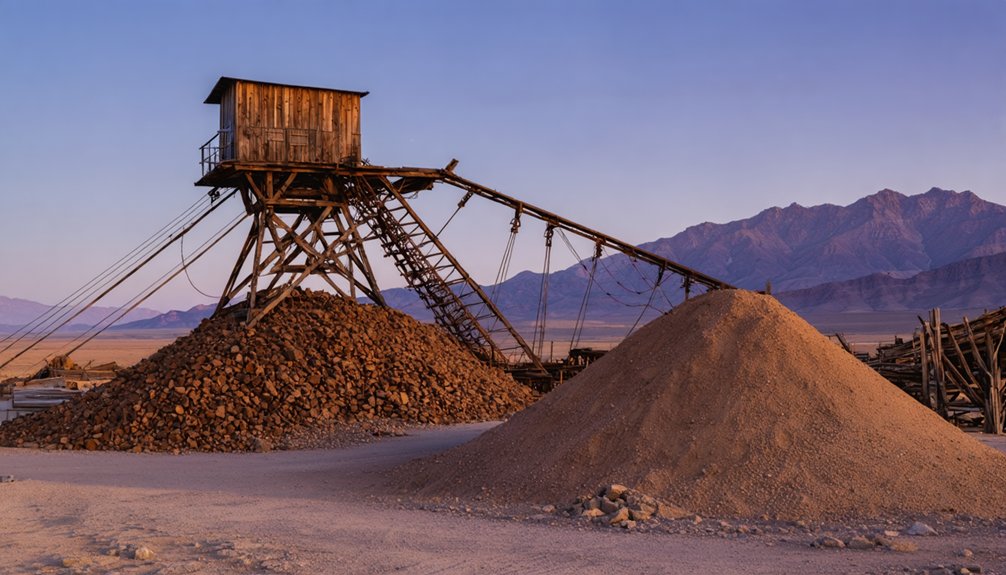
Thirty miles southwest of Las Vegas Springs, Potosi Mountain harbors Nevada’s pioneering mining legacy—a windswept site where Mormon settlers first struck lead in 1856.
You’ll discover historical significance at every turn, from crude smelters to abandoned rock cabins where 100 miners once carved existence from unforgiving terrain.
The mountain’s evolution reveals mining techniques advancing through decades:
Potosi Mountain’s mining legacy spans eight decades—from Mormon hand-tools to industrial tramways—charting Nevada’s relentless pursuit of mineral wealth.
- 1856: Mormon settlers hauled 9,000 lbs of ore using basic extraction methods
- 1913: Empire Zinc Company installed aerial tramways and narrow-gauge railways
- WWI Era: Nevada’s largest zinc producer extracted $4.5 million in minerals
- 1930: Final abandonment after zinc deposits proved economically exhausted
Today’s ruins whisper stories of boom-and-bust cycles that defined Nevada’s frontier character—where fortune-seekers chased liberty through backbreaking labor.
Planning Your Ghost Town Adventure From Las Vegas
Before you chase the ghosts of Nevada’s mining past, you’ll need a practical game plan—because these weathered settlements scatter across 50 miles of Mojave Desert, each demanding different commitments of time, effort, and preparation.
Pack essentials first: water, sturdy shoes, and sun protection are non-negotiable for desert safety. Camera gear matters for ghost town photography—Rhyolite’s ruins shine during golden hour, while Nelson charges $10 for photography permits at their museum.
Map your route carefully; St. Thomas requires GPS navigation, and certain sites demand high-clearance vehicles for rough terrain.
Build your itinerary around proximity. Combine Goodsprings and Nelson in a half-day loop, or dedicate a full day to Rhyolite with Death Valley’s edge beckoning beyond.
Watch for rattlesnakes, respect unstable structures, and leave before desert heat peaks.
Best Times to Visit Nevada’s Ghost Towns
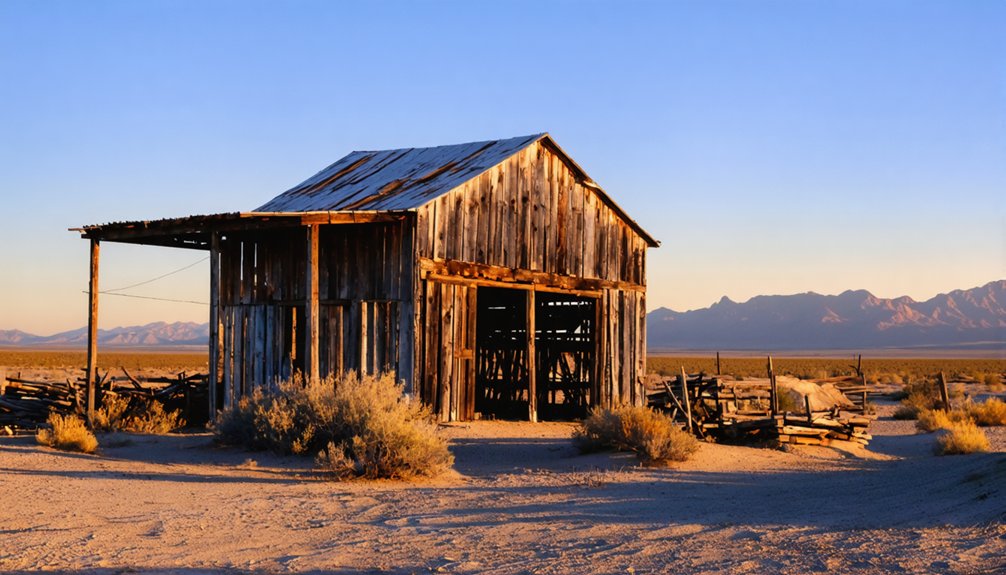
Fall transforms Nevada’s ghost towns into explorer’s paradise, when temperatures drop from summer’s punishing triple digits into the comfortable 60s and 70s.
You’ll experience ideal ghost town weather conditions for extended exploration without the physical strain of desert heat.
Seasonal advantages make autumn your best choice:
- Memorial Day through Labor Day (10 a.m. to 6 p.m. daily) marks primary operating hours, though fall’s cooler climate enhances comfort.
- Nevada’s dry conditions preserve historic structures in arrested decay, maintaining authentic boomtown relics for decades.
- Off-peak periods deliver fewer crowds at popular destinations between Reno and Las Vegas.
- High Sierra locations become accessible before winter snow closes mountain passes.
Spring offers moderate alternatives, while summer’s extended daylight hours maximize your touring freedom despite intense heat.
What to Bring for Your Ghost Town Exploration
Your survival in Nevada’s unforgiving desert hinges on thorough preparation, where forgotten essentials transform leisurely exploration into dangerous predicaments.
Pack desert survival gear including GPS devices, offline maps, and satellite communicators for remote areas lacking cell service. Bring one gallon of water per person hourly, sturdy boots for rocky terrain, and sun protection against relentless UV exposure.
Desert survival demands proper navigation tools, ample water supplies, and protective equipment to combat Nevada’s harsh terrain and isolated conditions.
Your high-clearance vehicle needs spare tires for rough access roads leading to sites like Nelson and Rhyolite.
For ghost town photography, carry cameras, notebooks, and binoculars to document structures like Cook Bank from safe distances. Don’t forget permission slips—Nelson charges $1 for walking or $10 for photography.
Essential items include first-aid kits, flashlights with extra batteries for dark buildings, gloves for handling rusted mining equipment, and trash bags to preserve these fragile historical environments.
Frequently Asked Questions
Are Ghost Towns Near Las Vegas Safe to Visit With Children?
Ghost town safety varies by location. You’ll find family-friendly activities at Goodsprings and Calico, with guided tours and preserved buildings. However, avoid unstable ruins and mine shafts at Nelson, keeping children close on clearly marked paths.
Can I Camp Overnight at Any of These Ghost Towns?
Like tumbleweed drifting past boundaries, you can’t camp within these ghost towns themselves. Camping regulations prohibit overnight stays in historic structures, but you’ll find freedom on nearby BLM lands where overnight permits aren’t required for dispersed camping.
Do I Need a 4×4 Vehicle to Reach These Locations?
You won’t need a 4×4 vehicle to reach these ghost towns. Standard cars handle the paved highways to Nelson, Goodsprings, Rhyolite, and Calico perfectly. Vehicle accessibility remains excellent year-round, letting you explore freely without special equipment.
Are There Guided Tours Available for These Ghost Towns?
Most lack formal guided tour options—you’ll explore independently through self-guided paths. Nelson offers the exception with museum interpretations explaining Techatticup Mine’s historical significance. Goodsprings and Rhyolite reward solo wanderers seeking authentic, unscripted discovery.
Which Ghost Town Is Closest to Las Vegas?
Nelson is the closest ghost town to Las Vegas, just 45 miles southeast. You’ll discover authentic Vegas history at this 1860s gold rush settlement, where freedom-seekers once struck it rich mining the legendary Techatticup Mine.
References
- https://travelnevada.com/ghost-town/ghost-towns-near-las-vegas/
- https://www.revealedtravelguides.com/las-vegas-blog/ghost-towns-to-visit-near-las-vegas/
- https://nobackhome.com/calico-ghost-town-perfect-stop-between-las-vegas-la/
- https://awesomeadventures.com/blog/haunted-las-vegas-adventures-ghost-towns-gold-mines-and-desert-legends/
- https://nvtami.com/2023/12/05/las-vegas/
- https://www.youtube.com/watch?v=mGkyVWaef30
- https://www.youtube.com/watch?v=SZnaiia63Jw
- https://travelnevada.com/ghost-town/
- https://www.tripadvisor.com/Attraction_Review-g1093759-d4446411-Reviews-Nelson_Ghost_Town-Nelson_Nevada.html
- https://nvtami.com/2025/01/27/rhyolite-ghost-town-nevadas-diamond-in-the-desert/