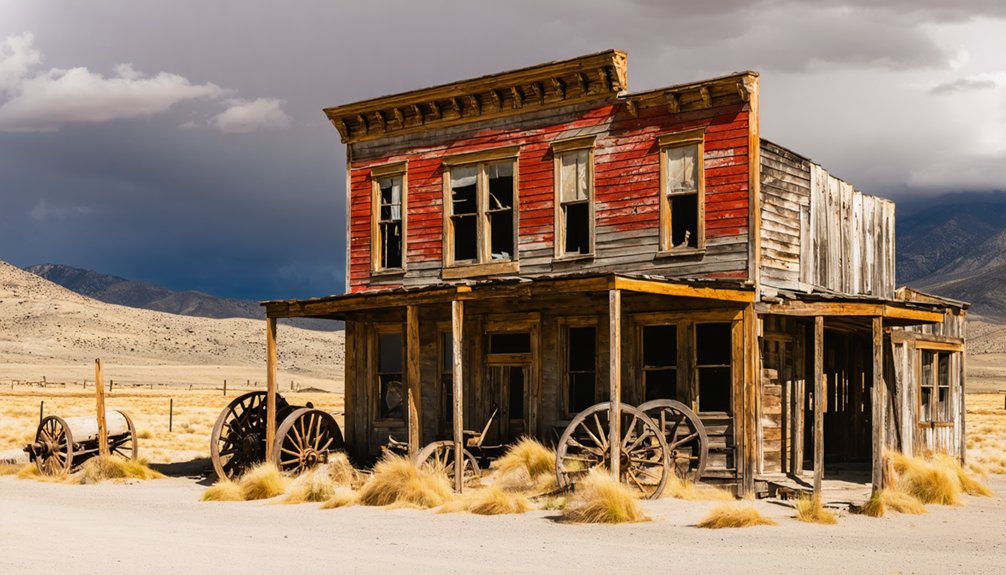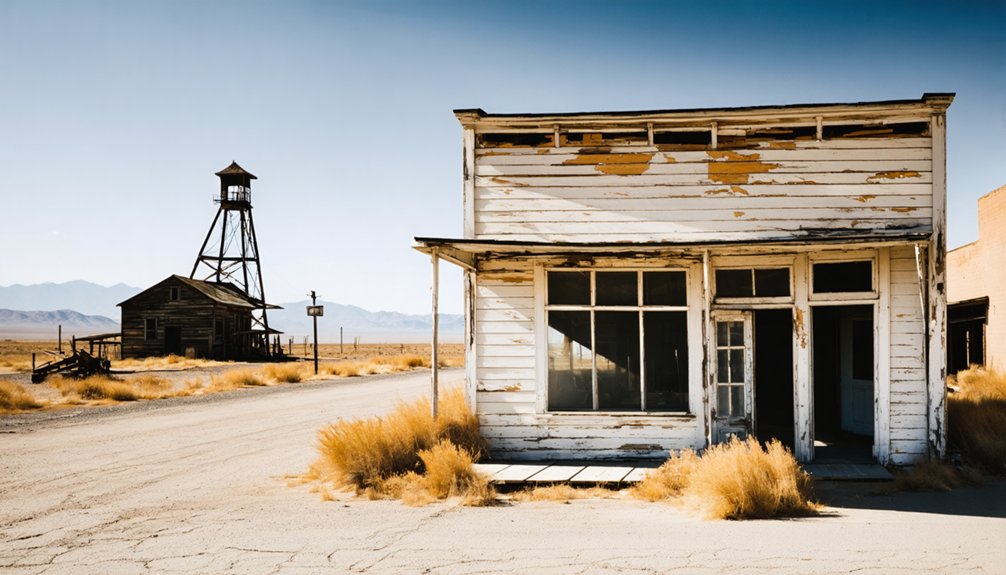
The Great Depression created thousands of ghost towns across America between 1929 and 1941, with one-third of the Great Plains’ rural population vanishing. You’ll find the heaviest concentrations in Kansas, Oklahoma, and the Dakotas, where economic collapse combined with devastating dust storms forced 2.5 million people to abandon their homes. Mining towns like Pennsylvania’s Shenandoah shrank to one-fifth their size, while single-industry communities suffered catastrophic job losses. The stories behind these abandoned settlements reveal how environmental disaster and economic ruin permanently transformed the American landscape.
Key Takeaways
- One-third of the Great Plains’ rural population vanished between 1930-1940, with heavy ghost town concentrations in Kansas, Oklahoma, and the Dakotas.
- Economic collapse forced approximately 2.5 million people to migrate, with nearly one in ten farms changing hands involuntarily between 1933-1934.
- Pennsylvania’s Shenandoah shrank to one-fifth its 1910 population as coal mining communities faced catastrophic job losses and abandonment.
- Combined drought and commodity price collapse created permanent abandonment zones in Oklahoma, Texas, and New Mexico’s agricultural panhandles.
- Single-industry mining and manufacturing towns suffered disproportionately, with southern Illinois losing three-quarters of mining jobs by 1941.
Economic Collapse and the Dust Bowl’s Perfect Storm
When the stock market crashed in October 1929, the shockwave hit America’s agricultural heartland with devastating force.
You’d find corn selling for just eight cents per bushel—barely enough to cover harvesting costs. This economic instability forced farmers into impossible choices: work the land harder or face bankruptcy.
The crisis exposed how government interference in markets created perverse incentives. Farmers abandoned sound agricultural practices, plowing marginal lands to compensate for collapsed incomes.
Meanwhile, high machinery costs and mounting debts pushed them toward short-term thinking over soil conservation.
By 1936, the economic devastation reached $25 million per day in losses, crushing any hope of recovery for struggling farm families. The simultaneous crises of collapsed commodity prices and relentless drought created conditions that forced widespread farm abandonment across the region.
Geographic Patterns of Depression-Era Abandonment
Between 1930 and 1940, the American Great Plains witnessed one-third of its rural population vanish, creating a concentrated band of abandoned communities stretching from North Dakota’s wheat fields to the Texas Panhandle.
You’ll find the heaviest concentration of ghost towns in Kansas, Oklahoma, and the Dakotas—areas where agricultural collapse intersected with failed rural infrastructure. The mainly agricultural panhandles of Oklahoma and Texas, plus portions of Kansas, Colorado, and New Mexico, formed the Dust Bowl‘s core abandonment zone.
In contrast, the ghost towns of California history reveal a different narrative, showcasing the impact of the Gold Rush and rapid urbanization. Many once-thriving mining communities now stand as relics, echoing the dreams and hardships of their former residents. These abandoned sites offer a glimpse into the past, attracting history enthusiasts and adventurers eager to explore their stories.
Where agricultural collapse met infrastructure failure, entire communities disappeared across the panhandles of Oklahoma and Texas through New Mexico.
This pattern displaced roughly 2.5 million people in one of America’s largest migrations. Settlement patterns that once supported homesteaders and businesses during westward expansion couldn’t survive the Depression’s economic reality.
Small towns declined continuously for seventy-five years following agricultural failures, revealing how vulnerable centralized rural infrastructure proved against environmental and economic shocks. The Dust Bowl devastated farming communities across the Great Plains throughout the 1930s, accelerating the abandonment of rural settlements that had already been weakened by economic collapse. As economic activity shifted elsewhere, the railroads and roads that had once connected these prairie communities either bypassed them entirely or ceased providing regular access.
Mining Communities Left Behind
While agricultural collapse devastated the Great Plains, America’s mining communities experienced their own systematic disintegration during the Depression years.
You’ll find the starkest mining legacies in Pennsylvania’s coal region, where Shenandoah shrank to one-fifth its 1910 population. Southern Illinois lost three-quarters of mining jobs by 1941, with 2,100 miners displaced when ten coal operations abandoned between 1930-1932.
Michigan’s Keweenaw Peninsula copper towns like Central Mine plummeted from 1,200 to 100 residents. These single-industry settlements showed community resilience couldn’t overcome economic reality—coal towns reported unemployment rates 3-50 times higher than neighboring areas during the 1937 recession.
Bank failures and foreclosures trapped workers, preventing migration. The pattern of population loss from economic decline mirrors modern Rust Belt cities like Detroit, which saw residents drop from 916,000 to under 700,000.
Thurmond, West Virginia exemplifies this pattern: once-thriving, now seven residents remain. In Franklin, Saline, and Williamson Counties, Illinois, approximately half the population depended on public aid by 1941 as traditional employment vanished.
Industrial Towns That Lost Their Heartbeat
As manufacturing contracts dried up after 1929, industrial towns dependent on single sectors faced catastrophic job losses that dwarfed even the mining communities’ struggles.
You’d find Dubuque experiencing factory closures that eliminated 2,200 positions between 1927 and 1934, with railroad employment plummeting from 600 to just 25 workers.
This job displacement wasn’t limited to small towns—Pittsburgh’s steel mills and Detroit’s automobile plants hemorrhaged workers throughout the Depression.
Jarrow’s shipbuilding collapse drove unemployment past 70%, effectively killing the town’s economy.
You’ll notice smaller mill towns suffered worse than diversified cities, as single-industry dependence meant no fallback employment.
British industrial cities in the Midlands, North, and Scotland faced particularly severe hardship, with Liverpool and Manchester recording devastating unemployment rates.
As the stigma of welfare diminished, desperate families who had previously relied on steady factory wages now sought government assistance to avoid starvation.
Agricultural Settlements Destroyed by Environmental Catastrophe
The Great Plains transformed into an apocalyptic wasteland when drought struck in 1930, releasing dust storms that buried entire agricultural settlements under drifts of topsoil stripped from neighboring farms.
You’d witness 75% of topsoil vanish by the late 1930s, with dust clouds reaching 8,000 feet and traveling hundreds of miles.
Farmers who’d plowed millions of acres of virgin prairie during WWI’s wheat expansion abandoned soil conservation practices when commodity prices collapsed—corn dropped to eight cents per bushel.
Without prairie restoration, winds devoured the exposed earth.
These black blizzards created such poor visibility that residents struggled with basic activities like mealtime and travel while suffering respiratory illnesses from the relentless dust.
Between 1933-34, nearly one in ten farms changed hands, half involuntarily. Families deeded properties to creditors or fled westward as migrant laborers, leaving ghost towns scattered across the devastated landscape.
The crisis forced 21% of rural families in the Great Plains onto federal emergency relief by 1937, transforming once-thriving agricultural communities into dependent populations struggling to survive.
The Human Toll: Migration and Population Exodus
Environmental devastation forced families from their land, but economic collapse pushed them into unprecedented homelessness. You’d witness nearly 25% unemployment by 1933, with businesses shuttering and workers evicted.
Family separation became routine as displaced workers sought opportunities elsewhere. Oklahoma lost 440,000 people—18.4% of its population—while California absorbed 14% of the nation’s transients despite representing just 4.7% of the total population. Up to 6,000 migrants crossed California’s borders daily.
Transient lifestyles defined the era: youth gangs rode boxcars as hoboes, families squeezed into relatives’ homes, and millions constructed Hoovervilles from packing crates and scraps.
States responded by increasing residency requirements, disqualifying these wanderers from relief. Immigration reversed entirely—net emigration exceeded immigration throughout the decade.
Federal Resettlement Programs and Forced Relocations
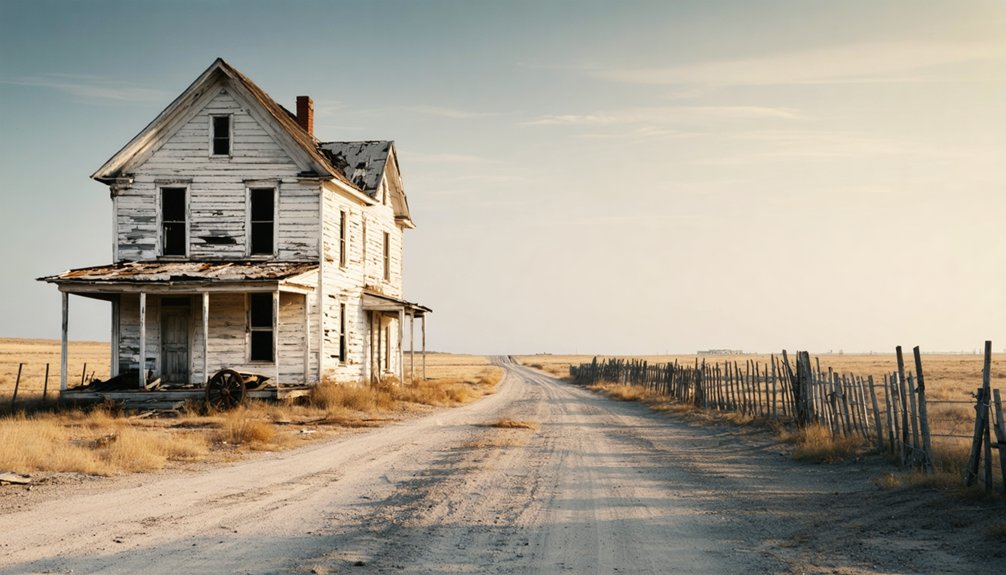
While millions of displaced Americans wandered the nation seeking work, the Roosevelt administration launched an ambitious but ultimately constrained experiment in social engineering. The Resettlement Administration, created May 1935 under Rexford Tugwell, originally planned to relocate 650,000 people from exhausted farmland. Congressional opposition slashed this vision dramatically—you’d see only a few thousand families resettled instead.
The agency’s greenbelt towns exemplified these resettlement challenges. While planners envisioned hundreds of communities, only three emerged: Greenbelt, Maryland; Greenhills, Ohio; and Greendale, Wisconsin.
These model towns combined urban amenities with rural green spaces, yet embodied troubling contradictions. Community segregation prevailed throughout—Mileston, Mississippi served African-Americans exclusively, while other projects remained whites-only.
Notable Ghost Towns From the 1930s
Across America’s urban landscape, makeshift communities rose from desperation as economic catastrophe drove millions from permanent housing into ramshackle settlements that would define Depression-era displacement.
You’ll find that Hooverville history began in 1930 when Charles Michelson coined the term for shantytowns blaming President Hoover. Seattle’s largest site housed 1,200 residents on tidal flats from 1932 to 1941, expanding to nearly 500 shacks by 1934.
New York’s Central Park hosted a settlement at a drained reservoir, repeatedly rebuilt after evictions. This shantytown resilience demonstrated self-governance—Jesse Jackson enforced safety rules as de facto mayor in one community.
Washington state alone featured dozens of these settlements, with health officials estimating 4,000-5,000 residents by late 1935, creating fluid populations that peaked during harsh winters.
Long-Term Economic Impacts on Surviving Communities
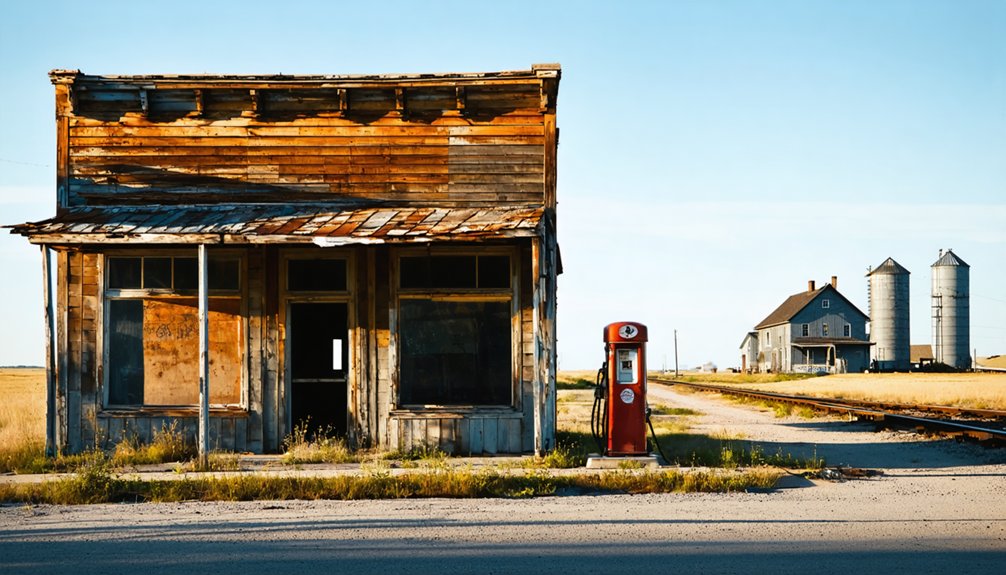
Beyond the temporary settlements that dotted America’s landscape, the Depression carved permanent scars into communities that endured but never fully recovered.
You’ll find evidence in places like Dubuque, where 2,200 layoffs against merely 300 new hires between 1927-1934 fundamentally altered the town’s economic trajectory. While national income reached 88% of 1929 levels by 1937, this incomplete economic recovery masked deeper wounds.
Community resilience required painful adaptations: Chicago’s housing stock transformed from accommodating 60 families to cramming 300 into subdivided kitchenettes, a spatial reorganization that persisted for decades.
Chicago’s desperate housing crisis crammed five times as many families into the same spaces, creating overcrowded conditions that endured for generations.
Washington State’s mill towns, despite achieving 93% income recovery, witnessed families permanently consolidating households. These survivors didn’t return to pre-crash normalcy—they constructed entirely new economic realities from Depression’s wreckage.
Preserving Depression-Era Ghost Towns for Future Generations
California’s Bodie State Historic Park demonstrates how “arrested decay” transforms abandonment into cultural asset—200,000 annual visitors now sustain nearby hamlets by exploring 200 structures frozen as miners left them in the 1930s.
You’ll find historic preservation requires significant investment: Bodie Foundation coordinates cemetery stabilization and depot repairs, while remote location complicates contractor access.
Community engagement proves essential—Ghost Town Club of Colorado’s 501(c)(7) status channels 100% of donations toward endangered sites, funding architectural surveys and volunteer cleanup efforts.
Yet Depression-era towns face distinct challenges. Unlike Gold Rush settlements, many lack historical significance qualifying them for preservation grants.
You’re witnessing preservation’s selective nature: sites offering compelling narratives attract resources, while others disappear. The decision determines which chapters of economic collapse future generations inherit.
Frequently Asked Questions
What Daily Life Activities Did Residents Perform Before Abandoning Depression-Era Towns?
You’d follow daily routines of manual labor—breaking rocks with sledgehammers, picking cotton using traditional farming techniques, fishing for food, and gathering with neighbors for cards before economic collapse forced you to abandon your homes.
How Do Ghost Town Property Rights and Land Ownership Work Today?
You’ll find property inheritance transfers freely through standard deeds, though land reclamation by municipalities occurs when tax foreclosures happen. Banks, government agencies, and private buyers compete for abandoned parcels, while conservation easements sometimes restrict your development rights permanently.
Can People Legally Explore or Photograph Abandoned Depression-Era Ghost Towns?
Exploration legality depends on ownership—you’ll need permission on private land like Dearfield’s parcels, while state-managed sites like Bodie allow regulated access. Photography ethics require respecting preservation efforts and safety restrictions on deteriorating structures.
What Artifacts Are Most Commonly Found in 1930S Ghost Town Sites?
Though trespassing laws vary, you’ll discover artifacts like cast-iron stoves, gaming equipment, mining tools, and unopened goods holding immense historical significance. Primary documentation confirms household furnishings, mercantile inventory, and religious items remain scattered throughout accessible sites.
How Did Children’s Education Continue During the Initial Depression-Era Population Decline?
You’d find rural education persisted through community resources like shared primers and federal grants, though shortened school terms and teacher shortages severely limited access. Families adapted by walking longer distances while educators sought philanthropic support for basic supplies.
References
- https://themortgagepoint.com/2024/10/25/americas-new-ghost-towns/
- https://www.housingwire.com/articles/how-great-recession-created-ghost-towns/
- https://www.lincolninst.edu/publications/articles/new-american-ghost-towns/
- https://www.youtube.com/watch?v=aTbMdOZRZO4&vl=en
- https://www.geotab.com/ghost-towns/
- https://www.lovemoney.com/gallerylist/86648/americas-empty-ghost-towns-and-why-theyre-abandoned-today
- https://247wallst.com/special-report/2018/11/02/30-american-ghost-towns-3/6/
- https://joybird.com/blog/top-ghost-towns-in-america/
- https://storymaps.arcgis.com/stories/124e04142d3147078fb4519a6b9a5c64
- https://en.wikipedia.org/wiki/Dust_Bowl