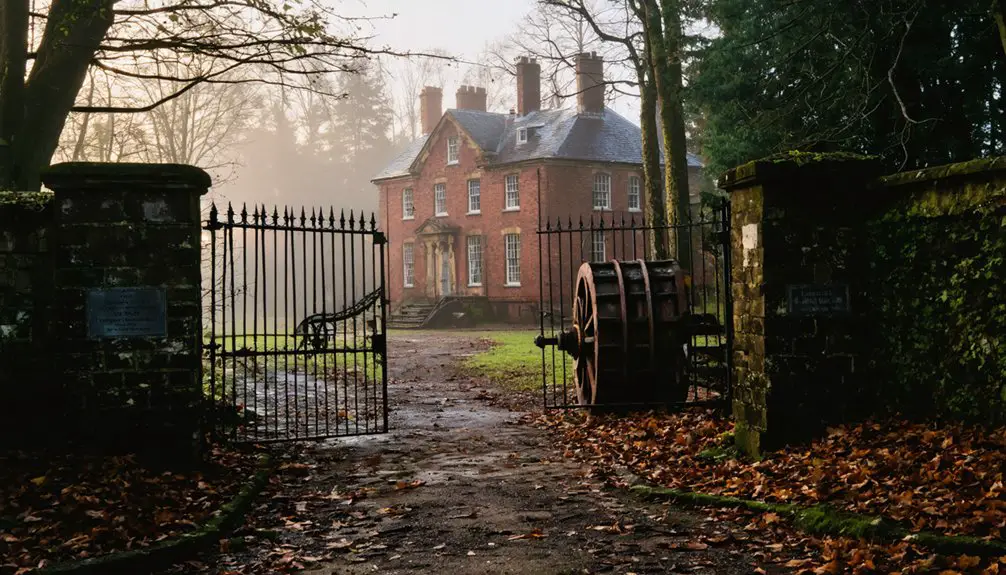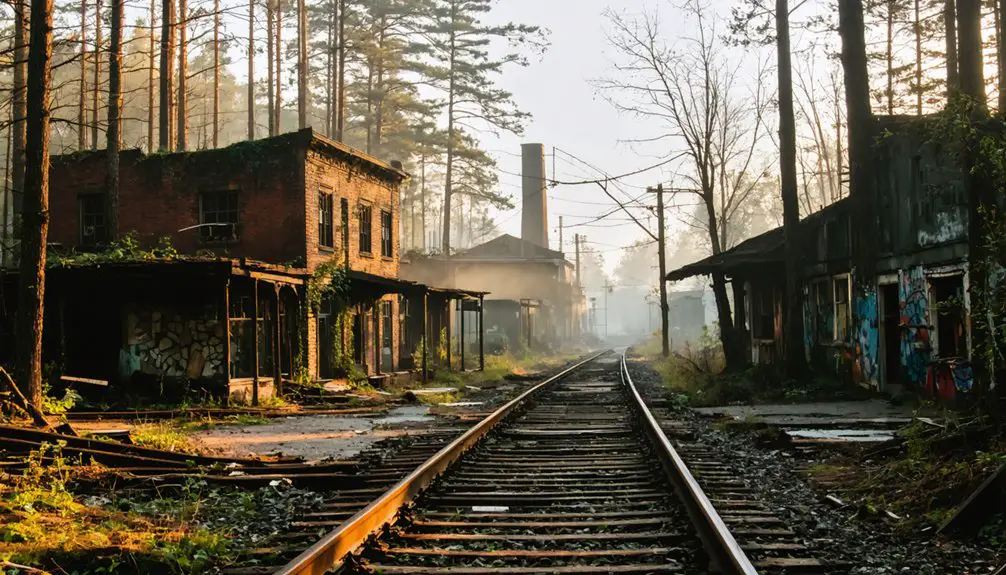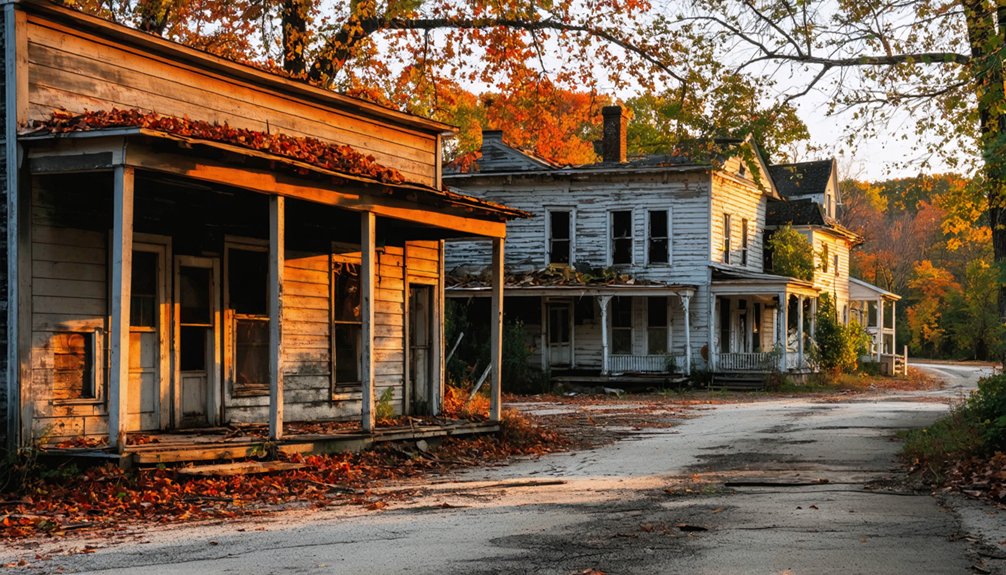
You’ll find New Jersey’s most atmospheric ghost towns ablaze with autumn color in the Pine Barrens, where Batsto’s Revolutionary War ironworks and Double Trouble’s sprawling cranberry bogs glow beneath crimson canopies. Feltville emerges from morning fog in Watchung Reservation, its abandoned worker cottages framed by golden maples, while Whitesbog’s historic blueberry fields transform into russet tapestries. Along the Wading River, Harrisville’s crumbling paper mill ruins hide beneath scarlet oak leaves, their stone foundations barely visible through fall’s vibrant decay—each location revealing deeper stories of industry, abandonment, and seasonal rebirth.
Key Takeaways
- Batsto Village in the Pine Barrens preserves Revolutionary War-era ironworks buildings now open for public exploration of industrial heritage.
- Feltville’s abandoned company town features ten original 1840s buildings with Adirondack porches offering scenic autumn views along Blue Brook.
- Whitesbog Village, birthplace of cultivated blueberries, contains historic structures and the Old Bog Trail near former cranberry farming operations.
- Double Trouble showcases 260 acres of cranberry bogs with vibrant fall foliage, historic worker cottages, and abandoned industry structures.
- Harrisville ruins along Wading River display foundation remnants and stone structures surrounded by autumn’s reds and golds.
Batsto Village: Revolutionary War Ironworks Amid Autumn Colors
When crimson maples frame weathered iron furnaces and golden hickories shade Revolutionary-era workshops, you’ll find yourself transported to 1766 at Batsto Village. Charles Read’s ironworks once thundered with purpose here in the Pine Barrens, forging cannons and ammunition that kept Washington’s army fighting.
Where autumn leaves meet Revolutionary iron—Batsto Village breathes life into 1766, when furnaces forged freedom for Washington’s fight.
You’ll walk paths where exempted workers fueled rebellion through industrial heritage rather than musket fire.
The Richards family’s 91-year stewardship preserved structures you’ll explore today—the general store from pre-Revolutionary days, the addition from 1847, and the imposing ironmaster’s mansion. The village’s name comes from the Swedish word “bastu,” meaning bathing place, likely referencing its use by Lenni Lenape Native Americans before European settlement.
Historic preservation saved this ghost town from becoming an Air Force depot in 1952.
Now New Jersey’s ownership lets you wander freely through autumn-painted grounds where charcoal smoke once billowed and molten iron flowed for American independence. Guided tours reveal Batsto’s supply of war ammunition and stories of British spies who once moved through these very streets during the Revolution.
Feltville: Fog-Shrouded Company Town in Watchung Reservation
Through morning mist that clings to the Watchung Mountains, you’ll discover white clapboard houses emerging like specters from New Jersey’s most haunted company town. David Felt’s 1840s industrial utopia turned ghost village offers you authentic historical architecture—ten original buildings where mill workers once lived under their employer’s iron rule.
You’ll find genuine haunted legends here: three sisters vanished in 1912, two girls drowned in the mill pond, and Revolutionary War soldier John Willcocks still rests beneath his 1776 headstone. The Wilcox Badgley Cemetery sits off the main trail, marking the final resting place of the area’s earliest settlers who arrived in 1736.
The Adirondack-style porches, added during Feltville’s brief resort era, frame perfectly composed autumn views along Blue Brook’s forested ravine. After Glenside Park’s decline, muralist Roberto de la Selva painted elaborate murals inside the homes, adding unexpected artistic treasures to this abandoned industrial settlement.
Visit dawn to dusk when October fog transforms this preserved company town into an otherworldly domain where freedom-seekers escaped urban constraints—before the mountains reclaimed them.
Whitesbog Village: Birthplace of Blueberry Cultivation
Beneath autumn’s copper canopy in the Pine Barrens, white clapboard buildings rise from cranberry bogs where Elizabeth Coleman White revolutionized American agriculture. You’ll discover Whitesbog Village, where blueberry cultivation transformed from wild harvesting to scientific farming in 1916.
White partnered with Dr. Frederick Coville, testing thirty-six wild plants until they perfected the Rubel and Harding varieties—each requiring five years of patient propagation.
This self-sufficient company town sprawls across 3,000 acres of sugar sand roads and forests, preserved as a testament to innovation. Elizabeth White’s 1923 house still stands beside those first cultivated bushes. Walk the Old Bog Trail along the lake where cranberry farming once thrived at New Jersey’s largest operation.
While the village’s general store and workers’ cottages await your exploration on weekend afternoons, here, agricultural history bleeds into wilderness—unbound and authentic. The site holds distinction on both National and State Registers, recognizing its pivotal role in American berry cultivation history.
Double Trouble: Cranberry Bogs and Cedar Swamp Ruins
Among cedar swamps where amber-stained water reflects October maples, Double Trouble State Park preserves a ghost of New Jersey’s cranberry empire.
You’ll wander through 260 acres of abandoned bogs where cranberry harvests once made this one of the state’s largest operations—Mill Pond Bog alone stretched 56 acres, New Jersey’s biggest.
The cedar swamp ruins tell stories of lumber and agriculture merged: Edward Crabbe’s rebuilt sawmill stands silent beside the packing house where workers sorted crimson berries.
Walk the self-guided trails through forests reclaiming what was once a complete company town, 8,000 protected acres where industry flourished for two centuries before the 1959 cranberry scare and eventual dissolution.
The village maintained its self-sufficient character with a general store, schoolhouse, and worker cottages that housed the migrant laborers who once hand-picked berries one at a time.
Timber harvesting from the natural cedar forests created the cleared swampland that became ideal habitat for cranberry cultivation beginning in the 1860s.
Production finally ceased in 2010, leaving autumn’s palette to paint these quiet waters.
Harrisville and Friendship: Deep Pinelands Abandonment
Where the Wading River once powered New Jersey’s paper industry, Harrisville’s brick and stone ruins emerge from pine and oak forests ablaze with fall color. You’ll discover hidden history along crumbling walls—all that remains of the Harris Brothers’ ambitious 1850s mill town.
The settlement thrived with gaslit streets and worker homes until economic collapse forced abandonment in 1891.
A devastating 1914 forest fire completed the destruction, leaving only the South wall standing among autumn’s crimson and gold.
These forest remnants tell stories of vanished communities. Stone scavengers stripped materials decades ago, but you can still trace underground gas piping and foundation outlines.
The YMCA briefly operated Camp Lion here before flames consumed everything.
William McCarty originally constructed the mill using salt hay from nearby marshes as a key papermaking material, damming the Wading River to power his operations in the 1830s. A major fire in 1846 destroyed most of the original mill structure, marking the beginning of the site’s troubled history.
Today, you’re free to explore Wharton State‘s preserved ruins, where nature’s reclaimed what industry abandoned.
Frequently Asked Questions
What Is the Best Time to Visit for Peak Fall Foliage Colors?
You’ll catch peak fall foliage during mid to late October, especially around October 25th. Plan your scenic drives through New Jersey’s abandoned villages when vibrant reds and golds paint the landscape, creating an unforgettable backdrop for exploring forgotten places.
Are Pets Allowed at These Ghost Town Locations?
Pet policies aren’t explicitly posted, but you’ll likely find leash regulations apply at these state park locations. Bring your furry companion along—just keep them leashed while exploring trails, historic buildings, and colorful autumn landscapes together.
Do I Need Permits or Fees to Access These Sites?
You won’t need permits or fees—these ghost towns welcome you freely from dawn to dusk. Just respect private property boundaries and any posted access restrictions. Autumn’s your invitation to explore weathered structures and golden trails without bureaucratic hassle.
Which Locations Are Wheelchair Accessible or Suitable for Strollers?
You’ll find wheelchair-accessible buildings at Feltville’s Church and Masker’s Barn, plus Batsto’s established pathways welcome mobility devices. Allaire’s grounds accommodate accessibility concerns wonderfully, while stroller-friendly paths wind through preserved landscapes, letting you explore history freely with your family.
Can I Camp Overnight Near Any of These Ghost Towns?
You can camp overnight near Batsto Village and Harrisville Ruins in Wharton State Forest with permits. Historical markers guide you to photographic spots where autumn light filters through pines, creating perfect conditions for capturing haunting ruins at golden hour.
References
- https://myfamilytravels.com/ghost-towns-in-new-jersey-that-tell-forgotten-stories/
- https://sojo1049.com/south-jersey-ghost-town-of-batsto-village/
- https://www.journeythroughjersey.com/blog/forgotten-jersey-ghost-towns-and-lost-villages/
- https://en.wikipedia.org/wiki/List_of_ghost_towns_in_New_Jersey
- https://www.e90post.com/forums/showthread.php?t=1109136
- https://pinelandsalliance.org/learn-about-the-pinelands/pinelands-history-and-culture/ghost-towns-of-the-pine-barrens/
- https://www.youtube.com/watch?v=YBrzv3E2O48
- https://www.searchingessexcountyhomes4sale.com/blog/5-haunted-places-in-nj-the-ultimate-fall-adventure/
- https://schifferbooks.com/products/ghost-towns-of-new-jersey
- https://en.wikipedia.org/wiki/Batsto_Village