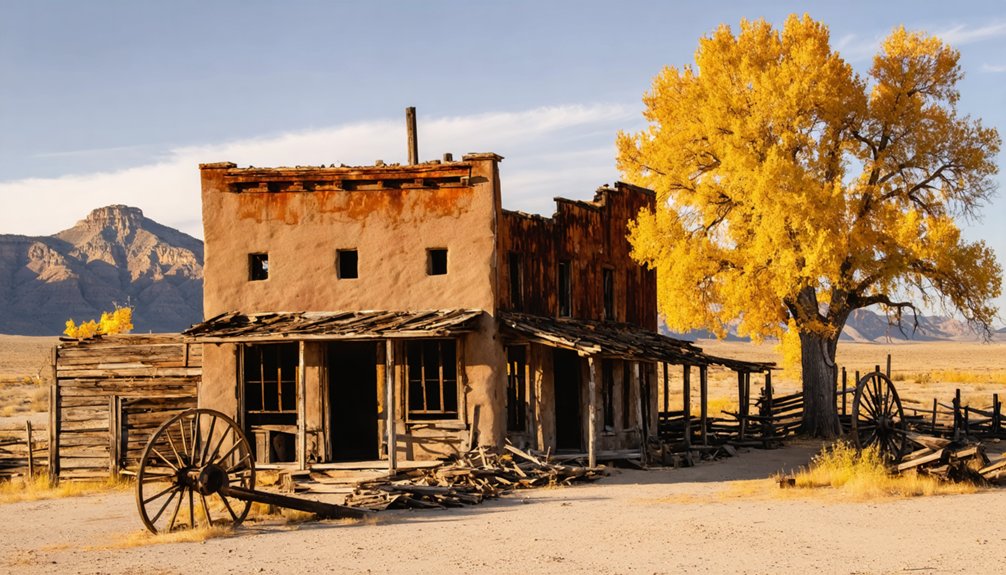
You’ll find New Mexico’s most spectacular ghost town foliage along the Enchanted Circle Byway, where Elizabethtown’s stone ruins stand beneath Wheeler Peak amid golden aspens at 8,000 feet. Madrid’s canyon transforms into an artist colony surrounded by blazing cottonwoods, while Mogollon’s weathered miners’ cabins glow against crimson maples at 7,000 feet. The Turquoise Trail connects abandoned settlements like Cerrillos and Golden through copper-hued volcanic hills, and Route 66’s forgotten towns—Glenrio, Cuervo, Budville—frame Depression-era architecture with October’s vibrant palette awaiting your discovery.
Key Takeaways
- Mogollon, at 7,000 feet, features golden aspens, red maples, and mining ruins including the Little Fannie Mine from the 1880s.
- Madrid’s canyon setting showcases autumn cottonwoods in gold, with over 40 galleries now occupying the abandoned 1954 coal town.
- Elizabethtown ghost town displays stone hotel ruins and adobe structures amid vibrant aspen groves near Wheeler Peak’s 13,161-foot summit.
- White Oaks offers Victorian-era structures and storefronts framed by autumn cottonwoods, founded in 1879 after gold discoveries.
- Route 66 ghost towns like Glenrio and Cuervo feature abandoned buildings surrounded by copper-toned grasses and golden cottonwoods.
Enchanted Circle Scenic Byway Ghost Town Adventures
When autumn paints the Sangre de Cristo Mountains in copper and gold, the 84-mile Enchanted Circle Scenic Byway becomes one of New Mexico’s most spectacular drives—and tucked along its winding route lies Elizabethtown, a weathered reminder of the territory’s wild mining past.
You’ll find this 1866 boomtown between Questa and Red River, where ghost town architecture still whispers stories of seven saloons and fortune-seeking prospectors. The Mutz Hotel’s stone shell stands defiant against time, while multi-level adobe structures showcase frontier ingenuity. Though fire gutted much of Elizabethtown in 1903, historic preservation efforts keep these ruins accessible. As New Mexico’s first incorporated town, Elizabethtown once swelled to nearly 9,000 residents during the 1869 gold rush before declining to just 100 people by 1872.
Circle Wheeler Peak—New Mexico’s highest summit at 13,161 feet—through aspen groves ablaze with yellow, and discover why this backcountry loop attracts riders seeking both natural beauty and untamed history. Nearby Red River offers the Red River Fish Hatchery as an educational stop for visitors exploring the scenic byway’s attractions.
Turquoise Trail Historic Mining Communities
Stretching fifty miles between Santa Fe and Albuquerque, the Turquoise Trail National Scenic Byway cuts through 15,000 square miles of piñon-studded hills where volcanic forces thrust copper-rich veins skyward 34 million years ago.
You’ll discover Cerrillos, where mining relics from North America’s oldest continuously worked turquoise mines tell stories spanning 1,200 years. Native Americans extracted chalchihuitl here since 900 CE, followed by Spanish miners and 1880s prospectors who shipped weekly cigar boxes of rough turquoise eastward by rail. The 1880s mining boom supported a bustling town with 21 saloons and four hotels. Tiffany & Company brought international recognition to the district when they showcased Cerrillos turquoise jewelry in Paris during the late 1880s.
Today’s heritage preservation efforts shine through Casa Grande Trading Post’s locally mined jewelry and the Turquoise Mining Museum’s antique displays. Golden survives with just ten families, while Cerrillos’ 200 residents maintain hiking trails and offer $75 mine tours. Historical Society plaques mark nineteen district buildings along this scenic corridor.
Madrid: A Living Ghost Town in Autumn Glory
Just three miles south along the byway, Madrid sprawls across a canyon where autumn transforms cottonwoods into golden torches against rust-red mine tailings.
Madrid unfolds where canyon walls cradle autumn’s gold—cottonwoods blazing brilliant against the scarred earth of forgotten mines.
You’ll wander through a company town that died in 1954 when natural gas killed coal, leaving 2,500 souls’ worth of empty wood-frame cabins rotting for two decades.
Historical preservation began in the 1970s when Joe Huber rented those shells to artists wielding hammers and vision.
Today’s artistic revitalization pulses through forty galleries and shops where miners once trudged.
The Mine Shaft Tavern’s longest bar in New Mexico pours beneath timbered ceilings, while October light streams through aspens onto streets that knew both abandonment and resurrection.
Oscar Huber built the first illuminated baseball park west of the Mississippi here in 1922, where the Madrid Miners once played.
Pueblo residents mined turquoise for centuries in this valley before coal ever powered the town’s rise.
You’re free to explore this ghost town that refused to stay dead.
Mogollon Mountain Fall Colors and Mining Heritage
You’ll find Mogollon clinging to the mountainside at 7,000 feet, where golden aspens blanket the high peaks each October. Fire-engine red maples frame weathered miners’ cabins.
The Bursum Road winds down from Glenwood through sheer canyon walls, delivering you to a town where antique stores and a mining museum still occupy century-old buildings. Warm, sunny days combined with cool nights intensify the red hues through anthocyanin production in the leaves. This former mining town has transformed into a tourist destination while maintaining its historic character.
From the historic cemetery perched above town, you can scan the entire valley as it transforms into a patchwork of scarlet oaks, golden aspens, and the dark green pines that never surrendered to autumn.
Historic Mining Town Ruins
Where rusted mining equipment meets flame-colored aspens, Mogollon’s crumbling stone foundations tell the story of New Mexico’s most productive gold and silver district. You’ll discover stone walls where 6,000 miners once worked crushing 18 million ounces of silver from toxic quartz dust.
The Little Fannie Mine‘s skeletal remains dominate the landscape—this operation ran continuously, 24 hours daily, producing $20 million in ore between 1887 and 1942.
Ghost town exploration reveals the harsh reality behind the wealth: miners averaged just three years before silicosis ended their careers. Walk past the 1890 jail and schoolhouse ruins, where eight-team freight wagons once departed for Silver City. The town sits at an elevation of 6,614 feet, where autumn temperatures create ideal conditions for viewing the surrounding fall colors. Repeated fires devastated Mogollon in 1894, 1904, 1910, 1915, and 1942, prompting rebuilding efforts with more durable stone constructions that still stand among the aspens today.
Mining history whispers through empty doorways, where autumn gold now illuminates what human ambition abandoned.
Autumn Aspen Viewing Access
The same mountains that concealed fortunes in silver now stage one of New Mexico’s most dramatic autumn displays, where golden aspens blanket elevations from 8,000 to 11,000 feet above Mogollon’s abandoned streets. You’ll navigate Bursum Road as it weaves down from the ghost town through shimmering groves, their white trunks towering against October skies. Sacaton Road delivers closeup views of the south-facing Mogollon escarpment rising abruptly from the Gila River Valley floor.
Aspen ecology thrives here—vast stands quaking in mountain silence, their leaves creating pathways of gold beneath your boots.
Fall wildlife emerges during early morning drives when deer browse among the crimson maples and scarlet ivy. The Crest Trail follows the ridgeline from Sandy Point to Mogollon Baldy, accessing remote groves unreachable by vehicle, where orangish reds cascade through canyons below.
Cerrillos Ancient Turquoise Mines Among Golden Aspens
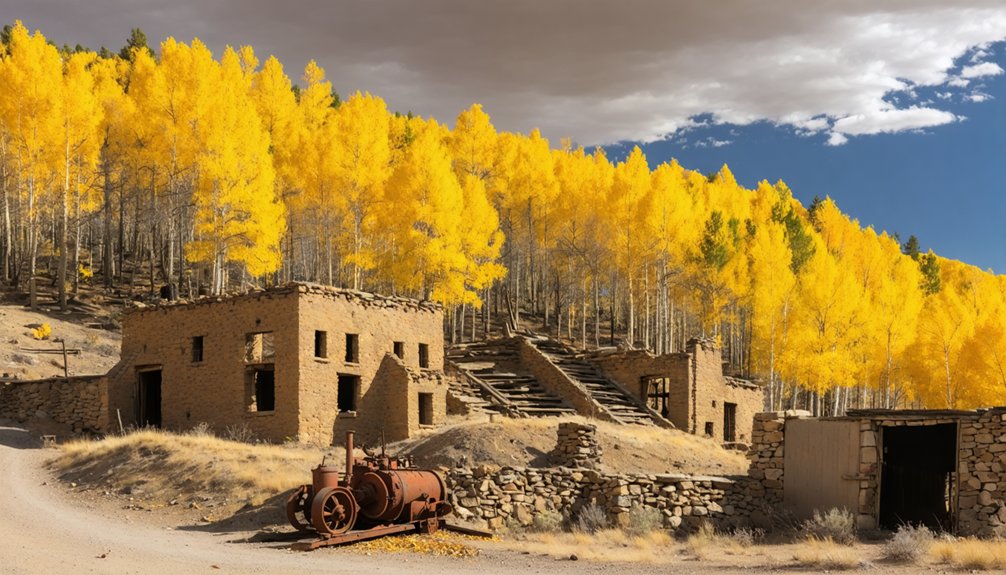
Just 30 miles from Santa Fe, Cerrillos sits beneath hills that yielded turquoise for over a thousand years, where ancient miners extracted the coveted blue-green stone centuries before Spanish cattle ranchers named these undulating rises “little hills.”
You’ll find this weathered mining settlement framed by autumn’s golden cottonwoods along the Galisteo Basin, where prehistoric extraction pits still pockmark the slopes that once supplied turquoise traded from Chaco Canyon to Central America.
The surrounding piñon-juniper hills glow amber and rust each October, casting warm light across a landscape where Native peoples, and later prospectors shipping gems to Tiffany & Co., pursued the Southwest’s most precious stone.
Ancient Mining Heritage Preserved
Beneath Mount Chalchihuitl’s golden aspen canopy, centuries-old turquoise mine shafts pierce the earth like portals to New Mexico’s layered past. You’ll discover ancient artifacts scattered across Bronze Trail sites—lapstones, mining tools, and processing debris left by Native American miners who extracted the sacred blue stone between A.D. 700-900.
Their mining techniques evolved over centuries, reaching peak sophistication during Chaco Canyon’s cultural zenith and later pueblo expansions. Walk among the massive open pit’s weathered walls where Spanish colonists, American prospectors, and Tiffany & Co.’s suppliers once sought fortune.
These preserved sites tell stories of trade routes stretching to Central America, of turquoise transformed into “Tiffany Blue” standards, of freedom-seeking miners who shaped southwestern commerce before railroad expansion scattered their operations across new horizons.
Fall Colors Near Santa Fe
Where ancient turquoise extraction meets autumn’s blazing transformation, the Cerrillos Hills south of Santa Fe become a striking canvas of amber aspens framing weathered mining operations. You’ll discover abandoned shafts surrounded by golden foliage that rivals any mountain lake’s reflected brilliance.
Your exploration route includes:
- Hyde Park Road ascending through Sangre de Cristo Mountains where aspens shimmer like gold coins
- Aspen Vista Trail offering immersive hiking beneath crimson-tinged canopies
- Santa Fe National Forest Scenic Byway reaching 13,000-foot alpine wilderness
- Enchanted Circle connecting Taos through fiery autumn corridors
Late September delivers peak colors—fiery golds complementing azure skies. Dappled sunlight creates photographic magic while quaking leaves generate nature’s percussion.
Where wildflower blooms once carpeted spring hillsides, autumn’s transformation now illuminates forgotten turquoise claims with breathtaking intensity.
Route 66 Abandoned Settlements During Peak Foliage Season
While Interstate 40 may have stolen the thunder from America’s Mother Road, autumn breathes new life into New Mexico’s forgotten Route 66 settlements. Cottonwood trees blaze gold against crumbling adobe walls and rusted neon signs.
You’ll find Glenrio straddling the Texas border, its seventeen abandoned buildings framed by October’s copper-toned grasses. The old Texaco station stands sentinel while the original roadbed cuts through landscapes painted in amber and rust.
Cuervo, physically split by Interstate 40’s construction, offers haunting ghost town photography opportunities. Cottonwoods glow against deteriorating mid-century architecture.
Budville’s defunct trading post becomes particularly atmospheric when fall’s crisp air mingles with the scent of sage. These sites represent more than route preservation—they’re portals to America’s pre-interstate freedom, best experienced when autumn transforms abandonment into art.
Sandia Crest Byway and Central Region Ghost Towns
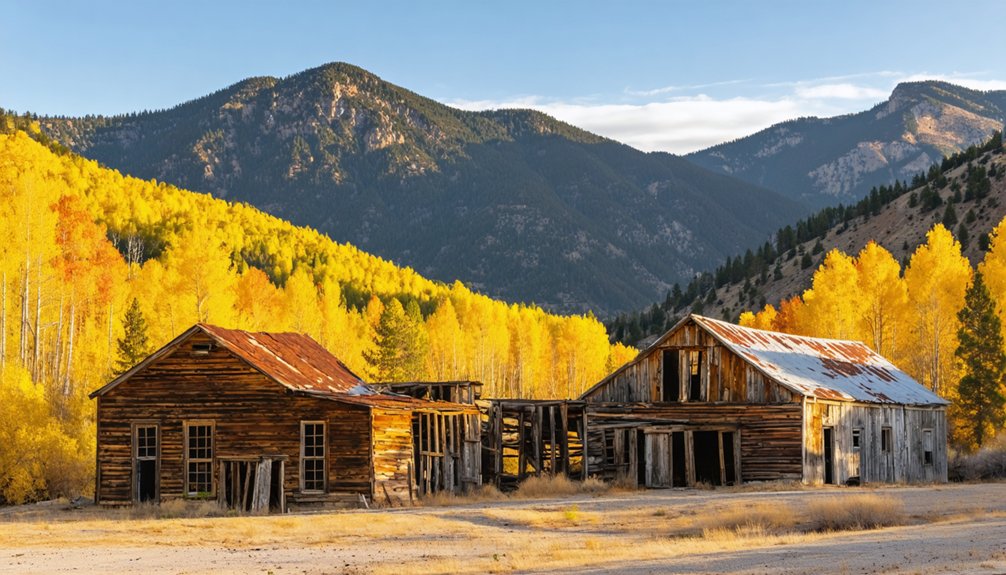
From the faded asphalt of historic Route 66, New Mexico’s ghost town trail climbs sharply toward the Sandia Mountains, where NM-536 twists through 3,000 vertical feet to reach the 10,678-foot crest.
Mid-October transforms aspen patches into golden fire against granite outcrops, while the Sandia Crest fall foliage frames sharp westward drops over Albuquerque’s sprawl.
Your route pairs high-altitude color with central region ghost towns:
- Madrid – Coal-mining skeleton reborn as artist colony along Highway 14
- Tinkertown – One man’s miniature obsession near mountain junction
- Abo Mission – Spanish stone ruins in grassland solitude
- Highway 165 – Rutted gravel east of I-25 for adventurous spirits
Navigate Highway 14 from the byway’s southern descent, avoiding Sunday crowds choking the curves above Placitas.
White Oaks Frontier Settlement Amid Fall Splendor
Gold fever shattered the stillness of the Jicarilla Mountains in 1879 when John Wilson—a Texas prison escapee, according to local lore—struck ore that would transform cattle country into New Mexico Territory’s second-largest city.
You’ll find Victorian homes with widow’s walks still standing where 2,500 fortune-seekers once hustled through dusty streets.
The South Homestake Mine‘s prosperity couldn’t overcome stubborn landowners who demanded premium prices when railroads came calling in the late 1890s. Those tracks bypassed White Oaks entirely, sealing its fate.
Billy the Kid frequented these saloons before a 1880 standoff left Deputy Jim Carlyle dead from friendly fire.
Today, historical preservation maintains the No Scum Allowed Saloon and fifteen resilient residents who’ve mastered tourism development without sacrificing authenticity.
Autumn cottonwoods frame empty storefronts—freedom’s golden monument.
Frequently Asked Questions
What Hiking Trails Connect Ghost Towns With Best Fall Foliage Viewing Points?
Like stepping through a golden portal, you’ll discover Crest Trail near Mogollon ghost town offers unmatched autumn photography spots. These historical landmarks at 7,000 feet blend old-growth forests with aspen groves, creating spectacular freedom-filled vistas.
Are Ghost Town Roads Accessible During Autumn Weather Conditions?
You’ll find most ghost town roads accessible during autumn, though higher elevations challenge navigation. Time your fall foliage photography adventures wisely—ghost town history awaits on clearer days, while mountain passes demand respect when weather shifts unexpectedly.
Which Ghost Towns Offer Overnight Accommodations During Peak Foliage Season?
You won’t find overnight stays within actual ghost towns due to preservation efforts, but you’ll discover authentic accommodations nearby at Bear Mountain Lodge and Ghost Ranch, where historical significance meets autumn’s golden embrace through rustic comfort and artistic heritage.
Do Ghost Towns Charge Admission Fees During Fall Tourism Months?
Autumn’s golden ticket costs little here. You’ll find most photography hotspots free—Lake Valley, Chloride, and Hillsboro welcome wanderers without fees. Historic preservation sites like Fort Selden charge $5, while Shakespeare requires $15 for guided exploration through crackling leaves.
What Wildlife Viewing Opportunities Exist Near Ghost Towns in Autumn?
You’ll find exceptional wildlife photography opportunities near ghost towns, from bighorn sheep at Sandia Crest to autumn birdwatching for phainopeplas at Dripping Springs. Mule deer roam golden aspen groves while black bears forage freely through Mogollon’s rugged wilderness.
References
- https://www.newmexico.org/fall-events/fall-colors/
- https://casaescondida.com/blog/fall-foliage-in-northern-new-mexico/
- https://newmexicotravelguy.com/new-mexico-ghost-towns/
- https://www.newmexico.org/places-to-visit/ghost-towns/
- https://www.atlasobscura.com/things-to-do/new-mexico/ghost-towns
- https://www.tripadvisor.com/Attractions-g28952-Activities-c47-t14-New_Mexico.html
- https://www.onlyinyourstate.com/trip-ideas/new-mexico/the-new-mexico-ghost-town-thats-perfect-for-an-autumn-day-trip
- https://mossandfog.com/exploring-new-mexicos-ghost-towns-on-a-road-trip/
- https://www.newmexicomagazine.org/blog/post/abandoned-ghost-towns-new-mexico/
- https://www.youtube.com/watch?v=O_1iT_a-Wzw