Horror films weaponize ghost towns as psychological battlegrounds where America’s darkest anxieties take physical form. You’ll encounter Stephen King’s Castle Rock, representing post-industrial decay, and Silent Hill, inspired by Centralia’s real coal fires that’ve burned since 1962. Raccoon City critiques corporate malfeasance through zombie apocalypse, while Whitewood’s cursed streets demand virgin sacrifices. Filmmakers select these desolate settings because they strip away civilization’s comforting presence, forcing you to confront primal fears in abandoned mining towns and fog-shrouded streets where environmental catastrophes breed supernatural terror and historical tragedies resurface as literal monsters.
Key Takeaways
- Centralia, Pennsylvania inspired Silent Hill’s fog-shrouded horror with its underground coal fire burning since 1962 creating toxic emissions.
- Castle Rock, Maine appears throughout Stephen King’s works representing post-industrial American gothic terror and supernatural dread.
- Raccoon City’s 1998 zombie outbreak demonstrates corporate malfeasance when Umbrella Corporation’s viral experiments contaminate an entire town.
- Whitewood, Massachusetts in *The City of the Dead* features a witch’s eternal curse requiring annual sacrifices since 1692.
- Sleepy Hollow combines fog-shrouded gothic atmosphere with the Headless Horseman’s supernatural revenge in Tim Burton’s 1999 adaptation.
Castle Rock, Maine: Stephen King’s Cursed Haven
Since its first appearance in *The Dead Zone* (1979), Castle Rock has functioned as Stephen King’s principal laboratory for American gothic terror, a recurring fictional Maine town that transforms the mundane anxieties of post-industrial decline into supernatural nightmare.
Castle Rock transforms ordinary American decay into supernatural dread, serving as Stephen King’s recurring laboratory for post-industrial gothic horror.
You’ll find Castle Rock’s cursed legacy woven through novels like *Cujo* (1981) and short stories from *Skeleton Crew* (1985), establishing literary connections across King’s interconnected universe.
The town’s eerie atmosphere emerges from supernatural events layered atop economic decline—industry flight, death rates exceeding births, and workaday despair. This post-industrial horror mirrors real Maine communities like Mechanic Falls, whose haunted history informed King’s fictional origins.
Though destroyed in *Needful Things* (1991), Castle Rock’s resurrection in later works proves its enduring power as freedom’s antithesis: a place where escape remains impossible. Mechanic Falls, believed to be the closest real-world match to Castle Rock, shares the small-town isolation and eerie history that permeate King’s fictional setting. The town received renewed attention through the Hulu series that aired from 2018 to 2019, bringing its dark mythology to television audiences.
Silent Hill: Where Coal Fires Birth Nightmares
Silent Hill’s atmospheric horror draws directly from Centralia, Pennsylvania, where an underground coal fire has burned since 1962, transforming a mining town into an abandoned wasteland.
You’ll recognize how the game’s perpetual fog and toxic air mirror Centralia’s smoke-filled streets, while the franchise’s signature shift between realities parallels the disorienting effect of heat distortion rising from cracked pavement above 1,000-degree infernos.
The coal fire becomes more than setting—it functions as the narrative engine generating both the environmental conditions for psychological terror and the metaphorical hellscape where trauma manifests as monstrous aberrations.
The town’s original prosperity stemmed from Wiltse Mine’s discovery in 1850, when high-quality limestone deposits transformed the area into a thriving mining community before its eventual decline.
The 2006 film adaptation made this connection explicit, with director Christophe Gans using Centralia’s burning mythology to enhance Silent Hill’s cinematic version, even temporarily titling the project “Centralia” during production.
Coal Fire Origins
In May 1962, a deliberate landfill fire in Centralia, Pennsylvania—a coal-mining town two hours northwest of Philadelphia—ignited a catastrophe that would burn for over six decades and inspire one of horror cinema’s most haunting settings.
The spark spread to rich anthracite coal deposits beneath the town, which sat atop unsealed strip mine pits from a century of mining operations. Local firefighters couldn’t extinguish the initial blaze as flames spread through abandoned tunnel networks.
Fire containment efforts consistently failed—water pumping would require twenty years, trenching proved futile, and smothering projects exhausted funding.
Today, the underground inferno advances seventy-five feet annually, generating toxic emissions exceeding 1,000 degrees Fahrenheit. Carbon monoxide and poisonous gases vent through ground cracks while white smoke pours from sinkholes, creating Silent Hill’s nightmarish foundation. The disaster forced the evacuation of the town as poisonous gas fumes and rising temperatures made habitation impossible.
Screenwriter Roger Avery cited Centralia as inspiration for the Silent Hill film adaptation, though the video game itself drew from different sources entirely.
Fog and Shifting Reality
When Konami’s developers transformed PlayStation hardware limitations into canonical horror in 1999, they discovered that obscured visibility could terrify players more effectively than explicit gore.
Silent Hill’s fog symbolism operates beyond mere aesthetics—it functions as reality’s deteriorating membrane, where sensory perception fails and psychological distortion manifests physically.
You’ll navigate three distinct states: baseline reality, the Fog World’s deceptive familiarity, and the Otherworld’s raw exposure of inner trauma. Each shift strips away protective illusions through ordinary doorways and encounters, disguising supernatural alterations as natural progression.
The fog doesn’t conceal monsters—it reveals your protagonist’s fragmenting psyche, where rusted surfaces and pulsing walls externalize suppressed guilt. The town’s location beside Tuca Lake connects its supernatural properties to Native American spiritual practices that once maintained equilibrium through seasonal ceremonies.
This reality-shifting mechanism transcends dimensional travel, instead presenting perception itself as fundamentally unreliable within Silent Hill’s boundaries. The bleak, industrial environments of the Otherworld contrast starkly with the foggy daytime atmosphere, creating a constantly changing mirror that heightens the sense that no version of reality offers genuine safety.
Creatures of the Mist
Beneath Pennsylvania’s Locust Mountain, Centralia’s burning coal veins provided screenwriter Roger Avery the geographical template for Silent Hill’s 2006 cinematic adaptation—a town where subterranean fires don’t simply destroy infrastructure but manufacture apocalyptic symbolism.
The mysterious fog perpetually shrouding Silent Hill mirrors Centralia’s toxic emissions, transforming atmospheric phenomena into narrative device. Where Centralia produces carbon monoxide reaching lethal concentrations, the film’s mist births grotesque manifestations—creatures emerging from haunting shadows cast by a town’s collective trauma.
The 1,000-degree temperatures documented in Centralia’s boreholes become metaphorical incubators for psychological horror. Avery recognized that authentic catastrophe requires no embellishment; a fire expanding 75 feet annually, consuming everything beneath civilization’s surface, already exists as humanity’s unconstrained nightmare—one demanding neither censorship nor sanitization. The Assumption of the Blessed Virgin Mary Church, erected in 1911, stands among only three structures surviving the decades-long inferno, its persistence against annihilation offering Silent Hill’s filmmakers a visual anchor for humanity’s stubborn defiance against obliteration. Beyond the film adaptation, Centralia serves as a place name that has inspired numerous horror narratives exploring themes of abandonment and environmental disaster.
Raccoon City: Ground Zero of the Zombie Apocalypse
Though founded in 1881 as an unremarkable industrial settlement in the Arklay Mountains, Raccoon City‘s trajectory shifted dramatically when the Umbrella Corporation established operations there in 1968.
You’ll find this Midwestern locale transformed from economic stagnation into a thriving hub through pharmaceutical investment—hospitals, orphanages, and university renovations masked sinister bioresearch agendas.
The corporation’s underground facilities, including the P-12A Incinerator Facility northeast of Raccoon Park, conducted illegal viral experimentation.
When t-Virus leaked in late summer 1998, the city became ground zero for zombie outbreak narratives that critique corporate malfeasance and governmental complicity.
This fictional catastrophe explores how unchecked scientific ambition, concealed beneath civic prosperity, can trigger societal collapse—a cautionary tale resonating with audiences questioning institutional authority.
Whitewood, Massachusetts: A Witch’s Eternal Revenge
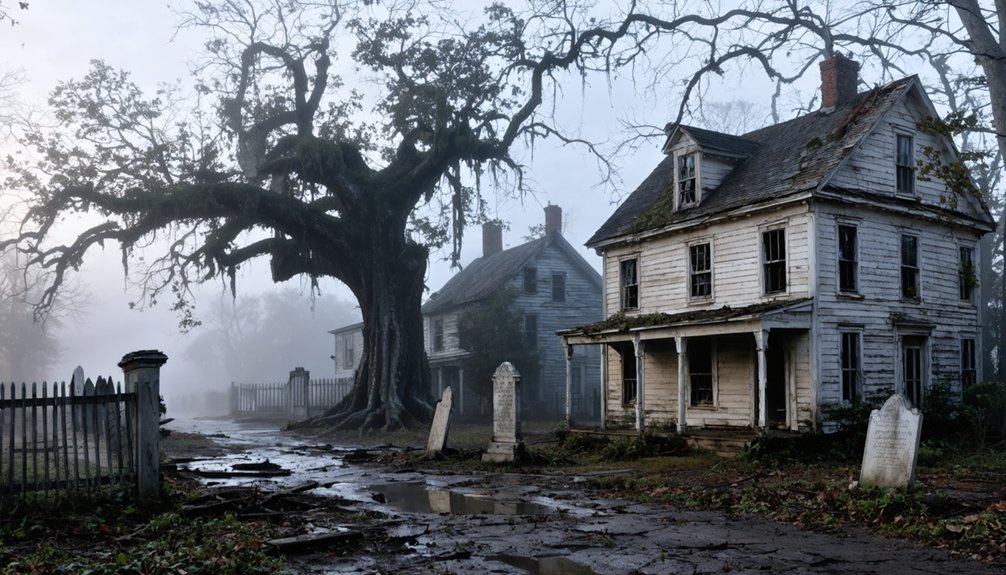
In 1960’s *The City of the Dead* (released as *Horror Hotel* in American markets), director John Llewellyn Moxey presents Whitewood, Massachusetts as a settlement frozen in perpetual damnation since Elizabeth Selwyn‘s 1692 execution.
Before burning, Selwyn and accomplice Jethrow Keane traded their souls for eternal life, cursing Whitewood as Lucifer’s domain through annual virgin sacrifices.
The fog-shrouded town operates as an elaborate trap—Professor Driscoll (Christopher Lee) lures witchcraft practices researchers while innkeeper Mrs. Newless, actually Selwyn herself, provides lodging at The Raven’s Inn.
This seemingly abandoned village maintains approximately twelve residents who teleport when detected, intensifying their supernatural revenge during Candlemas Eve and the Witches’ Sabbath.
The coven’s centuries-long operation demonstrates how colonial witch-burning paranoia birthed genuine supernatural threats, transforming legitimate historical investigation into deadly vulnerability.
Sleepy Hollow: Domain of the Headless Horseman
When you encounter Tim Burton’s 1999 reimagining of Washington Irving’s classic tale, you witness Ichabod Crane transformed from a superstitious schoolteacher into a rational constable whose scientific methods clash with Sleepy Hollow’s supernatural reality.
The Horseman’s curse extends beyond Irving’s singular ghost story into a conspiracy of blood magic and revenge that binds the undead Hessian soldier to the town’s dark history.
Burton’s gothic vision reconstructs the 1790 Hudson Valley settlement as a fog-shrouded domain where German Expressionist shadows and American folklore converge, turning Sleepy Hollow itself into a liminal space between Enlightenment reason and primal terror.
Ichabod Crane’s Investigation Begins
Tim Burton’s 1999 Gothic reimagining of Washington Irving’s classic tale transforms Ichabod Crane from a superstitious schoolmaster into a rational investigator whose empiricism faces its ultimate test.
Johnny Depp’s portrayal emphasizes Ichabod’s skepticism as he arrives in the isolated village to investigate three decapitations. You’ll find the investigator initially dismissing local legends about a headless Hessian mercenary whose rampage terrorizes the western woods.
The village elders—including Lady Van Tassel, Baltus Van Tassel, and Reverend Steenwyck—warn him of supernatural forces awakened after twenty years’ dormancy. Yet Crane’s forensic methods and autopsy techniques reveal his commitment to scientific rationalism.
Only after personally witnessing a victim’s decapitation does he acknowledge the horseman’s existence, forcing him to reconcile Enlightenment principles with inexplicable horror.
The Horseman’s Curse
Burton’s reimagining grounds the Horseman’s supernatural threat in a dark historical foundation: a Hessian mercenary who fell during the Revolutionary War, his head severed by his own broadsword in Sleepy Hollow‘s western woods.
The Horseman Origins reveal burial without his skull, trapping him in limbo—a Curse Mechanism Lady Van Tassel exploits through skull possession.
Her Control Rituals at the Tree of the Dead direct systematic executions of estate heirs and conspirators.
Key Confrontations escalate from the midwife’s family massacre to Brom’s failed combat attempt, demonstrating the entity’s unstoppable nature under Van Tassel’s command.
Resolution Events arrive when Crane returns the skull, restoring the Horseman’s humanity momentarily before he drags his summoner to Hell, permanently ending the terror that held Sleepy Hollow captive.
Burton’s Gothic Vision
Few directors have weaponized atmosphere as effectively as Tim Burton does in his 1999 adaptation of *Sleepy Hollow*, transforming Washington Irving’s 1820 tale into a fog-drenched nightmare where every shadow conceals potential decapitation.
Burton’s aesthetic creates a village imprisoned by supernatural dread, where Gothic elements operate as narrative architecture rather than mere decoration.
His visual strategy encompasses:
- Oversaturated color palettes contrasting blood-red against monochromatic landscapes
- Dutch Colonial structures with deliberately crooked spires suggesting metaphysical instability
- Practical decapitation effects grounding fantasy in visceral horror
- Strategic fog deployment transforming geography into psychological terrain
This $100 million production earned Academy recognition for cinematography that renders Sleepy Hollow as inescapable domain—a cursed hamlet where Christopher Walken’s undead Hessian enforces eternal Halloween.
Hobs End: Where Reality Unravels
When H.P. Lovecraft crafted Hobs End in “The Haunter of the Dark,” he fused urban decay with cosmic horror, creating a Providence suburb where forbidden knowledge triggers psychological breakdown.
You’ll find this ancient city namesake represents more than geographical location—it’s a threshold where reality distortion manifests through alien geometries and eldritch secrets.
Robert Blake’s supernatural exploration of the abandoned church awakens dormant forces, demonstrating Lovecraft’s signature motif: existential dread born from humanity’s insignificance against unknowable dimensions.
Blake’s transgression into forbidden spaces reveals Lovecraft’s core truth: mankind’s cosmic irrelevance breeds terror beyond mortal comprehension.
The 2005 film adaptation, featuring Jeffrey Combs, visualizes this unraveling through disorienting architecture and pulsating shadows.
Unlike rural isolation tropes, Hobs End proves urban landscapes equally harbor malevolent antiquity, influencing modern horror’s approach to reality-warping locales and establishing the archetype of cities concealing pre-human terrors.
Centralia, Pennsylvania: The Real-Life Silent Hill
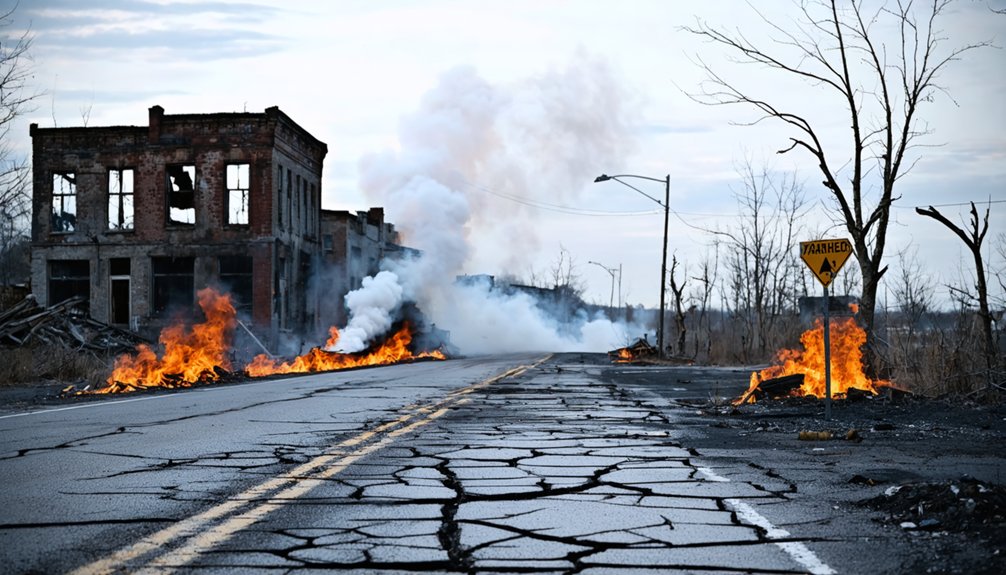
Beneath the streets of Centralia, Pennsylvania, coal has burned continuously since 1962, transforming this once-thriving mining community into America’s most infamous modern ghost town.
What began as routine trash burning ignited an exposed coal seam, triggering underground fires that drove nearly 3,000 residents from their homes. You’ll find toxic emissions still seeping through sinkholes across the landscape, creating the eerie atmosphere that inspired Silent Hill’s horror franchise.
The government’s response reveals bureaucratic paralysis:
- Failed containment: Water flushing, excavation, and trenching proved futile
- Projected timeline: 1983 studies indicated century-long burning potential
- Forced exodus: Federal relocation grants decimated the population from 1,000 (1980) to five (2020)
- Final settlement: Seven holdouts received $218,000 per home in 2013
This environmental catastrophe demonstrates how unchecked disasters erase communities.
Abandoned Mining Towns That Inspired Horror Cinema
While Centralia’s ongoing catastrophe demonstrates contemporary environmental horror, the cinematic exploitation of abandoned mines reveals a broader cultural anxiety about industrial collapse and geographic isolation.
You’ll find *My Bloody Valentine* (1981, 2009) invoking the 1968 Springhill disaster’s 75 fatalities, transforming Valentine Bluffs into claustrophobic terror through pickaxe murders in collapsed shafts.
*Beneath* (2013) traps you 600 feet underground where toxic air breeds madness, echoing the 1902 Frick Mine explosion’s 112 deaths.
Even *Mine Games* (2012) employs spectral visions and ghostly echoes in Washington’s forsaken tunnels.
These films weaponize historical references to urban decay—from Colorado’s St. Elmo (*Phantoms*, 1998) to Appalachian ruins (*Two Thousand Maniacs!*, 1964)—converting economic devastation into cinematic isolation that mirrors your fears of societal abandonment.
Why Filmmakers Choose Desolate Settings for Supernatural Terror
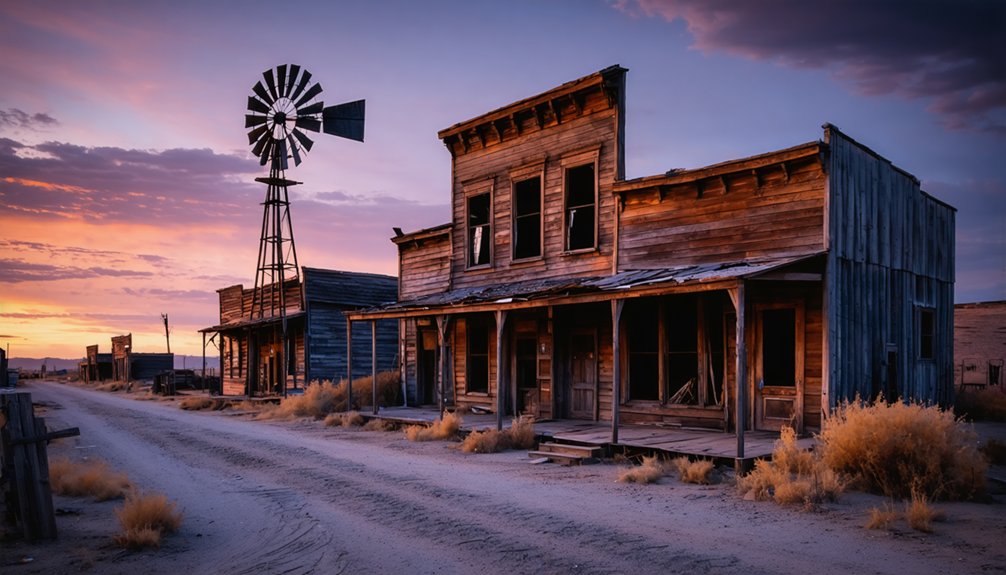
Beyond mining disasters’ tangible horrors, filmmakers systematically exploit desolate settings to manufacture supernatural terror through calculated atmospheric manipulation. The Horror Atmosphere you experience in these locations stems from deliberate environmental choices that strip away civilization’s comforting presence.
Strategic Desolation Impact Elements:
- Psychological Isolation – Empty streets in Burkittsville (*The Blair Witch Project*) intensify realism by removing escape routes and witnesses.
- Visual Decay – Real-life deterioration in Belchite, Spain enhances *Pan’s Labyrinth’s* fantasy horror through authentic architectural collapse.
- Production Economics – Accessible locations like Seneca Creek State Park deliver natural desolation without fabrication costs.
- Cultural Resonance – Iconic venues such as The Stanley Hotel perpetuate *Shining* lore, transforming filming sites into pilgrimage destinations.
These environments amplify vulnerability by eliminating societal safety nets, forcing confrontation with primal fears.
Frequently Asked Questions
Can Tourists Visit Any of These Ghost Town Filming Locations Today?
You’ll find that authentic ghost town tours aren’t documented in this data set, though various horror filming locations function as tourist attractions. The background information details accessible studio sets and active towns rather than abandoned settlements.
Which Horror Ghost Town Movie Had the Biggest Box Office Success?
You’ll find *Last Rites* (2025) dominates the horror genre’s ghost town box office with $494 million, surpassing *The Conjuring* franchise’s supernatural town narratives and demonstrating contemporary audiences’ unrestrained appetite for apocalyptic settings.
Are Any Ghost Town Horror Films Based on True Paranormal Events?
No ghost town horror films draw from documented real-life hauntings or paranormal investigations in abandoned mining settlements. While movies like *An American Haunting* cite true supernatural events, they’re not set in ghost towns you’d recognize.
The allure of ghost towns in famous western films often stems from their historical significance and atmospheric decay. These cinematic representations shape our understanding of the Wild West, transforming desolate landscapes into backdrops for epic tales of survival and intrigue. While they may differ from actual ghost town experiences, their impact on popular culture remains undeniable.
What Special Effects Create the Eerie Fog in Ghost Town Movies?
You’ll find fog simulation employs glycol-based fluids atomized through heated nozzles, while atmospheric techniques utilize chillers for ground-hugging effects. Backlighting enhances particle visibility, and post-production layering augments practical elements, granting filmmakers complete creative control over eerie environments.
Do Ghost Town Horror Films Typically Get Sequels or Franchise Expansions?
Ghost town horror films rarely achieve sequel potential due to self-contained narratives and modest box office returns. You’ll find franchise success remains elusive, as these atmospheric settings typically function as standalone experiences rather than expandable universes requiring continued investment.
References
- https://www.halloweencostumes.com/blog/p-1457-most-haunted-fictional-towns.aspx
- https://www.imdb.com/list/ls081522666/
- https://edgeeffects.net/horror-films-haunted-places-contested-spaces/
- https://www.youtube.com/watch?v=inTgO_R9p20
- https://en.wikipedia.org/wiki/Category:Films_set_in_ghost_towns
- https://www.filmscoremonthly.com/community/postid/1431928/
- https://exploringkingsmaine.com/2024/06/04/castle-rock-and-the-body/
- https://jakesrarebooks.com/blogs/jakes-take/stephen-kings-maine-real-locations-that-inspired-his-most-chilling-stories
- https://vfxvoice.com/bringing-to-life-stephen-kings-cursed-fictional-town-in-castle-rock/
- https://mafilm.org/2018/08/30/where-is-castle-rock-filmed-set-your-gps-for-a-creepy-stephen-king-inspired-road-trip/