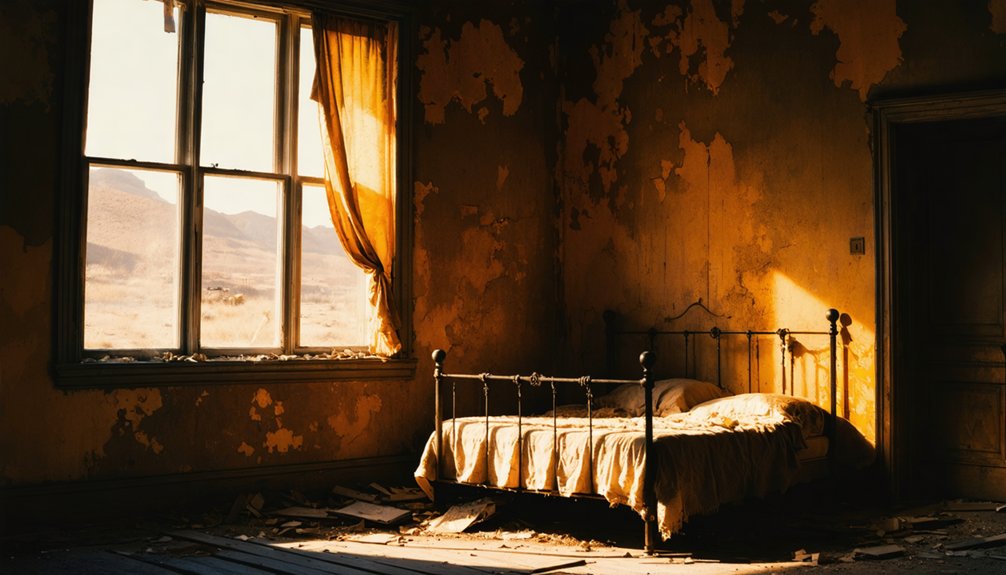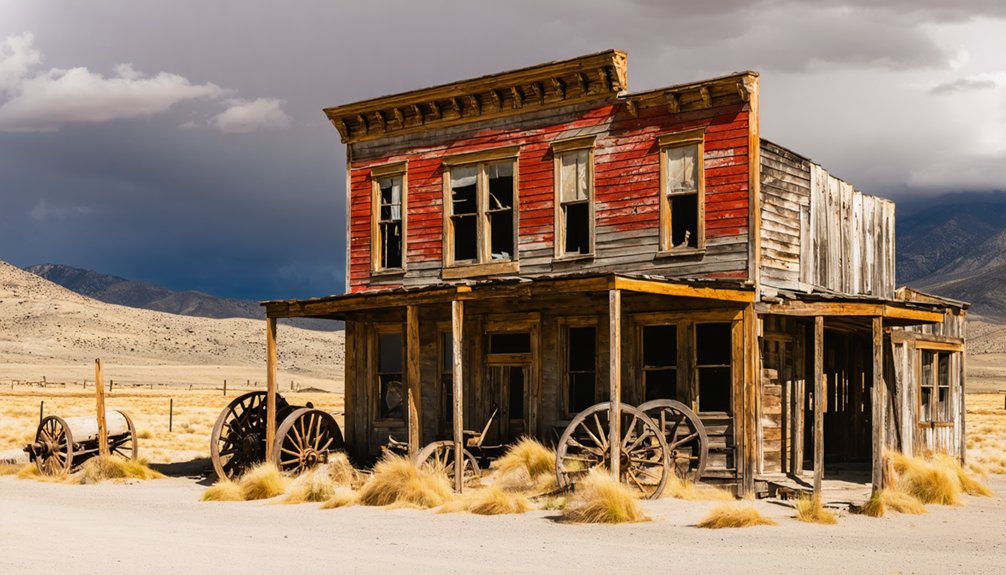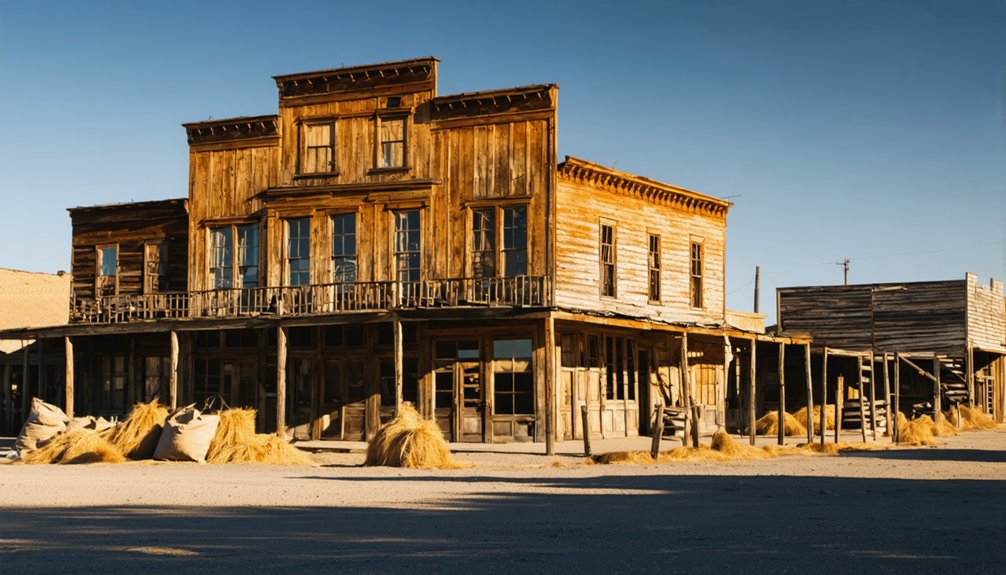
You’ll find ghost towns featured prominently in documentary series like *Ghost Towns of Canada* (2002), which systematically examined 13 abandoned settlements including Barkerville and Jackfish Bay, and Travel Channel’s *Haunted Towns* (2017), where the Tennessee Wraith Chasers investigated paranormal activity at Cape May’s historic locations. Notable filming sites include North Carolina’s Henry River Mill Village, featured in *The Hunger Games*, and Nevada’s Rhyolite, whose photogenic ruins near Death Valley have attracted numerous productions. The following exploration reveals how these abandoned communities’ economic decline and preservation efforts created compelling television narratives.
Key Takeaways
- *Haunted Towns* premiered in 2017 on Travel Channel, investigating paranormal activity in Jersey Shore ghost towns like Cape May.
- *Ghost Towns of Canada* documented 13 abandoned Canadian settlements from 2002, exploring economic and social factors behind community abandonment.
- Henry River Mill Village in North Carolina served as a filming location for *The Hunger Games* after mill closure.
- Rhyolite Ghost Town in Nevada features photogenic structures and has become a popular filming location near Death Valley.
- Shows like *The Dead Files* and *Expedition X* combine paranormal investigation with ghost town exploration for supernatural storytelling.
Haunted Towns Series and Cape May Investigations
When the Travel Channel premiered *Haunted Towns* on August 15, 2017, it introduced audiences to the Tennessee Wraith Chasers‘ methodical approach to investigating America’s most spiritually active locations.
You’ll find the Cape May episode represents a significant examination of Jersey Shore paranormal activity, focusing on sites where spiritualism history intersects with contemporary claims.
The team’s investigation centered on the Emlen Physick Estate, documented as harboring a portal for the Physick family spirits, alongside the Cape May Fish Market’s reported child apparition.
This Victorian-era resort town’s legacy as a spiritualism hub provided investigators with archival context for their evidence collection.
The series’ two-season run encompassed sixteen episodes, with Scott Porter, Steven McDougal, and Mike Goncalves maintaining consistent roles throughout their methodical documentation of supernatural phenomena.
The show combines Southern know-how, science, and engineering to conduct thorough investigations at each haunted location.
Each episode runs approximately 42 minutes, allowing the team sufficient time to explore the historical context and paranormal claims at each location.
Ghost Towns of Canada Documentary Series
The 2002 documentary series *Ghost Towns* presents you with an extensive 13-episode exploration of Canada’s abandoned settlements, chronicling sites from the Atlantic provinces to the Pacific coast.
You’ll encounter historical narratives embedded within structures marked by peeling paint and rotting wood, as the series systematically documents each location’s shift from prosperity to abandonment.
This coast-to-coast format allows you to examine diverse ghost towns including Barkerville and various industrial sites, with each episode revealing the economic and social forces that transformed thriving communities into architectural relics. The series features Cory Chetyrbok and Laura Toews as notable stars who guide viewers through these abandoned landscapes.
Among the documented locations, you’ll discover Jackfish Bay, which evolved from a tiny fishing village in the 1870s to a thriving railroad community before highway construction bypassed it in the early 1940s.
13-Episode Series Overview
Premiering in 2002, *Ghost Towns of Canada* constituted a 13-part documentary series that systematically examined abandoned communities across the nation’s diverse geographic regions.
You’ll find hosts Cory Chetyrbok and Laura Toews guiding explorations from Ireland’s Eye through Val-Jalbert, Grosse Isle, Silver Islet, and Barkerville, spanning Atlantic to Pacific territories.
The series employed investigative methodology to decode abandoned architecture—peeling paint and deteriorating structures serving as tangible evidence of forsaken settlements.
Director and writer Maureen Kelleher contributed to episode production, crafting historical narratives that illuminate why these communities failed.
Contemporary explorers like Blaine and Janice continue this tradition of documentation, navigating remote coastlines aboard vessels to uncover stories of forgotten coastal settlements such as Nemu, one of Canada’s oldest salmon cannery communities.
Newfoundland exemplifies this phenomenon, where over 30,000 people from 300 fishing outports have disappeared following the cod fishery collapse in the early 1990s.
With a 6.5/10 IMDb rating, the single-season documentary preserved archival records of Canadian settlement patterns, transforming physical decay into educational content.
You’re presented with stories revealing the economic, social, and environmental factors that precipitated each town’s abandonment.
Coast-to-Coast Exploration Format
Spanning Canada’s vast territorial expanse, the coast-to-coast exploration format systematically documented abandoned settlements through regional clustering that emphasized geographic and industrial diversity.
You’ll discover how the series mapped British Columbia’s coastline discoveries—from Anyox’s toxic copper operations on Granby Bay to Ocean Falls’ demolished pulp mill infrastructure.
The documentary framework extended beyond western territories, encompassing Quebec’s forgotten outposts and prairie grain elevator remnants that marked rail abandonment by 1981.
This methodical approach captured urban decay across multiple provinces, revealing how industrial collapse manifested differently in mining communities versus agricultural settlements.
Each episode preserved archival evidence of structures composting back to nature—concrete foundations, rusting locomotives, and empty bunkhouses—creating thorough records of Canada’s abandoned industrial heritage before complete environmental reclamation.
The series featured Greenwood, the smallest incorporated city in Canada, showcasing how even officially recognized municipalities could face near-abandonment following the collapse of their primary industries.
Antioch’s documentation highlighted John Eastwood’s multiple arch dam, a 1924 hydroelectric structure that combined minimal concrete use with maximum structural integrity through innovative thin arch design.
Henry River Mill Village: From Gold Rush to Hunger Games
When you examine Henry River Mill Village in Burke County, North Carolina, you’ll find a meticulously preserved textile mill community that transformed from a 1905 cotton yarn producer employing 450 workers into the cinematic setting for District 12 in *The Hunger Games* (2012).
The village’s authentic abandonment—following the mill’s 1960s closure, the 1977 lightning-strike destruction of the main building, and final resident departures in the early 2000s—provided filmmakers with an untouched representation of isolated, impoverished communities that required no artificial deterioration.
You can trace this evolution from self-contained company town, complete with “doogaloo” payment currency and 35 worker houses, through industrial decline to its 2019 National Register listing and current status as a publicly accessible filming location off Interstate 40. The village was originally founded by the Aderholdt and Rudisill families, who established the Henry River Manufacturing Company. The property was purchased in 2017 by Calvin Reyes and family, who envision transforming the village into a cultural hub through tours, events, and ongoing restoration efforts.
Mill’s Industrial History
In the early 1900s, the Aderholdt and Rudisill families recognized the industrial potential of Henry River’s waterpower—a resource that had been harnessed since 1860—and purchased 1,500 acres in the North Carolina foothills near Hildebran.
They established the Henry River Manufacturing Company in 1905, constructing a three-story mill from sun-baked mud bricks on a river rock foundation. This self-contained complex housed 450 employees across 35 worker houses, producing cotton yarn for embroidery and fine lace.
The facility’s operational evolution demonstrates significant industrial heritage:
- Exclusive waterpower operations until 1914
- Conversion to steam and electricity, tripling production by 1963
- Workers paid in “doogaloo” coins redeemable only at the company store
Despite modernization efforts, textile decline from overseas economic pressures forced closure in the 1960s, marking another casualty of American manufacturing’s transformation.
Hollywood Location Transformation
After decades of abandonment following the mill’s 1960s closure, Henry River Mill Village found renewed purpose when Lionsgate selected it as the primary filming location for District 12 in *The Hunger Games* (2012).
You’ll recognize how the village’s deteriorating worker houses provided cinematic authenticity that no fabricated set could replicate. The modest structures, built in 1905 for mill employees, perfectly embodied Panem’s impoverished coal-mining district without requiring extensive modification.
This location significance transformed the forgotten community into a cultural landmark, ultimately leading to its National Register of Historic Places designation on May 9, 2019.
The site’s lack of modern infrastructure—no running water or sewer systems—ironically enhanced its dystopian aesthetic, demonstrating how authentic decay surpasses Hollywood construction in capturing post-industrial desolation.
Touring the Abandoned Village
Accessing Henry River Mill Village requires traveling to I-40 exit 119, approximately one mile south of Hildebran, North Carolina, where you’ll encounter a remarkably preserved example of early twentieth-century Carolina textile mill architecture.
The abandoned infrastructure retains tangible remnants from its 1905 establishment, offering unrestricted exploration of a self-contained planned community that operated until the 1960s.
Your visit reveals multiple structural elements:
- Thirty-five worker houses constructed without modern utilities
- Two-story boarding house and brick company store
- Dam and bridge system (though dam suffered damage from county’s third-worst flood)
The site’s historical significance earned National Register of Historic Places designation on May 9, 2019.
Despite lightning strikes, hurricanes, and tornadoes, these sun-baked mud brick structures survived, creating an authentic ghost town experience free from contemporary constraints.
Rhyolite Ghost Town: Nevada’s Cinematic Relic
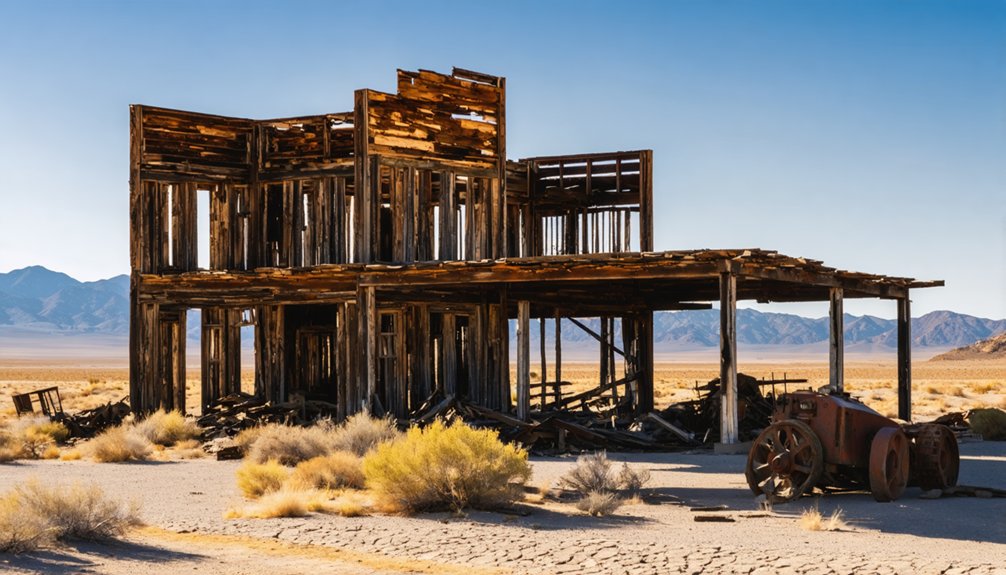
Rhyolite Ghost Town stands as one of Nevada’s most documented and cinematically significant abandoned settlements, its ruins attracting filmmakers and photographers since the mid-20th century.
Rhyolite history reveals a meteoric rise from two tents in 1905 to Nevada’s largest city by 1907, boasting three railroads, electricity, and a three-story stock exchange. The Montgomery Shoshone mine produced over $1 million before depleting, triggering complete abandonment by 1916.
Ghost town tourism thrives at this Bureau of Land Management site, where you’ll encounter the photogenic John S. Cook Bank building’s concrete shell and Tom T. Kelly’s Bottle House, constructed from 50,000 beer bottles.
The 1935 conversion of Rhyolite’s train depot into a casino presaged its transformation into a filming location near Death Valley.
Mysteries of the Abandoned: Hidden America
Expert contributors including infrastructure advisor Corina Kwami and historian Kenya Davis-Hayes analyze sites like:
Infrastructure experts and historians examine forgotten military installations and contested spaces across America’s shifting landscape.
- Black Hills Ordnance Depot’s WWII munitions bunkers in South Dakota
- Wendover Air Field’s atomic mission preparation facilities in Utah
- West Virginia Ordnance Works’ classified wartime production centers
You’ll discover how Amboy’s Route 66 revival contrasts with Money, Mississippi’s deliberate abandonment following Emmett Till’s murder, illustrating how Americans reclaim or reject contested historical spaces.
Paranormal Programming Beyond Ghost Towns
While ghost towns provide physical settings for paranormal storytelling, contemporary television has expanded beyond abandoned locations to explore supernatural phenomena through diverse methodological frameworks.
The allure of abandoned places in New England often presents a haunting backdrop for both folklore and modern narratives. Many explorers seek out these forgotten sites, drawn by the eerie stories and historical echoes that linger within their dilapidated walls. Such locations not only spark fascination but also serve as reminders of the region’s rich, often untold, history.
You’ll find paranormal documentaries like *Haunted Discoveries* employing scientific documentation across Kentucky and Illinois, while *Expedition X* combines Josh Gates’s adventuring with Phil Torres’s scientific expertise.
*The Dead Files* merges psychic abilities with retired detective Steve DiSchiavi’s investigative skills, focusing on locations where hauntings connect to heinous crimes.
*OUT THERE: Crimes of the Paranormal* documents eight cases where criminal activity intersects with supernatural elements through eyewitness testimony and expert analysis.
These programs examine haunted artifacts, mysterious creatures, and unexplained phenomena using research-based approaches that prioritize empirical evidence alongside cultural sensitivity, particularly evident in *Ghost Hunters of the Grand River’s* Indigenous perspectives.
The Tennessee Wraith Chasers’ Investigations
Their investigation techniques employed:
- EVP sessions utilizing “Spookey dictionary” devices for entity communication
- Solo investigations in isolated environments to maximize paranormal encounters
- Systematic deployment of meters and monitoring paranormal equipment at documented death sites
Featured locations included Rolling Hills Asylum in Bethany, New York (1,700+ recorded deaths) and Virginia City, Montana.
The series shifted from Destination America to Travel Channel for its second season.
Viewer Reception and Cultural Impact
Ghost hunting television programs established sustained cultural resonance through reality-style formats that transformed paranormal investigation into mainstream entertainment, with flagship series like Ghost Hunters and Ghost Adventures demonstrating unprecedented longevity—279 episodes across 16 seasons and over 300 episodes across 26 seasons respectively.
You’ll find viewer engagement metrics revealed significant preference variations, as focused single-property investigations generated higher satisfaction ratings than dispersed multi-location episodes. CBS’s “Ghosts” achieved 2,204,000 viewers with 77% growth by 2026, while Ghost Adventures: House Calls garnered 218,000 viewers with 10% trajectory.
The cultural significance manifested through multiple spinoff franchises and 24/7 streaming availability, extending audience reach beyond traditional broadcasts. Continuous syndication maintained accessibility while generating secondary revenue, establishing these productions as dominant forces within paranormal television’s specialized niche.
Frequently Asked Questions
Can Tourists Visit the Ghost Towns Featured in These TV Shows?
You can absolutely explore these sites—swipe right on freedom! Tourist regulations remain minimal: Cape May’s estate requires standard admission, Henry River offers organized tours, and Rhyolite’s town accessibility permits unrestricted wandering through Nevada’s historic ruins.
Are the Paranormal Activities Shown in These Programs Real or Staged?
You’ll find paranormal authenticity remains unverified across these shows; skeptics identify staged encounters as entertainment tactics, while believers cite documented phenomena. Investigators haven’t produced scientifically conclusive evidence, leaving interpretation to your critical assessment of presented footage.
How Do Production Crews Ensure Safety When Filming in Abandoned Locations?
Like miners carrying canaries into shafts, you’ll find crews deploy thorough safety protocols including structural assessments, personal protective equipment, and medical stations. Filming regulations mandate permits, insurance coverage, and emergency evacuation procedures before cameras roll in abandoned sites.
What Equipment Do Ghost Hunting Shows Use to Detect Supernatural Activity?
You’ll find ghost hunting shows deploy EMF detectors, spirit boxes, infrared cameras, and thermal imaging devices for spiritual readings, though equipment accuracy remains debated among researchers who question whether electromagnetic fluctuations truly represent paranormal phenomena.
Do Ghost Town Property Values Increase After Appearing on Television?
Yes, you’ll find property appreciation often follows television exposure. Terlingua, Texas saw land prices double post-pandemic, with twenty-acre parcels jumping from $6,500 to $40,000, demonstrating significant investment potential despite broader market influences.
References
- https://en.wikipedia.org/wiki/Haunted_Towns
- https://www.imdb.com/list/ls076012635/
- https://www.ranker.com/list/shows-like-mysteries-of-the-abandoned-hidden-america/molly-gander
- https://www.businessinsider.com/abandoned-places-used-in-movies-tv-shows-2020-9
- https://www.imdb.com/list/ls093389024/
- https://go.discovery.com/show/mysteries-of-the-abandoned-hidden-america-discovery-atve-us
- https://www.tvguide.com/tvshows/haunted-towns/episodes-season-1/1000682684/
- https://www.imdb.com/title/tt7260852/episodes/?year=2019
- https://www.imdb.com/title/tt7260852/
- https://tv.apple.com/us/show/haunted-towns/umc.cmc.33apgvp16xe2h31gt7doii3a1