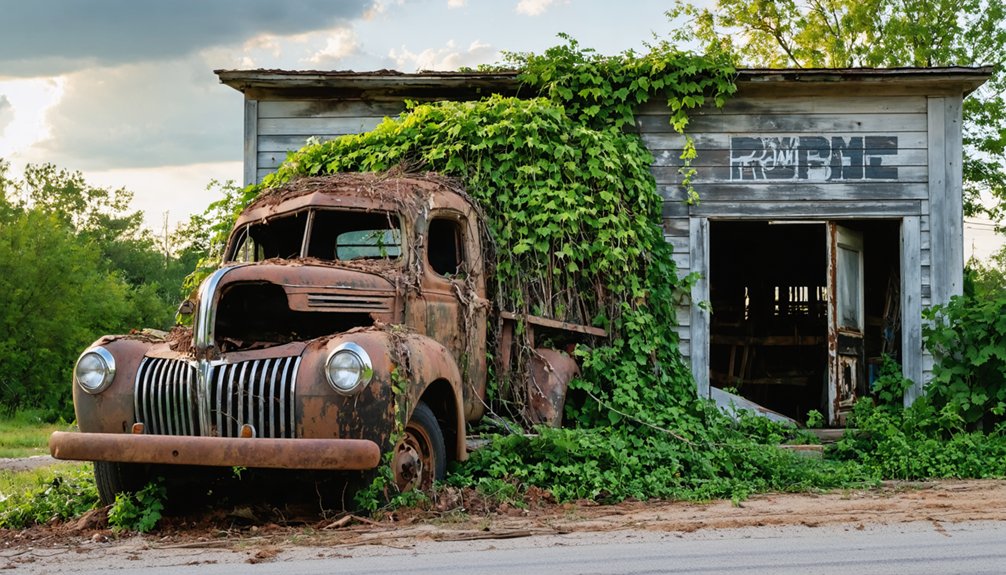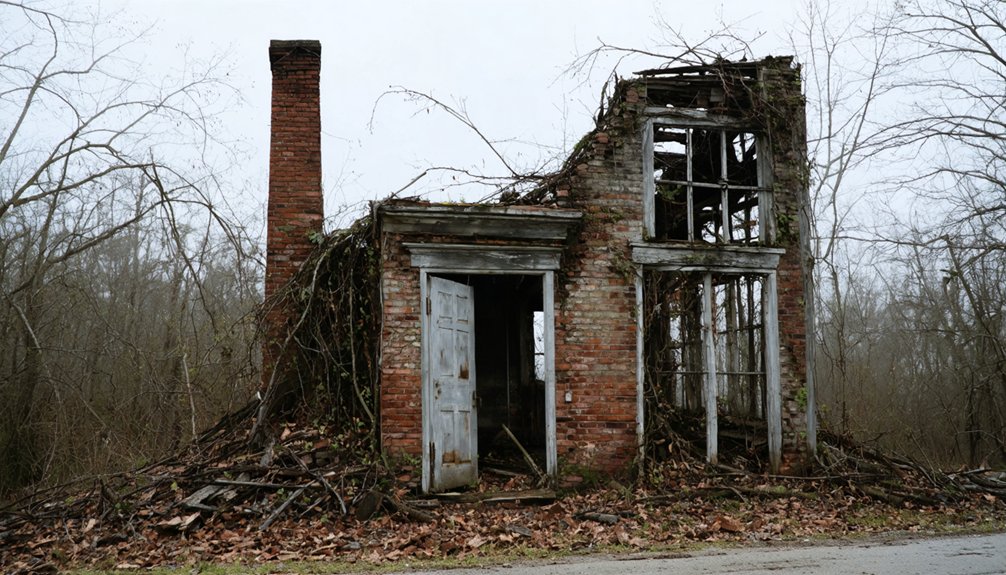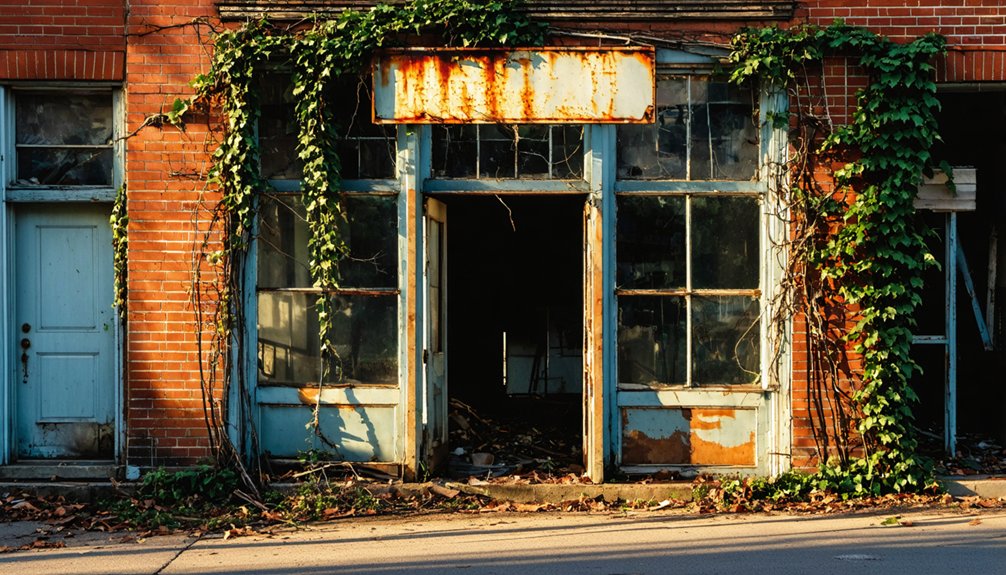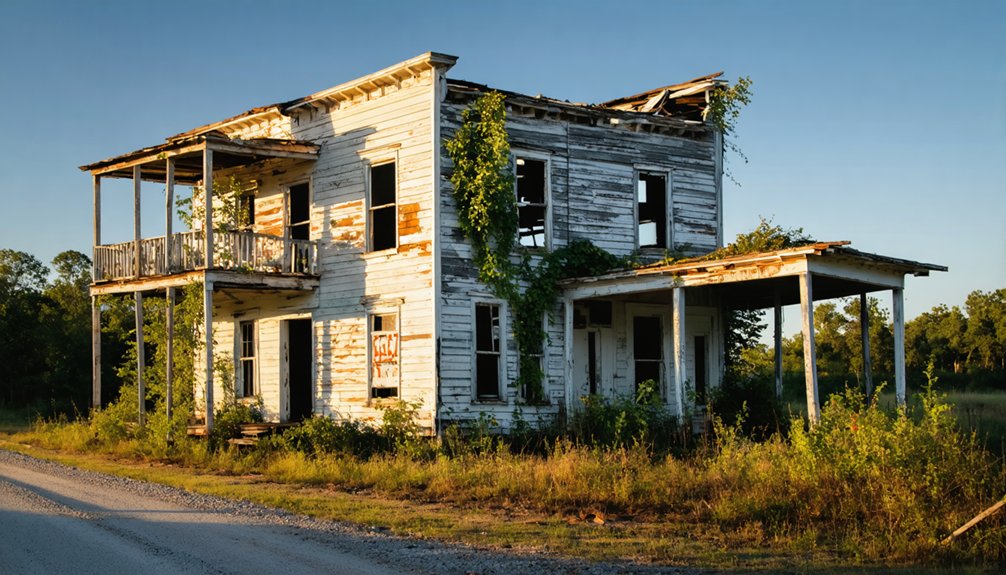
You’ll find Alabama’s ghost town properties ranging from $54,900 for 20-acre parcels with abandoned structures in Morgan County to $699,000 for restored antebellum estates, with most opportunities clustered between $100,000-$200,000. Northern counties show the highest concentration of vacant properties—Birmingham’s ZIP code 35218 alone has 316 abandoned homes representing 16.2% of housing stock. These properties feature Greek Revival and Victorian architecture, though you’ll need thorough title research given complex ownership histories spanning French, British, Spanish, and American sovereignties before making your investment decision.
Key Takeaways
- Alabama has 55 documented ghost towns with accelerating abandonment in areas experiencing population declines of 5.3% to 10.2%.
- Most ghost town properties are priced between $100,000-$200,000, with some abandoned properties available under $100,000 in northern regions.
- Large acreage parcels with abandoned structures concentrate in Morgan County, including 20-acre properties starting at $54,900 with existing utilities.
- Historic properties feature Greek Revival and Victorian architecture, averaging $377,297 across 10.5 acres with original architectural details intact.
- Title research requires verification through multiple sovereignties including French, British, Spanish land grants, and federal patents dating to 1806.
Understanding Alabama’s Abandoned Property Market
Alabama’s abandoned property market presents a complex landscape shaped by centuries of economic upheaval and demographic shifts.
You’ll find 55 documented ghost towns statewide, with abandonment trends accelerating in areas experiencing population declines of 5.3% to 10.2% over five years.
Birmingham’s ZIP code 35218 alone contains 316 vacant properties—16.2% of all homes—with median values dropping to $62,000-$74,200.
These depressed markets correlate directly with poverty rates exceeding 38%, double the national average.
Mining industry collapses and agricultural failures historically triggered settlement abandonment, while modern economic stagnation perpetuates the cycle.
Property revitalization opportunities exist where infrastructure remains intact, though most structures succumbed to fire and decay.
Similar to Gilman, Colorado’s fate, environmental contamination from historical mining operations can render entire communities uninhabitable and complicate redevelopment efforts.
You’re traversing a market where economic fundamentals determine viability more than historical significance alone.
High vacancy rates often signal urban decay indicators including increased crime and diminished community resources.
Price Ranges and Land Costs Across the State
Across Alabama’s ghost town and abandoned property market, you’ll encounter dramatic price variations ranging from $54,900 for a 20-acre Falkville parcel to $699,000 for a restored historic home in Mobile’s Church Street district.
Property valuation depends heavily on location and condition, with most opportunities clustering between $100,000-$200,000. You’ll find acreage trends revealing significant disparities: Falkville’s 20-acre listings span $2,745 to $27,450 per acre, while Semmes offers comparable acreage at $7,250 per acre.
Location determines value: rural acreage varies wildly from under $3,000 to over $27,000 per acre, with prime opportunities between $100,000-$200,000.
The statewide unrestricted land average sits at $16,372 per acre across 493 properties. If you’re seeking maximum freedom with minimal investment, abandoned properties under $100,000 remain available, particularly in northern regions.
Central Alabama’s historic homes command $265,000-$430,000, reflecting restoration potential and architectural significance. Before purchasing any property, research zoning laws and permits thoroughly to ensure your intended use aligns with local regulations and development restrictions. With Alabama’s real estate tax rate at just 0.36%, well below the national average of 0.99%, property ownership in these areas presents a compelling opportunity for long-term investment.
Historic Properties With Significant Character
You’ll find Alabama’s historic properties showcase distinct architectural periods, from Greek Revival homes with fluted Doric columns like the Johnston-Curtright House to Victorian-era dwellings from the 1890s available under $100,000.
These structures retain original details including two-story porticos, handcrafted staircases, and specialized fireplaces that distinguish them from standard residential construction.
Properties often carry significant provenance, such as Greenwood—an 1856 plantation built by U.S. congressman Sydenham Moore—preserving antebellum craftsmanship across 2,605 to 3,571 square feet on multi-acre parcels. The John Burns House in Burnsville exemplifies postbellum architecture from the 1870s, featuring three bedrooms and multiple fireplaces across 2,605 square feet on 4.35 acres. With 107 historic properties currently available, the average listing price stands at $377,297 across properties averaging 10.5 acres.
Architectural Styles and Features
When exploring ghost towns for sale in Alabama, the architectural heritage stands as one of the most valuable assets these properties offer. Greek Revival elements dominate these historic sites, with Doric columns, two-story porticoes, and classical proportions defining many structures.
You’ll find examples like the Johnston-Curtright House in Tuskegee, featuring six fluted columns, and Mobile’s Oakleigh House from 1833. Antebellum Architecture in these locations showcases raised-cottage designs—a practical response to flooding—alongside stately brick homes with columned facades.
At Cahawba, only two antebellum structures survive, including the circa-1840 Fambro-Arthur House. The house features construction with half sawed lumber and half hand-hewn materials, representing traditional building methods of the period. Brick foundations, iron fencing remnants, and portico ruins mark where grand residences once stood. The brick foundations and columned porticoes at Cahaba remain accessible for public exploration of these historical ruins.
These architectural features represent tangible market value for investors seeking authentic period properties.
Original Details Still Intact
Among Alabama’s ghost town properties, the John Burns House in Burnsville exemplifies how original architectural details drive market value for preservation-minded investors. Built in the 1870s, this 2,605-square-foot structure retains its inviting entry staircase showcasing period craftsmanship, multiple fireplaces, and an oversized sunroom with authentic brick floors.
Listed at $172,500 on 4.35 acres, it presents renovation challenges requiring structural repairs while offering unrestricted development potential.
Similar properties across Alabama’s abandoned settlements preserve late 1800s elements—Greek Revival porticos, Doric columns, and decorative Georgian features. The Johnston-Curtright House in Tuskegee showcases a two-story portico with six fluted Doric columns, representing the finest surviving examples of this architectural tradition. These authentic details demand specialized preservation techniques but attract buyers seeking character you won’t find in modern construction. Across the state, unrestricted properties offer flexibility in land use for buyers pursuing diverse development visions without zoning limitations.
With 772 historic homes available statewide, you’ll discover opportunities where original architectural integrity remains intact despite economic decline that created these ghost town settings.
Significant Historical Ownership Backgrounds
Alabama’s ghost towns carry ownership histories that extend through multiple sovereignties—French, British, Spanish, and American governments—creating complex title chains that investors must verify before purchase.
You’ll find historical significance in properties like Manasco, which maintains continuous family ownership since 1879 despite its 1900 abandonment.
Old Cahawba’s ownership changes began with federal land sales that escalated from $1.25 to $70 per acre through speculation, while Odena Plantation changed hands from the Taylor family to Captain John Oden between 1835 and 1854.
These properties require thorough title research through county tract books and Bureau of Land Management patents.
Spanish land grants, military warrants, and early federal patents dating to 1806 establish provenance that affects marketability and value for today’s buyers.
Large Acreage Parcels With Abandoned Structures
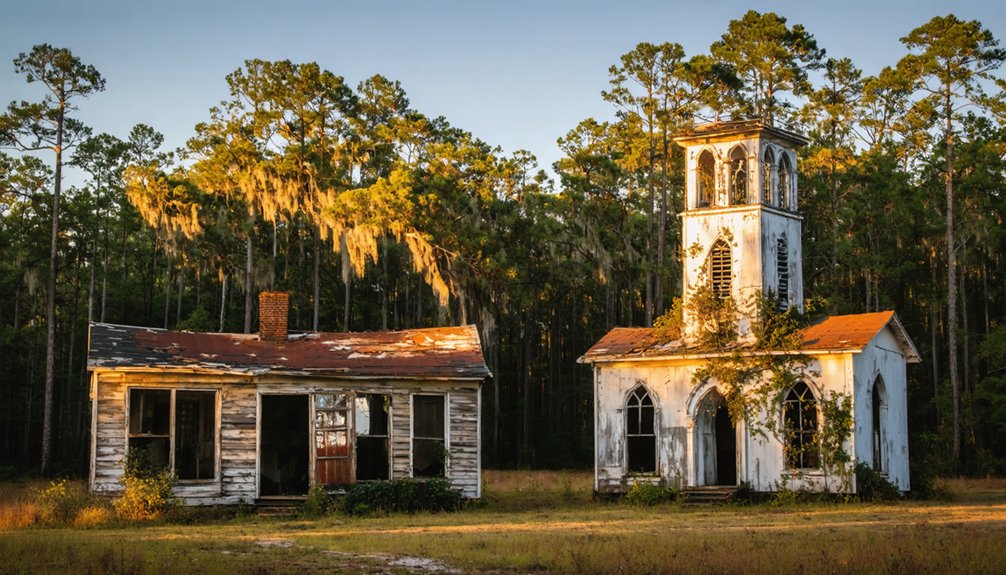
You’ll find substantial acreage parcels with abandoned structures concentrated in Morgan County, where Falkville’s 20-acre property sits at $54,900 with functional well and septic systems.
Creek-adjacent lands throughout Alabama’s rural counties offer similar combinations of derelict buildings on 10-to-40-acre tracts, typically priced between $90,000 and $149,900.
Mid-century brick estates built in the 1950s represent another segment, featuring 4-to-20-acre parcels with abandoned homes that maintain structural integrity despite years of vacancy.
Falkville 20-Acre Property
Several large-acreage parcels with abandoned structures have surfaced in Falkville, presenting opportunities for buyers willing to tackle renovation projects or land development.
You’ll find a 20-acre property with an abandoned house listed at $54,900, offering significant privacy for off-grid living or agricultural use.
Another option at 1825 Will Height Road includes a 1,152-square-foot structure with three bedrooms and one bathroom on 20 acres, though the building appears abandoned after just 16 days on market.
Falkville listings range dramatically—from the $54,900 distressed property to $554,900 for parcels with structures.
Property features vary considerably, with some parcels designated as vacant land while others retain existing buildings requiring substantial rehabilitation.
These Morgan County opportunities cater to buyers seeking autonomy and space.
Morgan County Creek Lands
When Morgan County was established in 1818 from Cherokee-ceded lands, its original name Cotaco referenced the large creek that now defines some of the area’s most distinctive parcels.
You’ll find properties along Cotaco Creek featuring classic karst development with over 40 caves on privately-owned land. These Creek allotments originally ranged from 320 to 640 acres, though most families were removed to Indian Territory by 1836.
Some Creek families who escaped removal received land grants and remained as farmers in Alabama. Today’s market includes abandoned structures like Carver Elementary School (closed 1966) and Cedar Plains Christian Church.
The Old State Bank Building from 1833 survived on its original 1824 town lot. These large-acreage parcels combine historical significance with natural features that attract buyers seeking unrestricted rural property.
Mid-Century Brick Estates
Alabama’s abandoned mid-century brick estates represent a distinct category of properties where architectural ambition met demographic decline.
You’ll find solid red brick construction from the 1977 era, featuring sunken fireplaces, wet bars, and open-plan living spaces that showcase mid century charm. These large acreage parcels often include overgrown zen gardens and resort-style pools awaiting revival.
Brick restoration projects here reveal exceptional construction elements—exposed brickwork and preserved period features that survived years of abandonment.
Properties like the McDonald House demonstrate successful transformations from crumbling time-warps to livable estates. You’re buying both the structure and sprawling grounds, though some face demolition despite architectural merit.
The dangerous state of these properties requires serious capital investment, but you’ll control substantial land with unique design features unavailable in modern construction.
Architectural Styles Found in Alabama Ghost Towns
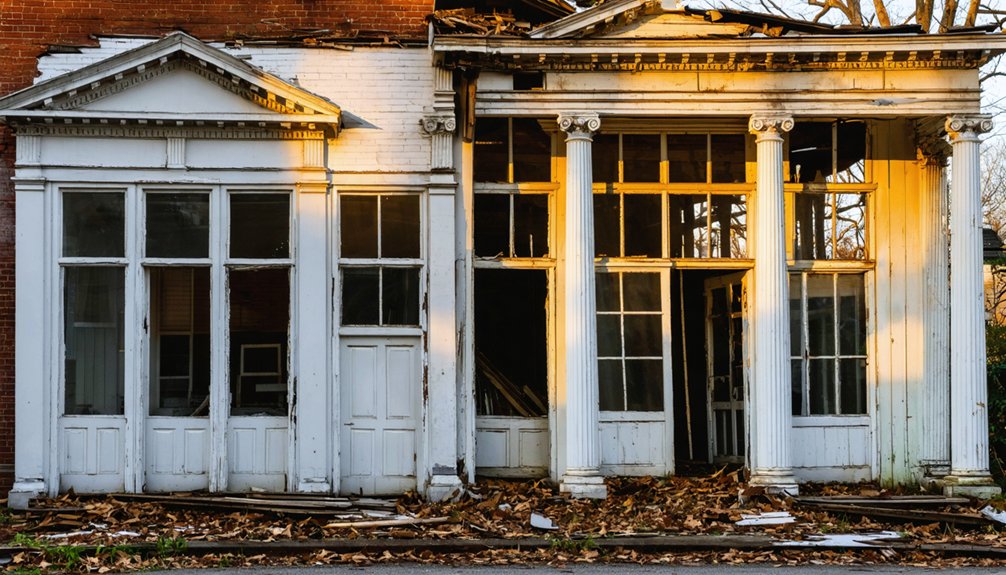
From stately Greek Revival columns to flood-resistant raised cottages, Alabama’s abandoned settlements preserve a remarkable cross-section of 19th-century Southern architecture that’s increasingly rare on today’s market.
Cahawba showcases antebellum architecture from its 1819 establishment, with brick foundations and columned porticoes marking former civic prominence. You’ll find the Fambro-Arthur House representing raised-cottage design—one of only two antebellum structures still standing.
Rocky Hill Castle exemplifies architectural fusion, combining Greek Revival Doric porticoes with Italianate elements and a five-story Gothic Revival tower built between 1858-1861. The structure featured Italian marble mantles and elaborate walnut staircases.
Later Victorian influences appear in properties like the Moulthrop House, blending Queen Anne with Greek Revival from the 1890s. These abandoned estates offer architectural diversity you won’t easily replicate.
Resources for Finding Historic Alabama Properties
Tracking down these architectural treasures requires maneuvering a fragmented marketplace where historic Alabama properties appear across both mainstream platforms and specialized registries.
You’ll find Zillow listing 772 designated homes, while Redfin showcases 3,358 vintage properties—but specialized sites like CIRCA and Old House Dreams curate endangered structures that mainstream platforms overlook.
These marketplaces filter by architectural style, restoration challenges, and historical significance, connecting you with Greek Revivals, Victorians, and weathered farmhouses across Mobile, Montgomery, and Birmingham.
Prices span $115,000 to $999,999, averaging $379,891. LandSearch provides per-acre pricing data ($35,911 average) for properties combining structures with land.
For urban exploration enthusiasts, Old House Dreams tracks “time capsule” properties and endangered listings requiring immediate preservation action.
Frequently Asked Questions
What Legal Requirements Must Buyers Meet When Purchasing Abandoned Properties in Alabama?
You’ll need to navigate title issues from previous owners, verify property disclosures through the Treasurer’s office, and understand that tax deeds don’t guarantee clear ownership—requiring your own thorough due diligence before purchase.
Are There Property Tax Incentives for Restoring Historic Homes in Alabama?
You’ll access significant savings through Alabama’s Class III property tax assessment at 10% for historic properties—half the standard commercial rate. Property restoration following historic preservation standards qualifies structures 60+ years old, slashing your annual tax burden.
How Do You Verify Ownership Status of Abandoned Ghost Town Properties?
You’ll verify ownership by researching property title records at the county recorder’s office, examining ownership history through deed transfers, and checking Alabama’s Unclaimed Property database for any state-held claims on the abandoned property.
What Insurance Challenges Exist When Buying Abandoned Alabama Structures?
Picture crumbling walls and shattered windows—you’ll face vacancy exclusions after 30-60 days, property liability gaps for trespassers, and carriers demanding costly structural assessments before they’ll even consider coverage for Alabama’s abandoned buildings.
Can Abandoned Properties Be Financed Through Traditional Mortgage Lenders?
You’ll find traditional mortgage financing options available for abandoned Alabama properties, though mortgage eligibility depends on the structure’s condition. Lenders require appraisals, inspections, and may demand renovation loans like FHA 203(k) for uninhabitable buildings.
References
- https://www.youtube.com/watch?v=mYsUx1aNGIo
- https://theforgottensouth.com/john-burns-house-dallas-alabama/
- https://www.zillow.com/al/historic_att/
- https://www.landsearch.com/unrestricted/alabama
- https://www.aol.com/articles/10-ghost-towns-us-actually-200604529.html
- https://www.abandonedalabama.com/class/residential/
- https://www.oldhousedreams.com/state/alabama/
- https://en.wikipedia.org/wiki/List_of_ghost_towns_in_Alabama
- https://247wallst.com/special-report/2019/10/14/30-american-ghost-towns-4/
- https://www.lovemoney.com/gallerylist/86648/americas-empty-ghost-towns-and-why-theyre-abandoned-today