You’ll find Arizona ghost towns for sale ranging from $40,000 entry-level parcels to complete townsites exceeding $1 million. Properties like Elfrida’s 348-acre site with 19 patented mining claims listed at $439,000 offer century-old ownership history and absolute mineral rights. The 62-acre Turquoise Mining District parcel near Tombstone provides documented copper, lead, and turquoise deposits. Premium listings include Cleator’s 40-acre townsite at $1.25 million with existing businesses. Understanding patented claims, development potential, and operational challenges will help you navigate this specialized investment landscape.
Key Takeaways
- Arizona ghost town properties range from $339,000 to $1.25 million, with entry-level parcels under $140,000.
- Elfrida offers 348 acres with 19 patented mining claims for $439,000, featuring century-old clear title.
- Cleator’s 40-acre townsite sold under $1 million, demonstrating accessible pricing for established ghost towns with infrastructure.
- Properties include patented mineral rights enabling extraction of gold, copper, turquoise, and other minerals alongside tourism revenue.
- Locations near Tombstone, Bisbee, and Sedona provide heritage tourism opportunities with Arizona’s established visitor traffic.
Historic Mining Properties Available Now
Arizona’s historic mining properties present investors with tangible assets backed by proven reserves and established infrastructure.
You’ll find authentic opportunities tied to the state’s mining history, where properties like Congress’s 46.28-acre site offer documented gold reserves of 20,992 ounces alongside water rights and operational access.
The market spans from $40,000 entry points to multi-million dollar acquisitions, with 29 active listings totaling $41.8 million in value.
These aren’t romanticized ghost town fantasies—they’re working claims with BLM registration and patented mineral rights.
Congress’s properties connect to Rich Hill and Vulture mines that produced 450,000 ounces combined.
The site includes 450 gallons per minute water rights and 20-acre feet allocations for operational needs.
Whether you’re targeting Superstition Mountains’ 40-acre claims or Gila County’s patented parcels, you’re buying documented resources, not speculation.
Some properties feature drill-ready targets with confirmed high-grade mineralization ready for immediate development.
Elfrida Ghost Town Properties: 348 Acres of Arizona History
You’ll acquire 19 patented mining claims spanning 348 acres of documented Arizona mining history when you purchase this Elfrida property.
The Costello family has maintained continuous ownership for over a century, establishing clear title and protecting authentic Courtland ghost town artifacts throughout the site.
This investment secures legally protected mineral rights and historical assets at the foot of the Dragoon Mountains, positioned within Cochise County’s established heritage tourism corridor. The property is located near historic Tombstone and Bisbee, both significant Wild West destinations that attract visitors year-round. The Courtland ghost town shares its name with multiple locations across the United States, making this Arizona site a distinct historical destination.
19 Patented Mining Claims
Deep in Arizona’s Turquoise Mining District, this 348-acre parcel along Ghost Town Trail delivers something increasingly rare: 19 fully patented mining claims with clear title dating back to the late 1800s.
Unlike unpatented claims requiring annual maintenance fees and BLM compliance, these patented claims represent absolute private ownership—you’ll control the mineral rights outright.
The portfolio includes Golden Chief, London, Crown Point, Silver Reef, and fifteen additional claims spanning generations of mining history.
You’re not buying bureaucratic headaches. Patented claims mean you’ve got the freedom to explore, develop, or hold without government interference.
The property is already set up for mine tours and glamping, offering established revenue streams beyond mineral extraction.
These historic claims carry Costello family connections from Tombstone’s legendary mining era, adding tangible heritage value to the investment.
At $439,000 for 348 acres with clear title in the Dragoon Mountains, you’re acquiring what the federal government stopped issuing decades ago—making this property uniquely positioned for investors seeking tangible assets with genuine scarcity.
Century-Old Costello Ownership
The $439,000 asking price—recently reduced—reflects generational shift, not market weakness.
With patented mining claims dating to the 1800s and 348 dividable acres on Ghost Town Trail, you’re not buying land.
You’re acquiring a century of sovereignty on Arizona’s own terms.
The nearby Courtland jail, built in 1909 from reinforced concrete and steel for just $1,000, stands as the sole surviving structure from a once-thriving mining town of 2,000 residents.
In Yavapai County, the town of Cleator sold for under $1 million, proving ghost town acquisitions remain accessible to individual buyers seeking authentic Arizona heritage.
Turquoise Mining District: 62-Acre Parcel in the Dragoon Mountains
You’ll find this 62-acre parcel in the historic Turquoise Mining District on the east flank of the Dragoon Mountains, positioned 14 miles east of Tombstone and 18 miles north-northeast of Bisbee.
This property sits within a district that produced copper, lead, zinc, and turquoise from 1883 through the early 1970s, with extensive drill core data documenting its geological potential.
The location’s proximity to Courtland and Gleeson—once-thriving mining communities that supported 500 residents—positions you within Arizona’s richest copper belt legacy while offering access to digitized exploration data for future assessment. The area experienced a major fire in 1912 that destroyed 28 buildings in Gleeson, though the town was subsequently rebuilt during the copper boom of World War I. Turquoise mines are typically located in arid regions, often near copper, zinc, or gold deposits, making this parcel characteristic of prime turquoise-producing territory.
Historic Mining District Location
Nestled on the east flank of the Dragoon Mountains in Cochise County, this 62-acre turquoise mining parcel offers investors access to a district that’s generated mineral wealth since 1877.
You’ll find yourself 14 miles east of Tombstone and 18 miles north-northeast of Bisbee, positioning you within the historically productive Courtland-Gleeson area.
The property’s turquoise history traces back to prehistoric Indians who extracted stones from Turquoise Ridge’s western slopes. This mining legacy intensified when Henry Durant located the first white claim in 1890.
The district’s mineral diversity attracted major players like Phelps Dodge during the 1907-1908 boom, while the Humbot mine alone yielded $100,000 from oxidized copper ore.
You’re acquiring proven ground where continuous operations have validated commercial-grade deposits across multiple minerals.
62-Acre Property Details
Geographic coordinates position this 62-acre mining parcel at 31°46’24″N, 109°49’18″W along a north-south trending ridge at Turquoise Mountain, east of the Dragoon Mountains‘ southern terminus.
You’ll find the property 18 miles northeast of Tombstone and 20 miles north of Bisbee in Cochise County’s historic Turquoise Mining District.
The geological significance extends beyond its namesake gem—turquoise mining opportunities exist alongside documented gold and galena deposits.
Mineralized zones feature turquoise stringers reaching several inches wide, nugget-like masses embedded in granite and Bolsa Quartzite formations.
Auriferous gravels concentrate along limestone pediments at Maud Hill’s base, while coarse gold deposits wash from gullies near established mine workings.
This investment-grade parcel positions you within a 4-mile north-south mineral belt containing proven reserves and infrastructure from operational mines like Copper Belle and Armstrong.
Investment Potential Overview
Since 1877, the Turquoise Mining District has attracted continuous capital investment through multiple commodity cycles, establishing your 62-acre parcel within a proven mineral system that generated over $100,000 from single claims during early operations.
Your investment analysis benefits from 85,087 feet of digitized drill core data across 113 holes, convertible to modern modeling software for precise resource assessment.
The district’s geology supports multiple revenue streams: copper, lead, zinc, gold placers averaging $1.12 per cubic yard, and turquoise deposits that historically exceeded copper values.
Major operators like Phelps Dodge conducted extensive prospecting campaigns, validating the area’s long-term viability.
For market evaluation purposes, you’re acquiring mineralized ground with documented yields, contemporary exploration data, and proximity to established infrastructure—positioning you to capitalize on rising commodity prices without speculative uncertainty.
49-Acre Mining Claims on Ghost Town Trail
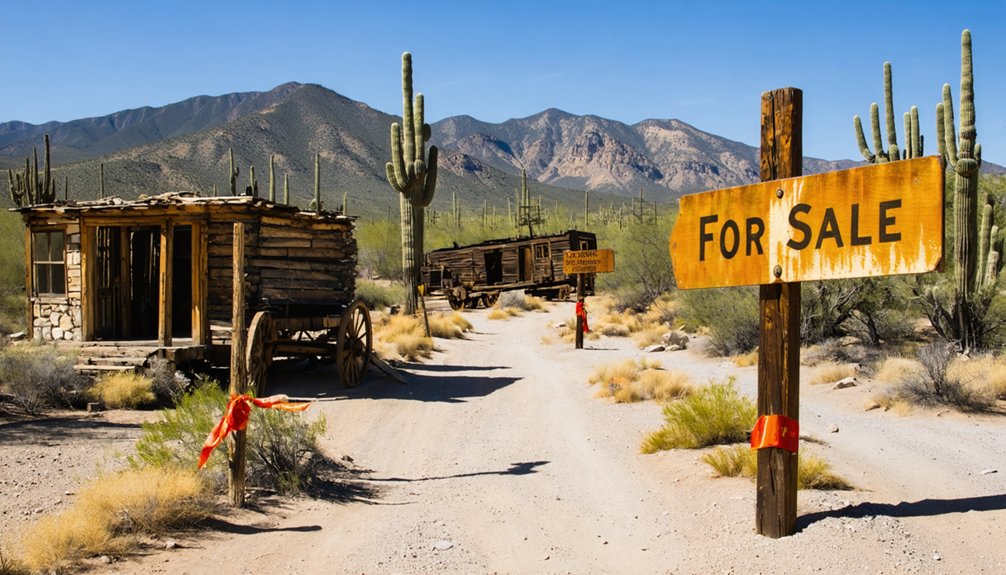
Several 20-acre mining claims along the Ghost Town Trail present unique acquisition opportunities for investors interested in Arizona’s historic Cochise County mining corridor.
You’ll find these parcels strategically positioned between Tombstone, Gleeson, Courtland, and Pearce—former mining communities connected by 34 miles of accessible dirt roads.
The ghost town heritage here spans turquoise and precious metal extraction, with Gleeson’s original turquoise operations and Courtland’s 2,000-person peak population demonstrating the area’s mineral wealth.
Historic mining operations pulled turquoise and precious metals from these mineral-rich lands, supporting thousands of prospectors throughout Cochise County’s boom era.
You’re 85-88 miles from Tucson with established road access via Gleeson Road and SR 80.
These mining claims offer development flexibility while maintaining proximity to historical sites, existing infrastructure remnants, and tourism traffic.
The region’s proven mineral deposits and unrestricted landscape appeal to freedom-seeking investors pursuing off-grid ventures or resource extraction operations.
Understanding Patented Mining Claims and Land Rights
Before investing in these historic mining parcels, you’ll need to understand the fundamental distinction between patented and unpatented mining claims—a legal difference that directly impacts your ownership rights, operational flexibility, and long-term asset value.
Patented claims grant you complete land ownership, identical to standard real estate. You’ll control surface rights, minerals, and access without federal oversight or annual fees. These properties, common in Arizona’s historic mining districts, operate outside restrictive mining regulations once title transfers.
Unpatented claims merely provide possessory mineral rights on federal land. You’ll pay $155 annually to BLM while facing strict usage limitations and permitting requirements. The government retains underlying ownership, constraining your autonomy.
Since the 1994 patent moratorium, new claims can’t achieve patented status, making existing patented parcels increasingly valuable for investors seeking genuine land ownership and operational independence.
Santa Claus Ghost Town: Arizona’s Abandoned Roadside Attraction
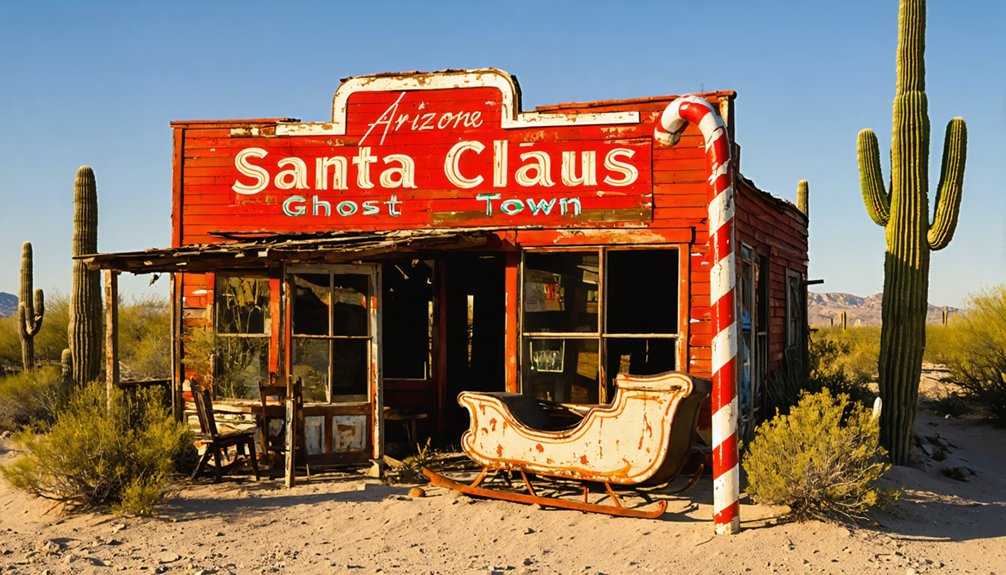
Nina Talbot transformed a barren stretch of Mohave County desert into one of Arizona’s most peculiar real estate ventures when she established Santa Claus in 1937, fourteen miles northwest of Kingman along US 93.
She designed the Christmas-themed attraction to sell surrounding acreage, featuring candy-striped buildings, a year-round Santa, and a popular December post office that drew thousands seeking special postmarks.
The roadside novelty peaked mid-century before declining in the late 1970s.
After multiple ownership changes and a final asking price of $52,500 in 1983, it found no buyers.
Businesses closed in 1995, and vandalism consumed what remained.
Today’s Santa Claus site offers only wasteland—a cautionary nostalgia trip for investors considering Arizona’s ghost town properties.
Complete demolition by 2021 erased this once-profitable roadside venture from existence.
Price Ranges and Market Trends for Ghost Town Properties
Arizona’s ghost town market currently spans $339,000 to $1.1 million, with acreage and patented mining claims driving valuations.
You’ll find aggressive price corrections defining recent activity—Elfrida’s 348-acre parcel dropped from $449,000 to $439,000 within months, signaling seller motivation in this niche sector.
At roughly $970 to $1,540 per acre for mineral-rights properties, you’re looking at speculative investments where historical provenance directly impacts pricing power.
Current Listing Price Spectrum
Ghost town properties across Arizona span a dramatic price spectrum from $139,000 to $1.25 million, with entry-level parcels offering raw land and mining claims while premium listings deliver turnkey operational towns.
For those seeking a unique investment opportunity, ghost towns for sale in Arizona provide a fascinating glimpse into the past. Whether you’re interested in restoration projects or simply want a picturesque retreat, these properties offer a range of possibilities for buyers. With Arizona’s diverse landscape and rich history, each ghost town has its own story waiting to be uncovered.
You’ll find 5-acre lots at 25 S Ghost Town Rd starting under $140,000, perfect for those drawn to authentic ghost town aesthetics without major capital commitment.
Mid-range options like the 286-acre Turquoise Mining District at $339,000 or 49-acre patented claims at $425,000 balance investment risks with expansion potential.
Premium acquisitions include Cleator’s 40-acre town with functioning bar and store at $1.25 million, offering immediate revenue streams.
Recent reductions—particularly in Elfrida—align with Arizona’s softening housing market, where inventory surges create negotiation leverage for strategic buyers seeking independence through alternative property ownership.
Historical Price Reduction Patterns
Since 2022, price negotiations on Arizona ghost towns have consistently delivered 20-30% reductions from initial listings, with Cleator’s $1.25 million ask settling at $956,000 establishing the benchmark for buyer leverage in this niche market.
You’ll find similar price fluctuations across comparable properties—Pearce-area listings started at $1,580,000 while Elfrida’s 49-acre mining tract holds at $425,000.
These patterns mirror historical significance trends dating back to the 1890s when Commonwealth Mine fetched $250,000 at peak production.
Today’s market rewards patient negotiators who recognize that ghost town sellers face limited buyer pools.
Properties with documented mining claims and intact structures command premium positioning, yet you’re positioned to negotiate aggressively given the specialized nature of these off-grid investments.
Investment Value Per Acre
Per-acre valuations reveal dramatic pricing disparities across Arizona’s ghost town market, where you’ll pay anywhere from $56 per acre for remote mining claims to $76,000 per acre for fully operational tourist destinations.
Your investment strategies should account for these multipliers: proximity to Death Valley or Tucson increases values 40-60%, while four-wheel-drive-only access cuts prices by half.
Market analysis shows operational businesses command $27,500-$76,000 per acre, mid-range properties with hospitality infrastructure average $1,950-$3,050, and entry-level parcels range from $3,400-$8,700.
The Bouse foreclosure at $3,400 per acre versus Silverton’s developed commercial spaces at $76,000 illustrates how infrastructure, accessibility, and revenue potential directly impact your per-acre returns in Arizona’s ghost town sector.
Development Potential and Investment Opportunities
Arizona’s ghost town properties offer investors a rare combination of historical charm and modern revenue potential, with listings ranging from $425,000 for 49 acres with patented mining claims in Elfrida to $1.25 million for Cleator’s 40-acre townsite complete with operating bar and general store.
Your development strategies can leverage multiple revenue streams. The $599,800 Willcox bed-and-breakfast proves hospitality works, while Pearce’s restored general store provides commercial reuse opportunities.
You’ll find patented mining claims in Gila County and Elfrida enabling mineral extraction alongside tourism initiatives.
Properties near Sedona and Flagstaff capitalize on Arizona’s booming visitor traffic, supporting eco-resorts and vacation rentals. The established customer base at Cleator’s operating businesses demonstrates immediate cash flow potential.
Mohave County’s proximity to Las Vegas and the Colorado River positions you for retiree-focused developments on affordable high-desert land.
Challenges of Owning Remote Historic Properties
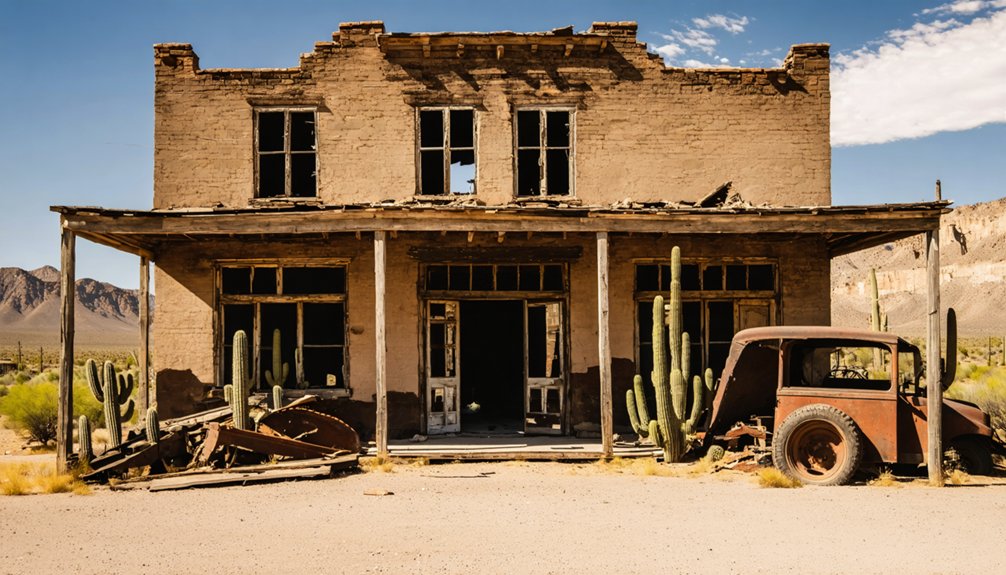
While ghost town properties promise unique investment returns, you’ll face substantial operational hurdles that directly impact your bottom line.
Property management challenges intensify when you’re dealing with structures miles from civilization—finding contractors willing to travel, securing materials, and monitoring vandalism become expensive propositions. You can’t simply call a local handyman when issues arise.
Historical preservation costs often exceed standard renovation budgets by 200-300%. You’re restricted in materials, methods, and modifications, limiting your ability to modernize efficiently.
Insurance premiums skyrocket for remote locations with limited emergency services. Water rights, septic systems, and power generation fall entirely on you.
Before committing capital, calculate whether these ongoing expenses align with your cash flow projections and risk tolerance.
Arizona’s Rich Ghost Town Heritage and Preservation
The financial burdens of remote ownership become more manageable when you understand the historical value driving your investment.
Arizona’s ghost town preservation opportunities stem from authentic mining history spanning the 1870s-1890s boom periods. You’ll find towns like Ruby, which housed 1,200 residents and led Arizona in lead and zinc production from 1934-1937, now standing as the most preserved ghost town in southern Arizona.
Congress benefited from strategic railway placement in 1893, while Fairbank’s role as Tombstone’s rail hub created lasting infrastructure. These properties offer tangible connections to Arizona’s economic cycles, from ore discovery to inevitable depletion.
Adobe foundations, cemetery remnants, and surviving structures at sites like Charleston demonstrate preservation potential that savvy investors recognize as irreplaceable assets.
Frequently Asked Questions
What Financing Options Are Available for Purchasing Ghost Town Properties?
You’ll discover traditional mortgages, auction purchases requiring cash deposits, owner financing with flexible terms, and specialized programs like NACA. These alternative lending solutions simplify purchase agreements, letting you claim Arizona’s abandoned properties without conventional banking restrictions.
Are Ghost Town Properties Eligible for Historic Preservation Tax Credits?
You’ll find ghost town properties are often eligible for historic tax credits if they’re on Arizona’s National Register. Preservation eligibility requires meeting federal standards and income-producing use, potentially offsetting your restoration investment considerably.
What Water Rights Come With Ghost Town Property Purchases?
You’re charting murky waters—ghost town properties typically lack established water rights unless they’re former farmland with documented entitlements. You’ll face significant property restrictions and must verify groundwater access through Arizona’s basin regulations before investing.
Can Ghost Towns Be Used for Commercial Tourism Operations?
You’ll reveal significant tourism potential by converting ghost towns into commercial operations. Arizona’s proven success stories—Tombstone, Jerome, and Oatman—demonstrate how historical significance drives visitor spending and creates profitable, freedom-focused business opportunities.
What Insurance Companies Cover Remote Ghost Town Properties?
Charting insurance coverage for remote properties feels like striking gold—rare but possible. You’ll need specialized carriers like Farmers, State Farm, or Lloyd’s of London who embrace high-risk ventures in Arizona’s untamed territories.
References
- https://www.zillow.com/homedetails/N-Ghost-Town-Trl-Elfrida-AZ-85610/439736690_zpid/
- https://www.coldwellbanker.com/az/elfrida/62-n-ghost-town-trl/lid-P00800000H48chwgBH2Rd9q6dBopGEPUt3XzEZwm
- https://www.youtube.com/watch?v=mk8A1n_gv6U
- https://www.shoparizonahighways.com/products/ghosttowns
- https://www.youtube.com/watch?v=u1KkAEZYqZY
- https://www.mysanantonio.com/realestate/article/spooky-spots-here-s-the-chilling-chance-to-buy-18458812.php
- https://toptenrealestatedeals.com/weekly-ten-best-home-deals/home/santa-claus-ghost-town
- https://www.highplainsprospectors.com/products/ghost-towns-of-arizona-1
- https://www.realtor.com/news/unique-homes/5-for-friday-the-13th-ghost-towns-for-sale/
- https://www.loopnet.com/Listing/13500-S-US-Highway-93-Congress-AZ/31466942/