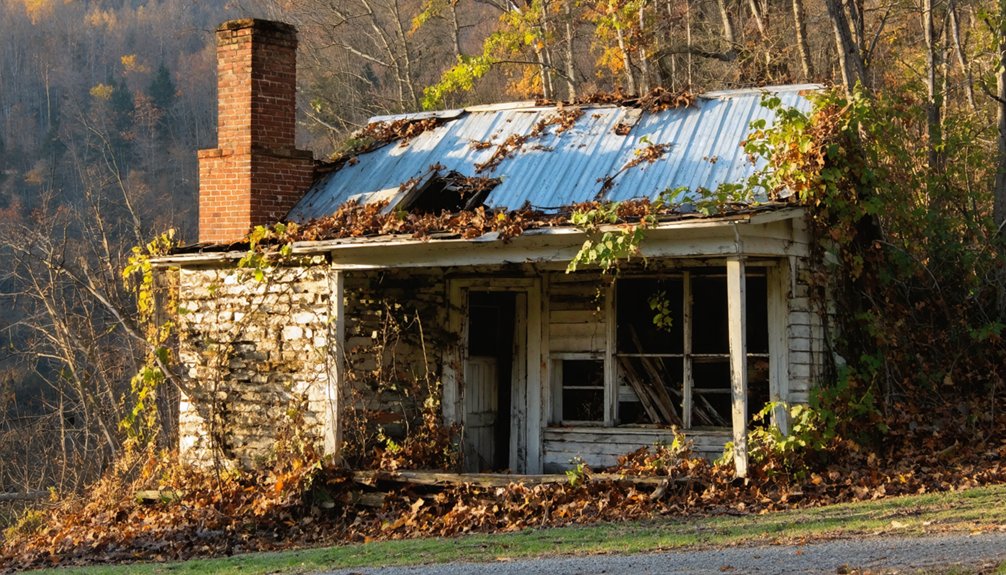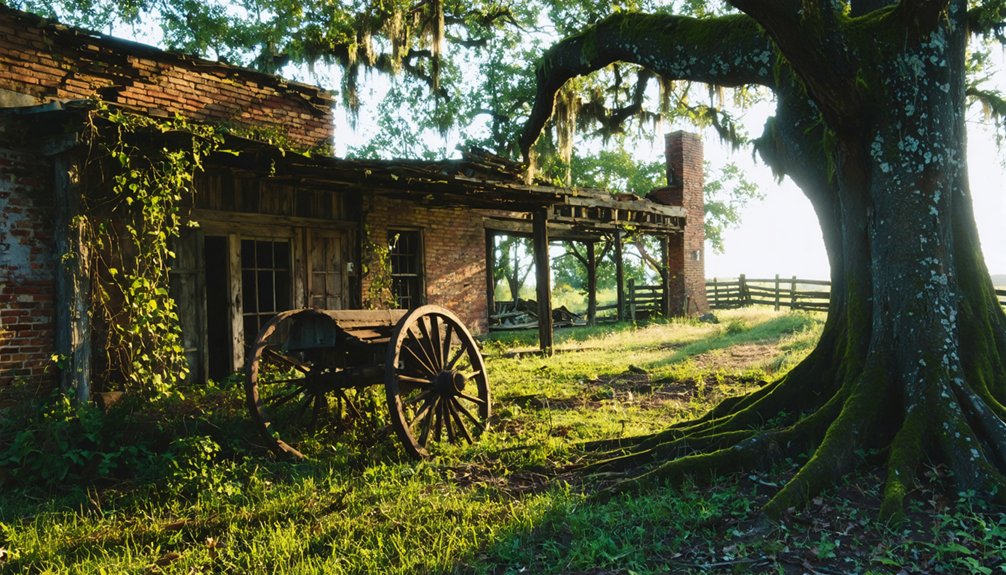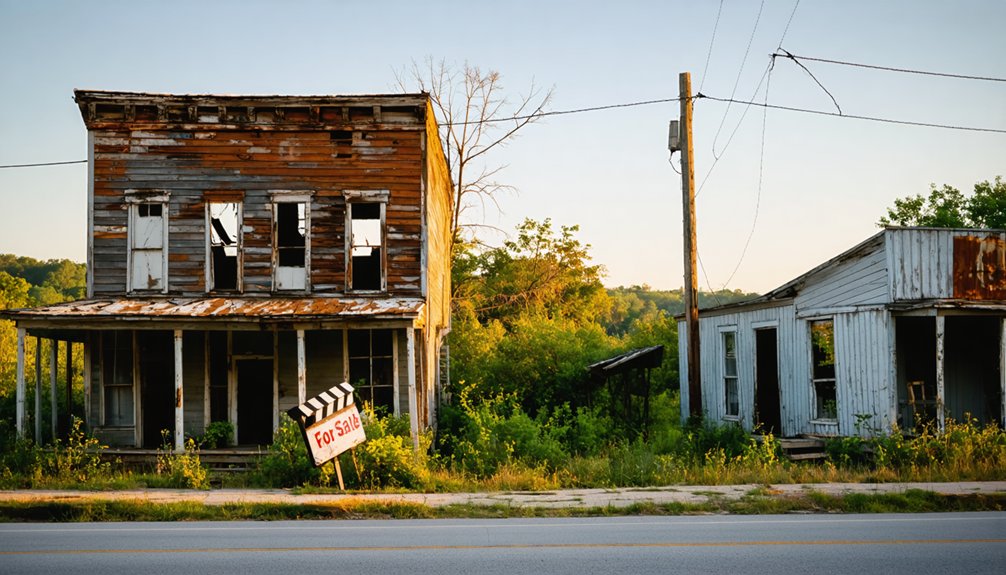
You won’t find complete ghost towns for sale in Arkansas like iconic Western properties, but you’ll discover numerous distressed parcels and abandoned town sites across the Ozarks. Current listings range from $49,000 for 10 acres in Melbourne to $267,323 for documented historical properties with early 1900s structures. Platforms like LandSearch and Zillow track these opportunities, with specialized auction schedules featuring properties as low as $400. Understanding the full investment landscape—including zoning complexities, restoration costs, and proven revenue models—requires examining thorough market documentation.
Key Takeaways
- No complete ghost towns are currently available for purchase in Arkansas, only distressed properties and historical parcels.
- Distressed properties average $267,323 statewide, with per-acre costs ranging from $2,500 to $17,172 depending on location.
- LandSearch tracks 120 distressed properties, while Zillow lists 9,447 land parcels, concentrated primarily in the Ozarks region.
- Assembling a ghost town property requires estimated investments of $150,000-$500,000 based on county location and property condition.
- Buyers face regulatory hurdles including zoning compliance, infrastructure restoration costs, and potential environmental liabilities from previous uses.
Understanding Arkansas Ghost Towns: From Boom to Abandonment
When French explorers established Arkansas Post in 1686 along the Arkansas River, they couldn’t have predicted it would become the first of many settlements to rise and vanish across the region.
Arkansas Post stood as Arkansas’s administrative heart for 135 years before joining the region’s pattern of forgotten settlements.
You’ll find Arkansas ghost towns followed predictable patterns: economic booms triggered rapid development, then catastrophic events caused abandonment. Railroad completion in 1871 spurred Hopefield’s growth, while zinc prices soaring to $160 per ton during World War I transformed Rush into a thriving community of thousands.
These towns possessed genuine historical significance—Rush earned National Register status, and Arkansas Post served as Arkansas’s administrative center until 1821. Yet most disappeared entirely, leaving minimal archaeological evidence. Hopefield suffered particularly devastating blows when yellow fever outbreaks in 1873 and 1878 drastically reduced its population alongside repeated flooding.
Understanding their cycles from prosperity to desolation reveals opportunities for community revival and preservation of Arkansas’s independent frontier heritage. Towns like Graysonia, a former lumber town with visible remnants near De Gray Lake, demonstrate how industry decline triggered abandonment across the state.
Where to Find Ghost Town Properties in Arkansas
Where should prospective buyers begin their search for Arkansas’s abandoned settlements and distressed properties?
Start with specialized real estate platforms like LandSearch, which tracks 120 distressed properties statewide, and Zillow’s 9,447 land listings.
You’ll find ghost town exploration opportunities concentrated in the Ozarks region, where 123 distressed properties average $267,323.
Historical parcels include 22.16 acres in Eureka Springs ($130,000) and 40 acres in Saint Joe ($149,000).
These bank-owned and neglected properties offer preservation efforts potential, from deteriorating farm residences to crumbling industrial sites.
Filter listings by acreage and price to locate forgotten land across rural farmlands and abandoned mountain hideouts.
Documentation-rich platforms enable you to uncover properties that preserve Arkansas’s historical legacy while securing your independent retreat.
Properties with National Register designation may qualify for tax credits and grants that offset restoration costs.
The US Marshals occasionally auction significant historical properties, such as the 735 acres in Mountainburg that includes remnants of the ghost towns Schaubburg and Armada.
Current Real Estate Listings and Auction Schedules
Arkansas’s current marketplace presents documented opportunities across multiple platforms, with Zillow tracking 9,447 land parcels alongside specialized distressed property inventories.
You’ll find current listings ranging from Melbourne’s 10.21-acre tract at $49,000 to West Fork’s 25-acre property at $140,000. Distressed properties average $267,323 across 120 documented listings, with per-acre costs hovering around $17,172.
Auction schedules reveal Pine Bluff’s $400 home sales, reflecting market corrections in declining municipalities. The oldhousesunder50k.com platform archives handyman specials like the 1955 yellow brick three-bedroom at $59,900.
You won’t find complete ghost towns listed, but these fragmented properties—abandoned structures, neglected parcels, and distressed holdings—represent the component parts. Your research requires monitoring multiple databases simultaneously, tracking properties that conventional buyers overlook in Arkansas’s rural corridors. Arkansas Apartments for Rent and other rental options provide alternatives if purchasing distressed properties proves too complex. Before proceeding with any purchase, research state zoning laws to ensure your intended use aligns with local regulations.
Pricing Benchmarks: What Ghost Towns Actually Cost
Market documentation reveals no complete ghost towns currently available for purchase in Arkansas, yet the component pricing tells a revealing story.
Ghost town pricing analysis requires examining comparable distressed properties and raw acreage acquisitions. Land value benchmarks indicate significant variation:
Evaluating ghost town acquisitions demands systematic comparison of deteriorating properties and undeveloped land transactions across multiple price points.
- Distressed properties average $16,372-$17,172 per acre, capturing abandoned structures and neglected buildings
- Raw land transactions range from $2,500 per acre (Marion County) to $16,633 per acre (Van Buren County)
- Larger parcels typically command $2,849-$8,625 per acre, depending on location and features
- Historic structures from the 1915-1920 era sell between $239,000-$495,000, establishing renovation baseline costs
These figures suggest assembling a functional ghost town property would require $150,000-$500,000 for foundational acreage plus structures, varying dramatically by county and condition. Current market conditions show distressed properties sitting for an average of 233 days, indicating patient negotiation opportunities for prospective buyers seeking abandoned settlement acquisitions. The current Arkansas land market features 78 total listings spanning diverse price points and acreages, providing potential building blocks for recreation-focused ghost town assemblages.
Transforming Abandoned Towns Into Profitable Ventures
While ghost towns typically conjure images of decay and abandonment, Arkansas’s distressed properties present documented investment pathways averaging $267,323 per listing—a figure that masks substantial variation in per-acre valuations and profit potential.
Your transformation strategy hinges on adaptive reuse frameworks that balance preservation with commercial viability. Mountainberg’s 735-acre property exemplifies this approach: orchards, waterfalls, and caves create infrastructure for heritage tourism ventures without requiring extensive demolition.
You’ll need community engagement protocols that satisfy regulatory expectations while maintaining operational autonomy.
Partnership models mitigate capital requirements but introduce governance complexities—documented disputes over protection versus development vision demonstrate this tension. Properties like Mountainberg carry native Ozark milkweed fields that support monarch butterfly populations, adding ecological value considerations to investment analysis.
Successful ventures align historical significance with buyer demographics: conservation-focused tourists versus development-seeking investors. Your profitability depends on matching asset characteristics to market demand while maneuvering through preservation requirements that constrain traditional development approaches.
Legal and Zoning Considerations for Buyers
Your adaptive reuse plans face immediate complications from Arkansas’s layered regulatory framework, where the Capitol Zoning District Commission wields exclusive authority over designated properties—superseding municipal control and creating approval bottlenecks that can delay projects by 6-12 months.
The Capitol Zoning District Commission’s exclusive authority creates regulatory bottlenecks that can stall adaptive reuse projects for six to twelve months.
Property permits require Commission authorization before local authorities can proceed:
- Building modifications, demolitions, and certificates of occupancy all demand Capitol Zoning District Commission approval
- Sign installations and privilege licenses require dual-layer review regardless of municipal ordinances
- Residential conversions must satisfy 20-foot lot minimums, 4:12 roof pitches, and masonry foundation enclosures
- Commercial developments adjacent to residential zones need 6-foot screening barriers with controlled lighting
Understanding zoning regulations through municipal office records—not online databases—determines feasibility.
Non-conforming uses trigger Master Plan compatibility assessments, potentially requiring variance applications that extend timelines indefinitely.
Success Stories From Similar Investments Nationwide

Documented revival projects across the American West provide measurable benchmarks for ghost town investments, with Animas Forks establishing the grant-funded preservation model after securing National Register of Historic Places designation in 2011.
That Colorado project obtained $330,000 in preservation funding through state historical funds, generating 250,000 annual visitors and validating ghost town tourism economics.
Cerro Gordo’s single-owner model demonstrates you’ll benefit from streamlined decision-making, where YouTube documentation attracted volunteer labor while modern infrastructure installation enabled remote property management.
Shaniko’s mixed-use approach proves revenue diversification works—converting historic structures into operational businesses like hotels and music venues while maintaining preservation standards.
The San Juan County Historical Society gathered over $12 million for preservation across multiple mining sites, demonstrating the funding potential when communities actively engage with their historical assets.
These projects prioritize roof repairs, foundation stabilization, and drainage systems before reconstruction.
You’ll find grant funding supplements private investment when documentation supports historical significance, reducing your capital requirements substantially.
Critical Risks Every Investor Must Evaluate
Before you commit capital to a ghost town property, you must examine documented patterns of infrastructure failure, regulatory barriers, and economic projections that have bankrupted previous investors.
Arkansas records show municipalities like Fort Smith doubled cleanup budgets to $300,000 annually while dealing with properties whose undisclosed zoning violations and code enforcement actions transferred remediation costs from negligent owners to taxpayers.
The O’Kelly House case exemplifies how post-purchase legal challenges, combined with infrastructure systems requiring complete replacement, can transform what appeared as bargain acquisitions into financial sinkholes with no viable exit strategy.
Infrastructure Collapse and Decay
Arkansas’s ghost town infrastructure tells a story of catastrophic failure across multiple timelines, from the 1912 flood that completely erased Hopefield—now buried under Mississippi River sediment and Interstate 40 bridge foundations near West Memphis—to the 1998 abandonment of Okay’s cement plant, where only concrete foundations mark what was once the town’s economic lifeline.
You’ll encounter infrastructure challenges manifesting as:
- Vacant properties exceeding 12% residential vacancy thresholds in nearly 30% of Arkansas counties
- River erosion continuously undermining structural stability in Cotter, Clarendon, and Des Arc
- Unregulated mine tailings contamination forcing evacuation of entire settlements
- Deteriorated main streets with overgrown lots scattered across rural communities
Economic decline accelerates physical decay.
Fort Smith doubled its blight cleanup budget to $300,000, demonstrating the financial burden of securing and demolishing unsafe structures throughout regions experiencing population loss since the 1960s.
Legal and Zoning Obstacles
Physical deterioration compounds when regulatory frameworks create unexpected barriers to restoration and redevelopment.
You’ll encounter zoning regulations frozen at specific dates, creating conflicts between your property rights and current building standards.
The Capitol Zoning District Authority maintains exclusive control over permits—building, demolition, occupancy—requiring Commission approval before you can proceed.
Nonconforming uses further complicate matters: existing structures that don’t meet current codes face continuation restrictions and amendment requirements.
Tax-delinquent properties carry unconfirmed zoning statuses, potentially invalidating your development plans.
Manufactured housing faces strict dimensional requirements, foundation specifications, and roof pitch standards.
Residential districts enforce minimum lot sizes and setback rules that may render your intended use impossible.
Without documented Commission agreements, you’re traversing regulatory territory where local authority remains contested and enforcement unpredictable.
Failed Revenue Projections
While regulatory obstacles create immediate barriers, financial miscalculations deliver the final blow to most ghost town acquisitions.
You’re competing in a saturated market of 4,531 documented ghost towns nationwide, where financial forecasting consistently overestimates market demand and underestimates infrastructure costs.
Critical projection failures include:
- Infrastructure restoration: Properties require operational standards before generating revenue, with unexpected failures like roof collapses drastically exceeding budgets.
- Environmental liabilities: Coal fires, contamination, and flood plains create unforeseen remediation expenses that eliminate projected revenue streams.
- Tourism viability: Without anchor attractions or established infrastructure, visitor interest collapses—marijuana legalization ventures and content-driven strategies have repeatedly run out of capital before profitability.
- Economic diversification barriers: Resource-depleted towns lack foundations for sustainable business models despite investment attempts.
Frequently Asked Questions
Can Foreign Investors Purchase Ghost Town Properties in Arkansas?
You’ll face significant restrictions under Arkansas’s foreign ownership laws affecting real estate acquisitions. Current investment regulations prohibit certain foreign parties from purchasing property statewide, though enforcement remains uncertain following December 2024’s preliminary injunction halting implementation.
What Property Insurance Options Exist for Abandoned or Deteriorating Ghost Towns?
You’ll find specialty dwelling insurance covers deteriorating structures, though carriers require basic safety measures like fencing. Property liability protection remains essential, with insurance coverage options including vacant home policies and customizable protections against vandalism, theft, and structural damage.
Are Ghost Town Purchases Eligible for Historic Preservation Tax Credits?
You’ll find preservation eligibility for ghost town purchases if structures qualify for National Register listing and you’re rehabilitating them as income-producing properties. Historic tax incentives require documented certification and meeting rehabilitation standards before claiming credits.
How Do Mineral Rights Affect Ghost Town Land Purchases in Arkansas?
What’s lurking beneath your prospective ghost town? Mineral ownership often exists separately from surface rights, requiring you’ll verify both through county records before purchase. Land leases and severed mineral rights complicate documentation, potentially limiting your operational freedom.
What Financing Options Do Banks Offer for Unconventional Ghost Town Investments?
Banks provide unconventional mortgages through C&I loans, construction-to-permanent financing, and portfolio loans for ghost town properties, though you’ll face investment risks requiring detailed documentation of redevelopment plans and property valuations for approval.
References
- https://www.youtube.com/watch?v=Xrht4eEms6o
- https://www.ezhomesearch.com/blog/ghost-towns-in-arkansas/
- https://www.youtube.com/watch?v=u1KkAEZYqZY
- https://www.ucneeleyforestry.com/results/AR
- https://www.cosl.org/catalog.aspx
- https://www.youtube.com/watch?v=s2a3hAf5d-Y
- http://freepages.rootsweb.com/~gtusa/history/usa/ar.htm
- https://kkyr.com/have-you-ever-been-to-this-old-abandoned-ghost-town-in-arkansas/
- https://aymag.com/arkansas-backstories-ghost-towns/
- https://www.nps.gov/arpo/learn/historyculture/arpo-timeline-4-decline.htm