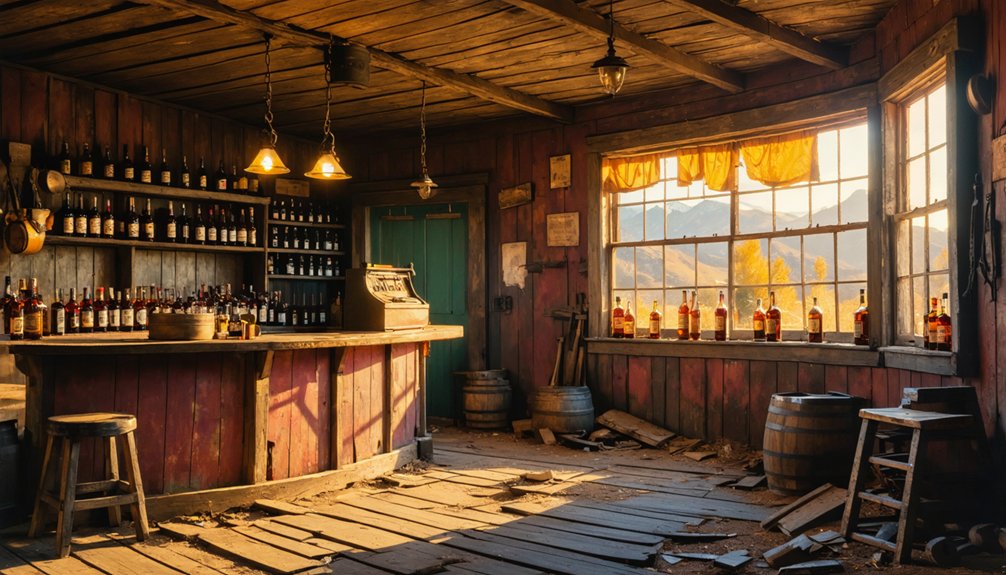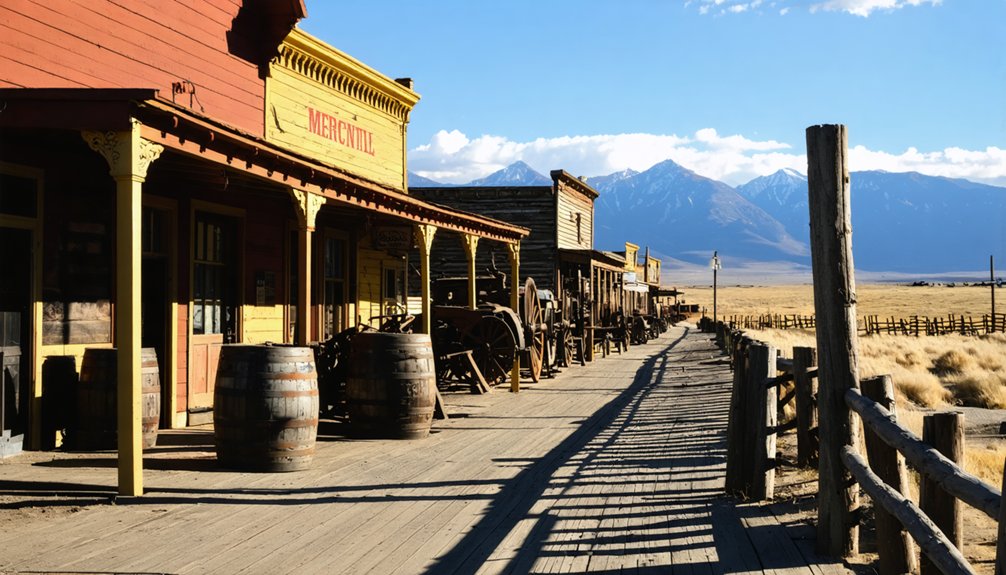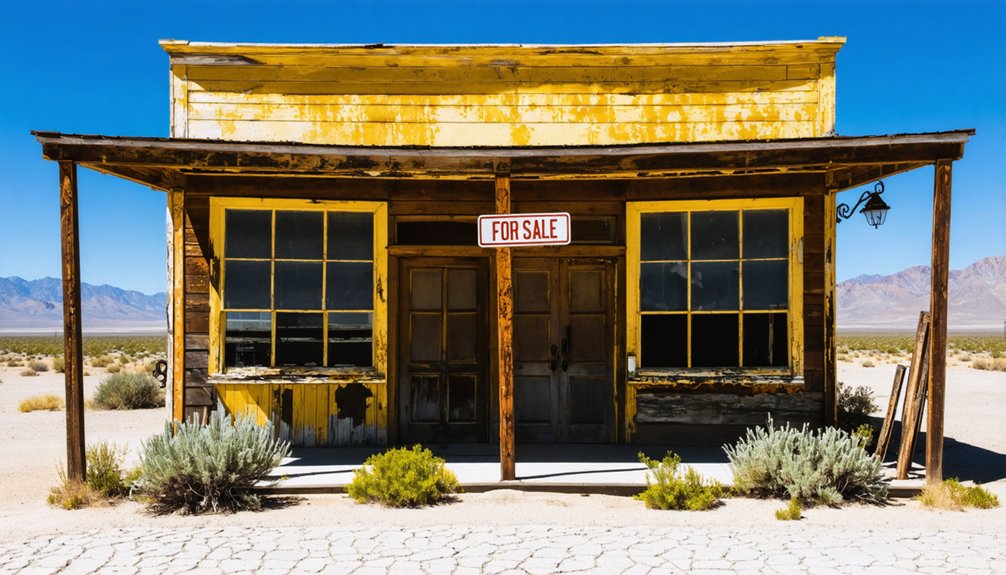
You’ll find California ghost towns priced from $99,000 for 62-acre parcels near Cerro Gordo to $22.6 million for properties like Eagle Mountain, which sold in April 2023. These former mining communities offer unique investment opportunities, though you’ll face challenges including infrastructure deficits, complex title searches, and environmental assessments from past mining operations. Heritage-focused buyers often outbid purely financial investors, while locations near Joshua Tree National Park and major highways command premium pricing. The following sections break down valuations, transaction histories, and investment considerations.
Key Takeaways
- California ghost town prices range from under $100,000 for vacant land to over $22 million for developed properties with infrastructure.
- Notable listings include Cerro Gordo at $925,000 with 22 buildings and Eagle Mountain, which sold for $22.6 million in 2023.
- Properties near Joshua Tree National Park and major highways command higher prices due to tourism potential and accessibility.
- Financing is challenging as banks classify ghost towns as high-risk investments requiring extensive legal and environmental due diligence.
- Successful investments depend on existing infrastructure, historical significance, proximity to attractions, and potential for tourist revenue generation.
Eagle Mountain: California’s Largest Ghost Town Sale
A $22.6 million transaction in April 2023 marked the latest chapter for Eagle Mountain, California’s largest ghost town sprawling across 10,000 acres in Riverside County near Joshua Tree National Park’s southeast corner.
Eagle Mountain Acquisitions LLC sold the property to Ecology Mountain Holdings LLC, a Cerritos-based company incorporated just weeks before the purchase.
You’ll find this ghost town transformed from a thriving Kaiser Steel Corporation mining community of 4,000 residents into abandoned remnants after the mine’s 1983 closure.
The site’s seen multiple revival attempts—a prison that closed following a deadly riot, a rejected landfill proposal, and a pending $2.5-billion hydroelectric plant application.
Conservation groups have opposed the hydroelectric project over concerns about groundwater impact in the area.
The town once featured modern amenities including a post office, recreation hall, and high school that served the mining community during its peak years.
Today, you’ll encounter drone training operations and film location possibilities, while the buyer’s ultimate plans remain undisclosed.
Cerro Gordo: A Silver Mining Town Reborn
- Population surged to 4,800 residents during peak operations in the 1870s.
- Averaged one murder weekly, earning its reputation as California’s most lawless mining town.
- Nearly $500 million in minerals extracted from 30 miles of underground tunnels.
- Perched at 8500 feet in the Inyo Mountains, the town overlooks the site of former Owens Lake.
- The American Hotel, built in 1871, stands as one of the town’s permanent structures from its boom period.
- Brent Underwood now owns and documents restoration efforts as @GhostTownLiving.
What Makes California Ghost Towns Valuable
You’re evaluating ghost towns that command prices from $925,000 to $1.4 million based on two critical factors: their preserved Wild West structures and their ability to attract paying visitors.
Historical authenticity determines whether you’re buying a genuine piece of California’s mining era—complete with original buildings, mining shafts, and artifacts dating back 15,000 years—or merely purchasing dilapidated property.
Tourist accessibility, including proximity to major routes and existing infrastructure like museums with daily 9 a.m. to 5 p.m. access, directly impacts your revenue potential through heritage tourism and commercial development. Properties spanning 300 acres with 22 structures offer substantial development possibilities while preserving historical integrity. Properties like Cerro Gordo demonstrate the financial challenges, requiring hard-money lender financing and contributions from multiple investors to complete the acquisition.
Historical Authenticity and Architecture
Key value indicators include:
- Original building materials: Intact brick vaults, granite jails, and wooden storefronts with period fittings
- Documented history: Known construction dates, builders, and residents from the 1870s-1880s mining era
- Authentic artifacts: Shelved goods in general stores, operational stamp mills, and Wells Fargo Express buildings
- Structural variety: Saloons, schoolhouses, hotels, and mining facilities representing complete township infrastructure
- Preservation approach: Properties maintained under arrested decay standards preserve authentic deterioration patterns while preventing further structural loss
- Educational opportunities: These properties offer valuable insights into early American life and economic changes that shaped California’s development
Sites maintaining “arrested decay” without restoration attract investors seeking genuine Western heritage properties with commercial potential.
Tourist Appeal and Accessibility
When evaluating ghost towns as investment properties, tourist traffic directly translates to revenue potential.
Calico Ghost Town demonstrates this principle with 240,000 annual visitors generating income through shops, restaurants, mine tours, and 259 campground sites.
You’ll find that ghost town tourism thrives when locations offer year-round access and multiple revenue streams—from event hosting to accommodation rentals.
Visitor accessibility determines market viability.
Properties near major metro areas like Sacramento and San Francisco command premium interest, while remote High Sierra sites like Bodie still attract dedicated travelers.
State park proximity, highway access, and existing infrastructure separate profitable ventures from stranded assets.
TripAdvisor data shows tourists seek authentic mining ruins combined with modern amenities—the balance that transforms abandoned settlements into cash-flowing heritage destinations.
Bodie’s transition to state park status in 1962 established a preservation model that maintains buildings in arrested decay while attracting visitors from various regions.
Historic sites like Hearst Castle prove that abandoned properties can evolve into major tourist attractions when properly restored and marketed.
Price Range and Recent Transactions
California’s ghost town market spans from $925,000 for Cerro Gordo’s 300-acre mining settlement to $22.5 million for Eagle Mountain’s former company town.
You’ll find pricing directly correlates with acreage, number of standing structures, and infrastructure condition—properties with preserved buildings commanding premiums over bare land.
Recent transactions reveal sellers sometimes prioritize heritage-focused buyers over highest bidders, as demonstrated when Cerro Gordo’s investors secured the property at $1.4 million despite competing offers.
Notable California Sales
Two major transactions in recent years illustrate California’s ghost town market spectrum, ranging from multi-million dollar industrial sites to million-dollar restoration projects.
One notable example can be found in the exploration of historic sites in Berryessa, California, where investors are seeking opportunities to revive the area’s rich heritage. These sites not only reflect the history of the region but also offer potential for tourism and community development. As more people discover these hidden gems, the demand for restoration and preservation efforts is likely to increase, fostering a renewed interest in local history.
Eagle Mountain sold for $22.6 million in April 2023 to Ecology Mountain Holdings, a massive 10,000-acre former iron mining site near Joshua Tree National Park.
This Riverside County property once commanded $41 million in escrow before failed landfill plans derailed the deal.
Meanwhile, Brent Underwood and investors purchased Cerro Gordo for $1.4 million in 2018, demonstrating ghost town preservation through active restoration.
The abandoned silver mining town now features:
- 30 miles of underground shafts with original infrastructure
- Resumed silver mining producing galena for jewelry
- Free daily museum access supporting urban exploration
- Rebuilt elevator enabling mine tours
Both properties showcase California’s diverse opportunities for independent ownership.
Pricing Factors and Variations
Ghost town pricing in California spans from under $100,000 for remote parcels to over $22 million for large-scale industrial sites, creating entry points across investment levels.
You’ll find 62-acre properties adjacent to Cerro Gordo at $99,000, while mid-tier options like Bridgeville command $1.2 million.
Pricing models factor acreage, structure count, and historical significance—Cerro Gordo’s 336 acres with 22 buildings listed at $925,000 but sold for $1.4 million when preservation commitment outweighed highest bids.
Eagle Mountain’s $22.5 million April transaction demonstrates industrial-scale valuations.
Your investment strategies must account for remote access limitations that suppress premiums and buyer intent variations.
Heritage restoration groups often pay above asking, while speculative investors target entry-level parcels.
Transaction prices fluctuate based on infrastructure, mining claims, and intended use.
Transforming Abandoned Towns Into Profitable Ventures
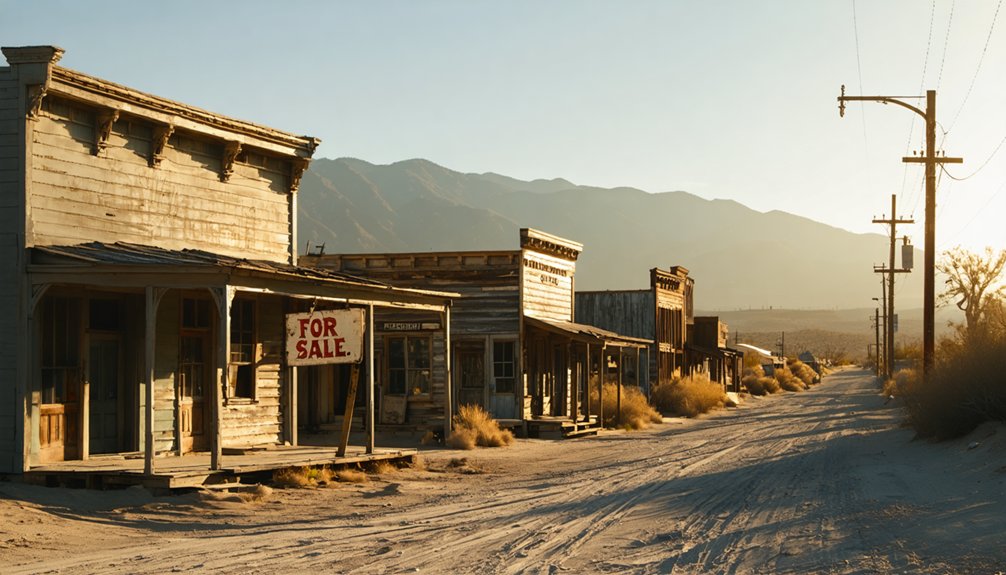
When Ecology Mountain Holdings acquired Eagle Mountain for $22.6 million in April, the transaction signaled how abandoned California settlements are becoming serious investment opportunities.
You’ll find successful transformations rely on strategic positioning—Eagle Mountain’s proximity to Joshua Tree National Park and its film production history create multiple revenue streams.
Cerro Gordo’s $1.4 million purchase demonstrates how authentic Wild West architecture attracts visitors seeking genuine historic experiences.
Your profitable ghost town venture should leverage:
- Film location partnerships generating steady income from productions like Tenet
- Sustainable tourism through preserved 19th-century structures and authentic atmosphere
- Community engagement via dining venues, live music, and special events
- Regional attractions combining national parks, hot springs, and historic sites
Resource-depleted mining towns now thrive through hospitality-focused redevelopment rather than extraction economics.
How to Evaluate a Ghost Town Investment
Before committing capital to a ghost town acquisition, you’ll need to conduct rigorous legal due diligence that extends far beyond standard real estate transactions. Extensive title searches verify clear ownership across all parcels, while zoning analysis reveals permitted uses and development restrictions.
Environmental assessments detect contaminants from mining operations—critical for understanding investment risks.
Property regulations vary considerably. Historic preservation ordinances may limit your renovation freedom, while overlay districts can offer density bonuses.
You’ll face infrastructure challenges: most sites lack water, electricity, and sewage systems, requiring substantial capital for restoration.
Financial viability hinges on multiple factors. Banks classify these properties as high-risk, complicating financing. However, tax abatements in Opportunity Zones can offset costs.
Evaluate market momentum through city council agendas and tourism potential to maximize returns.
Frequently Asked Questions
Are Ghost Town Buyers Responsible for Environmental Cleanup From Mining Operations?
Yes, you’ll inherit environmental liabilities once you purchase. Mining regulations hold current landowners responsible for existing pollution, even if you didn’t cause it. Clean Water Act violations and CERCLA designation create significant financial risks requiring careful due diligence.
What Zoning Restrictions Apply When Purchasing Abandoned California Towns?
You’ll face existing zoning classifications and land use regulations from the county, even for abandoned towns. These restrictions control building standards, permitted uses, and development density—though state laws may override local limits for housing projects.
Can Ghost Town Owners Charge Admission Fees to Tourists and Visitors?
You’re striking gold with admission pricing rights—property owners can charge tourist fees without special permits, though you’ll navigate tourist regulations including liability insurance, posted hours, and local business licensing requirements before collecting revenue.
Do Ghost Towns Include Water Rights and Utility Infrastructure Access?
You’ll typically acquire water rights automatically when purchasing a ghost town, as they’re appurtenant to the land unless explicitly reserved. However, utility access requires separate investigation since ghost towns often lack modern infrastructure connections.
What Insurance Requirements Exist for Owning Historic Ghost Town Properties?
You’ll need specialized policies covering historic preservation standards, guaranteed replacement cost using period-appropriate materials, extensive liability coverage for visitors, and sprinkler systems. Expect higher premiums due to outdated infrastructure and remote locations requiring specialized restoration methods.
References
- https://secretlosangeles.com/california-largest-ghost-town-eagle-mountain/
- https://abc7.com/post/california-ghost-town-sells-for-$14m/3778961/
- https://www.lmtonline.com/realestate/article/5-for-Friday-the-13th-Spooky-Ghost-Towns-for-Sale-17716649.php
- https://www.youtube.com/watch?v=9NbQToO9gOE
- https://www.ezhomesearch.com/blog/towns-for-sale-in-the-usa/
- https://nathanbarry.com/cerro-gordo/
- https://abc7news.com/post/ghost-town-for-sale-with-a-real-wild-west-history/3610524/
- https://www.realtor.com/news/unique-homes/ghost-town-mining-operation-california/
- https://www.latimes.com/california/story/2023-05-23/riverside-county-ghost-town-sells-for-22-6-million-to-mysterious-company
- https://www.sfgate.com/travel/article/eagle-mountain-california-ghost-town-18096768.php