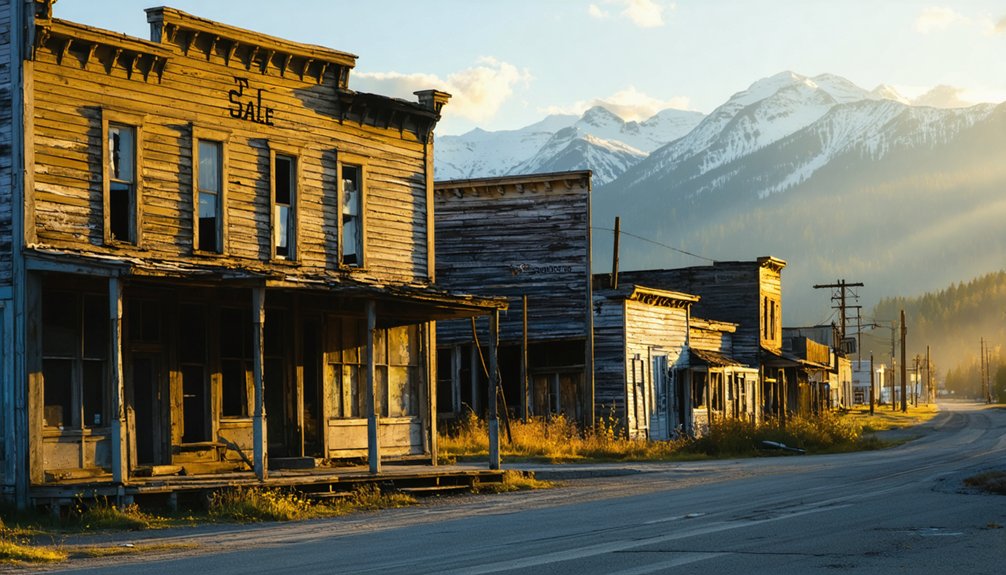
You can purchase entire Canadian ghost towns for considerably less than urban properties, with options ranging from $1.2 million for Bradian’s complete hamlet to $2.3 million for BC’s 50-acre site featuring six historic residences. These investments offer unique opportunities compared to Toronto’s $1.28 million average detached home price. Properties like Butedale include functional hydropower systems, while Edelweiss Village presents income-generating potential through restored Swiss chalets. Understanding freehold versus leasehold ownership, restoration costs, and environmental assessments becomes essential for evaluating these distinctive investment opportunities.
Key Takeaways
- Ghost towns in Canada range from $1.2 million to $2.3 million, offering multiple properties at lower costs than single urban homes.
- Notable listings include Butedale with hydropower infrastructure, Edelweiss Village’s six Swiss chalets, and Bradian’s historic mining hamlet.
- Freehold ownership provides absolute title and autonomy, while leasehold agreements limit occupancy rights from 20-99 years.
- Restoration costs often exceed purchase prices due to environmental assessments, hazardous materials remediation, and infrastructure decay.
- Ghost towns offer investment potential through eco-tourism, adaptive reuse projects, and proximity to mineral deposits with rising commodity prices.
What Makes Canadian Ghost Towns Attractive Real Estate Investments
Canadian ghost towns present compelling investment opportunities driven by substantial property devaluations that rarely emerge in conventional markets.
You’ll find median home prices ranging from $258,000 to $540,000 in declining cities—significantly below metropolitan benchmarks—while housing stock built before 1975 remains undervalued relative to replacement costs.
Ghost town investments capitalize on distressed pricing caused by population exodus rather than structural deficiencies, positioning your acquisitions for future appreciation.
Rural property appeal intensifies as out-migration eliminates bidding wars and strengthens your negotiating leverage.
You’re accessing entry points into Canadian markets without competing in saturated urban centers, acquiring assets that benefit from eventual economic diversification or infrastructure projects.
Property tax increases create short-term challenges but establish long-term opportunities for patient capital seeking substantial returns. Urban vacancy patterns, including 15% unoccupied downtown condos in major cities, demonstrate how underutilized real estate creates distinct market segments with variable investment profiles.
Market conditions favor buyers as average home market times have extended to 96 days in cities experiencing decline, allowing thorough due diligence and strategic acquisition planning.
Butedale: a Century-Old Rainforest Settlement With Hydropower Potential
Nestled on Princess Royal Island at 53°09′N 128°41′W, Butedale represents one of British Columbia’s most infrastructure-rich ghost town acquisitions currently available to private investors.
Understanding Butedale history reveals a fishing and logging camp founded in 1911 that evolved into BC’s northernmost salmon cannery by 1918, serving populations exceeding 400 during peak operations.
Critical Infrastructure Already in Place:
- Functional hydropower system fed by Butedale Lake and dam
- Protected moorage serving Inside Passage traffic (cruise ships, ferries, private vessels)
- Existing buildings including powerhouse, bunkhouses, and reduction facilities
The hydropower potential alone distinguishes this property from typical ghost town offerings.
You’re acquiring operational energy infrastructure plus established maritime facilities in a region where boat access remains essential.
The caretaker currently maintains generator operations using salvaged components.
The property features the spectacular Butedale Falls flowing directly from Butedale Lake into the ocean adjacent to the former docking area, recognized as a natural wonder that enhances the site’s tourism potential.
The small dam generates one megawatt of power, providing substantial energy production capacity for potential redevelopment projects.
Edelweiss Village: Swiss Alpine Heritage in the Canadian Rockies
You’ll find six meticulously refurbished Swiss Chalet-style homes from 1910-1912 perched on a 50-acre hillside at Golden’s western entrance, overlooking the Columbia Valley.
These aren’t replicas—they’re authentic Canadian Pacific Railway chalets built for the legendary Swiss mountain guides who pioneered Rocky Mountain tourism and led hundreds of first ascents between 1899-1954. The guides were originally brought to CPR hotels in 1899 to teach safe climbing techniques following Philip S. Abbot’s fatal climbing accident.
The Feuz family’s continuous ownership since 1959 has preserved irreplaceable artifacts and architectural integrity while adding modern amenities that position these rentable properties as both heritage assets and income-generating investments. The original guides returned to Switzerland each winter after their summer mountaineering service, until CPR offered five-year contracts with permanent homes in 1909.
Historic Swiss Guide Chalets
Between 1910 and 1912, the Canadian Pacific Railway commissioned six Swiss-style chalets on a hillside near Golden, BC—creating what would become one of the most distinctive heritage properties in the Canadian Rockies.
These three-storey residences housed professional Swiss mountain guides on five-year contracts, establishing Western Canada’s mountaineering foundation.
The Chalet Architecture features unique investment characteristics:
- Swiss Heritage authenticity with original design elements by architects George S. Rees and James L. Wilson
- Six individually distinct structures perched on a 50-acre hillside property
- Modern refurbishments maintaining historical integrity while generating rental income
The Feuz family’s 1959 acquisition transformed these chalets into Edelweiss Village + Resort.
Swiss guides led over 250 first ascents in the Rocky and Selkirk mountains by 1925, achieving this remarkable feat without a single fatality.
The Canadian Pacific Railway hired Swiss guides in 1899 to lead climbing expeditions, marking the beginning of professional mountaineering in the region.
You’ll find digitally documented heritage assets, preserved mountaineering artifacts, and income-producing properties that represent tangible connections to Canada’s alpine tourism history.
Heritage Preservation and Modernization
The Edelweiss Village story shifted dramatically in 2021 when a $2.3 million listing threatened these six irreplaceable chalets with demolition.
You’ll find that local advocates Ilona Spaar and Johann Roduit mobilized the Swiss Edelweiss Village Foundation, leveraging international support to save this National Trust-recognized endangered site.
The heritage impact extends beyond architecture—these structures represent the last tangible connection to Swiss guides who led hundreds of first ascents from 1899-1954.
Today’s modernization balance proves attainable: Montayne’s restoration completed Phase 1 for fall 2024, transforming deteriorating chalets into premium accommodations while preserving 110-year-old alpine character.
You’re looking at barrel saunas, upgraded trails, and planned destination spa alongside protected historic fabric. The village emphasizes community engagement through workshops and events that connect visitors with local traditions and Swiss cultural heritage.
University of Calgary’s digital preservation guarantees documentation survives, even as climate change claimed related Abbot Pass Hut in 2022. The Digital Heritage Preservation Research Group employed mobile lidar systems and multiple scanning technologies to create comprehensive three-dimensional records of all six chalets, ensuring precise structural details remain accessible for future research and restoration efforts.
Prime Golden District Location
Perched on a strategic hillside at Golden’s west entrance, Edelweiss Village commands sweeping views of the Columbia Valley and Canadian Rockies—a positioning that’s driven premium value since 1912.
The property’s investment potential stems from three core location advantages:
- Transportation Visibility: Originally sited for maximum exposure to CPR trains, ensuring constant tourist awareness and marketing value.
- Elevation Advantage: Steep slope positioning delivers unobstructed mountain views across the Columbia Valley, a feature you can’t replicate.
- Town Proximity: Near Hospital Creek and Golden’s center while maintaining private hillside seclusion among mature trees.
This 50-acre parcel represents Western Canada’s prime mountaineering territory, where Swiss guides conducted legendary first ascents.
You’re buying into established heritage tourism infrastructure with proven draw from nearby Chateau Lake Louise clientele—a turnkey revenue stream that’s operated for over a century.
The Rise and Fall of Bradian Ghost Town
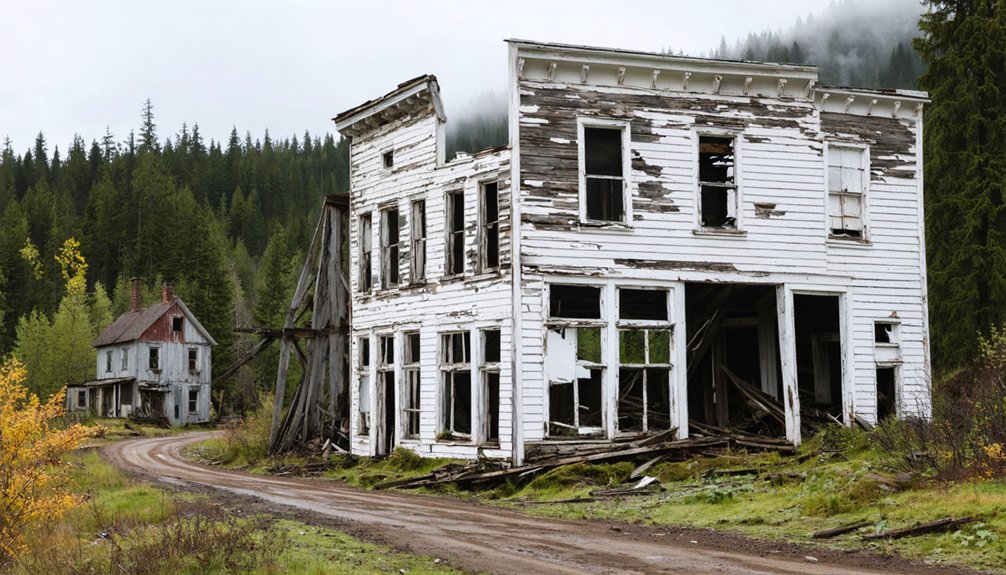
During Canada’s pre-war gold rush, Bralorne Mining Company established Bradian in the 1930s as “Townsite 3″—a strategic housing development for workers extracting precious metals from British Columbia’s coastal mountains.
The Bradian history reveals remarkable production: 4 million ounces of gold and 1.2 million ounces of silver between 1931-1970, making it Canada’s highest-grade operation.
Between 1931-1970, Bradian’s mines yielded 4 million ounces of gold—Canada’s most productive high-grade operation.
The 1971 mine closure devastated this 5,000-person community. You’d have witnessed 75% population loss overnight, with 80% of homes immediately abandoned.
Failed investments followed—bankruptcy, commune proposals, systematic dismantling by neighbors for building materials.
Community resilience emerged through Tom and Kathleen Gutenburg‘s 1997 purchase for $100,000. Their 20-year restoration preserved 22 structures from total decay.
Yet the 2016 sale to China Zhong Ya Group perpetuated instability, with quick relisting demonstrating continued investment challenges.
Understanding Property Rights: Freehold vs. Leased Land
Before you commit capital to purchasing a ghost town property in Canada, you’ll need to understand whether you’re buying freehold or leasehold ownership—a distinction that fundamentally affects your investment returns, financing options, and exit strategy.
Freehold grants you absolute ownership of both land and structures in perpetuity, while leasehold limits you to time-bound occupancy rights with ongoing ground rent obligations.
These ownership structures carry vastly different implications for property taxes, market valuation, and your ability to secure competitive mortgage financing.
What Is Freehold Land?
Freehold ownership represents the strongest form of property rights you’ll encounter in Canadian real estate, granting absolute title to both land and structures for an indefinite period. Known as “fee simple” under B.C.’s Property Law Act, this arrangement frees you from landlords, ground rent, and lease expirations—you own it perpetually.
Freehold advantages include:
- Complete autonomy over selling, leasing, renovating, or subdividing within municipal regulations.
- Superior appreciation potential compared to leasehold properties, enhancing long-term investment returns.
- No strata fees or council restrictions limiting your property decisions.
However, ownership responsibilities demand full coverage of maintenance costs, property taxes, insurance, and compliance with zoning bylaws.
You’ll shoulder these expenses independently, without shared budgets. For ghost town investments, freehold status means unrestricted control over your frontier asset’s future.
Leased Land Explained
Without land ownership, you’re maneuvering a fundamentally different investment model. Lease agreements typically span 20-99 years, with terms shortening annually and directly impacting resale value.
You’ll find these structures across Crown lands, First Nation reserves, mobile home parks, and retirement communities—often priced 30% below comparable freehold properties.
The trade-off? Limited equity accumulation and restricted appreciation potential. Your capital gains derive solely from the structure, not the underlying real estate.
Ontario leases exceeding 50 years trigger land transfer tax, while shorter terms remain exempt. Commercial leases run 5-10 years with negotiated extensions.
For investors seeking maximum autonomy, leasehold arrangements present inherent limitations despite lower entry costs.
Comparing Rights and Restrictions
When evaluating ghost town properties, you’re confronting two fundamentally different ownership structures that reshape your investment thesis.
Freehold vs. Leased: Critical Distinctions
- Control Authority: Freehold grants absolute dominion over your 30 acres, while leased portions surrender exclusivity through mandated public rights of way across 64 acres.
- Regulatory Exposure: Fee simple transfers on Nisga’a lands subject you to collective jurisdiction despite ownership—real estate regulations persist beyond your title deed.
- Exit Strategy Constraints: Investment risks multiply with leased land requiring discretionary approvals, right-of-first-refusal obligations, and potential reversion to band control upon mortgage default.
Recent First Nations assertions challenge even fee simple certainty, depressing property values and constricting financing options.
Your due diligence must quantify these governance layers before capital deployment.
From Salmon Canneries to Modern Ventures: Historical Significance
Canada’s ghost towns represent more than abandoned buildings—they’re tangible investment opportunities rooted in the nation’s resource extraction heritage.
You’ll find properties ranging from silver mining settlements like Sandon, British Columbia—once supporting 5,000 residents and 300 active mines—to abandoned railway communities across Western Canada. The historical significance extends beyond precious metals to coastal salmon canneries and northern operations like Giant Mine near Yellowknife, which operated until 2004.
These sites offer unique acquisition potential, though you’ll need to account for environmental remediation costs, particularly arsenic contamination at former mining locations.
Private preservation models, like Heritage Ghost Town’s rescue of 26 buildings without public funding, demonstrate viable ownership frameworks. Understanding each town’s boom-and-bust cycle helps you assess long-term development potential and regulatory considerations.
Comparing Ghost Town Prices to Urban Real Estate Markets
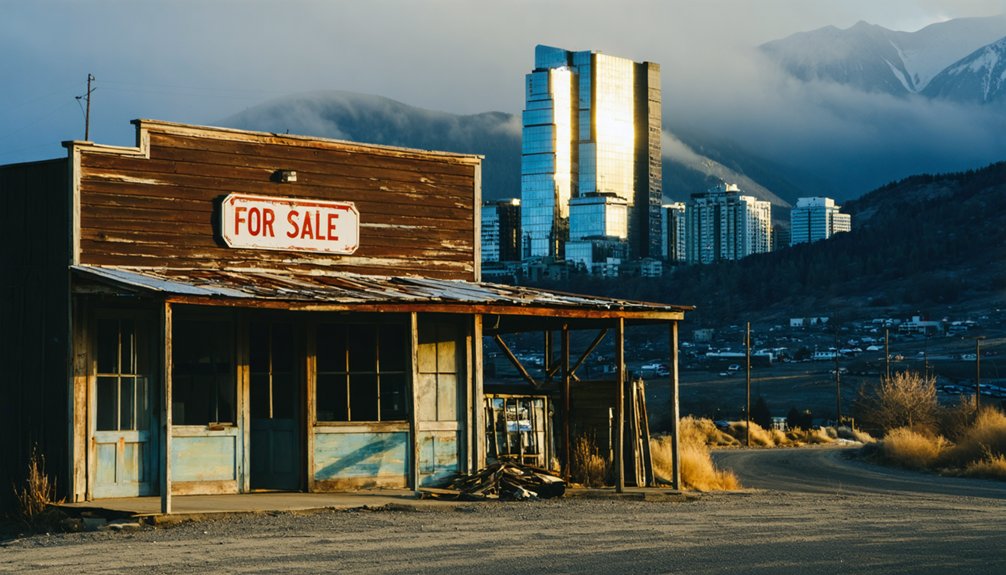
The investment case for ghost towns becomes clearer when you compare asking prices to Canada’s heated urban markets.
While Toronto’s average detached home hit $1.28 million in May 2022, you’ll find entire ghost town investments offering remarkable value:
- Bradian’s complete hamlet lists at $1.2 million—less than a single Toronto house, yet you’re acquiring an entire community.
- BC’s $2.3 million ghost town includes 50 acres and six historic residences, dwarfing urban comparables in land and structures.
- Sub-$1 million mining towns deliver full property portfolios for less than Oakville’s $1.8 million luxury average.
These urban comparables highlight ghost towns’ unique proposition: you’re not just buying property—you’re securing land, buildings, and development potential that traditional real estate markets can’t match.
Restoration Challenges and Opportunities for Buyers
Before you commit capital to a ghost town acquisition, you’ll need to account for restoration costs that often exceed the purchase price itself.
Investors looking at buying abandoned properties in Arizona should also consider the potential for appreciating land values in the area. With the right vision and investment, these neglected spaces can transform into lucrative ventures that attract new residents and businesses. Moreover, understanding local zoning laws and community dynamics can significantly enhance the success of such projects.
Environmental assessments will uncover toxic threats like arsenic trioxide dust from abandoned mining operations, requiring extensive remediation. You’ll face decaying infrastructure—rusting equipment, collapsed buildings, and overgrown paths demanding significant repair investments.
However, rising commodity prices create genuine opportunities. Sites near mineral deposits become viable again when market conditions shift favorably.
Your restoration strategies should leverage all available assets: historical structures suitable for adaptive reuse, natural reclamation that attracts eco-tourism, and economic development potential that draws workers.
Success requires maneuvering through remediation requirements while capitalizing on location-specific advantages.
Remote properties demand creative solutions, but they offer unmatched autonomy for buyers seeking independence from conventional real estate constraints.
Frequently Asked Questions
What Financing Options Are Available for Purchasing a Ghost Town?
You’ll need private lenders willing to finance unconventional properties, as traditional banks typically won’t. Explore crowdfunding options to pool investor capital. Consider seller financing or partnerships to structure creative deals outside conventional lending parameters.
Are There Property Tax Implications for Owning Abandoned Settlements?
You’ll face standard property tax on abandoned settlements based on assessed value, but vacant home taxes like Vancouver’s 3% levy could greatly increase costs if you don’t maintain occupancy or qualify for exemptions.
Can Foreign Buyers Purchase Ghost Towns in British Columbia?
You’ll find virtually zero barriers blocking your ghost town investments in British Columbia—foreign ownership regulations haven’t stopped Chinese firms and international corporations from purchasing properties like Bradian and Butedale outright.
What Permits Are Required to Develop Commercial Businesses in Ghost Towns?
You’ll need development permits, building permits, and safety codes permits for commercial structures. Check local zoning regulations first, as ghost towns may have unique restrictions. Don’t forget business licenses to operate legally and protect your investment.
How Accessible Are Ghost Towns During Winter Months in Canada?
Winter accessibility varies greatly—some ghost towns offer maintained roads and shuttle services, while others present serious travel challenges requiring snowshoes or skis. You’ll need to evaluate each property’s infrastructure and seasonal access before investing.
References
- https://curiocity.com/theres-a-100-year-old-ghost-town-for-sale-in-bcs-incredible-great-bear-rainforest/
- https://www.squareyards.ca/blog/10-ghost-towns-in-canada/
- https://www.timeout.com/news/this-eerie-and-beautiful-abandoned-village-in-canada-has-just-gone-up-for-sale-030422
- https://www.youtube.com/watch?v=Z9ew1ldDGL8
- https://www.youtube.com/watch?v=usITSo0I1jo
- https://www.youtube.com/watch?v=_O5lys-CeK4
- https://globalnews.ca/news/386369/15-of-downtown-vancouver-condos-sit-empty-turning-areas-into-ghost-towns-study/
- https://www.youtube.com/watch?v=r0wnTJ3cyVM
- https://www.youtube.com/watch?v=fP4xtZ3_9fE
- https://betterdwelling.com/this-weeks-top-stories-canadas-1-3-million-vacant-homes-and-investors-bought-25-of-real-estate-in-ontario/